





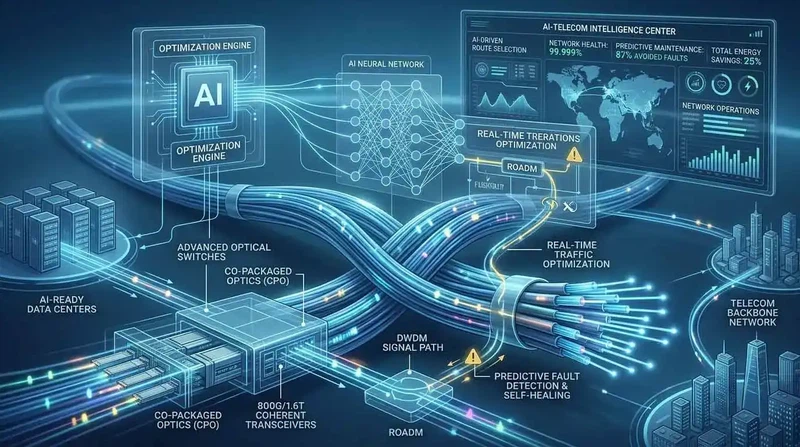
Artificial intelligence is reshaping how optical fiber networks transmit data, detect faults, and scale to meet the demands of modern computing. Rather than a vague promise, this shift is already visible in lab results, vendor announcements, and early commercial deployments across the telecommunications industry. This article examines the most significant developments at the intersection of AI and optical fiber communication, explains what each one means for operators and infrastructure planners, and identifies where uncertainty remains.
What Role Does AI Play in Optical Fiber Networks?
AI serves three distinct functions in today's fiber optic infrastructure, and conflating them leads to confusion. Understanding these roles is essential for evaluating which breakthroughs matter most to your network.
AI as a transmission optimization tool. Neural network equalization algorithms compensate for signal distortion over long fiber spans, enabling higher data rates on existing single-mode fiber. This is where AI directly increases raw throughput capacity.
AI as a network operations intelligence layer. Machine learning models monitor fiber health, predict faults, and automate configuration, turning passive cable infrastructure into self-managing systems. This reduces operational costs and improves uptime for optical network terminals and access equipment.
AI as a demand driver for next-generation fiber. Large-scale AI model training and inference generate unprecedented data volumes between data centers, pushing the industry toward lower-loss, lower-latency fiber types that can handle the traffic AI workloads produce.
AI-Powered Ultra-High-Speed Transmission: Breaking Capacity Records
One of the clearest examples of AI improving optical transmission comes from neural network-based signal equalization. Traditional digital signal processing struggles with the nonlinear distortions that accumulate in dense wavelength division multiplexing (DWDM) systems operating across multiple spectral bands. AI-based equalizers can learn and compensate for these impairments more effectively than conventional algorithms.
In early 2026, a research collaboration led by FiberHome Telecommunication Technologies, together with China Mobile and other institutions, reported a net transmission rate of 254.7 Tb/s over 200 km of standard single-mode fiber. According to Chinese industry media, the demonstration used AI-based neural network equalization and expanded the usable spectral bandwidth to 19.8 THz-roughly four times the bandwidth of conventional C-band systems. The team described this as a record for single-mode fiber transmission capacity at this distance, though it is important to note that this result has so far been reported primarily through Chinese-language technical media rather than a peer-reviewed English-language publication. Until an independent verification or conference paper (such as at OFC) confirms the details, the claim should be treated as a company-announced demonstration result.

For context, researchers at Aston University in the UK achieved 402 Tb/s in 2024 using all six wavelength bands in standard fiber, though over a different experimental setup. Japan's NICT has demonstrated over 1 petabit/s using multi-core fiber. What makes the FiberHome result notable-if confirmed-is the combination of AI-driven equalization with multi-band transmission on a single standard fiber, which has direct implications for upgrading existing optical cable infrastructure without replacing the physical plant.
AI-Driven Optical Network Operation and Maintenance
Beyond raw transmission speed, AI is changing how operators manage and maintain their fiber optic networks. At MWC Barcelona 2026, Huawei unveiled its Next Generation Optical Network product line, which applies AI across the full lifecycle of optical network management-from planning and deployment to fault diagnosis and energy optimization.
Several capabilities stand out from Huawei's official announcement:
- Intelligent energy management: The system analyzes real-time traffic patterns and dynamically adjusts port and board states. According to Huawei, when no traffic is present, all ports and boards enter full hibernation, reducing average energy consumption by 40%. This is a vendor-stated figure and has not been independently benchmarked.
- AI-powered fault diagnosis: A home broadband O&M agent can automatically identify and locate more than 60 types of configuration and connectivity faults, and supports natural language interaction with NOC engineers to resolve issues remotely, reducing on-site service visits.
- Latency-optimized architecture: Huawei outlined target latency benchmarks of 5 ms for national networks, 3 ms for regional networks, and 1 ms for metro networks, designed to support real-time AI computing access.
These capabilities reflect a broader industry trend: AI is turning optical fiber networks from passive transmission media into actively managed, self-optimizing systems. For telecom operators managing large-scale optical distribution networks, the potential reduction in manual intervention and energy costs is significant-though real-world results will depend on deployment scale and network conditions.
Hollow-Core Fiber: A New Generation of Low-Latency Optical Infrastructure

While AI enhances what current fiber can do, a parallel development is changing the fiber itself. Hollow-core fiber (HCF) transmits light through an air-filled core rather than solid glass. Because light travels roughly 47% faster through air than glass, HCF offers a fundamental latency advantage that no amount of signal processing can replicate in conventional fiber.
Two major manufacturers showcased hollow-core fiber advances at MWC Barcelona 2026:
YOFC (Yangtze Optical Fibre and Cable) launched its HollowBand® brand of anti-resonant hollow-core fiber. According to YOFC's official press release, the fiber reduces transmission latency by approximately 31% compared with conventional solid-core fiber and lowers nonlinear effects by nearly three orders of magnitude. YOFC has achieved commercial-scale production with ultra-low loss below 0.1 dB/km, and reports a record-low minimum attenuation of 0.04 dB/km-well below the 0.14 dB/km theoretical limit of traditional single-mode fiber. The company has deployed over 10 commercial and pilot projects globally, including a securities trading link between Shenzhen and Hong Kong that reportedly reduces round-trip latency to under 1 millisecond.
Hengtong also demonstrated its own hollow-core fiber technology at MWC 2026. According to Hengtong's announcement, their HCF reduces transmission latency by 33% compared with traditional solid-core fiber, with a bandwidth potential exceeding 200 THz. Hengtong stated that this technology has begun trials at multiple overseas locations and achieved what it describes as the first commercial deployment of a hollow-core fiber financial dedicated line in China, supporting ultra-low-latency connectivity for AI computing interconnection and high-frequency trading.
Both sets of figures are company-announced results. As Nokia Bell Labs has noted, hollow-core fiber remains above its own theoretical minimum loss, meaning further improvements are expected. The ITU-T is currently reviewing a new technical report on HCF to help establish industry-wide standards-an important step, since no formal standards exist yet for hollow-core fiber manufacturing, splicing, or testing.
Ultra-Low-Loss Fiber for Long-Distance AI Data Transmission
Not all next-generation fiber involves hollow cores. For long-haul terrestrial and submarine routes, incremental improvements in conventional optical fiber attenuation remain critically important. Lower signal loss means longer spans between amplifiers, fewer relay points, and higher overall system efficiency-all factors that directly affect the economics of interconnecting AI data centers across hundreds or thousands of kilometers.
At MWC 2026, Hengtong announced that its independently developed G.654.D optical fiber has achieved an attenuation coefficient of 0.144 dB/km in mass production. According to the company's press release, this figure approaches the theoretical limit for solid-core fiber and represents end-to-end control of the manufacturing process, from high-purity raw materials through preform deposition and precision drawing. This performance level is relevant for future 800G, 1.6T, and higher-rate coherent transmission systems, as well as marine communication networks and long-distance backbone optical cable routes.
It is worth noting that this is a company-announced production metric. Independent third-party testing results have not been publicly cited, though the 0.144 dB/km figure is consistent with the direction of industry progress. For comparison, YOFC's G.654.E fiber targets similar ultra-low-loss performance for 400G and beyond coherent transmission in long-haul terrestrial networks.
Fiber-Wireless Integration: Bridging the Bandwidth Gap for 6G
One of the most technically significant developments in 2026 addresses a long-standing challenge: the bandwidth mismatch between optical fiber communication and wireless communication. Fiber networks operate with enormous capacity, but converting optical signals to wireless frequencies has traditionally imposed severe bandwidth limitations, creating a bottleneck at the fiber-wireless boundary.
A research team led by Peking University, in collaboration with Pengcheng Laboratory, ShanghaiTech University, and the National Optoelectronics Innovation Center, published results in Nature describing an ultra-wideband integrated photonics approach to this problem. The team developed integrated photonic devices with operational bandwidths exceeding 250 GHz, enabling single-channel transmission rates of 512 Gbps for fiber-optic communication and 400 Gbps for wireless communication within a unified system.
This is a peer-reviewed result-the strongest evidence level among the developments discussed in this article. The research demonstrates that a single photonic platform can handle both fiber and wireless signals without the traditional conversion bottleneck, which has direct implications for 6G communication architectures that will need seamless handoffs between fiber backbone and wireless access networks.
That said, this remains a laboratory demonstration. Commercial deployment would require further engineering work on device packaging, thermal management, cost reduction, and integration with existing 5G fiber optic infrastructure. The path from a Nature paper to a deployable product typically spans several years.
Traditional Fiber vs. Hollow-Core Fiber: A Quick Comparison
| Parameter | Traditional Solid-Core Fiber (G.652/G.654) | Hollow-Core Fiber (Anti-Resonant) |
|---|---|---|
| Core medium | Solid glass (silica) | Air-filled tube |
| Latency advantage | Baseline | ~31–33% lower (company-reported) |
| Typical attenuation | 0.144–0.18 dB/km (production grade) | ~0.04–0.12 dB/km (best reported to date) |
| Nonlinear effects | Standard | Nearly three orders of magnitude lower |
| Bandwidth potential | ~10 THz (C+L band commercial) | >200 THz (theoretical) |
| Commercial maturity | Fully mature, globally deployed | Early commercial (10+ projects reported) |
| Standards | ITU-T G.652, G.654, G.657 | Under development (ITU-T review stage) |
| Cost | Low (mass production) | High (limited scale production) |
| Key use cases today | All general telecom and data center connectivity | Financial trading, DCI, latency-critical AI links |
Challenges and What Telecom Operators Should Watch
While the pace of innovation is genuinely impressive, several practical challenges will determine how quickly these advances reach production networks:
Standardization gaps. Hollow-core fiber currently lacks formal ITU-T standards for manufacturing, splicing, testing, and maintenance. Until these standards are in place, large-scale deployment will remain limited to pilot projects and niche latency-sensitive applications. The ITU-T is actively working on a technical report, but full standardization could take years.
Cost and manufacturing scale. Both YOFC and Hengtong have invested heavily in hollow-core fiber production, but the cost per kilometer remains significantly higher than conventional fiber. Mass adoption will depend on achieving price points competitive enough for general-purpose deployment, not just premium financial or AI computing links.
Verification and source credibility. Several of the claims discussed here come from vendor press releases rather than peer-reviewed publications or independent testing. The FiberHome 254.7 Tb/s result, Hengtong's 0.144 dB/km attenuation figure, and Huawei's 40% energy savings are all self-reported metrics. Operators evaluating these technologies should look for independent benchmarks, field trial data from third-party operators, and published conference papers (e.g., from OFC or ECOC) before making large infrastructure commitments.
Integration with existing infrastructure. Upgrading a live network is fundamentally different from a lab demonstration. Hollow-core fiber splicing, for instance, requires different techniques than solid-core fiber. Multi-band transmission requires new amplifiers and monitoring equipment. AI-based network management systems need training data from real operator environments, not just synthetic benchmarks. For operators managing large installed bases of fiber optic cable, backward compatibility and gradual migration paths matter as much as peak performance.
AI model training data demands. The explosive growth of AI workloads is both the catalyst for many of these fiber innovations and a moving target. The bandwidth and latency requirements of AI model training are increasing faster than many infrastructure roadmaps anticipated, which means even newly deployed capacity may need upgrades sooner than expected. Operators should plan for continued growth in data center fiber demand rather than treating current capacity targets as fixed.
FAQ
What is AI-based neural network equalization in optical fiber transmission?
It is a signal processing technique that uses trained neural networks to compensate for distortions that accumulate as light signals travel through optical fiber. Unlike traditional algorithms that follow fixed mathematical models, neural network equalizers can learn complex nonlinear impairment patterns and adapt to changing channel conditions, enabling higher data rates over longer distances.
How does hollow-core fiber reduce latency?
In conventional fiber, light travels through a solid glass core at roughly two-thirds the speed of light in a vacuum. In hollow-core fiber, light travels through air, which is much closer to the vacuum speed of light. This fundamental physical difference results in approximately 31–33% lower signal propagation delay, according to manufacturer specifications.
Is hollow-core fiber ready for widespread commercial deployment?
Not yet. As of early 2026, hollow-core fiber is deployed in a small number of commercial and pilot projects, primarily for latency-sensitive applications like financial trading and AI data center interconnection. Widespread adoption depends on cost reduction, industry standardization, and the development of compatible splicing and testing tools.
What does G.654.D fiber do differently from standard G.652 fiber?
G.654.D fiber is designed for long-haul, high-capacity transmission with ultra-low attenuation and a larger effective area than standard G.652.D fiber. The lower loss per kilometer means signals can travel farther before needing amplification, and the larger effective area reduces nonlinear distortion at high power levels. This makes G.654.D particularly suitable for 400G, 800G, and future coherent transmission systems on backbone routes.
How will AI and fiber optic innovation affect 6G networks?
The fiber-wireless integrated photonic devices demonstrated by Peking University's team point toward a future where fiber and wireless networks share a common infrastructure platform, eliminating the bandwidth bottleneck at the optical-wireless boundary. Combined with hollow-core fiber's latency advantages and AI-driven network management, these technologies collectively form the physical foundation that 6G networks will require for ultra-high-speed, ultra-low-latency connectivity.
Where can I learn more about optical fiber fundamentals?
For a comprehensive introduction to fiber types, structures, and applications, see our guides on what is a fiber optic cable, types of fiber optic cable, and single-mode vs. multimode fiber.