








Flat drop fiber optic cables are specifically engineered for last-mile connections—from the distribution point to your building or home. The market offers solutions ranging from $0.45 to $2.80 per meter, but the actual installed cost can vary by 50% or more depending on fiber count, installation method, and environmental protection level. This guide compares 15+ cable configurations from major suppliers, focusing on durability specifications, bend performance, and long-term maintenance costs.
Over the past seven years, we've worked with telecom contractors, ISPs, and enterprise network teams deploying these cables in everything from suburban residential areas to industrial complexes. The information here comes from actual installation projects, field failure data, and direct supplier feedback.
Here's what matters for most installations: tensile strength rating (affects pulling and hanging), crush resistance (matters for aerial or buried runs), temperature range (your climate), and connector compatibility. The price difference between basic and premium cables usually pays for itself within 2-3 years if you factor in truck rolls and service calls.
Not sure which configuration fits your project? The comparison tables below will help you avoid the most common—and expensive—mismatches.
Flat Drop Fiber Optic Cable Products
-
![Uni-tube Single Jacket Flat Cable]()
Uni-tube Single Jacket Flat Cable
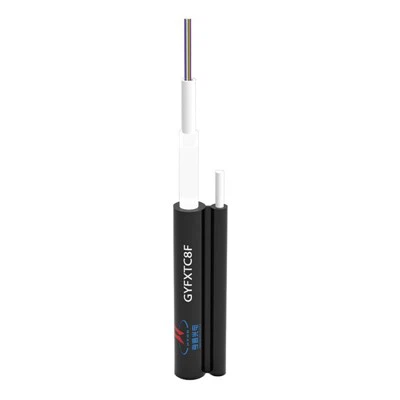
The structure of the Uni-tube Single Jacket Flat Cable is to insert single-mode or multi-mode optical fiber into a loose tube made of high-modulus plastic filled with waterproof compound and place itread more

Products Description
Our latest projects
Shanghai Jwell machinery Workshop co-operation projects

Single-Fiber Drop Cable
(50-70 meters typical spool)
Best for:
Individual residential drops, small business connections, point-to-point links under 500 meters
Core characteristics:
Simplest construction, lowest cost, easier to terminate in the field. Most common in FTTH deployments where you're connecting one subscriber at a time.
Price range:
$0.45-$0.85/meter
Typical products:
Corning OptiTip, CommScope Figure-8 single-fiber, Prysmian FlexNAP
Watch out for:
Limited upgrade path—if the customer needs more bandwidth later, you're pulling new cable. Also, some ultra-cheap versions ($0.30-0.40/meter) skimp on UV protection and fail within 3-4 years in direct sunlight.

2-Fiber Drop Cable
(45-65 meters)
Fit for:
Residential and small business where you want redundancy or future capacity, MDU risers, campus backbone extensions
Key difference:
Adds redundancy and troubleshooting flexibility without much cost increase. You can keep one fiber live while testing the other.
Price range:
$0.65-$1.20/meter
Common choices:
Corning OptiSheath, AFL Hyperscale 2F, OFS AccuDrop II
One thing:
The termination takes slightly longer (20-30 minutes vs 15 minutes per end), so factor that into labor costs for large deployments.

4-12 Fiber Drop Cable
(40-60 meters)
Designed for:
Multi-tenant buildings, small cell backhaul, business parks, situations where you're serving multiple endpoints from one drop
What it solves:
Running one 12-fiber cable is almost always cheaper than running 6 two-fiber cables, both in materials and labor. Plus easier pathway management.
Price range:
$1.40-$2.80/meter (12-fiber)
Available from:
AFL, Prysmian, OFS, Sumitomo
Note this:
Termination requires either pre-terminated assemblies (add 30-40% to cable cost) or field-splice kits. Not every tech can handle this reliably, so training matters.
Armored vs Non-Armored

Non-armored (dielectric)
Lighter, more flexible, easier to handle. Fine for 90% of aerial and indoor riser applications where there's no rodent risk or crushing hazard.

Lightly armored (corrugated tape)
Adds rodent resistance and modest crush protection. Good for shallow burial (with conduit) or areas with squirrels.

Fully armored (steel wire)
Serious protection for direct burial, bridge attachments, or anywhere the cable might get stepped on or crushed. Harder to work with—less flexible, heavier.
Quick Comparison Table
| Cable Type | Fiber Count | Weight | Min Bend Radius | Price/Meter | Best Use | Common Issue |
|---|---|---|---|---|---|---|
| Basic LSZH | 1-2 | 18-25g/m | 20mm | Contact us | Indoor riser, protected aerial | UV degradation if used outdoors |
| Standard outdoor | 1-2 | 22-32g/m | 25mm | Contact us | Most aerial drops | Can sag in extreme heat |
| Armored drop | 1-4 | 45-65g/m | 40mm | Contact us | Direct burial, rodent areas | Installation difficulty |
| Multi-fiber | 6-12 | 38-58g/m | 30-35mm | Contact us | MDU, enterprise | Field termination complexity |
How to Choose the Right Cable: 5 Key Questions

Installation Environment
The biggest cause of premature failure is using indoor-rated cable outdoors, or non-armored cable where rodents are active.
Decision path:
Aerial spans with no conduit → Standard outdoor-rated with UV-resistant jacket
Indoor risers or pathways → LSZH (low smoke zero halogen) for safety codes
Direct burial or underground conduit → Gel-filled or armored, depending on soil conditions
If you're not sure → Go with outdoor-rated; it works everywhere but costs 15-20% more
Common mistake: Using figure-8 self-supporting aerial cable in conduit. The messenger wire causes binding and makes pulling difficult.
Distance and Signal Loss Budget
You can't just assume every cable works for every distance. Installers sometimes grab what's on the truck and wonder why they can't get a clean signal.
How to evaluate:
Under 500m → Almost any cable works; focus on durability
500m-2km → Check attenuation spec; should be ≤0.35dB/km at 1550nm
Over 2km → Consider premium low-loss fiber (≤0.25dB/km) or you'll need mid-span amplification
For 10G+ services → Bend-insensitive fiber (G.657.A2 or B3) becomes important
If you're unsure: Get an OTDR test from your current cable. If you're seeing >0.40dB/km, upgrade to better fiber.


Fiber Count and Future-Proofing
Dark fiber is cheap now, expensive to add later.
Logic to follow:
Single residence, no business → 1-fiber is fine, 2-fiber is smart
Small business or power user → Start with 2-fiber minimum
MDU or campus → Calculate current need, then double it; still cheaper than re-pulling
Infrastructure build → 12-fiber might seem like overkill, but you'll use it
Typical mistake: Undersizing because "we can always add more later." That truck roll costs $400-800, and the new cable costs the same as doing it right the first time.
Installation Method Constraints
Some cables are engineered for specific installation methods. Use them wrong and you'll have problems.
Match cable to method:
- Blowing (compressed air):Smaller diameter (7-10mm), slick jacket, distance limited to 800-1200m per shot
- Pulling (winch/rope):Higher tensile strength (≥1000N), larger diameter OK, need pull-through design
- Hand-laid or tacked:Flexible drop cable, lower crush resistance acceptable
- Plowing or trenching:Needs armor, high crush rating (≥1000N/100mm)
Installation time: Figure 8-12 minutes per 100m for aerial drops (experienced crew), 15-20 minutes for buried with conduit, 5-7 minutes for blown fiber in pre-installed conduit.


Connector and Termination Strategy
This affects total cost more than you think: Cable is 30-40% of the budget; termination labor and hardware is the rest.
Your options:
Pre-terminated assemblies
Cable comes with connectors already on. Fast, reliable, but you need exact lengths. Add 35-45% to cable cost.
Field-terminated
Cheaper cable, but need skilled techs and tools. Termination failure rate: 2-5% for experienced installers, 10-15% for newbies.
Fusion splicing
Best quality, lowest loss, but requires $3k-8k splicer and training. Makes sense for 20+ drops or permanent infrastructure.
What installers actually do: Pre-terminated for 80% of residential drops (speed matters), field-terminated for custom lengths, fusion splice for anything mission-critical.
Technical Specifications That Actually Matter
Fiber Type Comparison
The fiber inside matters as much as the cable outside. Here's what the specs mean in practice:

G.652.D (Standard Single-Mode)
Works for:
Most applications under 2km, 1G/10G services
Attenuation:
0.35-0.40 dB/km at 1310nm, 0.25-0.30 at 1550nm
Limitation:
Sensitive to micro-bending, needs careful installation
Cost factor:
Baseline
Reality check:
Perfectly fine for 85% of drop cable applications
G.657.A2 (Bend-Insensitive, Moderate)
Works for:
Tight spaces, MDU risers, anywhere the cable makes sharp turns
Attenuation:
Similar to G.652.D (≤0.35 dB/km)
Advantage:
Handles 10mm bend radius without significant loss (vs 30mm for standard)
Cost factor:
+8-12%
When to choose:
Wall penetrations, tight cable trays, anywhere you can't maintain smooth curves

G.657.B3 (Ultra Bend-Insensitive)
Works for:
Extremely tight installations, in-wall routing, furniture-routed fiber
Attenuation:
Slightly higher (0.40-0.45 dB/km) but bend performance is excellent
Advantage:
5mm bend radius capability
Cost factor:
+15-20%
Trade-off:
The looser attenuation spec means it's not ideal for long runs over 1.5km
Environmental Ratings You Can't Ignore
| Specification | Basic Cable | Standard Outdoor | Premium/Armored | Why This Matters |
|---|---|---|---|---|
| Temperature range | -10°C to +60°C | -40°C to +70°C | -40°C to +80°C | Cable stiffens in cold, jacket cracks if under-rated |
| UV resistance | None/minimal | 20+ years | 25+ years | Non-UV cable fails in 3-5 years of sun exposure |
| Water blocking | None | Gel or tape | Gel + armor | Water intrusion causes fiber degradation and frozen cables |
| Tensile strength | 200-400N | 600-1000N | 1500-3000N | Affects installation and wind/ice loading |
| Crush resistance | 300N/100mm | 1000N/100mm | 3000N/100mm | Matters for burial depth and accidental damage |
Jacket Materials and What They Mean
Industry Solutions
Choose the plan that suits you best.
PE (Polyethylene)
Standard for outdoor. UV-resistant, handles temperature swings, reasonably flexible. Budget option.
01
LSZH
Required for indoor/riser in most building codes. Doesn't produce toxic fumes in fire. Less UV-resistant, needs protection if used outdoors.
02
MDPE (Medium Density PE)
Better abrasion resistance than standard PE. Good for conduit pulls where the cable scrapes against walls.
03
Aramid/Kevlar strength members
Handles higher pulling tension. Necessary for long aerial spans or multi-fiber cables.
04
Application Scenarios
Suburban Residential FTTH Deployment

Typical need:
200-300 home development, mix of 80-150m drop lengths, aerial and buried
What works:
2-fiber G.652.D drop cable, outdoor-rated PE jacket, figure-8 design for aerial (integrated messenger wire), standard dielectric for buried (in conduit)
Implementation details:
Pre-terminated cables in 25m increments (stock sizes: 25m, 50m, 75m, 100m) reduce installation time by 60%. Excess length coiled at pedestal. Field crews average 8-10 drops per day with this setup.
Multi-Dwelling Unit Vertical Riser
Challenge:
12-story building, serving 4 units per floor, want individual fiber to each unit plus redundancy
Solution:
2x 12-fiber riser-rated LSZH cables (one active, one backup), spliced to individual 2-fiber drop cables at each floor
Why this approach:
Pulling 48 individual drop cables up 12 floors is a nightmare. Running two 12-fiber backbones and splicing out at each floor takes 2 days instead of 2 weeks. Plus you have dark fiber for future bandwidth upgrades.
Implementation:
Pre-terminated 12-fiber breakout harnesses at each floor splice point, then 3-5m individual drops to each unit. Fusion splicing keeps loss under 0.15dB per connection.

Industrial Campus Backbone Extension

Requirements:
Connect warehouse facility 800m from main building, need redundant paths, equipment generates RF interference, occasional heavy vehicle traffic over underground route
Selected solution:
Dual-path installation—primary path: 6-fiber armored direct-burial cable (no conduit), secondary path: 6-fiber standard outdoor in 2" conduit along different route
Technical rationale:
Fiber immune to RF noise (unlike copper), armored cable handles vehicle weight, dual-path ensures uptime, 6-fiber supports current need (2 active) plus future expansion
Main Flat Drop Fiber Optic Cable Products
Uni-tube Single Jacket Flat Cable
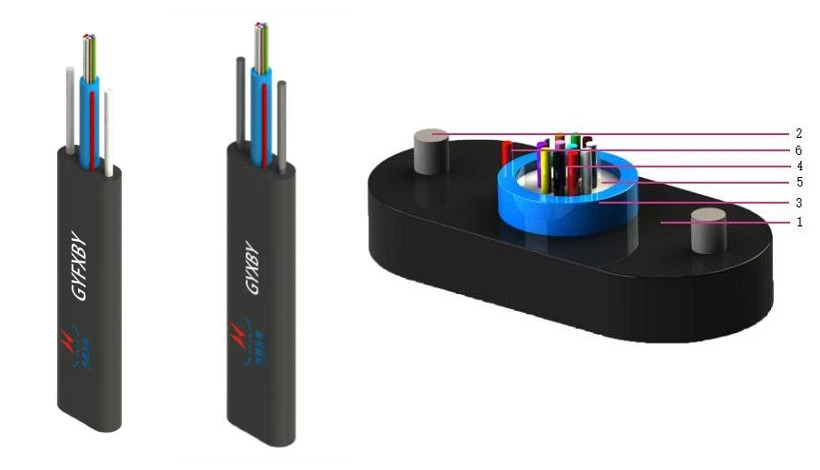
1-PE Sheath
2-FRP/Steel Wire
3-Loose Tube
4-Fiber
5-Tube Filling Compound
6-Rip cord
Hengtong is the top optical cable supplier?

33 Years Of Experience In Custom Solutions.
We Are A Famous Fiber Optic Cable Manufacturer.
Since its establishment in 1991, Hengtong has become one of the leading optical cable manufacturers, committed toproviding the highest quality customized optical cables to users around theworld. Over the years, we have accumulated rich experience as a manufacturerand supplier in the fiber optic cable industry.

Professional fiber optic cable manufacturer
Hengtong is renowned as a leading optical cable supplier and tailor-made optical cable producer. Our versatile product line serves an array of industries, including telecommunications, broadcasting, transportation, industrial automation, and others.

Customized services
Hengtong provides customers with personalized customized optical cable products and solutions, designing and producing according to customer needs and requirements, ensuring that the products fully match the needs of the project.

Fast delivery time
By providing instant quotes and optimizing our production process, Hengtong ensures swift delivery times for your convenience. Leveraging our vast technical expertise and proficiency, we expedite our operations efficiently to meet your deadlines effectively.
FAQ
Q: Why are fiber optics better than cable?
Q: What is Loose Tube Cable?
Q: Hybrid & Composite Cable
Q: How can I be sure that what you produce is what I want?
Q: How do I repair a broken fiber?
The best method for each situation depends on the optical loss budget, type of application, available equipment, and the skills of the repair technician. In most cases, you’ll choose a fusion or mechanical splice for repairs. You’ll use a connector splice when you must install another component or device in line with the fiber. .
Q: How do you ensure that the performance of the fiber optic cable is reliable?
Q: What is single-mode fiber?
Single-mode bandwidth / distance limit depends on the grade of transceiver. An inexpensive 1000-BaseLX device supports gigabit transmissions up to 5km. Other variants support much further distances.
Q: What are the bending radius requirements for FTTH Drop Cable?
Q: What is a better way of communicating, copper cables, or fiber optic cables?
Q: Will fiber cable survive harsh conditions?
In fact, tensile strength (resistance to pulling) of optical fiber exceeds 600,000 pounds per square inch. It’s stronger than copper or steel strands of the same diameter and easily surpasses the strength requirements of modern communications applications.
We're professional flat drop fiber optic cable manufacturers and suppliers in China, specialized in providing high quality products and service. If you're going to wholesale customized flat drop fiber optic cable, welcome to get quotation from our factory.