





Fiber optic splicing is a critical technical process in modern communication network construction. Whether it's data center cabling, telecommunications infrastructure upgrades, or enterprise network expansion, mastering the correct fiber optic splicing methods is essential. A detailed understanding of all aspects of splicing fiber optic cable helps in selecting the appropriate splicing method and ensuring construction quality.
What is Fiber Optic Splicing? Why Do We Need It?
Fiber optic splicing is the permanent connection of two optical fibers, including fusion splicing and mechanical splicing. The purpose is to ensure that optical signals can be transmitted between fibers with minimal loss. In practical applications, splicing optical fiber is mainly used in the following scenarios:
Network extension is the most common requirement. When a single fiber length cannot meet transmission distance requirements, multiple fibers must be connected through splicing techniques. Standard fiber optic products typically come in single-reel lengths of 2-4 kilometers, while actual network deployment requires spanning longer distances.
Fault repair also requires fiber optic cable splicing technology. During use, fiber optic cables may break due to construction damage, natural disasters, or aging. Through splicing technology, communications can be quickly restored. Compared to re-deploying an entire cable, on-site fiber splicing can significantly reduce repair time and costs.
Network branching and splitting are increasingly important in modern network architectures. Through devices such as optical splitters, one trunk fiber can branch out into multiple sub-routes, achieving point-to-multipoint network coverage. This application is particularly common in FTTH (Fiber to the Home) projects.
Equipment connection is also an important application scenario for fiber optic splicing. Fiber optic equipment such as switches, routers, and ODF patch panels connect to trunk cables through pigtails or patch cords.
Fiber optic splice quality directly affects network performance. Parameters such as insertion loss and return loss at splice points affect signal attenuation and transmission quality. Poor splices can even lead to communication interruptions.
Fusion vs. Mechanical Splicing: How to Choose?
Fiber optic splicing mainly falls into two categories: fusion splicing and mechanical splicing, which differ significantly in principle, performance, cost, and application scenarios.
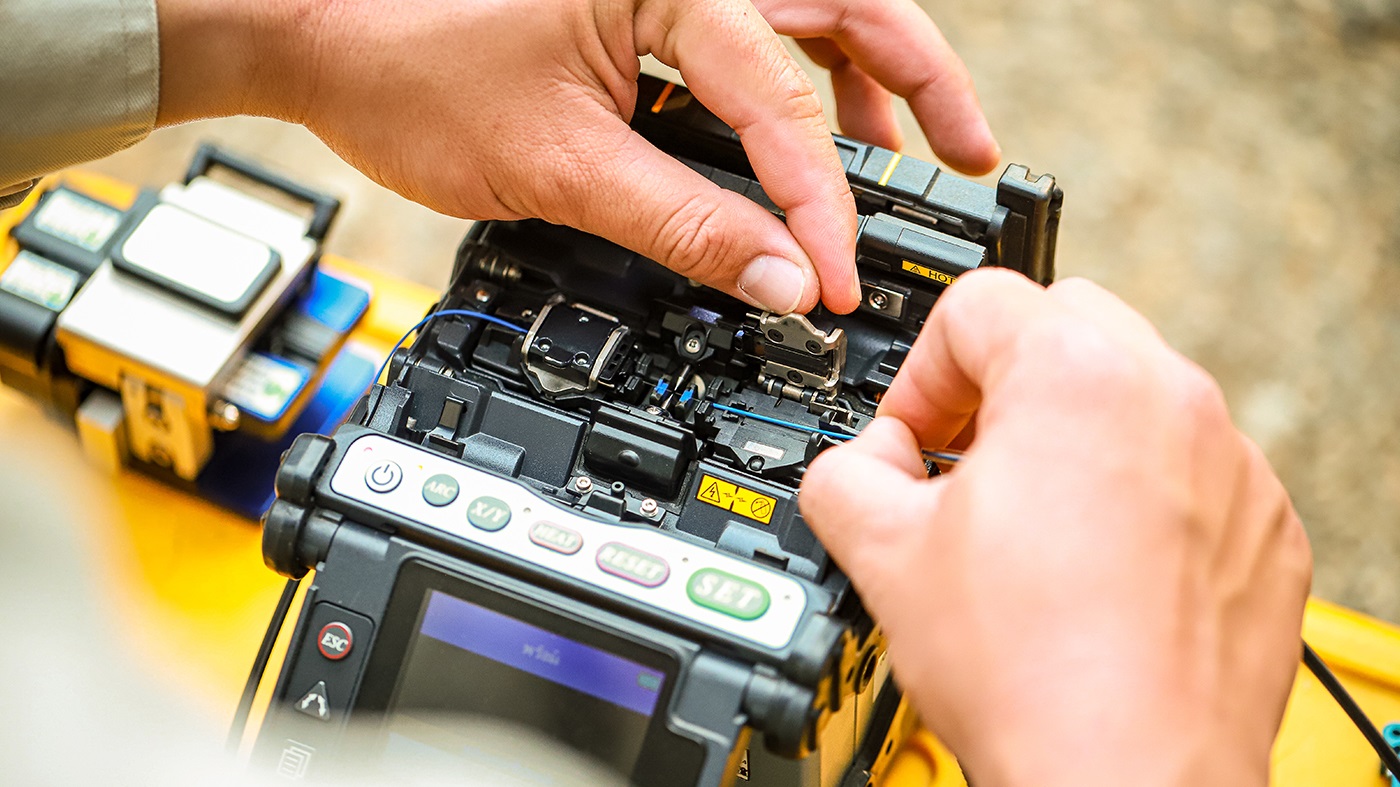
Fusion splicing technology primarily works by heating the end faces of two fibers to their melting temperature (approximately 2000°C) and fusing them together. Modern fusion splicers use electric arc discharge to generate high temperatures and ensure precise core alignment through precision alignment systems. The connection point after fusion splicing is almost integral with the original fiber, with insertion loss typically below 0.05dB and return loss reaching above -60dB, making it the best-performing splicing method currently available.
Mechanical splicing uses mechanical means to fix two fibers, bringing their end faces into precise alignment. The splice point fixes the fibers through special V-grooves or precision sleeves and uses index-matching gel to reduce light reflection at the interface. This method requires no heating and is relatively simple to operate, but performance is slightly inferior to fusion splicing, with typical insertion loss between 0.1-0.3dB.
Performance Comparison Table
|
Comparison Item |
Fusion Splicing |
Mechanical Splicing |
|
Insertion Loss |
0.02-0.05dB |
0.1-0.3dB |
|
Return Loss |
>60dB |
40-50dB |
|
Connection Strength |
Equivalent to original fiber (can withstand >1N pull) |
Lower (requires protection) |
|
Initial Cost |
High (splicer $7,000-$70,000) |
Low (connectors $1-$15) |
|
Per-Splice Cost |
Low (consumables <$1) |
Higher ($2-$15 per connector) |
|
Operation Time |
1-3 minutes each |
30 seconds-1 minute each |
|
Technical Requirements |
Professional training |
Relatively simple |
|
Durability |
Excellent (long-term use) |
Fair (requires periodic inspection) |
|
Repeatability |
Not removable |
Some types removable |
Selection Recommendations:
For permanent installations such as backbone networks, data centers, and long-distance transmission scenarios, fusion splicing is the preferred solution. Although initial equipment investment is high, fusion splice points are stable, have low loss, long lifespan, and lower total long-term costs. Especially in single-mode fiber applications, the low-loss advantage of fusion splicing is more pronounced.
In temporary application scenarios, mechanical splicing has advantages. For example, in field testing, temporary network setup, and rapid fault recovery situations, mechanical splicing is fast to operate and suitable for small-scale work.
For budget-limited small projects, if the number of splice points is small, mechanical splicing can be adopted to avoid the high cost of purchasing a fusion splicer.
In multimode fiber applications, due to the larger core diameter (50/62.5μm), alignment precision requirements are relatively lower, and mechanical splicing can also achieve good results, making it a cost-optimization choice.
Fiber Optic Splicing Tools Checklist
Fusion Splicing Core Equipment:
Fiber optic fusion splicer: Select single-core or ribbon splicer according to project needs, ensuring equipment calibration is valid and battery is sufficient
Fiber optic cleaver: High-precision cleavers can ensure end-face flatness within 0.5°, which is a prerequisite for low-loss splicing
Heat shrink protection sleeve heater: Used for mechanical protection of splice points; some fusion splicers have built-in heating functions
Optical Time Domain Reflectometer (OTDR): Used to test splice quality and locate fault points; essential equipment for quality acceptance
Optical power meter and light source: Used for insertion loss testing to verify splice point performance
Mechanical Splicing Specialized Tools:
Mechanical splice connectors
Fiber optic strippers: Used to strip fiber coating layers
Fiber optic cleaning tools: Including lint-free paper, isopropyl alcohol, specialized cleaning pens
Visual fault locator (red light pen): Used for fiber continuity testing and core identification
Auxiliary Tools and Materials:
Fiber strippers and scissors: Used to strip cable outer jackets and loose tubes
Miller pliers or diagonal pliers: Process cable strength members
Fiber splice closures or joint boxes: Protect splice points and provide cable fixing
Heat shrink sleeves: Various sizes for splice point protection
Fiber cleaning supplies: Lint-free paper, isopropyl alcohol, compressed air cans
Team Configuration Recommendations:
Small projects (fewer than 100 splice points) typically require 1 skilled operator; medium projects (100-500 splice points) recommend a 2-3 person team; large projects require multiple work groups based on schedule and workload.

Standard Operating Procedure for Fiber Optic Splicing
A standardized operating procedure is key to ensuring consistent splice quality.
Step 1: Cable Stripping and Fiber Identification
Strip the cable outer jacket at the predetermined splice location, typically requiring 1.5-2 meters of slack for operation. When using specialized stripping tools, control the force carefully to avoid damaging internal fibers. For armored cables, first remove the steel tape or steel wire, then process the inner jacket.
Cut the cable strength members and fix them in the appropriate positions in the splice closure. Clean the filling compound or dry powder inside the cable using lint-free paper with petroleum ether or specialized cleaner.
When removing the fiber bundle from the loose tube, be gentle to avoid excessive bending. Confirm each fiber's sequence number according to the fiber color spectrum or markings, use label paper to mark, and ensure correct correspondence with the other end cable's fibers. In complex projects, using a red light pen or visual fault locator for core identification can prevent misconnections.
Step 2: Fiber End-Face Preparation
Remove approximately 50-80 centimeters of fiber from the loose tube, and at about 5-6 centimeters from the end, use strippers to gently remove the coating layer (coating layer diameter is typically 250μm; after stripping, bare fiber diameter is 125μm). The stripper blade should be perpendicular to the fiber axis, with even force, avoiding damage to the glass fiber.
Use lint-free paper with isopropyl alcohol to wipe the bare fiber section 2-3 times in one direction, removing surface oils and micro-dust. Do not wipe back and forth, and do not let the bare fiber touch any object surface. After cleaning, immediately cleave the fiber to reduce airborne dust contamination.
Place the cleaned fiber in the cleaver's V-groove, ensuring the bare fiber section extends into the blade about 10-16mm. Quickly complete the cleaving action. A quality cleaved end face should be smooth and flat, with an end-face angle <0.5°, without cracks, chips, or burrs.
Step 3: Fiber Fusion Splicing Operation
Turn on the fusion splicer, confirm the equipment has completed preheating and the correct splicing program is selected. Pre-thread the heat shrink protection sleeve onto one fiber, positioning the sleeve at least 10 centimeters away from the splice area.
Place the two fibers into the left and right V-grooves of the fusion splicer respectively, with fiber end faces extending into the appropriate clamp positions, typically 10-12mm on either side of the clamp centerline. Close the windproof cover and start the automatic fusion splicing program. The splicer will perform core alignment, cleaning discharge, pre-splice inspection, splice discharge (high-temperature melting and fusing of fiber end faces), and splice quality assessment.
The entire automatic fusion process takes 10-30 seconds. After fusion is complete, check the estimated loss value displayed by the splicer; single-mode fiber should be <0.05dB, multimode fiber should be <0.1dB. Observe the splice point image; the splice area should be smooth and continuous, without bubbles, misalignment, or necking.
Step 4: Splice Point Protection
If splice quality is acceptable, open the windproof cover, remove the fiber from the splicer, move the pre-threaded heat shrink protection sleeve to the center position of the splice point, with the splice point at the center of the sleeve.
Place the sleeved fiber into the heater; heating temperature is typically 100-120°C for about 30-60 seconds. During heating, the heat shrink sleeve will contract and tightly wrap the fiber, and the internal hot-melt adhesive will melt and solidify, providing mechanical strength and waterproof protection for the splice point.
After heating is complete, remove the fiber and wait 10-20 seconds for cooling. Check whether the heat shrink sleeve has contracted evenly without bubbles or cracks. A qualified protection sleeve must completely cover the bare fiber section, with both ends tightly adhered to the coating layer.
Step 5: Fiber Coiling and Fixing
Coil the spliced fiber onto the coiling tray in the splice closure. When coiling, follow minimum bend radius requirements: single-mode fiber bend radius should be >30mm, multimode fiber should be >50mm. Coiling should be natural and smooth, avoiding crossing, twisting, or excessive tightness.
Use cable ties or fixing clips to secure the coiled fiber on the coiling tray, ensuring the fiber will not loosen due to vibration or movement. Pay special attention to the splice point section, placing it in the fixing groove of the coiling tray to avoid stress.
Finally, fix the cable strength members in the appropriate positions of the splice closure, secure the closure, and fill out the splice record. Affix identification on the exterior of the splice closure, noting the splice date, number of fibers, and other information.
Fiber Optic Splicing Safety Precautions
Fiber Fragment Hazards and Disposal
Fiber optic cutting produces tiny glass fragments with diameters of only 125 microns that can pierce skin and are difficult to detect and remove. Always perform cutting over a specialized cutting box or waste fiber collector. Do not touch the cutting area with hands or rub eyes.
Laser Radiation Hazards
Present during testing and maintenance. Lasers used in fiber optic communication, especially 1550nm infrared lasers, are invisible. Never look directly at fiber end faces or observe illuminated fiber end faces through a magnifying glass. Before testing, confirm the light source is turned off. Use an optical power meter to confirm "dark fiber" rather than judging light path continuity with the naked eye.
Chemical Hazards
Mainly from cleaners and cable filling materials. Isopropyl alcohol is flammable and volatile; use in well-ventilated environments and avoid contact with open flames. Cable filling compounds should avoid skin contact; wash hands thoroughly after work.
Electrical Safety
Particularly important when using fusion splicers. Splicers use high voltage to generate electric arcs; do not touch electrode parts during splicing. Regularly check equipment insulation performance, ensuring power cords and ground wires are intact. Note: Do not use fusion splicers in rainy weather or humid environments.

Single-Mode or Multimode: How to Choose for Fiber Splicing?
Selecting the appropriate fiber type is the foundation of fiber optic splicing project planning. Single-mode and multimode optical fibers have clear differences in physical structure, performance characteristics, and application scenarios.
Structural Differences:
Single-mode fiber has a core diameter of approximately 8-10 microns, allowing only one mode of light wave transmission, with a cladding diameter of 125 microns. Multimode fiber has a core diameter of 50 or 62.5 microns and can transmit multiple modes of light waves. This structural difference determines the fundamental performance differences between the two.
Transmission Performance Comparison:
Since single-mode fiber transmits only a single mode, there is no modal dispersion, so transmission bandwidth is virtually unlimited and can support 40G, 100G, or even higher rate transmissions. Transmission distance can reach tens or even hundreds of kilometers without repeaters. Single-mode fiber typically uses 1310nm or 1550nm wavelength lasers.
Multimode fiber has modal dispersion, limiting transmission bandwidth and distance. OM3-grade multimode fiber has a maximum transmission distance of approximately 300 meters at 10G rates; OM4 can reach 550 meters. Multimode fiber typically uses 850nm or 1300nm wavelength LEDs or VCSEL lasers, costing less than lasers used in single-mode systems.
Cost:
Multimode fiber cable itself is priced similarly to single-mode fiber, but matching optical modules (transceivers) are significantly cheaper than single-mode systems, offering cost advantages in short-distance applications. For example, a multimode SFP+ optical module might cost $40-$70, while a comparable single-mode module might cost $110-$210. However, in long-distance applications, single-mode systems require no repeater equipment, making comprehensive costs actually lower.
FAQ
What are the differences between OM3/OM4/OM5 multimode fibers?
|
Type |
Core Diameter |
850nm Bandwidth |
10G Distance |
40G Distance |
|
OM3 |
50μm |
2000MHz·km |
300m |
100m |
|
OM4 |
50μm |
4700MHz·km |
550m |
150m |
|
OM5 |
50μm |
4700MHz·km |
550m |
440m(SWDM) |
How often does a fusion splicer need calibration?
Regular maintenance schedule:
Electrode replacement: 2000-3000 cores (or when loss consistently exceeds standards)
V-groove cleaning: Before starting work daily
Motor calibration: Annually or when prompted
Factory calibration: Every 3 years or 50,000 cores
Daily inspection: Perform test splices with standard fiber; if loss >0.1dB, maintenance is required.
Why does fiber glow red with a red light pen but have no signal?
Red light (650nm) is only used for core continuity testing and does not represent normal communication wavelengths (1310/1550nm). Possible reasons include end-face contamination, microbend loss, or connector type mismatch.