






Understanding Fiber Optic Cable Manufacturing
From Theory to Production
The world of modern telecommunications relies heavily on fiber optic cable manufacturing, a sophisticated process that transforms raw materials into the backbone of global connectivity.

Fundamental Principles of Optical Waveguide
At the heart of fiber optic cable manufacturing lies the understanding of how light propagates through optical waveguides. The electromagnetic field distribution and modal characteristics within fiber waveguides determine the fundamental transmission properties of every fiber optic cable. Single-mode fibers, which support only one propagation mode, exhibit specific cutoff wavelengths that must be carefully controlled during fiber optic cable production.
These cutoff characteristics can change after cabling, making it essential for manufacturers to account for mechanical stresses and bending effects during the fiber optic cable design phase to ensure optimal performance in the final product.
The phenomenon of chromatic dispersion in single-mode fibers represents a critical consideration in fiber optic cable manufacturing. This wavelength-dependent propagation characteristic causes different spectral components of optical signals to travel at varying speeds, potentially limiting transmission distances and data rates in fiber optic cable systems.
Modern manufacturing techniques incorporate dispersion compensation strategies, including the production of dispersion-compensating fibers and the precise control of refractive index profiles during preform fabrication. These advanced approaches in fiber optic cable production ensure that the finished cables can support high-speed data transmission over extended distances without signal degradation.
Total Internal Reflection
The fundamental principle enabling light propagation through fiber optics
Mode Characteristics
Different propagation paths determine fiber classification
Dispersion Effects
Wavelength-dependent propagation impacts signal integrity

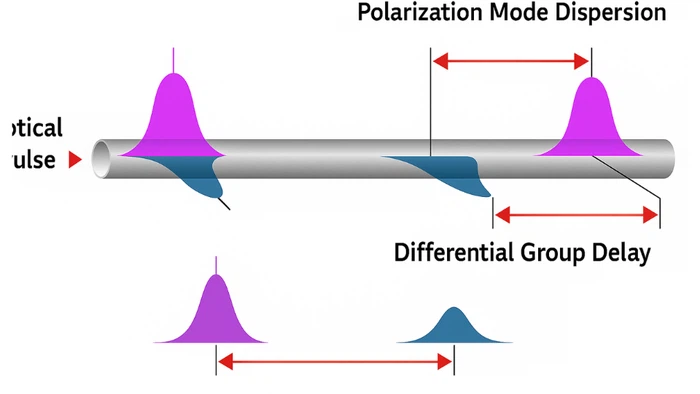
Polarization mode dispersion (PMD) presents another challenge that must be addressed through advanced fiber optic cable manufacturing techniques. This effect, caused by fiber birefringence, results in differential group delays between orthogonal polarization states within the fiber optic cable.
Manufacturing processes now include specialized spinning techniques during fiber drawing to minimize PMD, ensuring superior performance of fiber optic cable in high-speed transmission systems. These innovations in fiber optic cable production have become essential for meeting the stringent requirements of modern telecommunications networks.
Evolution of Communication Fibers
The progression of optical fiber standards from G.652 to G.657 reflects continuous improvements in fiber optic cable manufacturing capabilities.

G.652
G.652 Standard Single-Mode Fibers
- Deployed worldwide as the standard for fiber optic cable installations
- Multiple subcategories (A, B, C, D) available for different fiber optic cable applications
- G.652D offers reduced water peak attenuation in fiber optic cable systems
- Lower PMD values in newer fiber optic cable variants ensure better performance

G.653 - G.655
G.653 - G.655 Specialized Fibers
- G.653: Dispersion-shifted fibers for fiber optic cable networks
- G.654: Cutoff-shifted for submarine fiber optic cable use
- G.655: Non-zero dispersion-shifted fiber optic cable designs
- Tailored properties for specific fiber optic cable applications

G.657
G.657 Bend-Insensitive Fibers
- Maintains fiber optic cable performance under tight bends
- Enables flexible FTTH fiber optic cable installations
- Precise refractive index control in fiber optic cable manufacturing
- Trenched designs for better mode confinement in fiber optic cable

The introduction of G.657 bend-insensitive fibers marks a significant milestone in fiber optic cable manufacturing. These fibers maintain excellent performance even under tight bending conditions, enabling more flexible installation scenarios in fiber-to-the-home deployments.
Manufacturing these fibers requires precise control of the refractive index profile, often employing trenched designs that confine the optical mode more effectively than conventional step-index profiles.
Preform Manufacturing Technologies
Modified Chemical Vapor Deposition
The introduction of G.657 bend-insensitive fibers marks a significant milestone in fiber optic cable manufacturing. These fibers maintain excellent performance even under tight bending conditions, enabling more flexible fiber optic cable installation scenarios in fiber-to-the-home deployments.
Manufacturing these fiber optic cable components requires precise control of the refractive index profile, often employing trenched designs that confine the optical mode more effectively than conventional step-index profiles used in traditional fiber optic cable products.
Vapor-phase Axial Deposition
Vapor-phase Axial Deposition (VAD) and Outside Vapor Deposition (OVD) processes represent high-volume fiber optic cable manufacturing approaches. VAD technology enables continuous preform growth through the axial deposition of soot particles for fiber optic cable production, while OVD builds layers radially on a rotating target rod.
The combination of VAD core deposition with OVD cladding application has proven particularly effective for producing G.652D fibers used in fiber optic cable with superior optical characteristics.
Plasma Chemical Vapor Deposition
The Plasma Chemical Vapor Deposition (PCVD) and Outside Modified Chemical Technique System (OMCTS) offer alternative approaches in fiber optic cable manufacturing.
OMCTS technology, specifically developed for creating OVD cladding layers in fiber optic cable preforms, provides enhanced deposition rates and improved material utilization efficiency, contributing to more cost-effective fiber optic cable production processes.
Preform Manufacturing Process
The critical first step in creating high-quality optical fibers
MCVD Process
The Modified Chemical Vapor Deposition (MCVD) process is one of the most advanced techniques used in fiber optic cable manufacturing.
By precisely introducing chemical vapors into a rotating silica tube, manufacturers can achieve highly accurate deposition of glass layers with controlled dopants.
This method ensures excellent refractive index control, which is critical for optimizing light transmission, minimizing signal loss, and enhancing overall fiber performance.
For B2B applications, such as data centers, 5G backbone networks, and submarine communication systems, consistent refractive index profiles guarantee long-term stability and compatibility with high-capacity optical systems.
VAD Technology
Vapor Axial Deposition (VAD) technology is a leading method for producing optical fiber preforms. Unlike batch processes, VAD enables continuous preform growth, which significantly improves efficiency and consistency in fiber optic cable manufacturing.
During the process, silica particles are deposited directly onto a seed rod in an axial direction, forming large-diameter preforms with uniform structure and precise refractive index control.
For B2B applications-such as telecommunication carriers, data center operators, and submarine cable providers-VAD technology ensures stable supply, scalability, and the high reliability demanded by global optical networks.
OVD Process OVD
Outside Vapor Deposition (OVD) is one of the most widely used techniques in fiber optic cable manufacturing.
In this process, fine silica particles are deposited in radial layers onto a rotating ceramic rod. After deposition, the porous preform is consolidated at high temperatures to create a dense glass structure with precise refractive index control.
For B2B buyers such as telecom operators, data center providers, and system integrators, OVD ensures scalability, low attenuation, and reliable optical performance-qualities that are critical in next-generation fiber optic cable manufacturing.
PCVD Method
Plasma Chemical Vapor Deposition (PCVD) is an advanced technique in fiber optic cable manufacturing that uses microwave-generated plasma to deposit glass layers inside a silica tube.
Compared with other preform fabrication methods, PCVD offers exceptional precision in refractive index control by allowing fine adjustments of dopants such as germanium or fluorine during the plasma reaction.
For B2B applications, such as aerospace communication, sensor systems, and metropolitan backbone networks, PCVD delivers fibers with superior performance, reproducibility, and long-term stability.
Fiber Drawing and Coating Processes
The transformation of preforms into fiber optic cables occurs during the drawing process, where precise control of temperature, tension, and drawing speed determines the final fiber properties. The preform is heated in a drawing furnace to approximately 2000 °C, creating a necking region where the glass flows and reduces to the target fiber diameter of 125 micrometers.

The application of protective coatings immediately after cooling represents another crucial aspect of fiber optic cable manufacturing. Dual-layer UV-curable acrylate coatings are typically applied using pressurized coating dies to encapsulate the fiber before it is exposed to external contamination.
The primary coating absorbs mechanical stress and cushions microbending, while the secondary layer provides abrasion resistance and long-term environmental protection. Maintaining precise concentricity of these coatings is essential for ensuring reliable splicing, connectorization, and low insertion loss in large-scale deployments.
Advanced fiber optic cable manufacturing facilities employ laser-based diameter monitoring systems and closed-loop control to maintain dimensional tolerances within ±0.5 micrometers. This tight control is vital for compatibility with standard connectors and fusion splicing equipment.
Any deviation beyond tolerance can increase splice loss, reduce connector efficiency, and compromise signal integrity in long-haul networks. Automated control systems instantly adjust drawing speed or furnace conditions to maintain high process reliability, making this one of the hallmarks of modern production lines.


For PMD reduction, fiber optic cable manufacturers implement controlled fiber spinning during the drawing process. This technique introduces a carefully regulated twist along the fiber axis, effectively averaging out residual birefringence caused by structural asymmetries.
Reducing PMD is essential in high-bit-rate systems (10 Gb/s and above) and coherent transmission technologies, where polarization effects directly limit transmission distance and bandwidth. By integrating spinning control into drawing towers, manufacturers ensure that fibers meet international PMD standards for next-generation telecommunication networks.
The cooling process following drawing in fiber optic cable manufacturing requires careful management to prevent residual stresses that could affect fiber strength and optical properties. Helium gas cooling systems are widely used because of their high thermal conductivity and ability to deliver rapid, uniform quenching without introducing contaminants.
Proper cooling improves mechanical reliability, reduces micro-crack formation, and enhances resistance to fatigue over decades of service life. In high-performance applications such as submarine cables or data center interconnects, optimized cooling protocols are crucial to achieving ultra-low loss and long-term stability.

Fiber Drawing Process Stages
Preform Loading
The preform is carefully loaded into the drawing tower, aligned with precision to ensure proper fiber geometry during fiber optic cable production.
01
Heating in Furnace
The preform tip is heated to approximately 2000 °C in a graphite or ceramic furnace, softening the glass for drawing during fiber optic cable manufacturing.
02
Fiber Drawing
The softened glass is drawn down to the target diameter (typically 125 μm) with precise tension control to form the core of the fiber optic cable.
03
Diameter Monitoring
Laser micrometers continuously measure fiber diameter during fiber optic cable production, providing feedback for closed-loop control systems.
04
Cooling Process
Helium gas cooling systems rapidly and uniformly cool the fiber during fiber optic cable manufacturing to prevent residual stresses.
05
Coating Application
Dual-layer acrylate coatings are applied during fiber optic cable production to protect the fiber surface and provide mechanical strength.
06
UV Curing
The applied coatings are cured using UV radiation during fiber optic cable manufacturing to form a hard, protective layer.
07
Spooling
The finished fiber is spooled onto reels with precise tension control during fiber optic cable production to prevent damage.
08
Cable Structure Design and Manufacturing

The transition from individual fibers to functional fiber optic cables involves multiple design considerations and manufacturing steps.
Ribbon fiber technology, where multiple fibers are arranged in planar arrays and encapsulated in UV-curable matrix materials, enables high-density packaging crucial for modern fiber optic cable manufacturing.
The production of ribbon fibers requires precise alignment systems and uniform coating application to ensure reliable mass fusion splicing capabilities.

Loose tube designs in fiber optic cables provide mechanical isolation between fibers and cable structural elements, protecting against environmental stresses.
The secondary coating process for loose tubes involves extruding modified polypropylene or other thermoplastic materials around fiber bundles, with careful control of excess fiber length to accommodate differential thermal expansion and contraction.

The selection and application of filling compounds in fiber optic cable manufacturing significantly impact cable performance. Traditional gel-filled fiber optic cable designs use thixotropic compounds that prevent water ingress while allowing fiber movement.
However, dry fiber optic cable technologies employing water-blocking yarns and tapes have gained popularity due to easier installation and maintenance characteristics.
Fiber Optic Cable Structures
Cable Structure Components
- Optical Fibers
- Strength Members
- Buffer Tubes
- Outer Jacket

Ribbon Fiber Technology
Ribbon fiber arranges multiple fibers into flat arrays, enabling high packing density and faster mass fusion splicing. In fiber optic cable manufacturing, this technology improves installation efficiency and reduces labor costs, making it ideal for data centers and large telecom networks.
Loose Tube Designs
Loose tube designs allow fibers to move freely inside protective buffer tubes, reducing stress from bending and temperature changes. Widely used in fiber optic cable manufacturing, this structure enhances durability for outdoor and long-distance telecom applications.
Water Blocking Systems
Water-blocking systems use gel compounds or swellable dry materials to prevent moisture intrusion. In fiber optic cable manufacturing, they ensure long-term reliability in harsh environments such as buried or submarine installations.
Specialized Cable Types

ADSS Cables
All-Dielectric Self-Supporting (ADSS) fiber optic cables are designed for aerial installation along power transmission lines, where they must withstand significant mechanical loads while maintaining optical performance.
- No metallic components
- Self-supporting fiber optic cable design
- Resistant to electrical interference

OPGW Cables
Optical Ground Wire (OPGW) fiber optic cables combine optical communication capabilities with electrical ground wire functionality, integrating optical fiber units within metal wire structures.
- Dual function (fiber optic cable communication + grounding)
- Metal armor for strength
- Used on high-voltage transmission lines

Submarine Cables
Undersea communication fiber optic cables represent the most demanding application, designed to survive extreme ocean depths while maintaining performance over 25-year service lives.
- Multiple armor layers for protection
- Copper conductors for repeaters
- Pressure-resistant fiber optic cable designs
Submarine cable manufacturing represents perhaps the most demanding application in fiber optic cable manufacturing. These cables must survive deployment at ocean depths while maintaining hermeticity and optical performance over 25-year service lives.
The manufacturing process includes multiple armor wire layers, copper conductors for power delivery to repeaters, and specialized pressure-resistant designs that prevent water ingress under extreme hydrostatic pressures.

Quality Control and Testing
Throughout the fiber optic cable manufacturing process, rigorous quality control measures ensure product reliability. Optical Time Domain Reflectometry (OTDR) testing provides detailed characterization of fiber attenuation, connector losses, and splice quality. Mechanical testing protocols evaluate tensile strength, crush resistance, and bend performance according to international standards.
The measurement of cable tensile properties involves applying controlled loads while monitoring fiber optic cable strain and attenuation changes. These tests verify that cables can withstand installation forces without compromising optical performance.
Environmental testing, including temperature cycling and water penetration resistance evaluations, confirms long-term reliability under field conditions.
01
Optical Testing
OTDR, insertion loss, return loss, and bandwidth measurements for fiber optic cable manufacturing
02
Mechanical Testing
Tensile strength, crush resistance, and bend performance evaluations for fiber optic cable manufacturing
03
Environmental Testing
Temperature cycling, humidity resistance, and water penetration tests for fiber optic cable manufacturing

Materials and Manufacturing Innovation

Jacket Material Advancements
Advances in jacket material formulation have enhanced fiber optic cable durability and performance. Modern polyethylene compounds incorporate UV stabilizers, antioxidants, and flame retardants tailored for specific installation environments. The extrusion process for fiber optic cable jacketing requires precise temperature control and material flow management to achieve uniform wall thickness and surface quality.
Bend-Insensitive Fiber Technology
Dual-station multi-axis intelligent working platform for fiber optic cable assembly;
Synchronized CCD precision positioning for fiber optic cable components;
High welding precision and excellent consistency of welding joints, especially suitable for high-precision electronic device processes in fiber optic cable manufacturing.

Key Innovations in Fiber Optic Manufacturing
1970s
First practical optical fibers with low attenuation
1980s
MCVD and OVD manufacturing processes
2000s
Bend-insensitive fiber technology
2020s
Nanostructured fiber designs