





Do you ever wonder why your internet remains fast and dependable, even during storms or extreme temperatures? You rely on fiber optic cables for this level of performance. These cables use advanced technology and precise engineering to deliver data at incredible speeds. Unlike copper cables, fiber optics resist corrosion and signal loss, keeping your connection strong over long distances. Every step in their creation demands accuracy to ensure you get the most reliable network possible.
Key Takeaways
- Fiber optic cables use ultra-pure glass to transmit light signals, ensuring fast and reliable data transfer over long distances.
- The manufacturing process requires precision at every stage, from creating the optical fiber preform to applying protective coatings, to prevent signal loss.
- Quality control is essential; rigorous testing ensures that fiber optic cables meet industry standards for strength and performance.
- Fiber optic cables offer advantages over copper cables, including higher bandwidth, resistance to interference, and greater security for data transmission.
- Proper installation techniques are crucial for maintaining the integrity of fiber optic cables in various environments, such as underwater or underground.
Fiber Optic Cable Materials
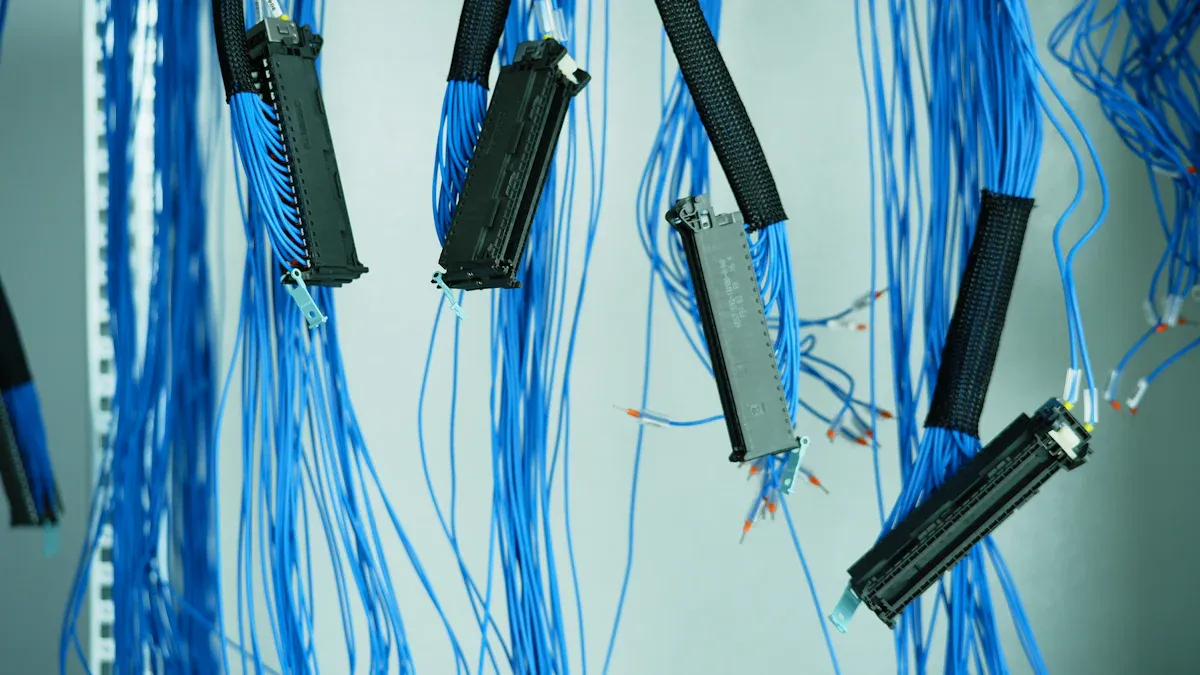
Fiber optic cables rely on a combination of advanced materials to deliver high-speed data with minimal loss. Each component plays a unique role in ensuring the cable's strength, flexibility, and performance.
Core and Cladding
You find the core at the center of every fiber optic cable. This part uses ultra-pure glass or sometimes plastic to transmit light signals. The cladding surrounds the core and uses a slightly different type of glass. This difference in material causes light to reflect back into the core, keeping the signal strong and focused as it travels.
Here's a quick overview of the main materials and their roles:
|
Material |
Role |
|---|---|
|
Core |
The central part that carries the light signal, ensuring efficient light transmission. |
|
Cladding |
A coating that reflects light back into the core, preventing signal loss and degradation. |
|
Coating |
Protects the fiber from physical damage. |
|
Strength Member (Aramid yarn) |
Provides mechanical strength to the cable. |
|
fiber optic cable Jacket |
Protects the fiber from environmental factors. |
Coatings and Strength Members
You depend on coatings to shield the delicate glass fiber from scratches and moisture. Manufacturers use special polymers for this layer. Strength members, often made from aramid yarn, give the fiber optic cable the ability to withstand tension and bending. The outer jacket, usually plastic, protects the entire assembly from harsh environments.
Why Material Purity Matters
You benefit from high-quality glass in fiber optic cables because it minimizes signal loss and boosts transmission quality. Even tiny impurities can absorb or scatter light, which weakens the signal and increases attenuation. Microscopic imperfections in the glass can cause distortion, affecting your internet speed and reliability. Uniform, high-purity glass allows light to travel farther and faster with fewer errors.
Manufacturing Process
You rely on a precise and controlled manufacturing process to create high-performance optical fiber cables. Each step in this process ensures that the final product delivers reliable data transmission, durability, and flexibility. Let's walk through the main stages and see why each is essential for quality and performance.
Optical Fiber Preform
You start with the creation of the optical fiber preform. This step uses ultra-pure silica glass, which forms the foundation for glass fiber optics. Manufacturers use advanced methods like Modified Chemical Vapor Deposition (MCVD) and Plasma Activated Chemical Vapor Deposition (PCVD). These technologies allow you to adjust the size, position, and shape of the preform's internal structure, ensuring uniformity and concentricity. The sol-gel process also helps remove contaminants, which boosts the purity and consistency of the preform. You need this level of precision because even tiny imperfections can cause signal loss in optical fiber cables.
Tip: A clean environment during preform production prevents contamination, which can degrade signal quality and reduce the lifespan of your optical fiber cables.
Drawing the Fiber
Once you have the preform, you move to the drawing process. You heat the preform in a specialized oven to temperatures above 1,900° C. This extreme heat softens the glass, allowing it to drip and stretch into a thin strand. You must control the drawing temperature and speed with great accuracy. If you get these settings wrong, you risk creating optical fibers with inconsistent thickness or poor transmission quality. The viscosity of the glass changes rapidly at high temperatures, so you need constant monitoring to maintain the ideal conditions. This step transforms the solid preform into long, flexible optical fiber strands that carry light signals over great distances.
Coating Application
Immediately after drawing, you apply a protective coating to the optical fiber. You use UV-cured acrylates for most applications because they offer excellent protection against environmental and mechanical damage. Specialty optical fibers may require coatings made from carbon, metals, nitrides, polyimides, or other polymers, depending on their intended use. You need to apply the coating quickly and evenly to shield the delicate glass from moisture, scratches, and bending stress. This step is crucial because unprotected optical fibers are vulnerable to breakage and signal degradation.
Coatings prevent physical damage and extend the lifespan of optical fiber cables.
You ensure the coating is uniform to maintain the optical fiber's performance.
Bundling Optical Fibers
After coating, you bundle multiple optical fibers together to form a fiber optic cable. You use methods like the Trenchless Integrity Pipeline System (TIPS), which involves placing the fibers inside steel conduits wrapped in protective fiberglass polymer. You adhere the polymer casing to the pipeline using a two-part adhesive resin. This design eliminates hard edges that could shear the conduits during installation, especially in challenging environments like boreholes. You face challenges such as preventing damage during installation and maintaining the integrity of each optical fiber. Careful bundling ensures that the cable remains flexible, strong, and ready for real-world applications.
Note: You must keep the manufacturing area clean throughout the process. Dust and debris can obstruct signals, leading to data loss and reduced performance. Regular cleaning and inspection help you deliver optical fiber cables that meet the highest standards.
Why does each step matter?
You need precision at every stage to produce optical fiber cables that deliver fast, reliable data transmission. The purity of the preform, the accuracy of the drawing process, the quality of the coating, and the integrity of the bundling all contribute to the fiber optic cable's performance. A clean manufacturing environment ensures that you avoid signal degradation and maximize the lifespan of your optical fiber cables.
Quality Control
Inspection and Testing
You depend on strict quality control to ensure fiber optic cables perform reliably in every environment. During production, you see two main types of tests: production testing and type testing. Production testing checks each fiber optic cable as it comes off the line. You measure optical loss, which tells you how much signal strength drops as light travels through the fiber optic cable. This step is crucial because even small losses can affect your internet speed and data integrity.
Type testing pushes fiber optic cables to their limits. You expose them to mechanical stress, such as pulling and compressing, and environmental challenges like temperature swings and water exposure. These tests help you confirm that the fiber optic cables will not fail under real-world conditions.
Common flaws you might detect during inspection include:
- Pits, chips, and scratches on the fiber surface
- Cracks or breaks in the glass
- Particles, dirt, or dust embedded in the coating
You also check for issues like fiber bending, connector contamination, and excessive optical attenuation. These problems can weaken the signal or cause complete failure.
|
Type of Flaw/Defect |
Description |
|---|---|
|
Physical connection failure |
Fiber bending, connector contamination, fiber link damage |
|
Equipment and signal failure |
Port failure, fusion quality issues, excessive optical attenuation |
|
Cascade node failure |
Splitter failures, errors in fiber jumper connections |
|
Environmental and construction issues |
Blockages, misalignments, external interference |
Ensuring Performance
You rely on quality control to guarantee that fiber optic cables meet industry benchmarks for strength, flexibility, and signal transmission. You measure tensile strength to ensure fiber optic cables can withstand pulling forces during installation. For most applications, you expect a proof-test strength of at least 50,000 psi, which means the cable can last nearly 20 years without failure. Demanding environments may require even higher strength.
You also test for signal loss, or attenuation. For single-mode fiber, you look for a typical loss of 0.35 dB/km at 1310 nm. Lower attenuation means better performance over long distances.
International standards organizations, such as NEMA, ISO, ANSI, and ITU, set strict guidelines for fiber optic cable design, materials, and testing. You follow these standards to ensure your fiber optic cables are durable, compatible, and reliable.
Rigorous quality control helps you catch defects early, maintain high performance, and deliver fiber optic cables that keep your network running smoothly. Without these checks, you risk costly failures and unreliable connections.
Final Product
Cable Structure
When you look at a finished fiber optic cable, you see a design built for performance and durability. Each layer serves a specific purpose in fiber optic communication and transmission.
- Core: This is the heart of the fiber optic cable. It transports light signals, usually made from ultra-pure glass or plastic, ensuring fast and efficient data transmission.
- Cladding: Surrounding the core, the cladding has a lower refractive index. It keeps the light signals contained, preventing loss during transmission.
- Coating: This layer shields the core and cladding from physical damage, moisture, and bending stress.
- Strength Members: Materials like aramid yarn give the fiber optic cable the strength to handle tension and mechanical stress during installation and operation.
- Jacket: The outermost layer protects the fiber optic cable from environmental hazards, such as water, chemicals, and temperature changes.
- This structure allows you to rely on fiber optic cables for stable, high-speed communication in demanding environments.
Ready for Installation
You prepare fiber optic cables for installation based on the environment and application.
- For underwater installations, you survey the seabed, choose armored, waterproof fiber optic cables, and use specialized vessels or remotely operated vehicles to lay and anchor the fiber optic cable.
- For aerial installations, you inspect poles, use safety gear, and secure the fiber optic cable with hardware that allows for sag and movement.
- For direct burial, you survey the route, dig a trench, lay a sand bed, place the fiber optic cable, and cover it with sand and warning tape.
These steps ensure the fiber optic cable remains protected and delivers reliable communication and transmission, whether you install it underground, underwater, or overhead.
Real-World Applications
You benefit from fiber optic cables in many ways.
- Bigger Bandwidth: Fiber optic communication supports more data than copper, making it ideal for internet, telecommunication, and streaming.
- Longer Distance, Faster Speed: Fiber optic transmission covers greater distances with less signal loss and delivers data at the speed of light.
- Higher Resistance: Fiber optic cables resist electromagnetic interference, ensuring stable communication.
- Greater Security: Fiber optic communication is harder to tap, protecting your data.
- Durability: Fiber optic cables withstand harsh environments, making them reliable for telecommunication, healthcare, defense, and more.
- You choose fiber optic cables because they offer unmatched performance, security, and reliability in modern communication and transmission systems.
You see how each step in fiber optic cable manufacturing shapes the future of communication.
Precision in production reduces signal loss and ensures fiber optic cables meet strict standards, giving you reliable, high-speed data.
Advanced technology, like WDM, boosts network capacity and efficiency.
Fiber optic cables deliver unmatched speed, low latency, and stable connections for your daily needs.
The next wave of innovation-hollow-core fibers and photonic crystal designs-will drive even greater performance as global demand grows.
FAQ
Why do you need fiber optic cables instead of copper cables?
You choose fiber optic cables because they transmit data faster and over longer distances. Fiber optics resist electromagnetic interference and corrosion. You get higher bandwidth and more reliable connections, especially for internet, telecommunication, and streaming applications.
Why does fiber optic cable manufacturing require such high precision?
You need high precision to prevent signal loss and distortion. Even tiny imperfections in the glass can scatter or absorb light. This reduces data speed and reliability. Precision ensures you receive consistent, high-quality communication and transmission.
Why do fiber optic cables use glass instead of plastic for most applications?
You rely on glass because it offers lower signal loss and supports longer transmission distances. Glass fibers handle higher temperatures and provide better durability. Plastic fibers work for short distances, but you need glass for demanding, high-speed networks.
Why is material purity so important in fiber optic cables?
You depend on pure materials to minimize light absorption and scattering. Impurities cause attenuation, which weakens your signal. High-purity glass ensures you get faster speeds, longer distances, and fewer transmission errors in your fiber optic communication.
Why do you see fiber optic cables in so many industries today?
You see fiber optic cables everywhere because they deliver unmatched speed, security, and reliability. Industries like healthcare, defense, and telecommunications trust fiber optics for critical data transmission. You benefit from stable connections and future-ready infrastructure.