






Is fiber internet better? Yes, it gives you faster speeds and is more reliable. Fiber optic internet also uses new technology that will last a long time. You will see the difference when you stream videos, play games, or join video calls. Here is how fiber optic internet and cable internet compare:
|
Metric |
Fiber Optic Internet |
Cable Internet |
|---|---|---|
|
Average Speed |
200 Mbps to 20 Gbps |
10 Mbps to 1 Gbps |
|
Upload Speed |
Symmetrical (200 Mbps to 20 Gbps) |
5 to 50 Mbps |
Speed is not the only thing that matters. Is fiber internet better for safety, price, and how easy it is to get? Look at these facts:
- Fiber optic internet is in 51.5% of U.S. homes.
- More than 78 million homes can use it now.
- You want the best internet. Is fiber internet better? The facts show that it is.
Key Takeaways
- Fiber optic internet is much faster. It can go from 200 Mbps up to 20 Gbps. Cable internet only goes up to 1 Gbps.
- Fiber gives you the same upload and download speeds. This is great for video calls and sending big files.
- Fiber optic internet is more reliable. It has fewer outages and works well even when many people use it.
- Fiber is safer because it uses light signals. These are harder to steal than cable's electrical signals.
- Fiber might cost more at first. But it makes your home worth more and is better for new technology in the future.
Fiber vs Cable: Speed
Speed is very important when you look at fiber vs cable. Most people want fast internet for streaming and gaming. Fast internet also helps with working from home. Let's see how fiber optic and cable internet work in real life.
Download Speeds
Download speed shows how fast you can watch movies or load web pages. It also matters for downloading files. Fiber optic internet has high bandwidth and works well all the time. Big fiber providers give much faster speeds than cable internet.
|
Provider |
Max Download Speed (Mbps) |
|---|---|
|
Google Fiber |
1,000–8,000 |
|
Verizon Fios |
300–2,300 |
|
Quantum Fiber |
200–8,000 |
|
Ziply Fiber |
50–50,000 |
|
AT&T Fiber |
100–5,000 |
|
Cable Providers |
Up to 1,200 |
You will see a big difference with 4K videos or large games. Fiber optic internet has enough bandwidth for many devices at once. You can stream, play games, and work at the same time. Cable internet works for most things, but it can slow down when lots of people use it.
Upload Speeds
Upload speed is important for video calls and cloud backups. It also matters when you share big files. Fiber optic internet gives symmetrical speeds. This means upload and download speeds are the same. Cable internet has much lower upload speeds. This can make things slower.
|
Task |
Fiber (500/500 Mbps) |
Cable (400/20 Mbps) |
|---|---|---|
|
Upload a 1 GB File |
~16 Seconds |
~7 Minutes |
|
Upload a 10 GB File (e.g., Video) |
~2.5 Minutes |
~70 Minutes |
|
HD Video Conference (1:1) |
Flawless, Crystal Clear HD |
Generally OK, may downgrade under load |
|
Backup 100 GB to Cloud |
~30 Minutes |
~12 HOURS+ |
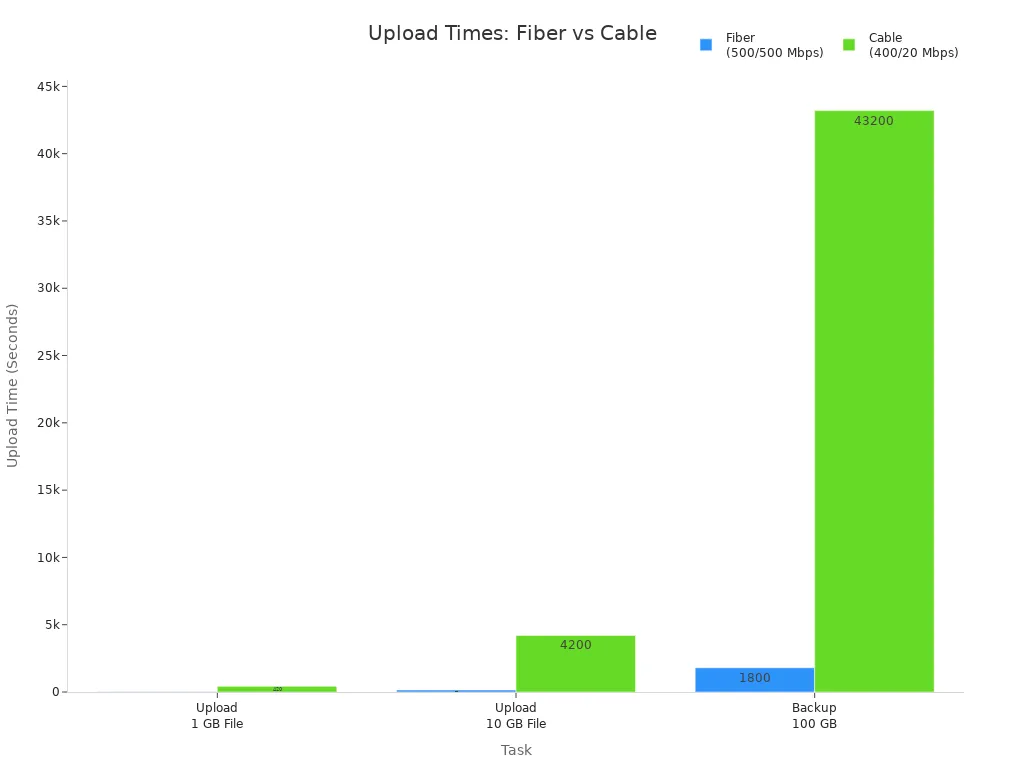
Tip: If you work from home, fiber optic internet helps you upload big files fast. You can join video meetings and back up data without waiting.
Fiber optic internet gives much faster uploads than cable. You can move big files in seconds. Cloud backups finish quickly. You can stream many 4K videos at once. Cable internet can be slow with uploads, especially if many people use it.
Latency
Latency is how fast data moves between your device and the internet. Lower latency means less lag. This is important for gaming and video calls. Fiber optic internet has lower latency than cable internet.
|
Internet Type |
Average Latency (ms) |
Impact on Gaming and Video Calls |
|---|---|---|
|
Fiber Optic |
5-20 |
Minimal latency, ideal for real-time activities |
|
Cable |
20-50 |
Higher latency, can cause delays and buffering |
|
Internet Type |
Latency (ms) |
Remarks |
|---|---|---|
|
Fiber Optic |
5–20 |
Very low latency, great for gaming and video calls. |
|
Cable |
15–30 |
Low latency, good for most things, but higher than fiber. Can get worse when the network is busy. |
- Gamers want ping rates below 50ms for smooth play.
- Fiber internet often gets ping below 20ms. Games and video calls feel instant.
- Cable internet can have higher latency. This can make games slow or video choppy.
You will notice the difference in fast games or clear video calls. Fiber optic internet keeps your connection stable. It works well even when many people are online. Cable internet can have more lag when lots of users share the network.
Note: Fiber optic internet gives symmetrical speeds and low latency. This makes cloud apps, remote work, and big file transfers smoother. You avoid lag, buffering, and slow uploads, even with many users online.
Fiber Optic Internet: Reliability
Consistency
You want your internet to work well every time. This is important for streaming, gaming, and working from home. Fiber optic internet gives you steady speeds all day long. It does not slow down when many people use it. Cable internet can get slower during busy times. You might see videos pause or games lag when everyone is online.
Here is a simple comparison:
|
Feature |
Fiber Optic Internet |
Cable Internet |
|---|---|---|
|
Speed Consistency |
Keeps speeds steady, even if many people are online |
Slows down when lots of people use it |
|
Performance During Peak Times |
Stays fast during busy hours |
Can get slower when many are online |
|
Electromagnetic Interference |
Not bothered by interference |
Can have problems from interference |
Fiber optic internet uses light to send data. This keeps your connection strong and stable. You get fast speeds for video calls, games, and backups. Your neighbor's internet use does not affect your speed.
- Fiber internet has very low lag for games and video calls.
- It gives the same upload and download speeds for good performance.
- High bandwidth means the network does not slow down, even when busy.
Outages
Losing internet can stop your work or fun. Fiber optic internet is very reliable. The cables are underground and well protected. Bad weather or damage does not cause as many problems as with cable internet.
Fiber optic internet is safe from most weather problems because it is underground and protected. Cable internet can break or lose signal in bad weather. Wind, snow, or ice can hurt cable lines and stop your service. Fiber stays safe because it is buried.
You have fewer outages with fiber optic internet. You stay online during storms or bad weather. Cable internet can stop working if a tree falls or ice covers the wires. Fiber optic cables do not have these problems, so your internet keeps working.
Peak Usage
Peak usage is when lots of people use the internet at once. This happens at night or on weekends. Cable internet shares its speed with your neighbors. This can make it slow and cause lag. Fiber optic internet gives you your own line. You get fast speeds, even if many people are online.
|
Feature |
Fiber Optic Internet |
Cable Internet |
|---|---|---|
|
Speed |
Fast, even when everyone is online |
Can slow down when many use it |
|
Reliability |
Very reliable, not much interference |
Can be unstable when busy |
|
Bandwidth |
Lots of bandwidth for many devices |
Bandwidth is shared with others |
|
Performance during peak |
Stays fast, no matter how many are online |
Slows down when lots of people use it |
Fiber optic internet does not slow down during busy hours. You keep high speeds for games, streaming, and video calls. You do not see lag or buffering, even if your whole family is online.
- Fiber optic internet does not slow down when many people use it.
- It keeps high speeds, no matter how many are online.
- Great for gaming, streaming, and other high-demand activities.
Cable internet slows down because you share it with others. Fiber optic internet fixes this problem. You get your own connection. You do not have to share bandwidth with neighbors. You get steady internet for all your devices.
Fiber networks use light to move data, so they are faster. Fiber has more bandwidth, so more people can use it without slowing down. Fiber connections are usually just for you, so your neighbor's use does not affect you.
Tip: If you need internet for work, school, or fun, fiber optic internet is best. You do not have to worry about outages, slow speeds, or lag, even when everyone is online.
Fiber vs Cable: Security & Privacy

Data Protection
You want your data to be safe online. Fiber optic internet keeps your data safe because of how it works. Fiber optic cables send data using light signals. This makes it very hard for someone to steal your information. If someone tries to break into a fiber optic cable, the signal drops right away. You will notice this fast, so your data stays safe.
Fiber optic connections use a point-to-point system. Your data goes straight from your device to where it needs to go. This direct path makes it harder for anyone to steal your data. Banks and hospitals use fiber optic internet for this reason. You get a private line that keeps your information safe.
Cable internet uses copper wires and electrical signals. These signals are easier for someone to steal. Someone with simple tools can take your data without you knowing. Cable networks often need extra protection to keep your data safe.
Tip: If you work with private data or work from home, fiber optic internet helps you worry less.
Network Vulnerabilities
You have fewer risks with fiber internet. The way fiber optic cables are built keeps them safe from outside signals. This means other signals cannot mess up your connection or steal your data. You get a strong and safe network.
Here is a quick comparison:
|
Feature |
Fiber Optic Internet |
Cable Internet |
|---|---|---|
|
Data Transmission |
Light signals |
Electrical signals |
|
Interception Risk |
Very low |
Higher |
|
Electromagnetic Interference |
Immune |
Susceptible |
|
Need for Extra Encryption |
Less often |
More often |
Fiber optic cables do not carry electricity. You do not have to worry about power surges or outside signals.
Cable internet can have outages and security problems during storms or when many people use it.
Fiber optic internet is the safer choice. You get a private, steady, and safe connection for everything you do online.
Fiber Internet: Cost & Value
Pricing
When you look at fiber internet and cable, you see price differences. Fiber internet plans usually cost between $40 and $120 each month. Cable internet plans are a bit cheaper, from $30 to $90 per month. Here is a simple chart:
|
Internet Type |
Average Monthly Cost (Range) |
Example State |
|---|---|---|
|
Fiber-optic |
$40 to $120 |
Rhode Island |
|
Cable |
$30 to $90 |
Hawaii |
Fiber internet costs a little more, but you get faster speeds. It is also more reliable than cable. Some companies give you deals or discounts if you sign up for a long time. This can help you save money.
Installation
Setting up fiber internet at home takes some work. It can take four to six hours to install fiber internet. Technicians put in new lines and use special tools with thin glass. Sometimes they need to dig or drill, but they try to fix any mess.
- Fiber internet installation usually costs $300 to $1,000.
- The price depends on your home, what is already there, and extra services.
- Some companies give free installation if you sign a long contract.
- Cable internet is cheaper to install and uses old copper wires.
Note: Many fiber internet companies give free installation or discounts if you agree to a longer contract.
Long-Term Value
Fiber internet gives you more than just fast speed. Homes with fiber internet can sell for up to 5% more. The U.S. government is spending over $42 billion on fiber. This shows they believe in this technology. Fiber internet is ready for the future and can handle more data. Experts say fiber internet will add over $36 billion to home values by the end of 2024.
You also save money over many years. Fiber cables last over 25 years and use less energy than cable. They are strong and do not break easily, so repairs cost less. Cable networks need more fixes and use more power, which can cost you more later.
Tip: If you want fast, steady, and future-ready internet, fiber is best for your home and life.
Is Fiber Internet Better for You?

Availability
You want internet that works well at home or work. Fiber internet is fast and reliable, but it is not everywhere yet. Where you live decides if you can get it. In the United States, cable internet is in more homes than fiber internet. Here is a quick look at how much each covers:
|
Internet Type |
National Coverage |
Urban Coverage |
Rural Coverage |
|---|---|---|---|
|
Fiber Internet |
46% |
49% |
38% |
|
Cable Internet |
82% |
- |
- |
- Fiber internet is growing, mostly in big cities. You see more choices in large city areas.
- Cable internet uses old wires, so it is easier to get almost anywhere.
- In the country, only 38% of homes can get fiber internet. Cable internet is still easy to find in most places.
Note: Fiber optic is new and not in as many places as cable internet, especially outside cities. More people want fiber internet to grow, but cable internet is still in most areas.
When Cable Makes Sense
You might think cable internet is better for you. Cable internet is a good choice in some cases:
- It costs less to set up, so it is good if you do not want to spend much.
- Cable internet is in most country areas, so you can stay online.
- If you just check email or surf the web, cable internet works fine and saves money.
|
Scenario |
Cable Internet Advantage |
|---|---|
|
Budget constraints |
Lower setup costs |
|
Rural location |
Wider coverage |
|
Simple online activity |
Sufficient performance |
Tip: If you do not need fast uploads or special features, cable internet gives you good service for less money.
Switching to Fiber
You want to get fiber optic internet for better speed and steady service. Changing to fiber internet has a few steps:
- Site Survey: A worker comes to your house to plan where the cables will go.
- Install Fiber Optic Cables: The worker puts in cables from the closest spot, and sometimes they have to dig.
- Install Optical Network Terminal (ONT): The ONT changes light signals into digital data in your house.
- Connect Equipment: The ONT hooks up to your router or modem to make sure it all works.
You might have some problems when you switch:
- It can cost more to set up.
- If you live far from a city, you might have to wait longer.
- You could lose internet for a short time while they install it.
Tip: Pick a time when you do not need the internet much for the install. Tell your family or team about the change and check your new internet after it is set up.
Fiber internet is ready for the future, but you should think about where you live, how much you want to spend, and what you need before you switch.
You want great internet at home. Fiber optic is fast, safe, and works well. Many people say fiber is better for games and streaming. It is also good for apps that need quick responses.
|
Feature |
Fiber Optic Internet |
Cable Internet |
|---|---|---|
|
Speed |
Up to 10,000 Mbps |
Lower than fiber optic |
|
Upload Speeds |
250–1,000 Mbps (symmetrical) |
5–50 Mbps (asymmetrical) |
|
Latency |
Lower, better for gaming |
Higher, more delays |
Think about where you live and how much you can spend. If you want fast internet for the future, look at what local companies offer. See if you can get fiber optic now.
FAQ
Why does fiber optic internet offer better performance than cable?
Fiber optic internet sends data as light through glass fibers. This makes your internet much faster. It also gives you less lag. Cable uses copper wires, which are slower. Copper wires can also have more problems with interference. Fiber lets more devices use the internet at once. Your connection stays strong, even when many people are online.
Why do upload speeds matter for home users compared to cable?
Upload speeds help with video calls and cloud backups. They also matter when you share files. Fiber gives you the same upload and download speeds. Cable often has slower upload speeds. This makes sending big files or live streaming take longer.
Why is fiber optic internet more reliable than cable during bad weather?
Fiber optic cables are buried underground. They do not get damaged by storms or wind. You have fewer outages and interruptions. Cable lines are above ground and can break in bad weather. Fiber keeps your internet working when cable might stop.
Why do security risks differ between fiber and cable internet?
Fiber optic networks use light signals to send data. This makes it hard for someone to steal your information. You get a private and direct connection. Cable uses electrical signals, which are easier to tap. Fiber helps keep your data safe from theft.
Why should you consider switching from cable to fiber internet?
You get faster speeds and better reliability. Fiber also gives you stronger security. It is ready for new technology and can raise your home's value. Cable may cost less, but fiber is better for gaming, streaming, and working from home.