







HENGTONG Customized Tight Buffered Fiber Optic Cable Manufacturer & Supplier
Indoor Multi Fiber Distribution Cable
GJPFJH(V)
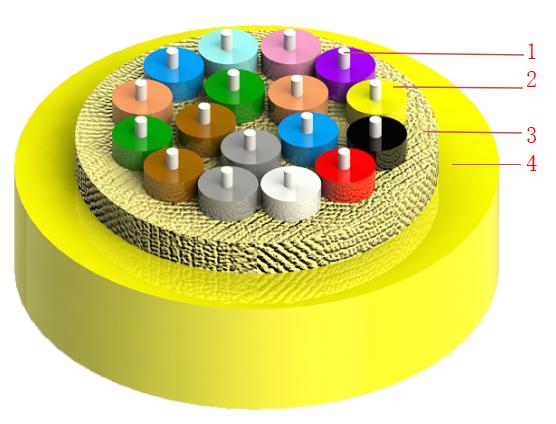
1-Optical fiber
2-Tight buffer
3-Strength member
4-Outer Sheath
Product features
High density, can be divided into several independent optical units
Flexible, excellent strain properties
Flame retardant outer sheath offering good protection
All dielectric structure design
Applications

Horizontal and vertical cabling inside buildings,Pigtail and patch cord in communication equipment
Fiber Transmission Performance
|
Cabled Optical fiber |
62.5um (850nm/1300nm) |
50um (850nm/1300nm) |
G.652 (1310nm/1550nm) |
G.657 (1310nm/1550nm) |
|
Max attenuation(dB/km) |
3.5/1.5 |
3.5/1.5 |
0.4/0.3 |
0.4/0.3 |
|
Typical value(dB/km) |
3.0/1.0 |
3.0/1.0 |
0.36/0.22 |
0.36/0.22 |
Technical Specification
|
Cable type |
Fiber counts |
Tensile force (N) |
Flattening force (N/100mm) |
Minimum bending radius (mm) |
Optical cable diameter (mm) |
|||
|
short term Horizontal Vertical |
Long term Horizontal Vertical |
short term |
Long term |
When installing |
After installation |
|||
|
GJPFJH(V) |
2 |
440 660 |
220 330 |
1000 |
300 |
20D |
10D |
4.2 |
|
GJPFJH(V) |
4 |
440 660 |
220 330 |
1000 |
300 |
20D |
10D |
4.7 |
|
GJPFJH(V) |
6 |
440 660 |
220 330 |
1000 |
300 |
20D |
10D |
5.2 |
|
GJPFJH(V) |
8 |
440 660 |
220 330 |
1000 |
300 |
20D |
10D |
5.8 |
|
GJPFJH(V) |
12 |
440 660 |
220 330 |
1000 |
300 |
20D |
10D |
6.3 |
• Standard length:1,000m or 2,000m; other lengths are also available.
• The cables are packed in wooden drums,or follow customer requirements.
• Usually the shipping method is ship, if you need other shipping methods, please contact us.
Partner


Tight Buffered Cable Construction

Indoor multi-core tight buffered fiber optic cable consists of the following elements:
- Optical fiber: 250 μm single-mode or multimode fibers compliant with ITU-T/IEC standards.
- Tight buffer: 900 μm tight buffer layer for additional mechanical protection and easy stripping/termination.
- Strength member: High-tensile aramid yarn providing pulling strength and supporting vertical installation.
- Outer sheath: Flame-retardant PVC or LSZH jacket suitable for indoor riser and distribution applications.
Tight Buffered vs Loose Tube Fiber Optic Cable
When designing building and campus networks, engineers often need to compare tight buffered vs loose tube fiber optic cable. Both use similar optical fibers, but the cable construction and typical application are quite different.

Tight buffered fiber optic cable
Tight buffered fiber optic cable is mainly used for indoor, premise and LAN cabling. Each fiber has a 900 μm tight buffer layer, which provides extra mechanical protection and makes the cable easy to strip and terminate directly into connectors, patch panels and equipment. This type of cable is ideal for building vertical wiring, riser shafts, equipment rooms and pigtail or patch cord assemblies, where flexibility and quick installation are important.
Loose tube fiber optic cable
Loose tube fiber optic cable is typically used for outdoor backbone and other harsh environments. Fibers are placed in gel-filled or dry loose tubes that allow movement inside the tube and provide better protection against moisture, temperature changes and mechanical stress. Termination is more complex and usually requires additional preparation such as gel cleaning and the use of fan-out or breakout kits.

| Item | Tight Buffered Fiber Optic Cable | Loose Tube Fiber Optic Cable |
|---|---|---|
| Typical use | Indoor distribution, riser, LAN, premise cabling | Outdoor backbone, duct, direct-buried, aerial routes |
| Buffer | 900 μm tight buffer on each fiber | Fibers in gel-filled or dry loose tubes |
| Installation | Easy termination, no fan-out kit needed | More preparation, gel cleaning, fan-out kit required |
Typical Applications of Tight Buffered Fiber Optic Cable in Buildings

Vertical Riser Cabling in Commercial Buildings
In high-rise office buildings, hotels and hospitals, multi-core tight buffered fiber optic cable is widely used for vertical riser cabling between main equipment rooms and floor distribution rooms. The compact construction and 900 μm buffered fibers make it easy to route in riser shafts, trays and conduits without complex fan-out kits. This type of tight buffered fiber optic cable provides a reliable optical backbone for building communication systems, including data, voice, security and building automation services.

Horizontal Distribution and Floor Cross-Connections
Tight buffered fiber optic cable is also ideal for horizontal distribution on each floor, connecting floor distributors, IDF cabinets and telecommunication outlets. The flexible indoor design allows installers to pull and route the cable through ceilings, raised floors and cable trays with minimal bending issues. As a result, tight buffered fiber optic cable is a preferred choice for LAN cabling, office area connections and short indoor runs between network equipment within the same building.

Indoor Pigtails and Patch Cords in Equipment Rooms
Because of its 900 μm buffered fibers and easy handling, tight buffered fiber optic cable is frequently used to manufacture indoor pigtails and patch cords in central equipment rooms and data rooms. The jacketed multi-core cable can be directly stripped and terminated into connectors, saving time during on-site assembly and maintenance. Using tight buffered fiber optic cable for pigtails and patch cords ensures high-density, flexible connections between patch panels, switches, ODFs and other active devices.

Indoor/Outdoor Transition Points
At building entry points, tight buffered fiber optic cable is often used as the indoor section following an outdoor loose tube cable. The outdoor cable is typically spliced to an indoor tight buffered fiber optic cable inside a splice closure or transition box to meet fire safety and installation requirements inside the building. This combination allows engineers to benefit from the robustness of loose tube designs outside and the easy termination of tight buffered fiber optic cable inside, creating a complete and compliant end-to-end link.
How to Select the Right Tight Buffered Fiber Optic Cable for Your Project
| Factor | Recommendation |
|---|---|
| Fiber Type | Choose between OM1, OM2, OM3, OM4 (multimode) or OS2 (single-mode). Select based on distance and bandwidth requirements: OM3/OM4 for shorter, high-bandwidth applications, OS2 for long-distance, high-speed connections. |
| Fiber Count | Options range from 2 to 12 cores. Choose based on network capacity. Small installations might need 2-4 fibers, while larger installations like data centers may require 8-12 fibers. |
| Jacket Type | Select PVC for general indoor use or LSZH (Low Smoke Zero Halogen) for areas requiring high fire safety standards, such as riser and plenum spaces. |
| Installation Environment | Consider the environment where the cable will be installed (riser shafts, cable trays, conduits, etc.). Ensure the cable meets the required minimum bending radius and tensile load values. A typical value is 20D during installation and 10D after installation. |
Installation Guidelines for Indoor Tight Buffered Fiber Optic Cables
| Installation Consideration | Recommendation |
|---|---|
| Pulling Tension | Avoid exceeding the maximum short-term pulling tension listed in the technical specification table for this tight buffered fiber optic cable. Long-term tensile load should remain below the recommended continuous value. |
| Bending Radius | During installation, the minimum bending radius should be ≥ 20 × cable diameter (20D). After installation, keep it ≥ 10 × cable diameter (10D). "D" refers to the outer diameter of the cable. |
| Cable Management | Use appropriate cable management hardware (e.g., clamps, trays, hooks) in riser shafts and racks to avoid crushing or excessive tension on the cable over time. |
| Termination | Tight buffered fiber optic cables can be directly terminated into connectors, patch panels, and distribution frames without the need for a fan-out kit, saving installation time. |
Customized Tight Buffered Fiber Optic Cable Solutions
As a manufacturer of tight buffered fiber optic cables, we support OEM and fully customized designs to match different project and branding requirements. Our engineering team can help you select or design the right custom tight buffered fiber optic cable for building, campus and industrial networks.
We can customize the following parameters for your tight buffered fiber optic cable:
Fiber type: single-mode OS2 or multimode OM1 / OM2 / OM3 / OM4
- Fiber count: 2, 4, 6, 8, 12 cores or other counts on request
- Jacket material and color: PVC or LSZH with customer-specified colors
- Printing: customer logo, part number, length marking and other print legends
- Standard length and delivery length: customized reel or coil lengths
- Packing: reels, drums, coils or special export packing according to project needs

These OEM / ODM tight buffered fiber optic cable solutions are widely used in commercial buildings, data centers, railway and metro communication systems, as well as factory and plant networks. By providing customized designs and flexible delivery options, we help our customers simplify installation and keep a consistent product specification across different projects and regions.
FAQ
Q: What is a tight buffered fiber optic cable typically used for in building vertical wiring?
A: A1: A tight buffered fiber optic cable is commonly used as the indoor backbone for building vertical wiring between main equipment rooms and floor distribution rooms. The multi-core tight buffered design is ideal for riser shafts, telecommunication rooms and IDF cabinets, where flexible routing and easy termination are required.
Q:Can you provide custom tight buffered fiber optic cable with LSZH jacket for riser applications?
A: A2: Yes, we can supply custom tight buffered fiber optic cable with LSZH (Low Smoke Zero Halogen) jacket for riser and other high fire-safety areas. Jacket material, color and printing can be customized according to local building codes and project specifications.
Q: Do you offer OEM / ODM tight buffered fiber optic cable manufacturing services?
A: A3: Yes, as an OEM / ODM tight buffered fiber optic cable manufacturer, we can produce cables with customized fiber types, core counts, jacket colors, print legends and packing. We support branding and labeling according to your own part numbers and project requirements.
Q: Can tight buffered fiber optic cable be used to make indoor patch cords and pigtails?
A: A4: Tight buffered fiber optic cable is very suitable for indoor patch cords and pigtails because each fiber has a 900 μm tight buffer that is easy to strip and terminate. Many customers choose multi-core tight buffered fiber optic cable for factory-terminated patch cord assemblies and on-site pigtail termination in equipment rooms.
Q: What is the difference between indoor tight buffered fiber optic cable and loose tube cable?
A: A5: Indoor tight buffered fiber optic cable uses 900 μm buffered fibers and is optimized for premise cabling, vertical risers and equipment rooms, where easy termination and flexible routing are important. Loose tube cable is normally used for outdoor backbone and harsh environments, with fibers placed in gel-filled or dry tubes for extra environmental protection.
Q:How do I choose the right fiber count for a multi-core tight buffered fiber optic cable?
A: A6: When selecting fiber count for a multi-core tight buffered fiber optic cable, consider the number of active links, future expansion and redundancy. For small building risers, 4–6 fibers may be enough, while larger commercial buildings or data centers often use 8–12 fiber tight buffered cables to support higher capacity and backup paths.
Q:Can indoor tight buffered fiber optic cable be used at indoor/outdoor transition points?
A: A7: Indoor tight buffered fiber optic cable is usually used on the building side of an indoor/outdoor transition point. The outdoor loose tube cable is spliced to an indoor tight buffered fiber optic cable inside a closure or transition box, so the indoor section meets fire-rating requirements and is easy to terminate inside the building.
Q: Do you support custom length and packing for tight buffered fiber optic cable reels?
A: A8: Yes, we can deliver tight buffered fiber optic cable in standard or custom lengths on wooden drums, plastic reels or coils. Custom packing and labeling help installers handle the cable more efficiently on site and make logistics easier for large projects.
Hot Tags: indoor multi core tight buffered fiber optic cable, China indoor multi core tight buffered fiber optic cable manufacturers, suppliers, optical cables for vertical cable connectivity in buildings, building vertical cable termination fiber optic cables, building vertical networking fiber optic cables, optical cables for vertical cable interfacing in buildings, optical cables for vertical cable feeding in buildings, optical cables for vertical cable management in buildings


