






As data centers scale toward 400G, 800G, and 1.6T links to support AI training clusters and cloud workloads, fiber port density inside the rack has become a real engineering constraint. The Multi-fiber Push-On (MPO) connector - particularly the ribbon-structured variant built on MT ferrule technology - is one of the dominant answers to that constraint. This guide explains what a ribbon-structured MPO connector actually is, where it earns its place over LC, how it maps to today's 400G/800G transceivers, and the design details engineers should review before deploying it at scale.
What Is a Ribbon-Structured MPO Fiber Connector?
An MPO connector is a multi-fiber interface defined by the IEC 61754-7 standard, built around a precision-molded rectangular MT (Mechanical Transfer) ferrule. Inside that ferrule, multiple fibers are aligned by two guide pins, allowing 8, 12, 16, 24, or even 32–48 fibers to mate in a single push-on operation.
"Ribbon-structured" refers to the fiber arrangement entering the connector. Instead of routing individual loose fibers, the cable carries fibers as a flat ribbon - typically 12 fibers held in parallel by a matrix coating. This ribbon layout matches the linear fiber holes in the MT ferrule, which enables mass termination: all fibers are polished and inspected in one operation rather than one-by-one. The result is a connector that combines high fiber count with manufacturable consistency.
If you are evaluating ribbon-based assemblies for a new build, our overview of ribbon fiber optic cable covers the cable-side construction that feeds into MPO termination.
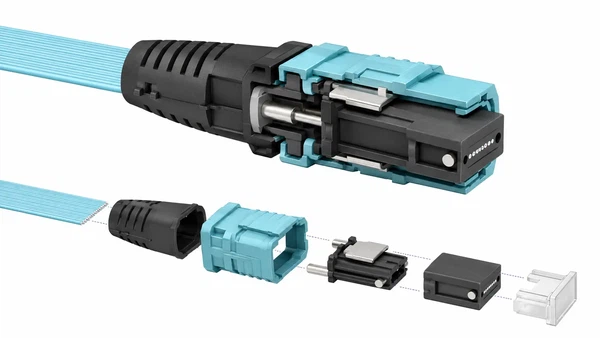
Ribbon-Structured MPO vs. LC: Where the Density Advantage Comes From
The most common comparison in a data center is MPO versus duplex LC. The two solve different problems.
| Attribute | Duplex LC | Ribbon-Structured MPO |
|---|---|---|
| Fibers per connector | 2 | 8, 12, 16, 24 (32/48 in extended variants) |
| Typical 1RU panel capacity | ~96 fibers (48 duplex ports) | ~144 fibers via MPO-12 modules; significantly more with MPO-24 |
| Termination method | Per-fiber polish | Mass termination of ribbon |
| Primary use | Two-fiber duplex links | Parallel optics, trunk distribution, breakout to LC |
| Polarity management | Simple (TX/RX) | Requires Method A/B/C planning |
| Field termination | Common | Almost always factory-terminated |
The density advantage is real but condition-dependent. In a leaf-spine fabric where most uplinks are 400G SR8 or 800G SR8, MPO trunking removes a large amount of patch panel real estate compared with an all-LC design. In a smaller environment with mostly duplex 10G/25G links, LC remains simpler and cheaper.
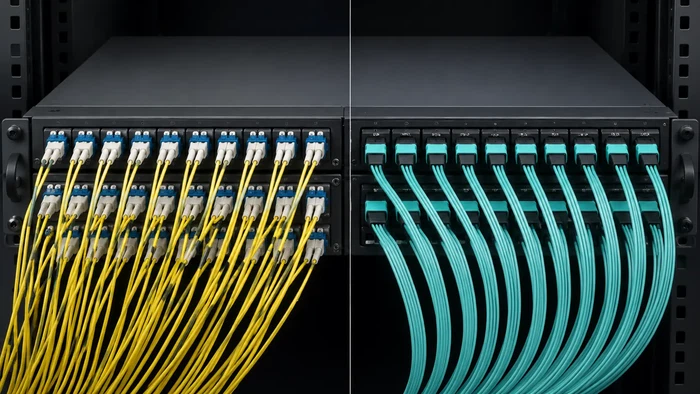
Rapid Deployment with Pre-Terminated MPO Assemblies
Because ribbon fibers can be polished and tested in parallel at the factory, MPO is most often deployed as a pre-terminated assembly - a trunk cable with MPO connectors on each end, plus cassettes or harnesses that break out to LC where individual transceivers need them. The result is a plug-and-play deployment model: no fusion splicing, no field polishing, no per-fiber inspection inside the cabinet.
Vendors and operators routinely report that pre-terminated MPO solutions reduce on-site installation time and labor compared with field-terminated LC bundles, especially in greenfield builds and large-scale migrations. The exact savings depend heavily on link count, splice volume, cable management complexity, and crew experience, so we recommend treating any single percentage figure (the "70% faster" claim seen in some marketing materials) as indicative rather than universal.
For the assemblies themselves, see our range of MPO and MTP products, which includes trunks, breakout harnesses, and conversion jumpers used in most modern data center fabrics.
MPO Connectors for 400G and 800G Parallel Optics
Most high-rate Ethernet optics above 100G use parallel optics, meaning multiple fiber pairs (or lanes) operate in parallel rather than a single duplex pair. This is where MPO becomes the practical interface choice.
Typical pairings seen in production networks:
- 400GBASE-SR8 - 8 transmit + 8 receive lanes over multimode fiber, usually mated to an MPO-16 or two MPO-12 connectors.
- 400GBASE-DR4 - 4 single-mode lanes, mated to an MPO-12 (APC). Frequently deployed in the form of a QSFP-DD DR4 optical module.
- 800GBASE-SR8 / DR8 - 8 lanes at 100G per lane; SR8 uses parallel multimode with an MPO interface, DR8 uses single-mode MPO-16.
- 800G in QSFP-DD800 / OSFP form factors - the form factor is independent of the optical interface, but parallel-fiber variants terminate on MPO.
The IEEE 802.3df and 802.3dj amendments define the PHY parameters for 400G and 800G Ethernet, and a growing portion of these PMDs assume MPO as the fiber interface. The IEEE 802.3df Task Force documents are the authoritative source for which fiber count and connector polish each variant requires.
If you are planning the optics side of an 800G rollout, our discussion of 800G optical modules walks through the lane structures and fiber requirements behind these standards.
Choosing Between MPO-12, MPO-16, and MPO-24
Fiber count selection is one of the most consequential decisions in an MPO design. The three most common variants behave differently:
- MPO-12 - the long-standing default. Fits 40GBASE-SR4, 100GBASE-SR4, 400GBASE-DR4, and breaks out cleanly into 4 duplex LC pairs. Good fit when most links are 4-lane parallel optics or when you need an easy migration path from existing infrastructure. See our primer on MPO 12-fiber cables for typical use cases.
- MPO-16 - designed specifically for 8-lane optics like 400GBASE-SR8 and 800GBASE-SR8/DR8. The native 16-position layout avoids the awkward "two MPO-12 connectors per port" workaround.
- MPO-24 - two rows of 12 fibers. Highest density per connector, useful for trunk consolidation, but polarity planning and inspection are more complex.
Single-mode deployments almost always use APC (angled) end-face polish to keep return loss low; multimode deployments use PC. Mixing them is not interchangeable, and getting this wrong is one of the more common field mistakes.
For broader selection context across single-mode and multimode, our guide on single-mode vs. multimode fiber covers fiber-type implications that ripple into MPO choices.
Engineering Considerations Before Deploying MPO
MPO connectors deliver density, but they shift complexity rather than remove it. A short checklist before committing to a design:
- Polarity method - TIA-568 defines Methods A, B, and C, each with different jumper, trunk, and cassette combinations. Pick one method and apply it consistently across the fabric. Mixed-method patching is the most common cause of broken links in MPO rollouts.
- Insertion loss budget - every MPO mate adds insertion loss. For 400G and 800G short-reach links, the allowable channel loss is tight (often below 2 dB for SR variants). Count mating points carefully across trunk + cassette + jumper chains.
- End-face inspection and cleaning - MT ferrules have a large surface area, and a single contaminated fiber in a 12- or 24-fiber ferrule can fail the entire link. Inspection scopes capable of viewing the full MT face, and dry cleaning tools designed for MPO, are non-negotiable. Our walkthrough on MPO inspection and cleaning covers the workflow.
- Gender and key orientation - MPO connectors are male (pinned) or female (unpinned), and key-up/key-down orientation matters. Trunk-to-cassette interfaces need to be planned before ordering.
- Single-mode vs. multimode fiber type - OM4 and OM5 multimode dominate short SR links; OM4 is the common floor for 400G SR. Single-mode (G.652.D or G.657.A1/A2) is needed for DR/FR/LR reaches.
For data center designs that combine these elements end-to-end, our data center connectivity solutions page outlines the typical cable, connector, and panel components used together in 400G/800G fabrics.
When MPO Might Not Be the Right Choice
MPO is not a universal upgrade. Cases where standard duplex LC remains the better answer include:
- Networks dominated by 10G and 25G duplex links where parallel optics offer no advantage.
- Small environments where the cost of MPO trunks, cassettes, and specialized test equipment outweighs density savings.
- Sites without trained staff for MPO polarity management and MT-face cleaning - error rates rise sharply in those conditions.
- Links that need frequent field re-termination; MPO is overwhelmingly a factory-terminated product.
Market Outlook
Forecasts for the MPO connector market vary significantly across analysts, reflecting different scope definitions and base years. Estimates published in 2024–2025 range broadly from sub-USD 1 billion to several billion dollars by the mid-2030s, with reported CAGRs typically between 13% and 19%. The shared signal across these reports is direction rather than magnitude: MPO volumes are tied to data center capex, AI cluster build-outs, and the 400G/800G upgrade cycle, all of which are projected to grow through the decade. Treat any single market figure as one data point among several.
Frequently Asked Questions
What is the difference between MPO and MTP?
MTP is a trademarked, performance-enhanced MPO connector produced by US Conec. MTP connectors are mechanically compatible with MPO connectors compliant to IEC 61754-7, but include refinements such as a removable housing, improved spring design, and tighter ferrule tolerances. In practice, MPO and MTP are mateable; "MTP" is a brand of MPO.
How many fibers can an MPO connector support?
Common variants are 8, 12, 16, and 24 fibers in a single MT ferrule. Extended versions reach 32 and 48 fibers in two- or three-row layouts, typically reserved for specialty high-density assemblies.
Is MPO suitable for 800G?
Yes, for parallel-optics PMDs. 800GBASE-SR8 and 800GBASE-DR8 are designed around an MPO interface (typically MPO-16). Serial 800G PMDs that use a duplex single-mode interface do not require MPO.
What is MPO polarity and why does it matter?
Polarity ensures that the transmit fiber at one end maps to the receive fiber at the other. MPO links use planned schemes - Method A, B, or C under TIA-568 - to handle this across trunks, cassettes, and jumpers. Mixing methods within a single channel breaks the link.
Why are most MPO connectors factory-terminated?
Mass-polishing 12 or more fibers in a single MT ferrule to the geometry required by IEC 61755 is difficult to do reliably in the field. Factory termination with 100% insertion-loss and return-loss testing per fiber is more consistent and cheaper at scale.
Does MPO work with QSFP-DD and OSFP modules?
The QSFP-DD and OSFP form factors are mechanical and electrical specifications; whether they use an MPO interface depends on the specific PMD inside the module. Parallel-fiber variants (SR4, SR8, DR4, DR8) use MPO; duplex variants (FR, LR) use LC or CS.
Summary
Ribbon-structured MPO connectors are not a marketing concept - they are an engineering response to the physical realities of dense parallel-optics fabrics. They earn their place where fiber counts are high, parallel optics dominate, and pre-terminated factory assemblies make economic sense. They are not a drop-in replacement for LC in every environment, and the engineering work they require (polarity, IL budgeting, end-face inspection, fiber-count selection) is real.
For teams planning a 400G or 800G build, the right starting point is the link inventory: how many lanes per port, which transceiver type, what reach, what end-face polish, what polarity method. From there, MPO-12, MPO-16, or MPO-24 - and the matching trunks, cassettes, and jumpers - becomes a much clearer decision.