






South America is no longer just a "future opportunity" in the global fiber map. Between large-scale data center expansion in São Paulo, Santiago, Bogotá and Querétaro, accelerating 5G rollouts, and a new generation of trans-oceanic submarine cables landing on its coasts, the region is moving into a phase where high-density fiber cabling becomes a real procurement question, not a long-term forecast.
For project owners, system integrators and telecom operators, that question often narrows down to one product family: MPO/MTP cable assemblies. This article looks at why these assemblies are starting to matter in South America, which markets will likely adopt first, what specifications matter most, and how buyers can prepare. The view is written from the perspective of a fiber optic cable manufacturer that ships MPO/MTP, trunk, breakout and custom assemblies into Latin America.
What Are MPO/MTP Cable Assemblies?
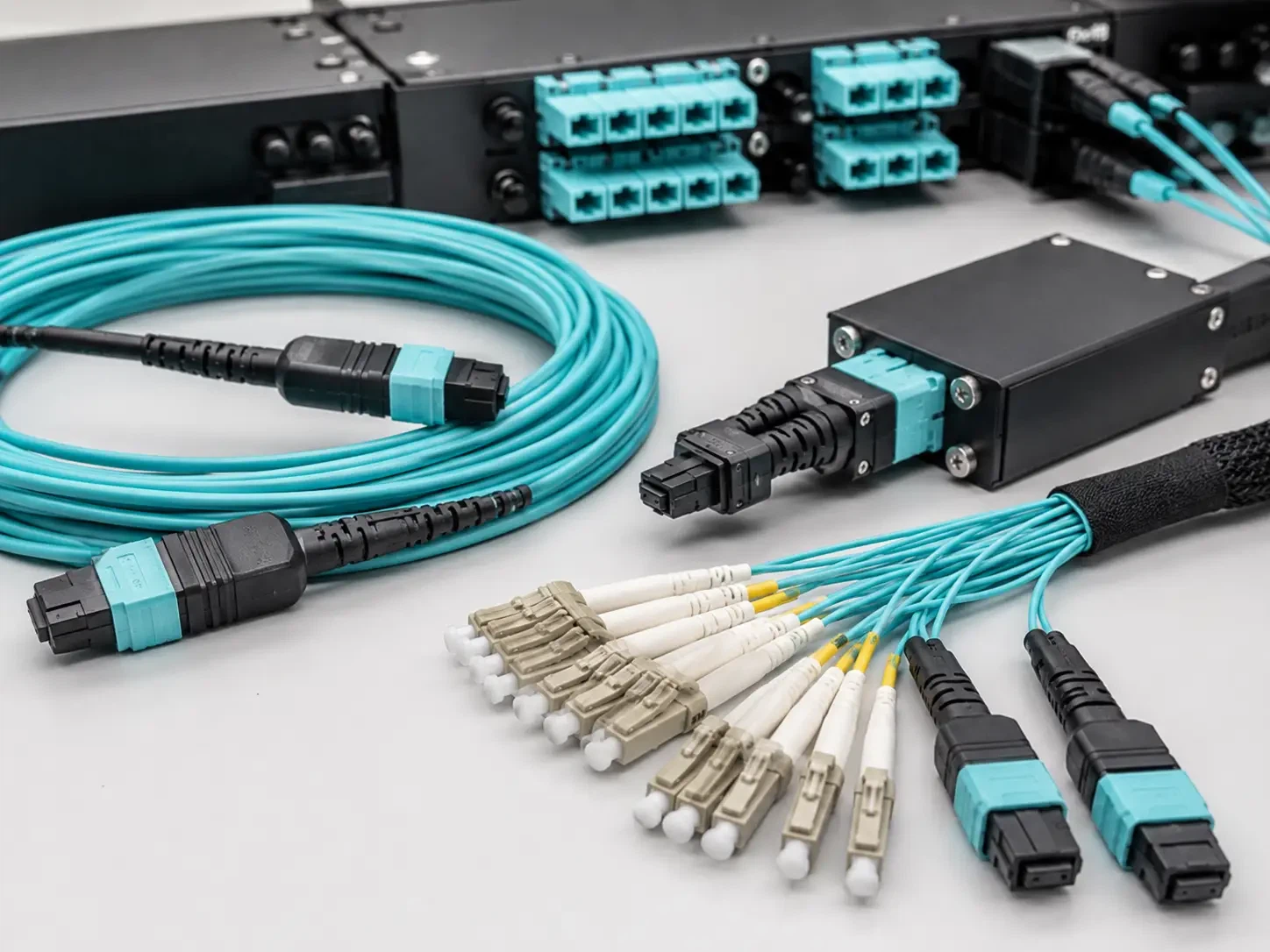
An MPO (Multi-fiber Push-On) cable assembly is a pre-terminated fiber cable that consolidates 8, 12, 16 or 24 fibers into a single connector. MTP is a higher-precision variant of the MPO standard, generally offering tighter mechanical tolerances and lower insertion loss. In practice the two terms are used in the same product family, and both interoperate when the polarity and connector gender match.
The reason data center designers reach for MPO/MTP is simple: a single MPO-12 connector replaces six LC duplex connections. That cuts rack-space congestion, simplifies patching, and supports parallel optics for 40G, 100G, 200G and 400G transceivers without splicing in the field. For a typical hyperscale row, factory-terminated MPO trunks can reduce on-site labor by a significant margin compared with field-terminated LC cabling, especially in markets where skilled splicing technicians are scarce.
Common building blocks in this family include MPO trunk cable, MPO breakout (harness) cable, MPO-to-LC conversion cassettes, MPO jumpers and MPO adapter panels. Hengtong's full range is grouped under the MPO/MTP product category.
Why South America's Networks Need Higher-Density Cabling Now
Three structural shifts are pushing the region toward denser fiber infrastructure at the same time.
Data center capacity is growing fast. According to JLL's Latin America Data Center Report Year-end 2025, colocation inventory in the region grew by 20% in a single year, setting a record for new inventory delivery, with demand concentrated in Brazil, Mexico, Chile and Colombia. The construction pipeline is already 42% pre-committed. That kind of growth rate forces operators to standardize cabling for rapid roll-out - and high-density MPO trunks are the standard way to do it.
5G is moving past the early-adopter phase. The GSMA Mobile Economy Latin America 2025 report projects 5G adoption in the region will reach 53% of mobile connections by 2030, with more than 30 operators in 13 countries already running commercial services and 18 more with announced deployment plans. 5G fronthaul and backhaul require many more fiber connections at base station aggregation points than 4G did, which is exactly where pre-terminated multi-fiber cabling earns its place.
Submarine cable landings are multiplying. The Humboldt cable, a 14,800-km system being built by Google and Chile's Desarrollo País, will become the first direct fiber route between South America and the Asia-Pacific when it enters service. Existing systems like Firmina, Monet and EllaLink already terminate in Brazil and Argentina. Every new landing station needs high-capacity inland interconnection - typically through MPO-based fiber distribution frames.

Key Demand Drivers in More Detail
Hyperscale and Colocation Data Centers
São Paulo remains the dominant Latin American hub, followed by Querétaro, Santiago and Bogotá. New hyperscale campuses in these markets are being designed around 100G and 400G spine-leaf architectures, both of which use parallel optics over MPO connectors. For project specifiers, this usually means OM4 multimode trunks for short-reach links inside the data hall, and OS2 single-mode trunks for longer DCI runs. Both are covered in detail on Hengtong's data center connectivity solutions page.
5G Fronthaul, Midhaul and Aggregation
Operators rolling out 5G in Brazil, Mexico, Chile and Colombia are concentrating early deployment on dense urban cores and high-traffic corridors. In aggregation rooms and central offices, MPO trunks help operators terminate large fiber counts quickly and reduce mean-time-to-repair. For operator-owned outside plant and central-office cabling, an integrated approach - covered in our 5G fiber optic cable solutions - typically combines outdoor backbone cable with indoor MPO assemblies at the demarcation point.
Cloud Regions and Enterprise Private Clouds
AWS, Google Cloud, Microsoft Azure and Oracle have all announced or expanded regional infrastructure in South America between 2022 and 2026. Each new region drives demand for high-density interconnection - both intra-DC and between availability zones - and is a leading indicator of MPO trunk and breakout demand.
Submarine Cable Landing Stations
Landing stations are essentially specialized data centers. They require armored outside-plant cable to reach the beach manhole, and inside, MPO trunks and cassettes feed traffic into operator-neutral cross-connect facilities. Combined with submarine projects already in service or under construction, this segment alone will add several thousand high-capacity ports across the region over the next five years.
Which South American Markets Are Likely to Adopt First?
Adoption will not happen evenly across the continent. Based on data center pipeline data and 5G commercial launches:
- Brazil (São Paulo, Rio de Janeiro, Fortaleza) - The largest data center and submarine cable market in the region. Fortaleza alone hosts landings for multiple trans-Atlantic systems.
- Chile (Santiago, Valparaíso) - Strong hyperscale presence, growing renewable-powered data center campuses, and the future Humboldt cable landing.
- Colombia (Bogotá, Barranquilla) - Emerging as a secondary hub with significant 5G rollout activity.
- Argentina (Buenos Aires) - Slower 5G timeline but a sizable enterprise data center base.
- Peru and Uruguay - Smaller but growing, especially around financial-sector private clouds.
Mexico, while technically North America, is often grouped with the region in operator and supplier planning and is one of the fastest-growing data center markets globally.

Common MPO/MTP Cable Options for South American Projects
For buyers preparing a tender or BOM, the main specification choices are summarized below. The right combination depends on transceiver type, distance, polarity scheme and installation environment.
- Fiber count: 8, 12, 16 and 24 fibers per connector are the most common. 8-fiber and 16-fiber variants are increasingly used for 400G and 800G applications.
- Fiber type: OM3, OM4 and OM5 for multimode inside the data hall; OS2 (G.652.D or G.657.A1) for single-mode and DCI links.
- Connector gender: Male (with pins) and female (without pins). Polarity and gender must be planned together.
- Polarity: Type A (straight-through), Type B (reversed pairs) and Type C (pair-flipped). Type B is the most common in modern hyperscale designs.
- Polish: UPC for multimode; APC for single-mode, especially when long-distance reach or PON co-existence is a concern.
- Insertion loss grade: Standard loss (≤0.35 dB) for typical builds; low-loss (≤0.20 dB) or elite-loss (≤0.10 dB) when the link budget is tight (long-reach 400G, dense cassette stacks).
- Jacket material: LSZH is increasingly required in data centers and public infrastructure; OFNP/Plenum where local code applies.
For projects that need non-standard lengths, custom labeling or operator-specific testing reports, factory-built assemblies are generally faster and more reliable than field termination. Hengtong's custom fiber optic cable service supports OEM/ODM, Spanish and Portuguese documentation, and 100% test reports per reel.
Challenges Slowing Adoption
The picture is not uniformly positive. Several real constraints continue to slow MPO/MTP penetration in South America:
- Upfront cost. MPO infrastructure has a higher per-port cost than traditional LC patching, even though total cost of ownership over the project life is typically lower.
- Skills and tooling. Reliable MPO testing requires specific cleaning kits, inspection scopes and reference cords. Many regional installers are still building this capability.
- Customs and logistics. Import duties, certification (Anatel in Brazil, SUTEL in Costa Rica, etc.) and long lead times remain procurement pain points. Buyers increasingly look for suppliers that can ship from regional stock or provide consolidated multi-product shipments.
- Legacy infrastructure. A meaningful share of regional networks still operate on lower-speed links where LC duplex remains adequate, which delays the trigger for an MPO migration.
How to Choose MPO/MTP Cable Assemblies for a South American Project
A practical selection workflow looks like this:
- Confirm transceiver and switch roadmap. 40G-SR4, 100G-SR4, 100G-DR1, 400G-SR8 and 400G-DR4 each imply specific fiber counts and connector types. Cabling decisions follow optics.
- Define link budget. Number of connections, distance and chosen fiber type drive whether standard, low-loss or elite-loss MPO is required.
- Choose polarity scheme and stick with it. Type B is most common for new builds. Mixing schemes inside one campus is a frequent cause of patching errors.
- Plan field vs factory termination. For backbone runs and structured cabling, factory-terminated MPO trunks dominate. For unpredictable cuts or repairs, keep MPO-LC breakout assemblies in spare stock.
- Specify testing. Require IL/RL reports per port, end-face images and pre-shipment polarity check. These should be included by default, not as an extra cost.
- Verify documentation language. For projects in Brazil, Chile, Colombia, Mexico and Argentina, drawings and test reports in English plus Spanish or Portuguese reduce site-acceptance friction.
Where projects involve both outdoor backbone and indoor patching - a typical scenario for 5G aggregation sites and submarine cable landing stations - combining outdoor cable with matching fiber optic cable assemblies from the same vendor simplifies acceptance and warranty handling.
Market Outlook: 2026–2031
Putting the data points together, 2026 to 2031 looks like the meaningful adoption window for MPO/MTP cable assemblies in South America. The timeline is not arbitrary - it follows three anchors:
- GSMA expects 5G to reach around 50% of regional mobile connections by 2030, with operator capex of roughly USD 90 billion between 2024 and 2030.
- JLL's pipeline data points to record colocation inventory growth, much of it concentrated in 2025–2028 deliveries.
- The Humboldt cable enters commercial service in late 2026 to 2027, with further trans-oceanic projects in planning.
If those three trends hold, MPO/MTP cabling shifts from a "specialty product for hyperscale" to a standard line item in operator and colocation tenders across the region during this period. Buyers who lock in supplier relationships, qualified specifications and consistent polarity standards before the wave will avoid the painful retrofits that mature markets went through a decade ago.
FAQ
Q: Is MPO Different From MTP?
A: MPO is the connector standard; MTP is a specific high-precision implementation of that standard. They interoperate when polarity, gender and fiber type match. For most South American buyers, the practical choice is between standard-loss MPO and low-loss / elite-loss MTP, depending on link budget.
Q: What Fiber Type Should I Use For A New Data Center In São Paulo Or Bogotá?
A: For intra-data-hall links, OM4 multimode is the dominant choice today, with OM5 used in some new designs anticipating SWDM optics. For DCI and longer single-mode runs, OS2 (G.652.D) with APC polish is standard. Many operators are using both in parallel.
Q: Can MPO/MTP Cables Be Customized For Length And Labeling?
A: Yes. Factory-built MPO assemblies are typically made to exact length, with operator-specified labeling, packaging and test reports. Custom lengths are usually preferred over coiled excess in dense racks.
Q: How Long Does Delivery To South America Typically Take?
A: For standard configurations, factory lead time is generally 2–4 weeks plus shipping. For large custom orders or first-article projects, planning 8–12 weeks before site deployment is realistic, especially when local certification or staged shipments are required.
Q: Are MPO Cables Compatible With Existing LC Infrastructure?
A: Yes, through MPO-to-LC breakout assemblies or MPO cassettes that fan out one MPO connector into multiple LC duplex ports. This is one of the most common migration paths from legacy LC patching to higher-density MPO trunks.
Working with the Right Supplier
For South American projects, the supplier matters as much as the product. The factors that consistently come up in tenders are: range (trunk, breakout, jumper, cassette and adapter panel in one BOM), insertion-loss grade options, full test documentation, multilingual support, and the ability to ship combined outdoor and indoor cable from one factory. Buyers planning new builds or upgrades in the region are welcome to contact Hengtong for sample test data, project-specific quotations and technical drawings.
South America is moving from "an emerging fiber market" to a region where high-density cabling is part of the baseline spec. The next five years will decide which suppliers and which standards anchor that baseline.