





What are Single Mode and Multimode Fiber?
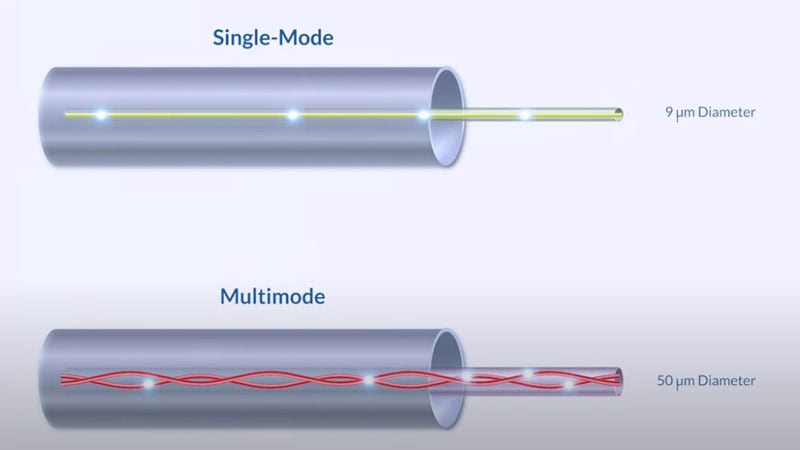
The core difference in fiber optic communication lies in how optical signals propagate. Single mode fiber allows light signals to travel in a single mode along a straight path through the fiber's center, while multimode fiber supports multiple light beams transmitting simultaneously at different angles through refraction within the fiber.
Single mode fiber optic cables have a core diameter of only 9 microns - equivalent to one-tenth the thickness of a human hair. Light beams experience almost no reflection within, propagating along a straight path. This design minimizes signal distortion, making it ideal for long-distance transmission. Multimode fiber optic cable has a core diameter of 50 microns or 62.5 microns. The thicker core means multiple light paths can work simultaneously. While this produces some modal dispersion, performance remains excellent in short-distance applications.
Key Differences Between Single Mode and Multimode Fiber
Core size is the most obvious difference between single mode and multimode fiber. The single mode fiber core size of 9 microns demands extremely high precision for light sources and connectors, while the multimode optical fiber 50/62.5 micron core provides stronger "light gathering capability," reducing requirements for splicing precision. This is why multimode fiber is more popular in environments like data centers that require frequent patch cord changes.
Regarding light sources and wavelengths, single mode fiber wavelengths typically use 1310nm or 1550nm laser sources, a combination that provides greater transmission distances. Multimode fiber uses 850nm or 1300nm wavelengths, paired with LED or VCSEL light sources. VCSEL manufacturing costs are far lower than lasers, which is the main reason multimode systems have relatively lower initial investment costs.
Dispersion is a key factor affecting transmission performance. In multimode fiber optics, light beams traveling different paths arrive at the receiving end at different times. This modal dispersion causes signal distortion, limiting transmission distance. Generally, multimode fiber performance degrades noticeably beyond 300-500 meters. Single mode optical fiber avoids modal dispersion issues due to having only a single light path, easily achieving transmission distances of several kilometers or even tens of kilometers.
Transmission Distance and Speed
Different grades of fiber show significant distance variations at various speeds. Single mode OS2 fiber can stably support 10-kilometer transmission distances across all speed grades from 1Gb to 100Gb. This consistency makes it the first choice for long-distance applications.
Multimode fiber performance is closely related to speed. In 1Gb Ethernet applications, all grades of multimode fiber from OM1 to OM5 can support 550-meter distances. However, when speed increases to 10Gb, OM1 and OM2 can no longer meet requirements - only OM3 and OM4 can support 300 meters and 400 meters respectively. In high-speed applications above 25Gb, multimode fiber distance is further reduced. OM3 can only support 70-100 meters, OM4 can reach 100-150 meters, while the latest OM5 can support 400 meters in 100Gb applications.
Although multimode fiber range is limited, in short-distance scenarios like data center interiors, 300-400 meter distances are completely sufficient. For campus networks requiring cross-building connections or longer distances, single mode fiber is the only choice.
|
Ethernet Standard |
OS2 (Single Mode) |
OM1 (Multimode) |
OM2 (Multimode) |
OM3 (Multimode) |
OM4 (Multimode) |
OM5 (Multimode) |
|
Fast Ethernet 100BASE-FX |
/ |
2000m |
2000m |
2000m |
2000m |
/ |
|
1Gb Ethernet 1000BASE-SX |
5000m |
275m |
550m |
550m |
550m |
550m |
|
1Gb Ethernet 1000BASE-LX |
5000m |
550m (requires mode conditioning patch cord) |
||||
|
10Gb Base SE-SR |
10km |
/ |
/ |
300m |
400m |
300m |
|
25Gb Base SR-S |
/ |
/ |
/ |
70m |
100m |
100m |
|
40Gb Base SR4 |
/ |
/ |
/ |
100m |
150m |
400m |
Cost Analysis
When discussing costs, many people first think of the cable price itself. In reality, single mode cables are usually 20-30% cheaper than high-grade multimode fiber optic cables (such as OM4) due to mature manufacturing processes. The real cost difference lies in optical modules.
Taking 1Gb speed as an example, the price difference between single mode and multimode SFP modules is minimal, at approximately $10 and $9 respectively. However, as speed increases, gaps begin to appear. 10Gb single mode SFP+ modules cost about $27, while multimode versions only need $20. For 100Gb QSFP28, single mode modules cost as high as $499, while multimode versions are only $99 - a $400 difference.
From a cost perspective, future upgrade possibilities must be considered. If choosing multimode fiber, you may experience upgrading from OM1 to OM3, then to OM4, with each upgrade requiring new cabling and significantly increased labor costs. Choosing single mode fiber allows one-time deployment of OS2, with subsequent speed increases requiring only optical module upgrades without replacing the physical layer.
For short-term projects or budget-limited scenarios, multimode fiber's low module cost advantage is obvious. However, for long-term construction planning, although single mode fiber has higher initial optical module investment, it avoids repeated construction and is more economical in the long run.

Compatibility
Single mode and multimode fiber absolutely cannot be mixed - this is an iron rule in network engineering. The reason lies in the enormous difference in core size. When a 9-micron core single mode fiber connects to a 50-micron core multimode fiber, it produces 10-20dB optical loss, enough to cause complete link failure. Conversely, multimode fiber connecting to single mode fiber will also fail to focus light beams properly due to numerical aperture mismatch.
In actual installation, you can distinguish by jacket color. According to TIA-598C standards, single mode fiber color is yellow jacket, while multimode fiber uses orange or aqua jackets. On distribution frames in equipment rooms, fiber types should be clearly labeled and physically isolated to prevent mis-insertion.
However, special cases exist. Using mode conditioning patch cords, 1000BASE-LX single mode SFP modules can work on multimode fiber. Additionally, through fiber media converters, bridging between single mode and multimode network segments is possible, but this adds extra equipment and failure points. Generally, these workaround solutions are not recommended.
How to Choose?
When choosing between single mode or multimode fiber, the most important criterion is transmission distance. If your application scenario transmission distance exceeds 1 kilometer, single mode fiber is the only choice, including campus networks, metropolitan area networks, and similar scenarios.
For short-distance applications like data center interiors and enterprise office floors, if transmission distance is within 300 meters, multimode fiber is the more economical choice. OM3 or OM4 multimode fiber paired with VCSEL optical modules can provide 300-400 meter transmission distances at 10Gb speeds, completely meeting most equipment room needs. Moreover, multimode optical modules are cheaper, significantly reducing costs in high-density cabling.
For 5G network fronthaul sections, due to the need for low-latency transmission of 25Gb eCPRI signals with transmission distances typically spanning several kilometers, single mode fiber is the standard configuration. In enterprise networks, using multimode fiber for floor access and single mode fiber for inter-building backbone is a common and economical hybrid deployment approach.
FAQ
LC, SC, MPO/MTP - how to choose?
1G/10G single-core bidirectional: Common LC-LC (most prevalent)
40G/100G SR4 (parallel multimode): Commonly use MPO/MTP
100G LR4 (single mode WDM): Commonly use LC
Which is better - single mode or multimode fiber?
Single mode fiber and multimode fiber each have advantages in cost and applications. Simply choose the most suitable one based on your application requirements.
Can multimode use single mode modules? Can single mode use multimode modules?
Generally cannot be mixed:
SR (multimode) modules: Require OM fiber (850nm), typically don't work to specification on OS2
LR/ER (single mode) modules: Require OS2 (1310/1550nm), may experience loss/dispersion/reflection causing instability or non-compliance on OM fiber
What is fiber optic glass, and why is it preferred over plastic for long-distance data transmission?
Fiber optic glass is made from ultra-pure, flexible silica fibers engineered to carry light through total internal reflection. It serves as a core material in modern telecommunications, medical imaging, and sensing systems. Compared with ordinary glass, fiber optic glass delivers much lower signal loss across long distances. It also outperforms plastic in high-speed, long-range data transmission, making it a preferred choice for advanced communication networks.