






When you look at fiber optic cables, you find several specialized materials working together. The core often uses ultra-pure glass or plastic. Silica provides excellent light transmission, while plastic offers flexibility and lower cost. Here is a quick comparison:
Material | Description |
|---|---|
Silica | Delivers high light transmission. |
Plastic | Adds flexibility and affordability. |
Polymer coatings, aramid yarn, and jackets like polyethylene or PVC add strength and shield the fiber from damage. Knowing these materials helps you choose cables that fit your environment and performance needs.
Key Takeaways
- Fiber optic cables use glass or plastic cores to transmit data. Glass cores are best for long distances and high speeds, while plastic cores are ideal for short-range applications.
- Cladding materials, either glass or plastic, guide light through the core. Glass cladding offers superior light containment, making it suitable for high-performance networks.
- Coatings and buffers protect the fiber from damage. Choose coatings based on your environment to ensure durability and reliability.
- Strength members like aramid yarn provide mechanical protection. They help cables withstand stress during installation and operation.
- Selecting the right outer jacket material is crucial. Use polyethylene for outdoor cables and PVC or LSZH for indoor installations to ensure safety and performance.
Core Materials

Fiber optic cables rely on the core to transmit data efficiently. You will find two main types of core materials: glass and plastic. Each material offers unique optical properties and performance benefits. Your choice of core material can impact the speed, distance, and reliability of your network.
Glass Core
Glass forms the backbone of most fiber optic cables. Manufacturers use ultra-pure silica glass because it delivers outstanding optical transmission. You benefit from minimal signal loss, which means data can travel over long distances without significant degradation. The low index of refraction in glass allows light to move through the Fiber optic cable with very little attenuation. This property makes glass ideal for high-bandwidth applications, such as internet backbone connections and large-scale data centers.
Tip: If you need to support long-distance data transmission or high-speed network infrastructure, select fiber optic cables with a glass core.
Glass fiber excels in environments where you require reliability and speed. It operates across a wide range of wavelengths, supporting advanced Fiber optic cable technology. You can use glass fiber cable in extreme temperatures, from -40°F to 900°F, making it suitable for outdoor installations and industrial settings.
Here is a comparison of attenuation rates and effective ranges:
Fiber Type | Attenuation Rate | Effective Range |
|---|---|---|
Glass Optical Fiber | ~0.2 dB/km | Long distances (km to hundreds of km) |
Plastic Optical Fiber | >1 dB/m | Short distances (<100 meters) |
Glass Fiber optic cable offers several advantages and disadvantages:
Advantages of Glass Optical Fiber | Disadvantages of Glass Optical Fiber |
|---|---|
Operates in extreme temperatures | Fragile: can break if bent or stressed |
Excellent transmission for long distances | Higher installation costs |
Lightweight and thin | Requires special equipment for splicing |
Plastic Core
Plastic Fiber optic cable provides a flexible and cost-effective alternative for short-range applications. You will find plastic fiber in home networks, automotive systems, and consumer electronics. The core uses materials like PMMA (polymethyl methacrylate), which offer good flexibility and ease of installation. Plastic fiber resists stress and is lightweight, making it easier for you to handle during setup.
Note: Choose plastic Fiber optic cable optic cables for simple installations where you do not need long-distance transmission or extreme durability.
Plastic Fiber optic cable has higher attenuation and dispersion than glass, which limits its use to short distances. It is sensitive to temperature changes and can be flammable, so you should avoid using it in harsh environments. However, plastic Fiber optic cable remains immune to electrical noise and provides ruggedness for everyday use.
Here is a summary of the main advantages and disadvantages:
Advantages of Plastic Fiber optic cable | Disadvantages of Plastic Fiber optic cable |
|---|---|
Lower costs | High attenuation and dispersion |
Flexibility | Temperature sensitivity |
Immunity to noise | Lower quality |
Ruggedness and easy installation | Flammability |
Lightweight | |
Stress resistance |
When you compare glass and plastic cores, consider your specific needs. If you require high bandwidth and long-distance data transmission, glass fiber is the best choice. For short-range, cost-sensitive projects, plastic fiber offers convenience and flexibility. Your selection will influence the performance and durability of your fiber optic cables.
📊 Quick Comparison:
- Glass Fiber optic cable optic cable: Best for high-speed, long-distance network applications.
- Plastic Fiber optic cable: Ideal for short-range, flexible, and budget-friendly installations.
Annotation: Data and technical details referenced from leading fiber optic technology sources and industry standards.
Cladding Materials

The cladding in fiber optic cables plays a critical role in guiding light through the core and ensuring efficient data transmission. You will find two main types of cladding materials: glass and plastic. Each type offers distinct advantages for different environments and applications.
Glass Cladding
Manufacturers often use highly purified silica for glass cladding. This material surrounds the fiber core and creates a lower refractive index than the core itself. The difference in refractive index allows total internal reflection, which keeps light confined within the core and prevents signal loss. You benefit from improved data transmission and reduced attenuation, especially in high-performance optic cables.
Type of Glass | Reason for Use |
|---|---|
Highly Purified Silica | Improves light transmission and reduces attenuation due to surface irregularities. |
Lower refractive index than the core allows for total internal reflection, confining light to the core. |
Fluoride-doped silica enhances the effectiveness of glass cladding. This specialized material further lowers the refractive index, which increases the containment of light and minimizes signal leakage. You can rely on fluoride-doped silica for demanding applications, such as long-distance data transmission and high-speed networks. Glass cladding withstands harsh conditions and maintains stable performance over time.
💡 Tip: Choose fiber optic cables with glass cladding for environments that require maximum data integrity and minimal signal loss.
Effectiveness of Glass Cladding
Cladding Material | Light Containment | Attenuation | Typical Application |
|---|---|---|---|
Fluoride-doped Silica | Excellent | Very Low | Telecom, backbone networks |
Standard Silica | Very Good | Low | Enterprise, industrial |
Glass cladding provides superior containment of light, which ensures reliable transmission of data over long distances. You will notice consistent performance in both indoor and outdoor installations.
Plastic Cladding
Plastic cladding offers a flexible and cost-effective alternative for certain fiber applications. You will find plastic cladding in specialty or budget-sensitive projects. This material surrounds the fiber core and provides adequate light containment for short-range data transmission.
Plastic cladding excels in environments where vibration resistance and flexibility matter. You can use plastic-clad fiber in automotive lighting, industrial illumination, and decorative installations. The lightweight nature of plastic cladding makes it easy to handle and install, especially in spaces with frequent movement or unstable conditions.
- Plastic fibers are preferred for illumination and decorative applications, such as backlighting and trim lighting.
- Their flexibility and vibration resistance make them ideal for automotive and industrial lighting purposes.
- Plastic optical fibers are lighter in weight and can withstand vibration and unstable environments.
- These characteristics also make them suitable for illumination and decorative applications.
Comparison of Light Containment
Cladding Material | Light Containment | Attenuation | Typical Application |
|---|---|---|---|
Good | Moderate | Automotive, decorative | |
Glass (Silica) | Excellent | Low | Telecom, backbone networks |
Plastic cladding does not match the light containment or low attenuation of glass cladding. However, you gain flexibility and durability in environments where cables experience frequent movement or vibration. You should select plastic cladding for short-distance data transmission and applications where cost and ease of installation are priorities.
📌 Note: For high-speed or long-distance optic cable installations, glass cladding remains the preferred choice. For decorative, automotive, or industrial lighting, plastic cladding provides the best balance of performance and value.
You need to consider the specific requirements of your project before choosing between glass and plastic cladding. Glass cladding ensures optimal light containment and data transmission for demanding networks. Plastic cladding offers flexibility and resilience for specialized or cost-sensitive applications.
Annotation: Technical details and material comparisons referenced from leading fiber optic cable manufacturers and industry standards.
Coatings and Buffers

When you select fiber optic cables, you need to consider how coatings and buffers protect the delicate glass or plastic fiber inside. These layers play a crucial role in maintaining performance, durability, and reliability, especially in challenging environments.
Primary Coating
The primary coating is the first layer applied directly to the Fiber optic cable. This coating shields the fiber from micro-bending, stress corrosion, and scratches. You benefit from improved durability and longer service life, even when the cable faces mechanical stress or environmental hazards.
You will find several common materials used for primary coatings, each offering unique advantages:
- Acrylate Fiber Coating: Dual-layer design with a soft inner and hard outer layer. This structure suits standard telecom applications and provides flexibility and protection.
- High-Temperature Acrylate: Withstands steam and harsh conditions, making it ideal for industrial and military settings.
- Fluoroacrylate: Non-toxic and rugged, this coating enhances tensile strength and is often used in medical devices.
- Silicone Coating: Soft and resistant to water vapor and chemicals. You should use this when chemical exposure is a concern, but it requires an additional buffer for full protection.
- Polyimide: Delivers excellent thermal stability, tolerating temperatures up to 450°C for short periods. This makes it suitable for high-temperature environments.
- Carbon Coating: Extends the Fiber optic cable's lifetime in high-stress applications.
- Polyetheretherketone (PEEK) and Polybutylene Terephthalate (PBT): Offer high chemical and abrasion resistance, often used in aerospace and industrial applications.
- Polypropylene (PP): An alternative to PVC, emits less smoke and no toxic halogens.
These coatings typically have a refractive index between 1.47 and 1.55, which helps maintain optimal light transmission. Most coatings operate in temperatures from -20°C to +130°C, but specialized types can handle even harsher conditions. You can easily strip these coatings for maintenance, and they resist delamination, ensuring the Fiber optic cable remains protected over time.
🛡️ Tip: For environments with frequent mechanical stress or temperature extremes, choose a coating material that matches your specific needs.
Buffer Layer
The buffer layer surrounds the primary coating and adds another level of defense. This layer increases mechanical strength and shields the fiber from moisture, physical impact, and environmental hazards. In real-world scenarios, the buffer layer prevents damage during installation and daily use, especially in outdoor or industrial settings.
Buffer Layer Function | Benefit to You |
|---|---|
Adds mechanical strength | Reduces risk of breakage |
Shields from moisture | Prevents water damage and corrosion |
Absorbs physical stress | Maintains signal quality and reliability |
You will notice that buffer layers come in tight or loose tube designs. Tight buffers offer flexibility and are easy to handle for indoor installations. Loose tube buffers provide extra protection against water and temperature changes, making them ideal for outdoor or underground applications.
When you compare coatings and buffer layers, you see that both are essential for protecting the fiber and ensuring long-term performance. The right combination of materials helps you achieve reliable data transmission, even in demanding environments.
Annotation: Technical details and material comparisons referenced from leading fiber optic cable manufacturers and industry standards.
Strength Members in Fiber Optic Cables
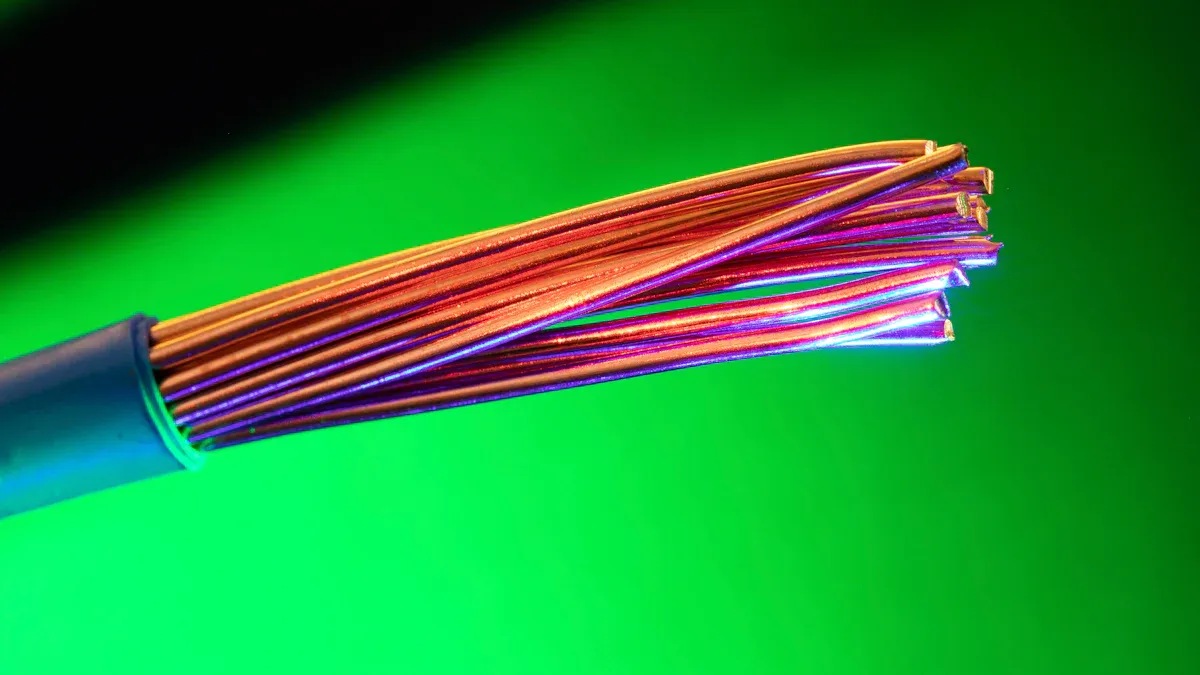
Fiber optic cables rely on strength members to protect the delicate Fiber optic cable inside and ensure reliable data transmission. These components help the cable withstand pulling, bending, and environmental stress during installation and operation. You will find that the choice of strength member directly affects the cable's durability, weight, and performance in different environments.
Aramid Yarn
Aramid yarn, often known by the brand name Kevlar, stands out as a leading strength member in fiber optic cables. You benefit from its exceptional tensile strength, which is five times greater than steel. This high modulus material allows cables to endure significant mechanical stress without breaking. Aramid yarn's low density keeps the cable lightweight, making it ideal for aerial installations or environments where minimizing weight and diameter is crucial.
You can trust aramid yarn to reinforce cables against external forces, such as pulling during installation or vibration in active environments. Its excellent dielectric properties mean it does not conduct electricity, so you avoid signal loss even in areas with high electromagnetic interference. Aramid yarn also resists high temperatures and chemicals, which helps maintain cable performance in extreme conditions. When you need a cable that combines strength, flexibility, and protection for the Fiber optic cable, aramid yarn offers a reliable solution.
💡 Tip: Choose cables with aramid yarn for installations that demand high durability, lightweight construction, and resistance to harsh environments.
Fiberglass and Steel
Manufacturers also use fiberglass rods and steel wires as strength members in fiber optic cables. Each material brings unique advantages for specific applications.
Material | Mechanical Protection Capability |
|---|---|
Steel Wire | Provides additional mechanical support, especially in heavy load or harsh conditions. |
Fiberglass Rods | Offers rigidity and support, particularly in armored cables designed for rugged environments. |
Steel wires deliver robust mechanical protection, making them suitable for cables exposed to heavy loads or direct burial. You might select steel-reinforced cables for outdoor or industrial settings where maximum strength is essential. However, steel adds weight and can conduct electricity, which may not suit all installations.
Fiberglass rods provide rigidity and support without adding much weight. You will find fiberglass in armored cables used in rugged or high-vibration environments. Fiberglass does not conduct electricity, so it helps maintain signal integrity in areas with electromagnetic interference.
When you compare these strength members, consider your installation environment. Aramid yarn excels in lightweight, flexible cables for indoor or aerial use. Steel and fiberglass offer superior mechanical protection for outdoor, industrial, or armored applications. By understanding these options, you can choose the right cable to protect your Fiber optic cable and ensure reliable light transmission and data performance.
Outer Jacket Materials

The outer jacket of fiber optic cables protects the inner components and ensures reliable data transmission in various environments. You will find several jacket materials, each designed for specific conditions and safety standards. Common options include:
- Polyethylene (PE)
- Polyvinyl Chloride (PVC)
- Polyvinylidene Fluoride (PVDF)
- Low Smoke Zero Halogen (LSZH)
- Plenum and Riser-rated jackets
Polyethylene
Polyethylene stands out as the standard jacket for outdoor fiber optic cables. You benefit from its moisture and weather resistance, which keeps the Fiber optic cable safe from rain, sunlight, and temperature changes. Polyethylene also offers good electrical performance across a wide temperature range and resists abrasion. These properties make it ideal for outdoor installations, such as direct burial or aerial cables, where you need protection against harsh elements.
PVC and Other Jackets
PVC is the preferred choice for indoor cables. You will appreciate its affordability and flexibility during installation. PVC meets UL-rated fire safety standards and provides moderate chemical resistance. However, it can become brittle in cold temperatures and does not offer the same abrasion resistance as polyethylene. For critical backbone cables, PVDF delivers superior flame resistance. LSZH jackets are suitable for both indoor and outdoor use, especially in areas with poor ventilation, because they emit minimal smoke and no toxic halogens during a fire.
Here is a comparison of key jacket materials:
Material | Fire Resistance | Flexibility | Abrasion Resistance | Typical Use |
|---|---|---|---|---|
Polyethylene (PE) | Moderate | Good | High | Outdoor, direct burial |
Moderate | Good (indoors) | Moderate | Indoor, riser spaces | |
High | N/A | High | Backbone, critical areas | |
LSZH | High | N/A | Moderate | Indoor/outdoor, plenum |
💡 Tip: For indoor spaces, choose PVC or LSZH jackets. For outdoor or underground installations, select polyethylene for greater protection.
Indoor vs. Outdoor Variations
You must match the jacket material to your installation environment. Indoor cables require flexibility and fire safety. PVC and LSZH jackets meet these needs, with LSZH offering extra safety in poorly ventilated spaces. Plenum-rated jackets provide the highest fire resistance and minimal smoke, making them essential for air-handling spaces. Riser-rated jackets suit vertical runs within buildings but do not meet plenum standards.
Outdoor cables face UV exposure, moisture, and temperature extremes. Polyethylene jackets protect against these hazards, ensuring your Fiber optic cable maintains performance and greater bandwidth even in tough conditions. You should avoid using indoor-rated jackets outdoors, as they lack the necessary weather resistance.
- Indoor cables: Flexible, fire-rated, easy to install in tight spaces.
- Outdoor cables: Durable, weather-resistant, designed for harsh environments.
- Plenum spaces: Require jackets with the highest fire and smoke safety.
- Riser spaces: Need moderate fire resistance for vertical pathways.
Selecting the right jacket material ensures your optic cables deliver reliable data and greater bandwidth, no matter where you install them.
You rely on fiber optic cables built from specialized materials-glass or plastic cores for transmitting light signals, cladding for guiding data transfer, coatings and buffers for protection, and strength members for durability. Choosing the right fiber cable depends on factors like distance, bandwidth, and environmental conditions. High-quality optical fibers and advanced fiber optic technology ensure reliable and accurate fiber optic cables for high-speed data. Material selection impacts performance, lifespan, and safety. Always evaluate your application needs to achieve the best results from your cables.
Remember: Proper material choices help you avoid failures and maximize the value of your fiber optic cable investment.
Key Considerations | Why They Matter |
|---|---|
Cable construction | Affects reliability and installation |
Environmental conditions | Influence durability and performance |
Regulatory standards | Ensure safety and compliance |
FAQ
Why do fiber optic cables use glass instead of copper for data transmission?
You use glass in fiber optic cable optic cables because it allows light to carry data with minimal signal loss. Glass supports high-speed network connections over long distances. Copper cannot match the bandwidth or reliability needed for modern internet and network infrastructure.
Why should you choose plastic fiber optic cables for home internet networks?
Plastic fiber optic cable optic cables offer flexibility and easy installation. You benefit from their lightweight design and lower cost. For short-range internet connections in your home network, plastic cables provide reliable data transfer without the complexity of glass fiber.
Why does the outer jacket material matter for your network installation?
The outer jacket protects your cables from moisture, chemicals, and physical damage. You need to select the right jacket for your network environment. For outdoor internet installations, polyethylene resists weather. For indoor network spaces, PVC or LSZH ensures fire safety and flexibility.
Why is cladding important for data integrity in fiber optic networks?
Cladding surrounds the core and keeps light signals inside. This design ensures your data travels efficiently through the network. Without proper cladding, you risk signal loss and reduced data transmission quality, which can impact your internet speed and reliability.
Why do you need strength members in fiber optic cables for internet networks?
Strength members like aramid yarn or steel protect the delicate fiber optic cable during installation and use. You avoid cable breaks and maintain stable data transmission. For demanding network environments, strength members ensure your internet connection stays reliable and secure.