






Single-mode and multimode fiber are the two main optical-fiber transmission media used in Ethernet, data centers, access networks, campus backbones, industrial communications, and many other systems. The difference is not simply that one is "for outdoors" and the other is "for indoors." The correct choice depends on the required data rate, link distance, transceiver type, installed fiber, optical loss budget, and future upgrade plan.
For short links, multimode fiber can provide a practical and cost-efficient solution when paired with short-reach optics. For longer links or networks that need greater reach and upgrade flexibility, single-mode fiber is usually the stronger choice. However, neither fiber type has one universal maximum distance. The supported reach is determined by the complete optical channel, not by the cable alone.
What Is Multimode Fiber?
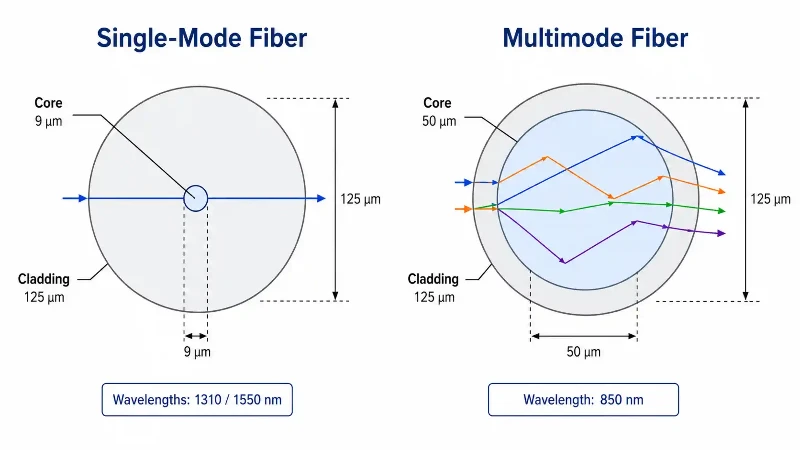
Multimode fiber has a relatively large core that supports multiple propagation modes. Because these modes do not all arrive at the receiver at exactly the same time, modal dispersion limits bandwidth as transmission distance increases.
Common graded-index multimode fiber categories include OM1, OM2, OM3, OM4, and OM5. OM1 is commonly associated with a 62.5/125 µm geometry, while OM2 through OM5 use a 50/125 µm geometry. OM3 and OM4 are laser-optimized fibers widely used with 850 nm short-reach Ethernet optics, and OM5 is a wideband 50 µm multimode grade intended for systems that use multiple short wavelengths.
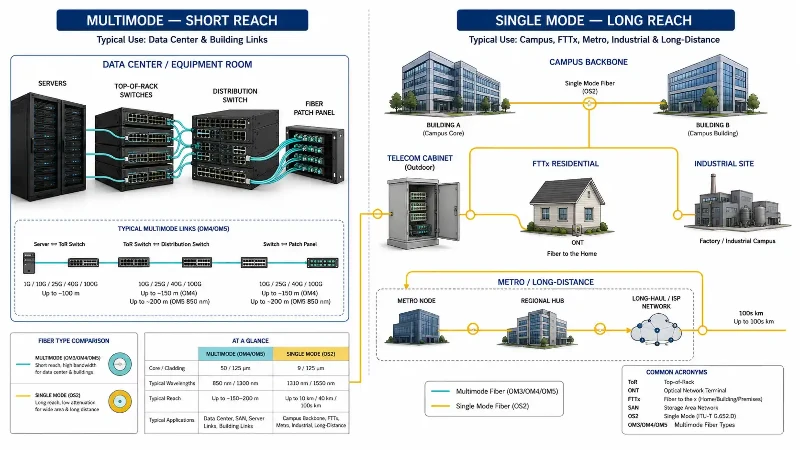
Multimode fiber is commonly selected for short equipment-room, building, and data-center links where the installed distance is within the reach of the selected optical modules. Its larger core also makes coupling light into the fiber less demanding than with single-mode systems, although connector cleanliness, polarity, loss, and transceiver compatibility still matter.
What Is Single-Mode Fiber?
Single-mode fiber has a much smaller core and is designed to support the fundamental propagation mode under its intended operating conditions. It is often described in introductory material as having an approximately 9 µm core, but engineering specifications for single-mode fiber also rely heavily on mode field diameter, which varies with fiber design and wavelength.
Because single-mode fiber avoids the modal dispersion that limits multimode links, it is suitable for much longer transmission distances. Common operating wavelengths include 1310 nm and 1550 nm, depending on the network and optical interface.
ITU-T G.652 is the basic reference family for standard single-mode optical fiber and cable. The current ITU-T G.652 Recommendation defines the geometrical, mechanical, and transmission characteristics of this fiber class. G.652.D fiber is widely used in access, metro, backbone, and general telecommunications infrastructure.
For access networks and installations where tighter bends are expected, G.657 fiber provides improved bending-loss performance compared with G.652. The current ITU-T G.657 Recommendation covers bending-loss-insensitive single-mode fiber, including category A fibers that are designed for compatibility with conventional G.652 applications. In dense termination points, distribution boxes, and indoor access routes, options such as G.657.A2 bend-insensitive fiber can be useful when the specified bending requirements justify it.
Single Mode vs Multimode Fiber: Key Differences
| Factor | Single-Mode Fiber | Multimode Fiber |
|---|---|---|
| Propagation | Designed to support the fundamental mode | Supports multiple propagation modes |
| Typical size description | Approximately 9 µm core is a common simplified description; mode field diameter is an important engineering parameter | 50/125 µm for OM2-OM5; 62.5/125 µm is common for OM1 |
| Common wavelengths | 1310 nm and 1550 nm, depending on the interface | 850 nm is common for modern short-reach Ethernet; other wavelengths depend on the system |
| Main dispersion concern | Chromatic and polarization-mode dispersion become relevant in higher-rate or longer systems | Modal dispersion is a major reach limitation |
| Typical reach | From short links to tens of kilometers or more, depending on optics and link design | Usually short reach, with actual distance determined by fiber grade, data rate, and transceiver specification |
| Typical optics | Laser-based LR, ER, ZR, coherent, PON, and other application-specific interfaces | Short-reach optics, commonly using 850 nm VCSEL sources for Ethernet |
| Common applications | FTTx, campus backbone, metro, telecom, long-reach industrial links, utility communications, data-center interconnect | Data-center internal links, equipment rooms, building backbones, short enterprise links |
| Upgrade flexibility | Generally stronger where future reach or higher-capacity optical systems may be required | Good for defined short-reach architectures, but upgrade reach may be constrained by the installed OM grade |
How Far Can Single-Mode and Multimode Fiber Transmit?
There is no technically correct answer such as "multimode works up to 550 meters" or "single-mode works for 100 kilometers." Fiber type is only one part of the link. The actual supported distance depends on the Ethernet or transport standard, transceiver launch power, receiver sensitivity, wavelength, fiber attenuation, modal or chromatic dispersion, connector loss, splice loss, and any design margin.

The following values are useful examples rather than universal cable limits:
| Optical Interface Example | Fiber | Example Reach | What It Shows |
|---|---|---|---|
| 1000BASE-SX | 50 µm multimode | Up to 550 m on legacy 50 µm MMF in Cisco's published specification; some laser-optimized 50 µm configurations are specified for longer reach | The often-quoted 550 m figure belongs to particular 1 GbE combinations, not all multimode links |
| 10GBASE-SR | OM3 multimode | Up to 300 m in Cisco's SFP+ specification | Higher data rates can reduce multimode reach |
| 10GBASE-SR | OM4 multimode | Up to 400 m in Cisco's SFP+ specification | Higher-bandwidth OM grades can extend supported short-reach links |
| 10GBASE-LR | G.652 single-mode | 10 km in Cisco's SFP+ specification | Single-mode supports substantially longer Ethernet links with long-reach optics |
| 10GBASE-ER | G.652 single-mode | Up to 40 km in Cisco's SFP+ specification | The transceiver class, not the fiber alone, sets the supported system reach |
Cisco's Gigabit Ethernet SFP specifications and 10GBASE SFP+ specifications illustrate why fiber-selection tables should always name both the optical interface and the fiber grade.
For an actual project, use the equipment manufacturer's transceiver specification as the governing reach value and verify the complete channel loss. A cable that is physically long enough is not automatically an optical link that meets the required power and dispersion budget.
Is Single-Mode Fiber Faster Than Multimode Fiber?
Fiber itself should not be described as having one fixed "speed." Both single-mode and multimode cabling can carry high data rates when matched to the correct optics and standards. The practical difference is that multimode bandwidth is more strongly constrained by modal dispersion over distance, while single-mode fiber provides a transmission medium that is better suited to long reach and very high-capacity optical systems.
For a 10 GbE link inside one equipment room, OM3 or OM4 may be entirely appropriate. For a multi-kilometer 10 GbE campus backbone, 10GBASE-LR over single-mode fiber is the more relevant architecture. The data rate is the same; the optical system and supported reach are different.
Which Costs Less: Single-Mode or Multimode?
Multimode has traditionally been attractive for short-reach networks because compatible short-reach optics can be economical. However, it is risky to select fiber only by assuming "multimode is cheaper." Module pricing changes over time, different switch platforms support different optics, and the installed cabling may remain in service much longer than the transceivers.
A better comparison is total installed cost:
- fiber cable and termination cost;
- transceiver cost at both ends;
- patch cords, adapters, and panels;
- testing and certification;
- number of intermediate switches or media-conversion points;
- future migration to higher data rates;
- cost of replacing an installed backbone later.
For a fixed, short internal link, multimode can still be a sensible cost choice. For backbone infrastructure expected to serve several equipment generations, single-mode may reduce the risk of a future reach limitation even if the original optical modules are not the lowest-cost option.
Correct Application Scenarios
1. Data Centers and Equipment Rooms
Multimode OM3 or OM4 is commonly suitable for short-reach server, switch, and patch-panel links when the specified Ethernet interface supports the required distance. OM5 may be considered where the selected optical architecture specifically benefits from wideband multimode operation.
Single-mode is appropriate where the data center requires longer internal reach, campus connectivity, data-center interconnect, or an upgrade strategy built around single-mode optics. For higher-density architectures, the fiber type must also be coordinated with connector format, lane count, polarity, and the selected high-speed optical transceiver. For a broader view of topology and cabling decisions, see the site's fiber-optic data-center guidance.
2. Office Buildings and Enterprise Networks
For short building links, multimode can be practical, especially where existing OM3 or OM4 infrastructure already matches the required optics. For building-to-building or campus backbone links, single-mode often offers more reach and a cleaner long-term upgrade path.
The cable construction must still match the installation environment. Fire rating, riser or plenum requirements, pulling strength, bend performance, and indoor/outdoor transition requirements are separate from the question of single-mode versus multimode. An indoor optical cable can contain either fiber type depending on the product design and network requirement.
3. FTTx and Broadband Access
Single-mode fiber is the standard choice for FTTx access because distribution and drop networks must cover much greater distances than typical room-level LAN links and may need passive optical splitting. G.652.D is common in general single-mode infrastructure, while G.657 fibers are particularly useful where access cables experience tighter routing and bending near customer premises or distribution points.
4. Metropolitan, Backbone, and Long-Distance Links
Single-mode fiber is the normal choice for metro, backbone, cross-campus, and long-distance transmission. However, saying that single-mode "automatically supports hundreds of kilometers" is incomplete. At these distances, system design must account for the selected wavelength, optical power budget, chromatic dispersion, amplifier architecture where applicable, splice and connector losses, and the exact transceiver or transport platform.
5. CCTV and Industrial Monitoring
For short security-camera aggregation links inside a building or local facility, multimode may work well if the Ethernet optics and distance are compatible. For distributed cameras across a large industrial site, highway, utility corridor, or municipal network, single-mode usually becomes more practical because of the longer reach between active nodes.
The selection should be based on the network topology and optical interface, not on the word "CCTV." A 100 m camera uplink and a 10 km monitoring backbone are different transmission problems even if both carry video.
6. Outdoor and Utility Communications
Outdoor installation does not automatically require single-mode fiber. "Outdoor" describes environmental and mechanical requirements such as UV exposure, moisture protection, tensile load, crush resistance, aerial span, duct installation, or direct burial. Both single-mode and multimode fibers can be incorporated into outdoor cable constructions.
Long outdoor backbone and utility links nevertheless tend to favor single-mode because distance requirements are usually greater. The cable construction should then be selected separately for the route, such as duct, underground, or aerial fiber-optic cable.
Can a Project Use Both Single-Mode and Multimode Fiber?
Yes, but the boundary must be designed correctly. A campus can use single-mode fiber for a long outdoor backbone and multimode fiber for short internal links. The important point is that the two media should normally meet at active network equipment that provides the correct optical interface for each segment.
Do not treat single-mode and multimode fibers as interchangeable strands that can simply be spliced together to create one transparent link. Their mode characteristics and associated transceivers are different. Directly mixing them can introduce severe coupling loss or unstable performance. If a design uses both media, document the conversion point, transceiver type, connector interface, and loss budget for each segment.
How to Choose Between Single-Mode and Multimode Fiber
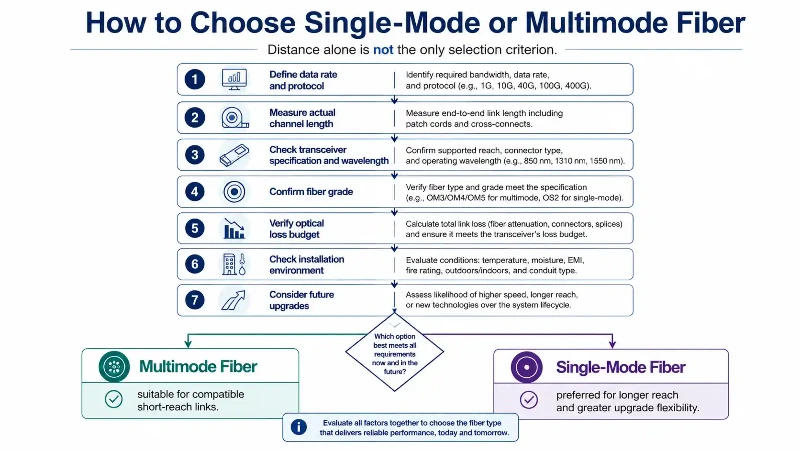
- Define the data rate and protocol. Start with the actual interface: 1 GbE, 10 GbE, 25 GbE, 40 GbE, 100 GbE, PON, Fibre Channel, or another transport system.
- Measure the real channel length. Include patching routes and reasonable installation margin rather than using straight-line building distance.
- Select the optical transceiver. Check the manufacturer's supported fiber type, wavelength, connector, and maximum channel reach.
- Confirm the installed or proposed fiber grade. For multimode, identify OM1, OM2, OM3, OM4, or OM5 rather than writing only "MMF." For single-mode, confirm the applicable fiber specification and cable design.
- Calculate the optical loss budget. Include fiber attenuation, connectors, splices, passive components, and design margin.
- Check the installation environment separately. Indoor fire rating, outdoor water blocking, aerial tensile load, duct dimensions, bend radius, and mechanical protection are cable-construction requirements, not transmission-mode rules.
- Consider the upgrade path. If the cable will remain installed through several generations of active equipment, compare future optics and reach before optimizing only for today's module price.
A Practical Selection Example
Consider a site with a 2.5 km link between two buildings and several short links of less than 100 m inside each equipment room. A reasonable architecture may use single-mode fiber and long-reach optics for the 2.5 km backbone, while existing OM3 or OM4 cabling can continue to serve compatible short-reach links inside the buildings.
This is not a recommendation to splice single-mode directly to multimode. Each fiber segment must terminate on equipment or a conversion point that uses optics designed for that segment. The example simply shows why a mixed campus can use both fiber types without treating them as one continuous optical medium.
FAQ
Can single-mode and multimode fiber be connected directly?
They should not normally be connected as if they were interchangeable parts of one optical channel. Single-mode and multimode systems use different propagation characteristics and typically different optical transceivers. Where both media are required, use active equipment, media conversion, or a specifically documented interface design.
Is single-mode fiber always better than multimode?
No. Single-mode provides much greater reach and strong long-term flexibility, but multimode remains a practical choice for many short-reach links. The better option is the one that meets the required interface, distance, budget, and upgrade plan with the lowest overall project risk.
Can multimode fiber run 1 km?
Sometimes, with specific low-rate or specially supported optical combinations, but 1 km is not a general multimode design rule. For example, Cisco documents some 1000BASE-SX operation over laser-optimized 50 µm multimode fiber at distances longer than the commonly quoted 550 m. Always verify the exact transceiver and fiber combination.
Is OM4 better than OM3?
OM4 provides higher specified modal bandwidth than OM3 and can support longer reach for some short-wave optical interfaces. That does not mean every project must use OM4; if an OM3 channel already meets the selected interface's distance specification and upgrade plan, it may remain adequate.
What is the difference between G.652.D and G.657 fiber?
Both are single-mode fiber families. G.652 defines conventional single-mode fiber characteristics, while G.657 is designed for improved bending-loss performance. G.657 category A fibers are intended to maintain compatibility with G.652-type applications while providing stronger bend performance for access and dense-routing environments.
Which fiber should I use for a data center?
For short internal links, OM3 or OM4 multimode is common when it matches the chosen short-reach optics. Single-mode is often preferred for longer data-center links, campus connections, data-center interconnect, or architectures that prioritize long-term reach flexibility. The transceiver roadmap should be reviewed before the cabling is finalized.
Which fiber is better for outdoor CCTV?
For long outdoor CCTV backbones, single-mode is usually the more practical transmission medium because of reach. For short local outdoor links, multimode can also work if the optical interface supports the distance. Separately, the cable itself must have an outdoor construction suitable for the route and environmental exposure.
Final Selection Rule
Do not choose fiber by a single shortcut such as "indoor equals multimode" or "outdoor equals single-mode." First define the data rate and optics, then verify the distance, fiber grade, loss budget, installation environment, and future upgrade requirement. In most short-reach equipment-room and data-center links, multimode remains a valid option. For FTTx, campus backbones, metro networks, and longer industrial or outdoor transmission, single-mode is usually the preferred foundation.