





What Is Single Mode Fiber?
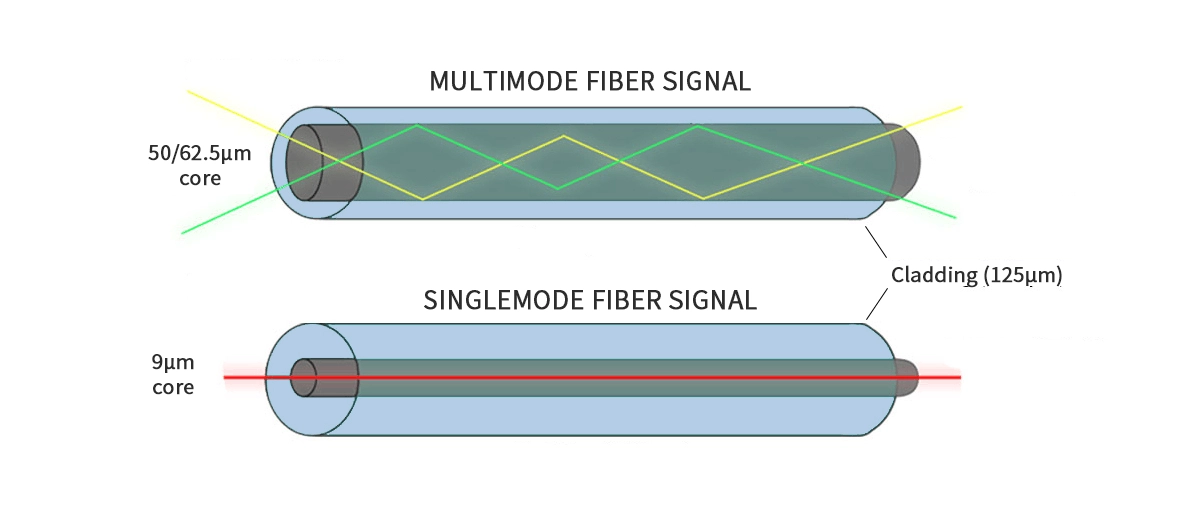
Single mode fiber has a very small core diameter of about 8–10 μm, which supports the transmission of only a single optical mode. To put it precisely, the single mode optical fiber core is normally 8–10 microns in diameter - far narrower than multimode variants. This design greatly reduces signal loss and enables extremely high bandwidth over long distances, typically ranging from 10 km to more than 100 km. Because it commonly works with laser-based light sources, SMF fiber optic cable is widely used in telecommunications, cable television systems, and other long-distance communication applications.
Singlemode fiber conforms to standards such as ITU-T G.652. Its ultra-narrow core forces light to travel only in the fundamental mode (HE₁₁), eliminating modal dispersion at its source - and that's the fundamental reason it can sustain high bandwidth and low loss over long distances, not merely a design trade-off.
In real-world network deployments, single mode fiber optic cable is commonly found in links ranging from 10 km to several hundred kilometers. Typical attenuation figures are approximately 0.35 dB/km at the 1310 nm window and 0.20 dB/km at the 1550 nm window. The low attenuation at 1550 nm makes it the medium of choice for long-haul transmission and DWDM (Dense Wavelength Division Multiplexing) systems - a single fiber can carry 80 or more wavelength channels simultaneously via WDM, with per-channel rates exceeding 100 Gbps. This is something multimode fiber simply cannot achieve.

How Single Mode Fiber Works
The core limitations of fiber optic transmission are dispersion and attenuation. The design of single mode fiber optics addresses both at a fundamental level.
Eliminating modal dispersion: In multimode fiber, different light paths (fiber optics modes) travel different path lengths, causing various parts of the same pulse to arrive at different times - a phenomenon known as modal dispersion. As distance increases, pulses broaden and usable bandwidth shrinks. Because the core of a single mode fiber is narrow enough to allow only the fundamental mode to propagate, modal dispersion is eliminated entirely.
Types of dispersion: Eliminating modal dispersion doesn't mean eliminating all dispersion. Two additional types matter in practice. The first is Chromatic Dispersion (CD), caused by the fact that light sources emit more than one wavelength. Standard single mode fiber (G.652) has zero dispersion near 1310 nm and approximately 17 ps/(nm·km) at 1550 nm. The second is Polarization Mode Dispersion (PMD), caused by geometric asymmetries in the fiber, which becomes a critical concern in high-speed (≥40 Gbps) long-distance links - particularly in older cable plants. Both can be managed through dispersion compensation modules (DCMs) or coherent receiver technology.
Low attenuation through wavelength selection: Single mode fiber typically works with laser light sources operating at two low-attenuation single mode fiber wavelengths - 1310 nm and 1550 nm - along with a 1625 nm maintenance window. These wavelengths avoid water-peak absorption, and combined with the fiber's inherently low scattering characteristics, they enable low signal loss over long distances.
Single Mode Fiber Types
Under ITU-T standards, single mode fiber comes in several subtypes, and choosing the right one matters:
G.652 (OS1/OS2): The most common standard single mode fiber type. Single mode fiber OS1 is designed for indoor use with a maximum attenuation of 1 dB/km; OS2 is for outdoor use with a maximum of 0.4 dB/km. The physical specs are identical - the difference lies primarily in installation quality and testing requirements.
G.653: Dispersion-Shifted Fiber (DSF), which moves the zero-dispersion point to 1550 nm. However, it causes Four-Wave Mixing (FWM) interference in DWDM systems and has largely been replaced by G.655.
G.655 (Non-Zero Dispersion-Shifted Fiber, NZ-DSF): Retains a small amount of dispersion at 1550 nm to suppress FWM while maintaining low attenuation - well suited for DWDM long-haul transmission.
G.657: A bend-insensitive single mode fiber with a minimum bend radius as low as 5 mm, specifically designed for in-building wiring and dense conduit environments.
By contrast, common multimode fiber types - OM3, OM4, and OM5 - have core diameters of 50 μm or 62.5 μm and are designed for short-reach high-speed Ethernet (e.g., 100GbE up to 100 m on OM4). Their application scenarios barely overlap with those of singlemode fiber.
Core Advantages of Single Mode Fiber
Low attenuation - especially at 1550 nm - is the foundation. It allows signals to travel farther without regeneration. On top of that, the absence of modal dispersion means pulse shapes remain clean after long-distance transmission, enabling higher data rates. Together, these two properties make single mode fiber the only viable medium for WDM/DWDM: high channel count, high data rate, and long single mode fiber distance - all at the same time. That combination represents the core value proposition of SMF fiber optic infrastructure.
Optical cable also outlasts transceivers by a wide margin. A G.652 cable installed in conduit or direct-buried is typically rated for a design life of over 25 years, while optical modules cycle through generations every few years as speeds increase. The bandwidth headroom of single mode fiber optic cable means that capacity can be upgraded simply by swapping transceivers - from 10G to 100G or even 400G - without touching the fiber. That's the practical economic argument for choosing singlemode fiber in campus backbone and data center interconnect deployments.
Single Mode vs. Multimode Fiber: How to Choose
The key decision factors are link distance and whether WDM expansion will be needed in the future.
For links under 300 meters with no near-term WDM requirement - such as intra-data-center connections or same-floor switch interconnects - OM3/OM4 multimode fiber paired with VCSEL sources has a lower upfront cost and is a reasonable choice. Beyond 300–500 meters, or for backbone links carrying aggregated traffic, single mode fiber's advantages start to outweigh the cost difference. Beyond 2 km, multimode fiber is largely impractical, and single mode fiber is the only realistic option.
On the cost side, the fiber cable itself isn't dramatically more expensive - the real gap is in the optics. A short-reach single mode fiber transceiver (e.g., 10GBASE-LR) typically costs several times more than a comparable multimode module (10GBASE-SR). That said, as coherent optics and silicon photonics become more mainstream, this gap is narrowing at higher port speeds. Multimode fiber's bandwidth isn't inherently low - OM4's effective modal bandwidth at 850 nm can reach 4,700 MHz·km - but that bandwidth drops off rapidly with distance. Single mode fiber has no such degradation mechanism, which is why "long distance + high speed" is a combination only single mode fiber optics can deliver.
Core size: The single mode core size is approximately 8–10 μm, while multimode fiber cores are 50 μm or 62.5 μm.
Light propagation: Single mode fiber transmits only one optical mode. Multimode fiber allows multiple light paths simultaneously.
Distance: Single mode fiber range spans from 10 km to over 100 km. Multimode fiber is primarily used for short-distance links.
Dispersion characteristics: Single mode fiber has significantly lower modal dispersion, which helps maintain signal integrity over longer distances.
Bandwidth vs. distance: Multimode may be sufficient at short distances, but when both distance and data rate increase, single mode fiber performs substantially better.
Key Applications of Single Mode Fiber
Telecom carrier backbone and metro transport networks (DWDM systems are built almost exclusively on single mode fiber)
Data center interconnect (DCI), especially 100G/400G links across campuses or cities
Enterprise campus inter-building cabling, typically spanning 500 m to several kilometers
Cable TV (HFC) fiber segments from headend to node
Backbone transmission for rail transit, power utilities, and industrial control networks
Direct fiber connections in 5G fronthaul deployments
FAQ
Q: Can Single Mode And Multimode Connectors Be Used Interchangeably?
A: The physical connector types - LC, SC, FC, and others - are compatible in form factor, meaning both fiber types can plug into the same connector interface. However, the fiber types themselves cannot be mixed. Mating single mode fiber to multimode fiber causes severe mode field mismatch loss due to the core diameter difference (8 μm vs. 50 μm), typically exceeding 10 dB. The link will not function properly.
Q: How Can You Quickly Identify Single Mode Vs. Multimode Cable By Appearance?
A: IEC 60304 provides recommended jacket color conventions: single mode fiber optic cable typically has a yellow jacket; multimode OM1/OM2 uses orange; OM3 uses aqua; OM4 uses violet; OM5 uses lime green. Connector boot colors follow similar conventions - blue boots generally indicate single mode fiber. These colors are guidelines, not mandatory standards. Different manufacturers may vary, so formal acceptance testing should rely on OTDR measurement and labeled documentation.
Q: Does Single Mode Fiber Support Bidirectional Transmission On A Single Cable?
A: Yes, in two ways. The most common deployment uses two fibers - one for transmit, one for receive. Alternatively, BiDi (bidirectional) technology transmits signals in both directions over a single fiber using different single mode fiber wavelengths - for example, one end transmits at 1310 nm and receives at 1550 nm, while the other end does the reverse. BiDi reduces fiber count, which is valuable when cable resources are limited (such as leased carrier conduit), but both ends must use matched-wavelength transceivers and cannot be mixed.
Q: Can You Plug A Single Mode Transceiver Into Existing Multimode Cable To Extend Reach?
A: No. A single mode fiber transceiver is designed with optical parameters - numerical aperture, mode field diameter, and source type - matched specifically to single mode fiber. Connecting a single mode laser transceiver to multimode fiber results in extremely poor coupling efficiency, and the multimode fiber will still excite multiple modes, preserving modal dispersion. None of the advantages of single mode fiber are gained.
Q: What Should You Watch For When Testing Single Mode Fiber With An OTDR?
A: Wavelength selection should match the actual operating wavelength. The 1310 nm wavelength is used to assess near-end link loss, while 1550 nm is better suited for detecting macro-bend losses - bending that appears negligible at 1310 nm can produce significantly higher attenuation at 1550 nm.
Q: What Connector Types Are Used With Single Mode Fiber?
A: Common options include: LC (compact, the standard for data center and enterprise networks, default for SFP/SFP+ modules), SC (square-body, common in older enterprise and telecom equipment, easy to handle but larger footprint), FC (threaded locking mechanism, mainly used in test equipment and vibration-sensitive industrial environments), and MTP/MPO (multi-fiber parallel connectors in 12- or 24-fiber configurations, used for high-density cabling and backbone interconnects).


