






You face critical choices when planning your enterprise network infrastructure. Multi mode fiber gives you reliable, high-speed data transmission for short-range connections, making it ideal for data center upgrades or campus network expansions. You need to understand fiber types to maximize performance and control costs. Many organizations choose fiber for traditional network upgrades, short distance interconnections, or industrial environments where stability and speed matter most. By considering factors such as cost-effectiveness and suitability for short-range applications, you make informed decisions that support your network's future growth.
Key Takeaways
- Multimode fiber is ideal for short-range, high-speed data transmission, making it perfect for data centers and campus networks.
- Understanding the different types of multimode fiber (OM1, OM2, OM3, OM4, OM5) helps you choose the right one for your network needs.
- Multimode fiber is more cost-effective than single-mode fiber, especially for short-distance applications, due to lower transceiver costs.
- Installation of multimode fiber is easier because of its larger core size, reducing the risk of errors and saving on labor costs.
- Modal dispersion can affect signal quality over long distances, so plan your network layout to stay within recommended limits.
- Regularly assess your network's performance and future needs to ensure your multimode fiber supports growth and technology changes.
- Use high-quality connectors like LC and SC to maintain signal integrity and avoid performance issues in your network.
- Multimode fiber supports high-speed applications, making it a reliable choice for modern business operations and data sharing.

Multi Mode Fiber Principles

Definition
You encounter multimode fiber as a core component in modern enterprise networks. Multimode fiber refers to optical fiber designed to carry multiple light modes simultaneously. Industry standards, such as ISO/IEC 11801, categorize multimode fibers by OM (optical mode) designations. These include OM1, OM2, OM3, OM4, and OM5, each with specific transmission characteristics and recommended applications. You rely on these standards to ensure compatibility and performance across your network infrastructure.
How It Works
Multimode fiber operates on the principle of transmitting several light paths, or modes, through a larger core diameter. You benefit from the following physical properties:
- Multimode fiber features a core diameter of 50 or 62.5 microns, which supports multiple simultaneous light transmission paths.
- The process of total internal reflection keeps light signals contained within the core, bouncing them off the cladding boundary.
- Modal dispersion occurs as light travels different paths, causing signal spread and limiting transmission distance and speed.
- You use multimode fiber for short-range, high-bandwidth applications because its design enables efficient light transmission over moderate distances. Modal dispersion remains a key factor in determining the maximum speed and reach of your network links.
Tip: When planning your network, consider how modal dispersion impacts signal quality and transmission distance. Multimode fiber excels in environments where you need reliable, high-speed light transmission over short to medium distances.
Comparison with Single Mode Fiber
You must compare multimode fiber with single-mode fiber to select the best solution for your enterprise network. The following tables highlight the differences in transmission performance and construction:
|
Fiber Type |
Maximum Distance |
Maximum Speed |
|---|---|---|
|
Single-Mode |
Up to 140 km |
Up to 100 Gbps and beyond |
|
Multimode |
Up to 2 km |
10 Gbps to 400 Gbps |
|
Attribute |
Single-Mode Fiber (SMF) |
Multi-Mode Fiber (MMF) |
|---|---|---|
|
Core Diameter |
5 µm to 10 µm |
50 µm to 65 µm |
|
Light Source |
Edge-emitting laser |
LED or VCSEL |
|
Modal Dispersion |
Minimal |
High |
|
Distance Capability |
Up to 100 km |
Typically <2 km |
|
Installation Complexity |
High (requires precision) |
Lower (easier alignment) |
|
Typical Applications |
Long-haul communication systems in aerospace, defense, and satellite networks |
Rugged, short-range links in industrial, vehicle, and tactical environments |
Single-mode fiber uses a narrow core diameter, supporting only one light mode. You achieve minimal modal dispersion and long-distance transmission, but installation requires precision and higher costs. Multimode fiber, with its larger core, supports multiple light transmission paths, making it ideal for short-range, cost-effective deployments. You find multimode fiber easier to install and maintain, especially in environments where you prioritize speed and reliability over extreme distance.
- Single-mode fiber advantages: Higher bandwidth, longer transmission distance, lower attenuation.
- Single-mode fiber disadvantages: Higher cost, complex installation.
- Multimode fiber advantages: Lower cost, easier installation, optimal for short-range transmission.
- Multimode fiber disadvantages: Lower bandwidth, higher signal dispersion over long distances.
You make informed decisions by weighing these factors against your network's requirements. Multimode fiber delivers robust performance for enterprise environments where short-range, high-speed light transmission is essential.
Multimode Fiber Optic Cable Structure

Core and Cladding
You rely on the core and cladding to define the essential structure of a multimode fiber optic cable. The core carries the light signals, while the cladding surrounds the core and keeps the light contained through total internal reflection. Most multimode fiber optic cables use a core diameter of either 50 or 62.5 microns, paired with a cladding diameter of 125 microns. This design allows multiple light modes to travel simultaneously, supporting high-speed transmission over short distances.
|
Core Size (μm) |
Cladding Diameter (μm) |
|---|---|
|
62.5 |
125 |
|
50 |
125 |
You benefit from this structure because it provides durability and strength for enterprise environments. The glass materials used in fiber optic cables resist corrosion and mechanical stress, ensuring reliable performance in demanding network installations. Multimode fiber optic cable construction supports repeated handling and installation without significant loss of transmission quality.
Note: The larger core diameter in multimode fiber increases modal dispersion, which can limit transmission distance. You should consider this when planning your network layout.
Types (OM1, OM2, OM3, OM4, OM5)
You choose from several multimode fiber optic cable types, each designed for specific bandwidth and transmission needs. The OM (Optical Multimode) classification helps you match the right cable to your network requirements. OM1 and OM2 offer basic performance for legacy systems, while OM3, OM4, and OM5 deliver higher bandwidth and longer transmission distances for modern enterprise networks.
|
Fiber Type |
Core Diameter (µm) |
Bandwidth (MHz/km) |
10G Distance (m) |
25G Distance (m) |
40G Distance (m) |
100G Distance (m) |
|---|---|---|---|---|---|---|
|
OM1 |
62.5 |
N/A |
33 |
N/A |
N/A |
N/A |
|
OM2 |
50 |
N/A |
33 |
N/A |
N/A |
N/A |
|
OM3 |
50 |
2000 |
300 |
70 |
100 |
100 |
|
OM4 |
50 |
4700 |
400 |
100 |
150 |
70 |
|
OM5 |
50 |
4700 (850 nm) |
N/A |
N/A |
N/A |
N/A |
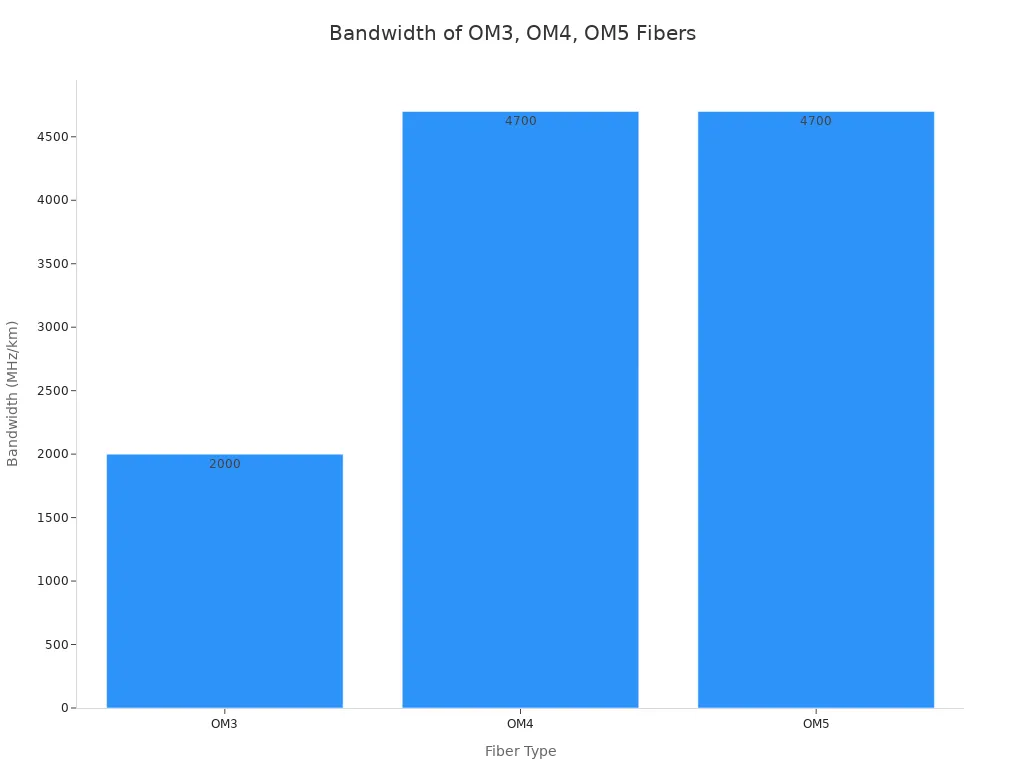
You see that OM3, OM4, and OM5 multimode fiber optic cables support higher bandwidth and longer transmission distances. These types use advanced glass formulations and tighter manufacturing tolerances, which improve durability and reduce signal loss. OM5 fiber optic cable also supports multiple wavelengths, making it ideal for next-generation enterprise networks.
Transmission Characteristics
- You depend on multimode fiber optic cable for reliable transmission in short-range applications. The larger core diameter allows multiple light modes to travel, but this increases modal dispersion and signal distortion over longer distances. You notice that multimode fiber experiences higher attenuation and inter-modal dispersion compared to single-mode fiber optic cables. The zigzag or semi-elliptical propagation paths, influenced by the refractive index of the glass core, cause varying arrival times for light signals.
- Multimode fiber optic cables provide robust performance for high-speed local area networks, data centers, and backbone cabling. You achieve optimal transmission quality by selecting the right cable type and managing installation practices. The glass materials used in multimode fiber optic cable construction offer excellent strength and resistance to environmental stress, ensuring long-term durability in enterprise settings.
Tip: You should always evaluate the transmission characteristics of your multimode fiber optic cable to ensure it meets your network's speed and distance requirements.
Network Uses and Benefits

Cost-Effectiveness
You often face budget constraints when planning your enterprise network. Multimode fiber offers a clear advantage in cost-effectiveness, especially for short-range applications. The total cost of ownership for a multimode network remains lower than single-mode solutions due to several factors:
- Multimode transceivers cost two to three times less than single-mode transceivers. As you increase data rates, the price gap widens even further.
- Single-mode optics require precision alignment and tighter tolerances, which increases interconnect costs.
- While the cable itself may be slightly more expensive, the transceiver price dominates the overall network cost. Single-mode transceivers can cost up to five times more than multimode options, depending on the data rate.
- Multimode fiber is easier to install and terminate, which reduces labor costs and minimizes downtime during network upgrades or expansions.
- The larger core size of multimode fiber simplifies alignment and termination, making it ideal for organizations that need frequent changes or moves within their network.
- You can see that for local area networks and campus environments, multimode fiber delivers high-speed data transmission without the high costs associated with single-mode systems. This cost advantage makes multimode fiber the preferred choice for many enterprise network uses.
Installation and Maintenance
You want a network infrastructure that is easy to install and maintain. Multimode fiber meets this need with its user-friendly design and straightforward handling requirements. The larger core size (50 or 62.5 microns) makes multimode fiber easier to align and terminate, reducing the risk of installation errors.
- Handle fiber optic cables with care to avoid physical damage.
- Use high-quality connectors and components to ensure long-term performance.
- Implement a clear labeling system for cables and connections. This practice simplifies troubleshooting and routine maintenance.
- Test all connections after installation to confirm network performance meets industry standards.
- Schedule regular inspections to check for physical damage and ensure all connections remain sealed against moisture.
Tip: Plan your cable routes carefully, measure and cut cables accurately, and document your installation. These steps help you maintain high network performance and simplify future upgrades.
You benefit from lower installation complexity and reduced maintenance costs. Multimode fiber allows your IT team to make changes quickly, which is essential in dynamic enterprise environments where network requirements evolve rapidly.
Performance for Enterprise Networks
You rely on network performance to support business operations, data transfers, and communication. Multimode fiber delivers the speed and reliability you need for most enterprise uses, especially over short to medium distances. The following table highlights the maximum data rates and distances for different multimode fiber types:
|
Fiber Type |
Core Size (microns) |
Max Data Rate |
Max Distance (meters) |
|---|---|---|---|
|
OM1 |
62.5 |
1 Gb |
275 |
|
OM2 |
50 |
1 Gb |
550 |
|
OM3 |
50 |
10 Gb |
300 |
|
OM4 |
50 |
100 Gb |
400 |
|
OM5 |
50 |
100 Gb |
150 |
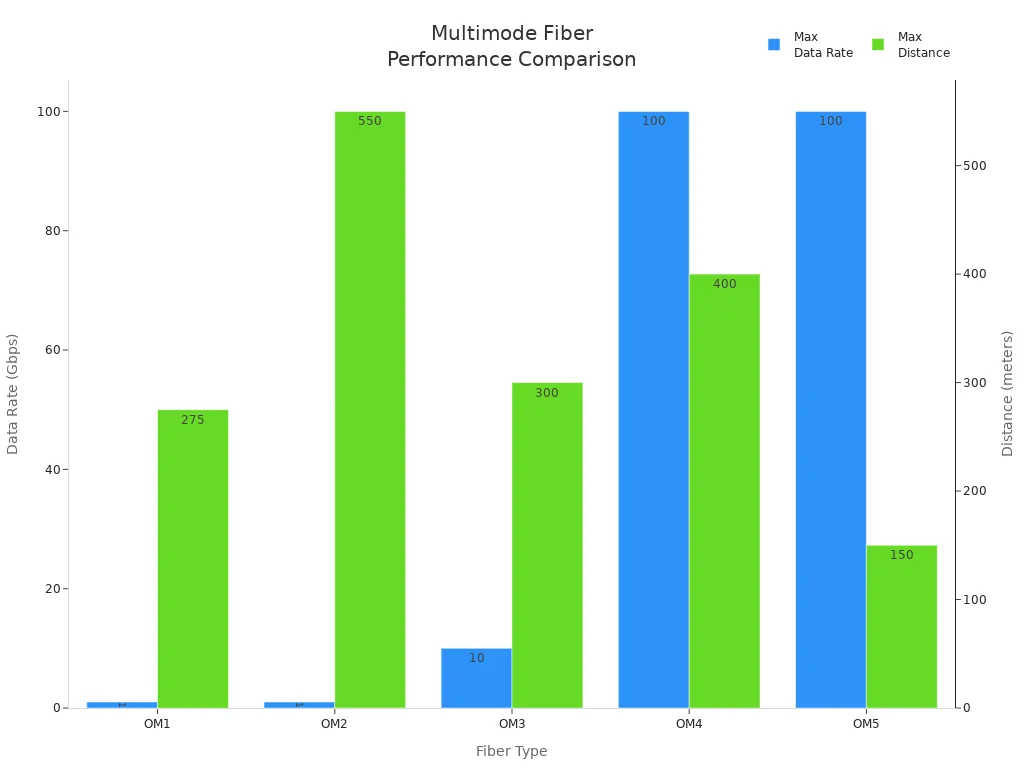
You see that multimode fiber supports high-speed data transmission for distances that match most enterprise network layouts. For example, you can deploy OM3 or OM4 multimode fiber in your data center or campus backbone to achieve 10 Gb or even 100 Gb speeds over several hundred meters. This level of performance meets the demands of modern applications, including cloud computing, virtualization, and real-time collaboration.
Multimode fiber excels in environments where you need reliable, high-bandwidth connections between servers, switches, and storage devices. The network performance you achieve with multimode fiber ensures smooth data flow, minimal latency, and consistent uptime. You can scale your network as your business grows, knowing that multimode fiber will continue to deliver the performance your enterprise requires.
Note: Multimode fiber is not designed for ultra-long distances, but it provides outstanding performance for the majority of enterprise network uses. You maximize your investment by matching the right fiber type to your specific network needs.
Applications in Enterprise Networks
Data Centers
You depend on multimode fiber to power the heart of your data centers. Multimode fiber supports high-speed connections between servers, switches, and storage systems, making it the backbone of modern data center infrastructure. You achieve cost-effective, high-density networking by using multimode fiber for short to medium-range links. This approach allows you to maximize rack space and streamline cable management.
|
Application Type |
Description |
|---|---|
|
Cost-effective connections |
Multimode fiber provides an economical system for high-speed connections between servers, switches, and storage. |
|
Short to medium range |
Optimized for short to medium range data transmission, making it ideal for intra-data center communication. |
|
High-density applications |
Designed for high-density environments where space and efficiency are crucial. |
You often choose multimode fiber for backbone connections in high-speed core networking. It also enables ultra-fast server interconnections in high-performance computing clusters. Multimode fiber supports high-speed data transmission across short distances and leverages advanced light sources like VCSELs for reliable, cost-effective performance. In data centers, you benefit from simplified installation and maintenance, which reduces downtime and operational costs.
Tip: When you design your data center, select multimode fiber to support scalable, high-bandwidth applications. This choice ensures your network can handle future growth and evolving data demands.
Campus Networks
You use multimode fiber to connect buildings and departments across large campus environments. Multimode fiber cables deliver seamless connectivity for students, staff, and devices throughout educational institutions and enterprise campuses. Their versatility and reliability make them a preferred choice for a wide range of applications in campus networks.
Multimode fiber enables robust networking throughout the campus, supporting high-speed data transfer for classrooms, labs, and administrative offices.
You benefit from the fiber's resilience to outdoor weather conditions and electromagnetic interference, ensuring stable performance even in challenging environments.
"Typically, campus environments use fiber-optic cabling infrastructure to support connections between buildings, as they not only enable data traffic over longer distances, but are also more resilient to outdoor weather conditions and electromagnetic interference (EMI)."
You can deploy multimode fiber to support local area networks, wireless access points, and security systems. This approach ensures your network remains flexible and scalable as your organization grows.
Backbone Cabling
You rely on multimode fiber for backbone cabling in enterprise networks. The backbone cabling system acts as the central nervous system of your business, linking critical areas such as reception, production floors, and storage rooms. Multimode fiber enables your teams to communicate efficiently, access data quickly, and operate essential systems with speed and stability.
- Multimode fiber supports various data transfer protocols, including Ethernet and Infiniband.
- Its high capacity and reliability make it ideal for backbone applications within buildings.
- You achieve a cost-effective solution for enterprise and data center applications up to 500–600 meters.
Multimode fiber provides the performance and flexibility you need to support demanding applications and future-proof your network infrastructure. You can easily scale your backbone cabling as your data requirements increase, ensuring your network remains robust and responsive.
High-Speed LANs
You need a reliable and high-performance solution when building high-speed LANs in your enterprise. Multi mode fiber stands out as the preferred choice for these network applications, especially when you require fast data transfer across short to medium distances. You benefit from its unique structure, which supports multiple light paths and enables rapid communication between devices.
Multi mode fiber delivers several advantages that make it ideal for high-speed LANs. You can see these benefits clearly in the table below:
|
Advantage |
Description |
|---|---|
|
Cost-Effective Solution |
Multi mode cables are generally more affordable than single-mode cables, making them ideal for high-speed communication without excessive costs. |
|
Simplified Installation |
Their larger core makes multi mode cables easier to align and terminate, simplifying installation and maintenance. |
|
High Bandwidth for Short Distances |
Multi mode cables support high data transfer rates for short distances, ideal for applications like data centers and campus networks. |
|
Versatility |
Widely used in environments requiring frequent changes, compatible with various devices and connectors. |
|
Durability and Longevity |
Designed for robust performance, multi mode fibers withstand physical stresses better than copper cables and are less susceptible to interference. |
You achieve high bandwidth and low latency with multi mode fiber, which is essential for supporting demanding network applications such as video conferencing, real-time data analytics, and large file transfers. The fiber's ability to handle high data rates over short distances ensures that your LAN infrastructure remains future-proof and scalable.
You also gain flexibility in your network design. Multi mode fiber allows you to reconfigure or expand your LAN as your business grows. Its compatibility with a wide range of connectors and devices means you can integrate new technologies without major disruptions. You reduce downtime and maintenance costs because the fiber resists physical damage and electromagnetic interference.
Tip: When you plan your high-speed LAN, choose multi mode fiber to balance performance, cost, and ease of installation. This decision helps you meet current needs and prepares your network for future upgrades.
You find that multi mode fiber supports the rapid pace of modern business. It enables seamless collaboration and efficient data sharing across your organization. By selecting this fiber for your high-speed LANs, you ensure your network delivers the speed, reliability, and adaptability required in today's enterprise environments.
Choosing Multimode Fiber Optic Cable

Selecting the Right Type
You need to select the optimal multimode fiber optic cable for your enterprise network. The right choice depends on several critical factors that impact performance, cost, and future scalability. Consider the following criteria:
- Bandwidth requirements for your applications
- Maximum transmission distance needed within your facility
- Cost-effectiveness compared to single-mode fiber solutions
- Types of multimode fiber available (OM1, OM2, OM3, OM4, OM5)
- Core sizes and compatibility with existing hardware
- Data rate capabilities for current and future network upgrades
- Application requirements, such as support for high-speed LANs or backbone cabling
- Budget constraints for installation and maintenance
Multimode fiber often provides the best value for enterprise networks. You benefit from high data rates and sufficient reach for most LAN and data center applications, while keeping costs lower than single-mode alternatives. OM3, OM4, and OM5 types deliver higher bandwidth and longer transmission distances, making them suitable for modern, high-performance environments.
Tip: Evaluate your network's growth plans and select a fiber type that supports both current needs and future expansion.
Connector Options
You must choose the right connectors to ensure reliable network performance. LC and SC connectors dominate multimode fiber installations due to their compact size and robust design. These connectors minimize signal loss and maintain high-quality connections.
|
Connector Type |
Insertion Loss |
Return Loss |
Compatibility |
|---|---|---|---|
|
LC |
< 0.3 dB |
> 45 dB |
Multimode |
|
SC |
< 0.3 dB |
> 45 dB |
Multimode |
LC and SC connectors offer low insertion loss, which helps preserve signal integrity across your network.
High return loss values contribute to better signal quality and reduced interference.
You achieve reliable performance and easy maintenance with these connector options.
Note: Select connectors that match your fiber type and network equipment to avoid unnecessary signal degradation.
Compatibility Considerations
You must address compatibility issues when integrating multimode fiber into your existing network infrastructure. Matching SFP modules with the correct fiber type is essential for efficient communication. Using incompatible modules can prevent connections from establishing and degrade signal quality.
- Ensure SFP modules and fiber cables are designed for multimode applications.
- Avoid mixing single-mode cables with multimode SFPs, as this can cause signal loss.
- Clean connectors and module ports regularly to prevent interference.
- Monitor environmental conditions, such as temperature and humidity, which can affect SFP module performance.
- Check device specifications, since older hardware may only support specific fiber types.
- Verify that devices from different manufacturers are compatible with your chosen multimode fiber type.
Industry standards, such as IEEE 802.3, guide the deployment of multimode fiber in enterprise networks. These standards define specifications for Ethernet and high-speed applications, including 100GBASE-SR and 400GBASE-SR4, which support advanced data rates over multimode fiber.
Tip: Review your network's hardware and cabling before upgrading or expanding. Compatibility ensures seamless integration and optimal performance.
Limitations and Considerations

Distance Constraints
You must consider distance limitations when deploying fiber in your enterprise network. Multi mode fiber excels at short-range transmission, but its performance drops as distance increases. Modal dispersion causes light pulses to spread, which leads to signal distortion and reduced data integrity. You see this effect most clearly at higher speeds.
The following table shows the maximum recommended distances for different multi mode fiber types at various transmission speeds:
|
Cable type |
Distance |
Speed |
|---|---|---|
|
OM1 62.5-/125-micron |
2000m |
100Mbps |
|
275m |
1Gbps |
|
|
33m |
10Gbps |
|
|
OM2 50-/125-micron |
2000m |
100Mbps |
|
550m |
1Gbps |
|
|
82m |
10Gbps |
|
|
OM3 50-/125-micron |
2000m |
100Mbps |
|
550m |
1Gbps |
|
|
300m |
10Gbps |
|
|
100m |
40Gbps |
|
|
100m |
100Gbps |
|
|
100m |
400Gbps |
|
|
OM4 50-/125-micron |
2000m |
100Mbps |
|
550m |
1Gbps |
|
|
400m |
10Gbps |
|
|
150m |
40Gbps |
|
|
150m |
100Gbps |
|
|
100m |
400Gbps |
|
|
OM5 50-/125-micron |
2000m |
100Mbps |
|
550m |
1Gbps |
|
|
400m |
10Gbps |
|
|
300m |
40Gbps |
|
|
300m |
100Gbps |
|
|
100m |
400Gbps |
|
|
100m |
800Gbps |
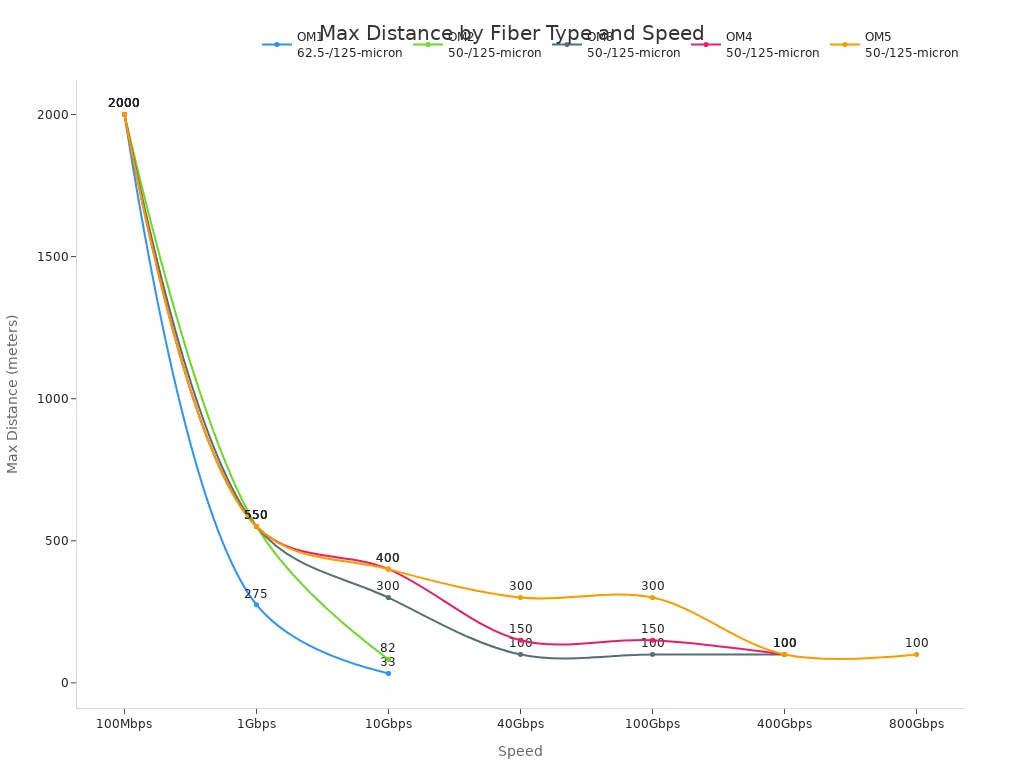
You notice that as transmission speed increases, the maximum distance drops sharply. For example, OM1 fiber supports only 33 meters at 10Gbps. You must plan your network layout carefully to avoid exceeding these limits.
Note: If your network requires longer transmission distances, multi mode fiber may not meet your needs.
Bandwidth Limitations
You face bandwidth constraints when using multi mode fiber for high-speed applications. Modal dispersion leads to signal distortion, which affects data integrity and complicates network scalability. The core size of multi mode fiber restricts the amount of data you can transmit, especially as your network grows.
|
Description |
Impact on Network Design and Scalability |
|---|---|
|
Modal dispersion leads to signal distortion over long distances. |
Reduces data integrity, complicating high-speed applications. |
|
Limited bandwidth of MMF affects high-data-rate systems. |
Challenges scalability as network demands increase. |
|
Core size restrictions of MMF may necessitate upgrades to SMF. |
Forces network developers to consider alternative solutions for higher data throughput needs. |
You must evaluate your network's future requirements. If you expect rapid growth or need to support advanced applications, bandwidth limitations of multi mode fiber may force you to upgrade to single mode fiber.
Tip: Always assess your network's scalability needs before choosing fiber for transmission.
When to Use Single Mode Fiber
You should select single mode fiber in scenarios where multi mode fiber cannot deliver the required transmission performance. Single mode fiber offers minimal signal loss and supports high bandwidth over long distances. You find it ideal for wide area networks, long-distance telecommunications, and high-speed backbone connections.
|
Scenario |
Reason for Preference |
|---|---|
|
Long-distance transmission |
Minimal signal loss and high integrity of data transmission |
|
High bandwidth applications |
Supports vast distances with high-speed connectivity |
|
Wide area networks (WAN) |
Ideal for extensive network connections |
|
Fiber to the home (FTTH) |
Ensures reliable and fast connections to residences |
|
Long-distance telecommunications |
Maintains speed and integrity over long distances |
- Long-distance transmission
- High bandwidth applications
- Wide area networks (WAN)
- Fiber to the home (FTTH)
- Long-distance telecommunications
You gain reliability and future-proofing for your network by choosing single mode fiber in these cases. Multi mode fiber remains a cost-effective solution for short-range transmission, but single mode fiber is the preferred choice when you need maximum performance and scalability.
Callout: If your enterprise network demands high-speed transmission across large campuses or between remote sites, single mode fiber provides the best results.
You gain significant advantages by choosing multi mode fiber for your enterprise network. This fiber type delivers high-speed data transmission, cost savings, and easy installation. You match fiber to your network needs by evaluating bandwidth, distance, and scalability. You plan upgrades by reviewing fiber types and connector options. You monitor fiber performance as technology evolves. You ensure your network remains reliable and future-ready by regularly assessing fiber requirements.
FAQ
Why should you choose multimode fiber for your enterprise network?
You gain cost savings and easy installation with multimode fiber. It supports high-speed data transmission for short distances, making it ideal for data centers and campus networks. You optimize your network performance without overspending on long-distance capabilities.
Why does multimode fiber excel in short-range applications?
You benefit from a larger core diameter, which allows multiple light paths. This design supports high bandwidth over short distances. You avoid the complexity and cost of single-mode fiber when your network does not require long-distance transmission.
Why do enterprise networks prefer multimode fiber over copper cabling?
You achieve higher data rates and lower latency with multimode fiber. Fiber resists electromagnetic interference, ensuring stable network performance. You future-proof your infrastructure for advanced applications and rapid business growth.
Tip: Fiber cabling supports speeds up to 400Gbps, while copper often maxes out at 10Gbps.
Why do you need to consider OM3, OM4, or OM5 fiber types?
You select OM3, OM4, or OM5 for higher bandwidth and longer reach. These types support advanced network speeds and future upgrades. You ensure your enterprise network remains scalable and competitive.
|
Fiber Type |
Max Speed |
Max Distance |
|---|---|---|
|
OM3 |
10Gbps |
300m |
|
OM4 |
100Gbps |
400m |
|
OM5 |
100Gbps |
150m |
Why is multimode fiber installation simpler than single-mode fiber?
You work with a larger core, which makes alignment and termination easier. You reduce installation errors and labor costs. Your IT team can quickly deploy and maintain your network infrastructure.
Why should you upgrade your legacy network to multimode fiber?
You boost network speed and reliability. Multimode fiber supports modern applications like cloud computing and video conferencing. You position your business for future technology demands.
Why does modal dispersion matter in multimode fiber networks?
You experience signal distortion over longer distances due to modal dispersion. This effect limits bandwidth and reach. You must plan your network layout to avoid exceeding recommended distances.
Note: Modal dispersion impacts data integrity at speeds above 10Gbps.
Why do you need to match connectors and transceivers with your fiber type?
You prevent signal loss and connection failures by using compatible components. You maintain optimal network performance and avoid costly troubleshooting.