





Air Blown Micro Cable: Which Optical Fiber Cable Fits Your Network?
Choose the STL 432F when your route needs 200+ fibers per cable, your duct space is severely constrained, and your field teams already have 200µm splicing equipment. It packs 432 single mode fiber optic cable cores into a single 8.8mm cable-fewer cables, fewer splice points, fewer duct openings.
Choose the Hengtong GYCFHTY when you're building an access network with varied fiber counts (12–144 per segment), you want to phase your fiber optic cable installation, and your teams use standard 250µm splicing tooling. It gives you the flexibility to match cable capacity to actual demand at each distribution point.
What Problem Does Air Blown Micro Cable Solve?
Air blown micro cable solves a specific problem: getting more fiber into existing duct infrastructure without the mechanical stress of cable pulling. Operators install microduct conduit for fiber optic cable pathways first, then blow fiber through them with compressed air. Unlike direct burial fiber optic cable that requires trenching for every upgrade, air blown cables can be replaced or upgraded later without re-excavating the route.
The STL 432F and Hengtong GYCFHTY take fundamentally different approaches to this same technology. Understanding those differences matters because choosing the wrong cable doesn't just cost money-it affects your installation timeline, your fiber optic cable splicing workflow, your future upgrade path, and how many times you need to open a duct.
What Each Product Actually Is
STL 432F Micro Cable
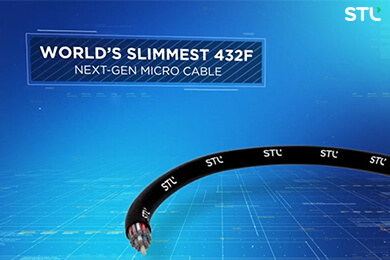
STL markets this as the world's thinnest 432-fiber micro cable. The trick is the fiber itself: 200µm coating diameter instead of the standard 250µm. Thinner fiber means more fibers per buffer tube, more tubes per cable, and a finished product that squeezes 432 fiber optic cable cores into an 8.8mm outer diameter. STL's broader Micro-LITE product line runs from 2 to 864 fibers, but the 432F is the flagship-the configuration they lead their marketing with.
The fiber options are G.657.A1 or G.657.A2 depending on the ordered variant. Both are bend-insensitive single mode fibers, built for tight urban routing. The cable uses stranded loose tube construction with an FRP central strength member and HDPE outer sheath-standard architecture for air blown applications.
Hengtong GYCFHTY
Hengtong's GYCFHTY is a stranded loose tube micro air blown cable covering 2 to 144 cores. It uses the same FRP + HDPE architecture as the STL, but with industry-standard 250µm fiber. Cable diameters range from 5.5mm at 72 fibers to 8.0mm at 144 fibers.
The fiber type menu is broader: G.652D for standard single-mode transmission, G.655 for non-zero dispersion-shifted applications, and G.657.A2 for bend-insensitive access. This range of SM fiber optic cable types means a single cable platform covers backbone, metro, and access segments without switching product families. (Both products in this comparison are single mode optical fiber cables. Multimode fiber optic cable is designed for short-reach data center links and falls outside this guide.)
Hengtong's group does manufacture 200µm and 180µm fiber (the BendCom® Smini series). The GYCFHTY uses 250µm by design choice, not by technological constraint.

Specification Comparison
Important context: STL's values below come from a publicly available 432F-specific datasheet (24 loose tubes × 18 fibers, single jacket, Rev 1.0, dated March 2020). Hengtong's values come from the published GYCFHTY series page. Cable diameter and weight are NOT comparable across this table-you're looking at a 432-fiber cable vs. configurations up to 144 fibers.
|
Parameter |
STL 432F |
Hengtong GYCFHTY |
|
Maximum Fiber Count |
432 (up to 864 HD variant) |
144 |
|
Fiber Coating |
200µm (reduced) |
250µm (industry standard) |
|
Fiber Type |
G.657.A1 / G.657.A2 |
G.652D / G.655 / G.657.A2 |
|
Blowing Speed |
Not published |
50 m/min |
|
Max Blowing Distance |
Not published |
1,000 m |
|
Attenuation 1310/1550nm |
0.35 / 0.23 dB/km |
0.36 / 0.22 dB/km |
|
Tensile Strength |
1000 N |
0.3G / 1.0G (long/short term) |
|
Min Bend Radius (install/static) |
15D / 10D |
20D / 10D |
|
Crush Resistance |
500 N/100mm |
150 / 500 N/100mm (long/short) |
|
Operating Temp |
-30°C to +70°C |
-40°C to +70°C |
Project Usage Differences
The 200µm vs. 250µm Fiber Question
This is the biggest practical difference between these two products, and it ripples through every aspect of deployment.
STL's 200µm fiber is how they achieve the high fiber density-smaller coating means more fibers per tube. The trade-off is real: your splicing teams need 200µm-compatible fiber holders for fusion splicing fiber optic cable at this diameter. Fujikura, FITEL, and Sumitomo all make them, but if your field crew walks up to a splice closure with standard 250µm clamps, they're stuck until someone fetches the right tooling.
What makes the coating difference possible? Both cables use the same 125µm glass cladding-the core of what fiber optic cable is made of doesn't change. STL reduces the UV-acrylate coating layer from 62.5µm to 37.5µm per side, which is what demands a different holder geometry in the splicer.
Hengtong's 250µm fiber works with every fusion splicer, splice tray, fiber optic cable connectors, and fiber management panel already deployed in the industry. No procurement lead time for new clamps, no retraining, no risk of a technician using the wrong holder and damaging fiber.
Fiber Count: One Big Cable vs. Right-Sized Cables
A 432-fiber cable is a powerful asset on a high-capacity feeder route. One cable, one installation event, one duct opening-and you've got 432 fibers deployed. For trunk routes where you know you need 300+ fibers, the math is straightforward: one STL 432F beats three separate 144-fiber pulls in labor, duct space, and splice points.
But most access networks don't look like that. A typical FTTH last-mile fiber optic cabling segment needs 12, 24, or 48 fibers at each distribution point. Deploying a 432-fiber cable to serve a 24-fiber demand means 408 fibers sitting dark-capital tied up in capacity you may not need for years, if ever.
The Hengtong GYCFHTY's 2–144 fiber range lets planners specify exactly the capacity each segment requires. That precision reduces material cost and avoids over-provisioning in access segments where demand is distributed and uncertain.
Mid-Span Access: Can You Tap Into the Cable Mid-Route?
In access networks, you rarely need all your fiber at one endpoint. Distribution points are scattered along the cable route-every few hundred meters in a residential FTTH build. Hengtong explicitly documents mid-span access for the GYCFHTY: operators can cut into the microduct at any point to create a branch connection without affecting cables in adjacent ducts.
This capability also simplifies fiber optic cable repair. If a section of outdoor fiber optic cable is damaged by construction work or environmental stress, technicians can isolate the affected microduct and blow in a replacement segment rather than re-pulling the entire route.
STL's 432F materials don't address this capability. That doesn't mean it's impossible-stranded loose tube cables generally support mid-span access.
Phased Deployment vs. Full Capacity Now
These two products reflect two different capital strategies.
The STL 432F says: deploy maximum capacity on day one. Pay more upfront, but lock in future capacity while the duct is open. This makes sense when duct permits are expensive, trenching rights-of-way take months to secure, or you have high confidence in long-term fiber demand on that route.
The Hengtong GYCFHTY says: install microducts now, blow fiber as subscribers connect. Start with a 24-fiber cable today, blow a second cable next year when demand grows, replace with a higher-count cable when technology evolves. Initial capital expenditure stays low, and you avoid installing fiber optic cable capacity that might sit idle for years.
Neither approach is universally right. The correct answer depends on your duct access costs, your subscriber uptake projections, and your organization's capital allocation priorities.
The Splicing Reality Check
Specifications don't capture everything. Here's something that matters on the ground:
A 432-fiber cable is a complex object to manage at a splice point. That's 24 buffer tubes, each containing 18 fibers, all needing identification, organization, and termination. The splice closure is larger. The documentation burden is heavier. The technician needs more time and more experience. A single misidentified fiber can cascade into a troubleshooting nightmare-and verifying every splice with a fiber optic cable tester adds proportionally more time.
Terminating fiber optic cable at this density also demands careful fiber optic cable color code tracking. With 24 tubes following the standard 12-color sequence (repeated twice with dashes or rings for the second set), documentation errors multiply fast if your team isn't meticulous.
A 72-fiber or 144-fiber cable from Hengtong's range involves a fraction of that complexity. Fewer tubes, fewer fibers per event, faster splice times, and a lower error rate for less experienced fiber optic cable splicers. Some operators further reduce on-site labor by ordering pre-terminated fiber optic cable assemblies for distribution segments, though this option is more common in structured indoor fiber optic network cable installations than outdoor air blown routes.
If your project timeline is tight and your splice teams vary in experience level, the reduced per-event complexity of a lower-count cable is a real operational advantage-one that doesn't show up on any datasheet.
Decision Table: STL 432F vs. Hengtong GYCFHTY
|
Decision Factor |
STL 432F |
Hengtong GYCFHTY |
|
High-density trunk (200+ fibers) |
One cable solves it |
Need multiple cables |
|
Last-mile access (12–48F) |
Oversized for the job |
Right-sized per segment |
|
Splicing tooling |
Requires 200µm holders |
Standard 250µm compatible |
|
Phased rollout |
Possible, not optimized |
Designed for staged blowing |
|
Mid-span branching |
Not documented |
Documented feature |
|
Multi-vendor fiber sourcing |
200µm supply limited |
Any 250µm supplier |
|
Fiber type flexibility |
G.657 only |
G.652D, G.655, G.657.A2 |
|
Installation data transparency |
Partial (datasheet has mech specs) |
Full blowing specs published |
Scenario Guide: Which Cable for Which Network?
Use the STL 432F when:
Your route needs 200+ fibers and duct space is the binding constraint
You're deploying 5G fronthaul from centralized baseband units to many radio heads
Duct permits are expensive or slow-maximize fiber per installation event
Your field teams already operate with 200µm splicing equipment
Use the Hengtong GYCFHTY when:
Your fiber optic cable for internet access network has distributed demand: 12–48 fibers at each tap point
You want to phase your rollout to match capital expenditure with subscriber growth
Mid-span branching is required at multiple points along the route
Your field teams use standard 250µm equipment and you want zero tooling changes
You need G.652D or G.655 fiber types alongside G.657.A2
Multi-vendor fiber sourcing flexibility matters to your supply chain strategy
FAQ
Q: What Fiber Count Does Each Route Segment Actually Need?
A: If the answer is consistently 200+ fibers, the STL 432F reduces splice events and duct usage. If the answer varies between 12 and 144 fibers across different segments, the Hengtong GYCFHTY's range is a better fit.
Q: What Splicing Tools Do Your Field Teams Carry Today?
A: Teams Already Equipped For 200µm Fiber Have No Incremental Cost With STL. Teams On Standard 250µm Gear Deploy Hengtong's Cable With No Tooling Investment.
Q: How Confident Are You In Your Demand Forecast?
A: High Confidence And Concentrated Demand Favor Deploying Full Capacity Now With A High-Count Cable. Uncertain Or Subscriber-Driven Demand Favors Phased Rollout With Flexible Cable Configurations-Blow Fiber As You Need It.