





Fiber optic cables carry information by sending light signals along ultra-thin strands of glass or plastic fiber, delivering significantly greater speed, capacity, and transmission range compared to traditional copper wiring. Built from three key layers - an inner core, a surrounding cladding, and an outer protective coating - these cables serve as the backbone of modern broadband networks, telecom infrastructure, and industrial communication systems. Understanding how optical fibers work can greatly help solve some challenging problems.
What Is Optical Fiber
Optical fiber is a communication conductor that uses light as its information carrier and glass or plastic as its transmission medium. The basic process works as follows: electrical signals are converted into light pulses, transmitted at high speed through extremely thin glass strands, and then converted back into electrical signals at the receiving end. A standard communication fiber has a diameter of about 125 micrometers - roughly the same as a human hair. Despite this incredibly thin cross-section, the interior features a precision multi-layer concentric structure, with each layer serving an independent function.
It is important to distinguish between optical fiber and fiber optic cable. A fiber optic cable is a complete cable assembly that houses one or more optical fibers along with strength members and protective jackets, designed to transmit data as pulses of light over long distances.

The Four-Layer Physical Structure of Fiber Optic Cable
To understand what a fiber optic cable is made of, let's take a closer look at its four precision-engineered layers from the inside out.
Core
Located at the very center, the core has a diameter ranging from 8 to 62.5 micrometers and serves as the actual channel through which light signals travel. The core is made from high-purity silicon dioxide (SiO₂) doped with trace amounts of germanium (Ge) to increase its refractive index. The purity of the core directly determines signal transmission distance and loss levels - communication-grade fiber requires glass purity of 99.99% or higher.
Cladding
The fiber optic cable cladding surrounds the core with a uniform diameter of 125 micrometers. It is also made of silicon dioxide, but with a different doping formula that gives it a slightly lower refractive index than the core. This refractive index difference is the physical prerequisite that enables light signal transmission - without it, light would simply leak out of the fiber.
Coating (Buffer)
One or two layers of UV-cured acrylate coating are applied over the cladding, bringing the total fiber diameter to 250 micrometers. The coating protects the bare glass from microbending, scratching, and moisture intrusion. Coating degradation is one of the primary causes of performance decline in fibers after long-term use.
Jacket
The outermost protective structure is typically made from polyethylene (PE) or polyvinyl chloride (PVC), with some specialized applications using Low Smoke Zero Halogen (LSZH) materials. The jacket may also contain aramid fibers (Kevlar), steel wire, or fiberglass reinforced plastic (FRP) rods as strength members to resist tensile, compressive, and bending stresses during installation.
Together, these four layers - high-purity silica core, doped silica cladding, acrylate coating, and polymer jacket - make up the essential optical fiber materials found in every communication-grade cable.
In actual deployments, dozens to thousands of optical fibers are bundled together into an optical cable. Optical cable and optical fiber are two different concepts: fiber is the transmission medium; cable is the complete product comprising fibers, strength members, and protective jackets.
How Do Fiber Optic Cables Work
Total Internal Reflection
The fundamental principle behind how fiber optic cables transmit data is Total Internal Reflection (TIR). When light travels from a medium with a higher refractive index into one with a lower refractive index, and the angle of incidence exceeds the critical angle, the light is reflected 100% back into the higher-index side rather than passing through the interface. Fiber optics exploits exactly this principle: the core's refractive index (approximately 1.467) is higher than the cladding's (approximately 1.460), so light signals continuously bounce off the core-cladding interface at shallow grazing angles, propagating along the fiber.
A key parameter here is the Numerical Aperture (NA). NA describes the maximum angle range over which the fiber can accept incoming light, determined by the refractive index difference between core and cladding. A larger NA provides greater coupling tolerance, making it easier to align with a light source, but also increases dispersion and degrades signal quality. This is one of the core trade-offs in fiber design.

The Complete Optical Communication Link
To understand how fiber optic cable works in a real-world system, we need to look at the three core stages of an optical fiber communication link.
Transmitter: Electrical signals are first encoded into a digital pulse sequence (0s and 1s), then a light source converts them into optical pulses. There are two types of light sources: laser diodes (LD) and light-emitting diodes (LED). Laser diodes offer higher output power, narrower spectral width, and faster modulation rates, making them suitable for long-distance, high-speed scenarios. LEDs are lower-cost but have wider spectral width, suited for short-distance applications.
Fiber (Transmission Segment): Once optical pulses enter the fiber, they propagate along the core. In long-distance transmission, optical amplifiers are placed at regular intervals to compensate for signal attenuation. Modern Dense Wavelength Division Multiplexing (DWDM) optical fiber technology can simultaneously carry 80 to 160 different wavelength channels in a single fiber, each independently carrying data, enabling single-fiber capacity at the terabits-per-second level.
Receiver: A photodetector (typically a PIN photodiode or avalanche photodiode, APD) converts received optical pulses back into electrical signals, which are then restored to original data through clock recovery and decision circuits.
Signal Attenuation
Light transmission through fiber is not a lossless process. Signal attenuation is the core constraint in fiber optic communication system design.
Attenuation comes from three main sources. The first is material absorption - residual hydroxyl ions (OH⁻) in the glass create absorption peaks at specific wavelengths (around 1383 nm), which is why modern communication fibers primarily use the 1310 nm and 1550 nm low-loss windows. The second is Rayleigh scattering - interactions between light and microscopic density irregularities in the glass cause scattering losses, the dominant loss mechanism at shorter wavelengths. The third is bend loss - excessively small fiber bend radii cause light signals to leak from the core.
For reference, the current mainstream G.652D single-mode fiber has a typical attenuation of 0.35 dB/km at 1310 nm and 0.20 dB/km at 1550 nm. This means that at 1550 nm, signal power drops to 1% of its original level after traveling 100 km. As a result, long-haul trunk lines require optical amplifiers every 80 to 100 km for signal regeneration.
Fiber Optic Cable Types: Single-Mode vs. Multi-Mode
Optical fibers are classified into two major categories based on the number of transmission modes. These types of fiber optic cable differ fundamentally in physical parameters, performance specifications, and suitable applications.
Single-Mode Fiber (SMF)
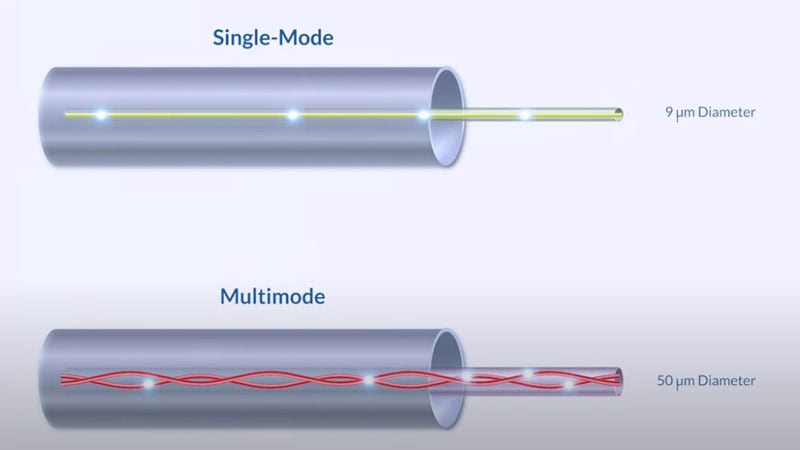
Single-mode fiber has a core diameter of 8 to 10 micrometers and allows only one fundamental mode (LP01) to propagate. By eliminating intermodal dispersion, single-mode fiber achieves a bandwidth-distance product far exceeding that of multi-mode fiber, making it the standard choice for medium- and long-distance communication.
Typical operating wavelengths are 1310 nm and 1550 nm, using Distributed Feedback Laser Diodes (DFB-LD) as light sources. Transmission distance can reach tens to hundreds of kilometers (extendable to thousands of kilometers with optical amplifiers). The outer jacket color code is yellow.
Mainstream standard designations include ITU-T G.652 (standard single-mode), G.655 (non-zero dispersion shifted), and G.657 (bend-insensitive, designed for FTTH deployment).
Multi-Mode Fiber (MMF)
Multi-mode fiber has a core diameter of 50 or 62.5 micrometers, allowing hundreds to thousands of modes of optical fiber to propagate at the same time. Different modes travel at different speeds, arriving at the receiver at different times - a phenomenon called intermodal dispersion - which directly limits multi-mode fiber's transmission distance and bandwidth.
Typical operating wavelengths are 850 nm and 1300 nm, using VCSELs (Vertical Cavity Surface Emitting Lasers) or LEDs as light sources. Transmission distances are typically within a few hundred meters. For jacket color identification: OM3/OM4 uses aqua, OM5 uses lime green, and OM1/OM2 uses orange.
Selection Criteria
Among the different types of fiber cable, the deciding factor is transmission distance. For distances under 300 meters - such as intra-data-center interconnections and in-building cabling - multi-mode fiber offers a cost advantage, as its compatible optical modules are significantly less expensive than single-mode equivalents. Beyond 500 meters - campus backbones, metropolitan networks, and long-haul trunk lines - single-mode fiber is the only viable option. Within their respective optimal distance ranges, neither type is universally superior; a multi-mode solution often delivers lower total cost of ownership.
How Are Fiber Optic Cables Made
Fiber optic cables are primarily composed of ultra-pure silica glass (silicon dioxide), which is drawn into filaments thinner than a human hair for the transmission of optical signals. A typical fiber optic cable consists of several key components: a central core that carries the light signals, a surrounding glass cladding that enables internal reflection, a polymer protective coating that shields the fiber from physical damage, and reinforcing strength members, such as Kevlar or steel, that enhance the cable's mechanical durability.Optical fiber production sits at the intersection of precision chemical engineering and optical science. The entire process is divided into two stages: preform fabrication and fiber drawing.
Preform Fabrication
A preform is a high-purity glass rod approximately 10 to 20 centimeters in diameter and about 1 meter long, with the core-cladding refractive index profile already established internally. There are four main fabrication methods: MCVD (Modified Chemical Vapor Deposition), OVD (Outside Vapor Deposition), VAD (Vapor Axial Deposition), and PCVD (Plasma Chemical Vapor Deposition).
Taking the OVD process as an example: high-purity silicon tetrachloride (SiCl₄) and germanium tetrachloride (GeCl₄) gases undergo oxidation reactions in a hydrogen-oxygen flame. The resulting SiO₂ and GeO₂ particles deposit onto a rotating target rod, building up layer by layer to form a porous glass body (called a "soot preform"), which is then dehydrated at high temperature, sintered, and collapsed into a solid, transparent preform.
A single preform can yield hundreds of kilometers of fiber. The preform's quality determines all of the fiber's optical performance characteristics - including attenuation, dispersion, and cutoff wavelength - parameters that are locked in at the preform stage and cannot be corrected during the drawing process.
Fiber Drawing
The preform is fed into a draw tower, a vertical structure approximately 20 to 30 meters tall. The bottom end of the preform is heated to approximately 2,000°C to soften the glass, which is then drawn under gravity and tension control into a fiber with a diameter of 125 micrometers. Drawing speed can reach 1,000 to 2,500 meters per minute.
During the drawing process, the fiber passes through an inline laser diameter gauge for real-time monitoring with accuracy of ±0.1 micrometers, then immediately enters the coating stage - two layers of acrylate are cured under UV lamps, bringing the fiber diameter to 250 micrometers. The entire process from softening to coating cures in less than one second.
After drawing, the fiber undergoes proof testing, typically subjected to 0.69 GPa (approximately 1% strain) of tension to eliminate sections containing microcracks, ensuring that the shipped fiber's mechanical reliability meets the 25-year service life requirement.

Fiber Optic Cable Advantages over Copper
When comparing fiber to copper, the advantages of optical fiber become immediately clear. The table below highlights why fiber has become the preferred medium for modern networks.
|
Parameter |
Fiber Optic |
Copper |
|
Bandwidth & Speed |
A single SMF with DWDM can achieve Tbps-level capacity |
Equivalent copper maxes out at 25–40 Gbps, distance-limited to 30 m |
|
Transmission Distance |
SMF can transmit 80–100 km without repeaters |
Cat 6A copper is effective to 100 m only |
|
EMI Resistance |
Carries light signals; completely immune to electromagnetic interference |
Requires additional shielding with limited effectiveness |
|
Security |
Light signals do not radiate externally; physical tapping is extremely difficult |
Electrical signals produce electromagnetic radiation that can be intercepted |
|
Weight & Volume |
1/10 to 1/20 the weight of equivalent-capacity copper |
Heavier and bulkier |
|
Power Delivery |
Data only; endpoints require independent power |
Supports Power over Ethernet (PoE) - data and power simultaneously |
|
Cost Structure |
Fiber itself is inexpensive; optical modules and splicing equipment cost more |
Lower total system cost within 100-meter short-distance scenarios |
|
Installation |
Requires professional fusion splicers or pre-terminated connectors; trained technicians needed |
RJ45 connectors with field crimping; simple installation |
Fiber and copper are complementary, not competitive. Current mainstream network architecture follows the "fiber-to-the-edge" principle - backbone and aggregation layers use fiber, while the access layer (the last few tens of meters to end devices) continues to use copper. This architectural pattern is not expected to change fundamentally in the next 5 to 10 years.
Optical Fiber Applications
The uses for fibre optics span nearly every industry, from telecommunications to medicine. Here are the key application areas.
Telecom and Internet Backbone
The global internet runs on fiber. Undersea fiber optic cables and terrestrial long-haul trunk cables connect continents. 5G base station fronthaul and midhaul networks also rely on fiber, with each base station requiring 6 to 12 fiber cores. At this scale, the use of fiber optic cable in networking forms the very backbone of global connectivity.
Data Centers
Data centers use OM3/OM4 multi-mode fiber for short-distance high-speed interconnections internally. Between data centers, single-mode fiber with coherent optical communication technology is used, with per-wavelength speeds already reaching 400G and 800G deployments underway.
FTTH (Fiber to the Home)
FTTH brings fiber directly to residential users, using PON (Passive Optical Network) technology to distribute optical signals to multiple end users, achieving gigabit-class broadband access at low cost.
Industrial and Sensing
Fiber optic sensors are used for temperature and strain monitoring, widely deployed in oil and gas pipelines, power cables, tunnel fire warning systems, and large-scale structural health monitoring.
Medical
Fiber optic application in medicine continues to expand - endoscopes, surgical lasers, and imaging systems all rely on optical fibers for illumination, imaging, and precision surgical support.
Military and Aerospace
Fiber optics replaces copper in military communications, data buses, and aerospace systems, offering EMI immunity and eavesdropping resistance. Fiber optic gyroscopes are widely used in aircraft and missile guidance systems.
FAQ
Q: How long do fiber optic cables last?
A: Communication-grade fiber optic cables are engineered for a minimum service life of 25 years under standard operating conditions. However, real-world longevity depends on environmental factors such as UV exposure, moisture ingress, rodent damage, and mechanical stress during installation. Submarine cables, for instance, are designed to exceed 25 years with redundant fiber pairs to account for gradual degradation.
Q: Are fiber optic cables affected by weather or temperature extremes?
A: Glass fiber itself is highly resilient to temperature variations, operating reliably from −40°C to +70°C in most cable designs. Unlike copper, fiber is unaffected by lightning-induced surges or electromagnetic storms. However, extreme ice loading can cause excessive bending on aerial cables, and repeated freeze-thaw cycles may degrade jacket integrity over decades. Gel-filled or dry-block cable designs are specifically engineered to prevent moisture penetration in harsh climates.
Q: What is the minimum bend radius for fiber optic cables?
A: Standard single-mode fiber (G.652) typically requires a minimum bend radius of 30 mm during installation. Bend-insensitive fibers (G.657A2/B3), designed specifically for tight indoor routing and FTTH deployments, can tolerate bend radii as small as 5–10 mm with negligible additional loss. Exceeding the minimum bend radius causes light to escape the core - known as macro-bend loss - which degrades signal quality and may result in link failure.
Q: Can fiber optic cables carry electrical power alongside data?
A: Standard fiber cannot deliver electrical power. However, emerging Power over Fiber (PoF) technology uses dedicated fiber strands to transmit laser light that is then converted to electricity at the remote end via photovoltaic cells. PoF is currently used in niche applications - such as powering remote sensors in high-voltage environments or explosive zones - where running copper power lines is unsafe. Output is limited to a few watts, so it does not replace PoE for typical networking equipment.
Q: What is multimode fiber (MMF)?
A: Multimode fiber (MMF) is an optical fiber built around a wider core - typically 50 or 62.5 µm in diameter - that allows light to travel along many distinct paths simultaneously. This multi-path design enables MMF to work with affordable, lower-power light sources like VCSELs and LEDs, significantly reducing overall system costs for end users. As a result, it has become the go-to solution for short-reach, high-throughput links found inside enterprise buildings, campus backbones, and data center switch-to-server connections. The trade-off, however, lies in a physical phenomenon known as intermodal dispersion: because each light path carries a slightly different transit time, signal pulses gradually spread and overlap as they travel, which caps the usable link length at roughly several hundred meters - a fraction of what single-mode fiber can achieve over the same infrastructure investment.