

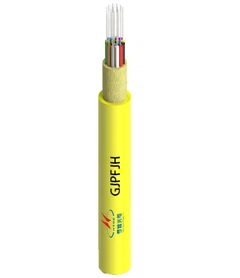


For engineers, network planners, and procurement teams, to better determine whether ribbon fibre is suitable for a specific project.
Optical fibre cables are advanced transmission media designed to carry information by pulsing light through extremely thin glass fibres. Because of this design, they can handle large amounts of data with less interference and over much greater distances than traditional metal wiring. They are commonly found in internet and telecommunications infrastructure, and their performance relies on light being guided through the fibre with minimal leakage, which helps preserve signal quality. In practical use, singlemode fibre is preferred for extended-range communication, whereas multimode fibre is typically chosen for shorter links.
Within this broad family of optical fibre cables, one construction method has become particularly important for high-density, high-efficiency deployments: the ribbon format. This document examines how ribbon fibre cables are constructed, where they offer clear advantages, and when other cable formats remain the better choice.
Differences of Ribbon Fibres
A ribbon fiber optic cable organises its optical fibres into flat, parallel rows bonded together with a UV-cured matrix. In this fiber optic ribbon structure, each fibre has a fixed, known position within the ribbon. That fixed position is the only thing that matters for understanding why ribbon fibre exists: because every fibre's location is predetermined and colour-coded, all 12 fibres in a ribbon can be fused simultaneously in one machine cycle. No identification step. No sequential splicing.
Every economic and operational advantage of ribbon fiber - lower installed cost at scale, faster splicing, lower error rate - is a consequence of that single characteristic.
Standard optical fiber ribbon formats hold 4, 8, 12, or 24 fibres. The 12-fibre format is by far the most widely deployed. Complete cables range from 12 fibres to several thousand depending on ribbon count and cable design.

Ribbon Cable Types
Fully Bonded Flat Ribbon
In a fully bonded flat ribbon cable fiber optic design, fibres are bonded continuously along their entire length, producing a stiff flat structure. This rigidity is what enables precise fibre alignment in the splicer fixture. The limitation is geometric: a flat rectangle does not pack efficiently inside a round tube. Corner space is wasted, which caps the maximum fibre density achievable in a given cable diameter.
Flat ribbon is well-established, broadly supported by existing tooling, and the lower-risk choice where extreme density is not required.
Intermittent Bonded Ribbon (Rollable Ribbon)
The bonding matrix is applied only at fixed intervals - typically every 10–35 mm depending on manufacturer. The unbonded sections allow the fiber ribbon to flex into a roughly cylindrical form, which fills a round tube far more efficiently than flat ribbon. The same cable diameter that accommodates a few hundred fibres in flat ribbon format can carry 3,000 fibres or more in rollable ribbon cable designs. The cross-sectional pattern of rolled fibres resembles a spider's web, which is why this format is also called SpiderWeb Ribbon (commonly written as spiderweb ribbon).
Two trade-offs matter in practice. First, the bond point interval affects how the ribbon handles in cold conditions - the bonding matrix stiffens at low temperatures, and rollable ribbon in cold environments requires more careful handling during the unrolling step before splicing than product literature typically acknowledges. Second, to splice rollable ribbon, the ribbon must be temporarily unrolled and held flat in the splicer fixture. In a climate-controlled workshop this is straightforward. Inside a manhole in winter it is a real variable, and teams transitioning from flat ribbon splicing should complete handling practice before the first live deployment.
How to Choose
Flat ribbon fiber optic cable is suited for moderate fibre counts with straightforward duct geometry. Rollable ribbon is the better choice when maximising fibre count in a constrained duct is the primary requirement - practically, this means above approximately 288 fibres or on routes where the duct is at or near capacity.

HENGTONG Ribbon Fibre Optic Cable
The Ultimate Solution for High-Density Network Infrastructure
Ribbon Fibre vs. Loose Tube
In a loose tube cable, fibres sit in buffer tubes with no fixed position. Every splicing job begins with fibre identification, and every splice is made individually.
|
Contrast |
Ribbon Fibre |
Loose Tube |
|
Fibre arrangement |
Fixed order, colour-coded |
Free inside buffer tube |
|
Fibre density |
High (very high with rollable) |
Moderate |
|
Splicing method |
Mass fusion: 12 fibres per cycle |
Single-fibre fusion |
|
Splicing speed (288 fibres) |
Approx. 2–4 hours |
Approx. 1.5–2 days |
|
Economic crossover |
More economical above ~72–96 fibres |
More economical below ~72–96 fibres |
|
Cable flexibility |
Less (flat) / comparable (rollable) |
More flexible |
|
Tooling requirement |
Ribbon-specific splicer, cleaver, stripper |
Standard single-fibre tools |
Advantages of Ribbon Fibre
Duct-Constrained Routes
When existing duct space is the binding constraint, rollable ribbon enables fibre capacity that cannot be achieved with any other cable format in the same diameter. In dense urban networks where ducts are already occupied, this means more bandwidth without new civil works. Among large-scale operators, duct exhaustion - not splicing economics - is frequently the primary reason for choosing ribbon fibre.
High Splice-Point Trunk Routes
On backbone routes with many splice points, the difference between ribbon and loose tube splicing is measured in working days per site, not hours. A 288-fibre loose tube cable has 288 individual splice operations per splice point. A 288-fibre ribbon cable has 24. On a trunk route with 20 splice points, the aggregate difference is roughly 5,760 single-fibre splices versus 480 ribbon splices. This compresses duct access windows, reduces crew days, and removes a significant source of programme risk on large projects.
Fault Restoration Speed
For operators with contractual restoration time commitments, ribbon fibre allows damaged splice points to be re-prepared and re-spliced in a very short time, while loose tube requires significantly longer.
Splice Error Elimination
On a 288-fibre loose tube cable, 288 fibre identification decisions must be made correctly before splicing. A single transposition error produces a fault that may not appear until a circuit is tested under load. Ribbon fibre removes this failure mode entirely - position is fixed, identification is not a step.

When Not to Choose Ribbon Fibre
Low Fibre Count Projects
Below the economic crossover for your specific conditions, ribbon fibre costs more and requires more expensive tooling. Loose tube is the correct choice - using ribbon fibre here is a pure cost penalty.
Routes with Tight Bends or Difficult Conduit Geometry
Flat ribbon cable is stiffer than loose tube of similar fibre count. In routes with multiple tight bends or congested conduit shared with other services, this stiffness creates real installation difficulty. Rollable ribbon is more flexible but does not fully close the gap. Assess the route geometry before specifying, particularly on urban duct routes with many directional changes.
Splicing Into Existing Loose Tube Infrastructure
This is the limitation most consistently underestimated in project planning. Where a ribbon cable connects to an existing loose tube network - at aggregation nodes, network boundaries, exchange entry points, or during phased migrations - mass fusion splicing cannot be used at the transition point. The ribbon is fanned out into individual fibres and each is spliced one-by-one to its loose tube counterpart. The speed advantage disappears entirely at every such joint.
In practice, mixed-technology networks are common, and ribbon-to-loose-tube joints occur more frequently than pre-project estimates assume. For example, on a project with 30 transition joints at 144 fibres each, that is 4,320 individual single-fibre splices that were not in the mass fusion estimate. This is a recurring source of schedule overruns on network migration projects.
Applications
FTTH / FTTx Access Networks
The two dominant cost drivers in last-mile FTTH are duct utilisation and splicing labour. Rollable ribbon addresses both. Among operators deploying at urban scale, it has become the default format because duct capacity - not splicing economics - is typically the binding constraint. In greenfield suburban FTTH with available duct space, flat ribbon is often sufficient and simpler to handle.
Metropolitan and Long-Haul Trunk Routes
At 288 fibres or more with multiple splice points over long distances, the splicing programme duration is a genuine project risk. Ribbon fibre is chosen here primarily to compress the programme timeline and reduce crew days, not because of cable density.
Data Centres
Data centre ribbon fibre is driven by a different logic than access or trunk applications. MTP and MPO connectors - the standard multi-fibre interface for 40G, 100G, and 400G structured cabling - are physically based on the 12-fibre ribbon format. Ribbon cable in a data centre is not primarily a cost optimisation or a density decision. It is a consequence of the connector standard. If the project uses MTP-based structured cabling, ribbon fibre is not a choice to evaluate - it is the specification. If the project uses LC or SC connectors, the ribbon case must be made on its own merits and cannot be assumed from the data centre context.
5G Fronthaul
Urban 5G fronthaul routes face the same duct constraints as FTTH builds, combined with deployment schedules that do not accommodate multi-day splicing programmes. Both drivers apply simultaneously, which is why ribbon fibre has become standard for dense urban 5G fronthaul builds.
Rail and Critical Infrastructure
Constrained conduit, short access windows, and the value of fast fault restoration make ribbon fibre a practical fit for rail and transit environments, independent of the pure economic crossover argument.
FAQ
Q: How do I calculate the ribbon vs. loose tube crossover for my project?
A: Cable premium ÷ labour saving per splice point × number of splice points. Get like-for-like quotes for both cable types at your fibre count. Calculate the per-splice-point time saving using mass fusion versus single-fibre rates from your contractor. Multiply that saving by your splice point count and your crew day rate. If the total labour saving exceeds the cable premium, ribbon is cheaper. If not, loose tube wins.
Q: How do I estimate the impact of ribbon-to-loose-tube transition joints on my schedule?
A: Count every boundary where ribbon meets loose tube, then budget each one at 3–5× the time of a ribbon-to-ribbon joint at the same fibre count. Common locations: aggregation nodes, exchange entry points, network boundaries, and any phased migration interface. If you have 20 transitions at 144 fibres, that is 2,880 single-fibre splices - add those to your schedule explicitly, not as a contingency line.
Q: What handling practice does my team need before deploying rollable ribbon?
A: At minimum, supervised unrolling and fixture loading in cold and confined conditions before any live joint. The specific failure mode is ribbon damage during the unrolling step when the bonding matrix is stiff. Practice should replicate the worst-case site environment, not a workshop. One damaged ribbon in a 3,456-fibre cable delays the entire splice programme.
Q: When is ribbon fibre not the default for data centre builds?
A: When the cabling specification uses LC, SC, or other single-fibre connectors instead of MTP/MPO. In that case, evaluate ribbon on cost and density alone - the connector-driven rationale does not apply.
Q: How much spare capacity should I install on a new duct route?
A: 1.5–2× current demand. The incremental cable cost is typically 15–30% of the project total. A return visit to install a second cable costs 80–100% of the original project (re-permitting, traffic management, crew mobilisation), so under-provisioning is almost always more expensive than over-provisioning.