





If fiber internet is available at your address, it is almost always the stronger long-term choice for rural connectivity. Fiber delivers lower latency, faster symmetrical speeds, and more consistent performance under load. But availability is the deciding constraint: according to the FCC's Broadband Data Collection, roughly 95 percent of U.S. homes now have access to terrestrial fixed broadband at 100/20 Mbps or faster - yet nearly 19 percent of serviceable locations in rural counties still lack that access. For those locations, satellite internet - especially newer low-Earth orbit (LEO) systems - is often the only practical path online right now.
This guide compares fiber and satellite across the dimensions that matter most for rural households, home offices, farms, and small businesses: real-world speed, latency, reliability, cost structure, and scalability. We include current performance data, a side-by-side comparison table, and a decision framework to help you choose based on your actual workload - not just headline numbers.

How Fiber Internet Works
Fiber internet transmits data as pulses of light through thin glass or plastic strands. Because the signal travels through a dedicated physical medium rather than through the atmosphere, it avoids the interference, weather sensitivity, and distance-related degradation that affect wireless technologies. Most modern fiber deployments use passive optical network (PON) architectures that can deliver symmetrical gigabit speeds to residential users - meaning upload and download rates are equal. That symmetry matters for tasks like video conferencing, cloud backup, and uploading security camera footage from a farm or job site. To understand the underlying technology in more detail, see our guide on how fiber optic cable internet works.
Fiber networks are also highly upgradeable. The same physical cable that delivers 1 Gbps today can support 10 Gbps or beyond with upgraded electronics at each end - no new trenching or aerial runs required. This is why fiber is widely considered a future-ready infrastructure investment, not just a current-generation service.
How Satellite Internet Works
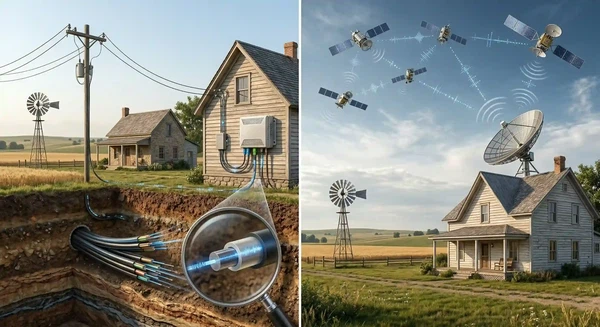
Satellite internet sends data between a ground terminal (the user's dish), satellites in orbit, and gateway stations on the ground. Traditional geostationary (GEO) satellite providers like HughesNet and Viasat use satellites parked roughly 36,000 km above Earth. At that altitude, the round-trip signal path introduces latency that typically exceeds 600 milliseconds - enough to make video calls choppy and online gaming nearly unusable.
The landscape shifted dramatically with LEO constellations, most notably SpaceX's Starlink. LEO satellites orbit at around 340–550 km, cutting the signal path by a factor of roughly 65. According to Ookla's 2025 analysis, Starlink now delivers a median download speed of approximately 105 Mbps with median latency around 45 ms - a massive improvement over legacy satellite, though still behind fiber on both metrics.
Fiber vs Satellite Internet: Side-by-Side Comparison
| Factor | Fiber | Satellite (LEO / Starlink) | Satellite (GEO / Legacy) |
|---|---|---|---|
| Typical download speed | 300 Mbps – 10 Gbps | 75 – 220 Mbps | 25 – 50 Mbps |
| Typical upload speed | 300 Mbps – 10 Gbps (symmetrical) | 8 – 25 Mbps | 1 – 3 Mbps |
| Latency | 7 – 14 ms | 20 – 60 ms | 450 – 700 ms |
| Weather sensitivity | Minimal | Moderate (rain/snow can reduce speeds 10–20%) | High (rain fade common) |
| Data caps | Usually none | Priority data; deprioritization during congestion | Hard caps common |
| Equipment cost | Usually included by provider | ~$299 – $499 upfront for terminal | Often leased or included |
| Monthly cost range (U.S.) | $50 – $100 for most residential plans | $90 – $120 for standard residential | $50 – $150 depending on tier and cap |
| Scalability | Very high (electronics upgrade, same cable) | Limited by shared satellite capacity | Low |
| Rural availability | Growing but still limited in remote areas | Available in most locations with clear sky view | Available almost everywhere |
Sources: FCC Measuring Broadband America (fiber latency 8–14 ms); Ookla 2025 Starlink analysis; provider-published plan details as of early 2026. Actual performance varies by location, provider, and network load.
Speed and Latency: What the Numbers Actually Mean for Daily Use
Raw download speed is the metric most people compare first, but for rural users who depend on their connection for work, latency and upload speed often matter more. Here is why.
The FCC's Measuring Broadband America program found that fiber connections typically deliver idle latency between 8 and 14 ms. LEO satellite latency has improved substantially - Starlink reported median latency around 24 ms by late 2025 - but it still fluctuates more than fiber under congestion or adverse weather. Legacy GEO satellite latency above 600 ms makes real-time interaction essentially unworkable.
That latency gap has direct consequences. A 50 ms round trip on satellite is tolerable for a single video call, but stack two concurrent Zoom meetings, a cloud backup running in the background, and a kid streaming video, and the experience degrades. On fiber, even modest gigabit plans handle that mix without noticeable friction because both the speed and the response time remain consistent under load.
Upload speed is the other overlooked factor. Fiber typically offers symmetrical speeds - 500 Mbps down and 500 Mbps up, for example. Starlink's upload averages 8–25 Mbps. For a single user browsing and streaming, that is fine. For a farm running IP security cameras that upload continuously, or a home office sending large design files to clients, asymmetrical upload becomes a bottleneck.
Reliability: Weather, Obstructions, and Consistency
Fiber's physical signal path is enclosed in cable, making it largely immune to rain, snow, wind, and atmospheric interference. Once installed, a well-maintained fiber optic cable delivers stable performance year-round. The main reliability risks for fiber are physical damage - backhoe cuts, rodent damage, or severe flooding - rather than day-to-day weather variation.
Satellite connections are more exposed. Heavy rain or snow can reduce LEO satellite throughput by 10–20 percent temporarily. Starlink terminals include a built-in heater to melt snow accumulation on the dish, but users in heavily forested areas face a separate problem: the dish needs a clear 100-degree view of the sky to maintain a stable link. Trees, barns, silos, or terrain obstructions that block even part of that view can cause intermittent drops. In practice, this means a satellite dish that works perfectly in an open field may struggle when relocated 50 meters to a site with partial tree cover.
For mission-critical rural applications - telehealth consultations, point-of-sale systems, alarm monitoring - fiber's consistency advantage is significant. When the connection cannot afford intermittent drops during a patient consult or a transaction, wired infrastructure provides a level of predictability that satellite cannot fully match.
Availability: The Constraint That Often Decides
This is where satellite's advantage is clearest. LEO satellite service can reach virtually any location with an unobstructed view of the sky. No trenching, no pole attachments, no waiting for a provider to extend infrastructure to your road.
Fiber deployment, by contrast, requires physical infrastructure - underground conduit or aerial cable - to reach each premises. According to the Fiber Broadband Association, fiber now passes roughly 56.5 percent of U.S. households, with strong growth driven by federal programs like the BEAD initiative and USDA's ReConnect Program. But rural rollout remains uneven. A property one mile past the end of an existing fiber route may face a build-out cost of tens of thousands of dollars, or a wait of years for subsidized expansion.
In many rural decisions, this means the real question is not "which technology is better?" but "which technology can I actually get installed at my address within a reasonable timeframe?" Satellite answers that question faster. Fiber answers it better - but only if and when the infrastructure reaches you.
Cost: How to Compare the Full Financial Picture
Comparing monthly plan prices alone is misleading. A realistic cost comparison for rural internet should account for at least four components: equipment, installation, monthly service, and what you give up in performance.
Fiber residential plans in the U.S. typically range from $50 to $100 per month for speeds between 300 Mbps and 1 Gbps, with equipment usually included by the provider. Installation may be free in areas with existing infrastructure, or it may involve a construction fee if the provider needs to extend the line to your premises.
Starlink's standard residential plan runs approximately $120 per month (as of early 2026), with a one-time hardware purchase of roughly $299 to $499 depending on the terminal model and any current promotions. That upfront cost is a meaningful difference - over a three-year span, a Starlink subscriber may pay $1,500–$2,000 more than a fiber subscriber on a comparable plan, while receiving lower speeds and higher latency.
However, if fiber is not available and the alternative is legacy GEO satellite at 25 Mbps with a 50 GB data cap, or no internet at all, Starlink's cost becomes far more justifiable. Cost evaluation only makes sense relative to the options that are actually deployable at your address.
Scalability: Planning for Growth, Not Just Today's Needs
One factor that many comparison guides underweight is how well each technology scales as your needs grow. A household that uses 200 Mbps today may need 500 Mbps in two years as more devices connect, more work moves to the cloud, and video resolution keeps climbing.
Fiber scales efficiently. Upgrading from a 500 Mbps plan to a 2 Gbps plan on the same fiber line is typically a software change or an electronics swap - not a new installation. The underlying glass can support capacities far beyond what any household or small business currently requires. For rural communities, schools, or clinics planning multi-year connectivity strategies, this headroom is a meaningful advantage. Learn more about fiber-to-the-home network design in our beginner's guide to FTTH.
Satellite capacity is shared across all users within a coverage beam. As more subscribers join in a given area, per-user throughput can decline during peak hours. SpaceX continues to launch additional satellites to add capacity - the constellation's total throughput grew from roughly 40 Tbps in 2022 to around 445 Tbps by late 2025 - but scaling satellite bandwidth requires launching and maintaining physical hardware in orbit, which is fundamentally more constrained than upgrading ground-based electronics.
Best Use Cases: Matching the Technology to the Workload
Remote Work and Home Offices
If your work involves frequent video calls, screen sharing, cloud-based tools, or uploading large files, fiber is the stronger choice whenever it is available. The combination of low latency, symmetrical upload, and consistent performance under multi-device load makes a material difference. A 30 ms latency spike during a video call with a client is tolerable; a 200 ms spike during a screen-share presentation is noticeable and disruptive.
Satellite can work for lighter remote work - email, asynchronous collaboration, occasional video calls - but users who depend on real-time interaction for several hours per day will feel the difference, especially during evening peak hours when satellite networks are most congested.
Farms with Connected Equipment
Modern precision agriculture increasingly depends on connectivity: IP cameras monitoring livestock, soil sensors uploading data, GPS-guided equipment, and weather stations feeding real-time dashboards. These applications generate steady upstream traffic and benefit from low-latency responsiveness. Fiber to the farmstead supports these workloads reliably. The USDA estimates that full-scale adoption of connected agricultural technologies could generate $47 billion in annual economic benefit - but only with dependable broadband reaching the fields, not just the farmhouse.
Where fiber cannot reach the property, satellite provides a viable baseline - sufficient for camera feeds and sensor data at moderate resolution, though upload constraints may limit simultaneous high-bandwidth streams.
Seasonal Cabins, Off-Grid Properties, and Temporary Sites
Satellite is often the better fit here. A cabin used four months per year does not justify the cost of a fiber build-out. A construction site that needs connectivity for 18 months benefits from satellite's portability and rapid setup. Starlink's standard residential kit can be installed and operational in under an hour with no provider visit required.
Schools, Clinics, and Community Hubs
Multi-user sites with high reliability requirements - rural clinics running telehealth, schools supporting 50 or more simultaneous student connections, community centers offering public internet access - should prioritize fiber whenever deployment is feasible. The FCC's 2024 broadband report set a long-term goal of 1 Gbps download and 500 Mbps upload precisely because modern institutional use demands that level of capacity. Satellite cannot consistently deliver those speeds to a site serving dozens of concurrent users.
Hybrid Approach: Fiber Where Viable, Satellite Where Needed
In large rural service areas - a county, a cooperative territory, a tribal region - the most realistic broadband strategy is often a hybrid model. Fiber serves the homes, businesses, and institutions that can be reached economically through existing or subsidized infrastructure. Satellite fills in the scattered locations where terrain, distance, or cost make fiber deployment impractical in the near term.
This is not a compromise - it is how most successful rural broadband programs are structured. The USDA's ReConnect Program and the NTIA's BEAD initiative both fund fiber-first deployments while acknowledging that some locations will require alternative technologies. A hybrid strategy also provides redundancy: a clinic with fiber as its primary connection and a Starlink terminal as failover has meaningfully better uptime than either technology alone.

How to Choose: A Decision Framework for Rural Internet
Step 1: Check address-level availability. Do not compare technologies in the abstract. Use the FCC National Broadband Map and contact local providers to confirm what can actually be installed at your specific address - not your zip code, not your county, but your premises.
Step 2: Define your actual workload. List the devices, applications, and usage patterns that will run on this connection. Be specific: how many simultaneous video calls? Do you upload large files? Do you run security cameras or IoT sensors? A household streaming Netflix has different requirements than a home office with three concurrent Zoom meetings and a cloud backup running.
Step 3: Weigh latency requirements. If your workload is latency-sensitive - real-time video, VoIP, gaming, remote desktop - fiber's 8–14 ms latency will feel noticeably better than satellite's 25–60 ms. If your usage is primarily streaming and browsing, the latency gap matters less.
Step 4: Calculate total cost over three years. Include equipment purchase, installation or construction fees, monthly service charges, and any expected upgrade costs. A technology that costs more monthly but avoids a $5,000 build-out fee may be the rational choice for a seasonal property. Conversely, investing in fiber installation today often pays back within two to three years through lower monthly costs and better performance.
Step 5: Factor in growth. Where will your bandwidth needs be in three years? If you expect to add devices, hire remote employees, or expand connected operations, fiber's upgrade headroom becomes a significant advantage. Choosing satellite today because it is faster to install, then switching to fiber in two years when it arrives, is also a valid strategy - just make sure you are not locking into a long-term commitment that penalizes the switch.
FAQ
Is satellite internet fast enough for remote work in rural areas?
For lighter remote work - email, document editing, occasional video calls - LEO satellite like Starlink is generally sufficient. For heavy remote work involving multiple hours of daily video conferencing, large file transfers, or real-time collaboration tools, fiber's lower latency and higher upload speed provide a meaningfully better experience. The gap is most noticeable when multiple users or devices share the connection simultaneously.
How does latency affect video calls and gaming on satellite vs fiber?
Fiber latency typically ranges from 7 to 14 ms, which is imperceptible in video calls and competitive gaming. LEO satellite latency of 25–60 ms is workable for video calls but can introduce slight audio delay. For competitive multiplayer gaming, even 40–50 ms of additional latency affects responsiveness. GEO satellite latency above 600 ms makes real-time interaction essentially unusable for both applications.
Is fiber always cheaper than satellite internet?
On a monthly basis, fiber plans are often less expensive than Starlink for comparable or better performance. However, if fiber is not already available at your address, the build-out cost to extend the line can range from a few hundred to tens of thousands of dollars depending on distance. In those cases, satellite may be the more cost-effective option in the short term, even if the monthly rate is higher. The right comparison is total cost of ownership over your expected usage period, including equipment, installation, and service charges.
Can Starlink replace fiber for a rural business?
For a single-user or light-use business, Starlink can work as a primary connection. For businesses that depend on consistent upload speeds, serve multiple concurrent users, or run latency-sensitive applications like VoIP or cloud-hosted software, fiber remains the more dependable choice. Some rural businesses use Starlink as a backup connection alongside a primary fiber or fixed wireless link, which provides both performance and redundancy.
What is a hybrid fiber-satellite setup, and when does it make sense?
A hybrid setup uses fiber as the primary connection for speed and reliability, with satellite as a failover or secondary link. This makes sense for rural sites where uptime is critical - clinics, emergency services, businesses - or for areas where fiber covers most of the community but a few outlying properties cannot be reached cost-effectively. It also applies at a network planning level: a cooperative or municipality might deploy fiber to clustered homes and use satellite to serve the most remote addresses.
Should I wait for fiber or sign up for satellite now?
If you have no usable internet today and fiber rollout in your area is uncertain or more than a year away, signing up for satellite now is a reasonable decision. You gain immediate connectivity without a long-term contract in most cases. If fiber arrives later, you can switch. However, if your local utility or cooperative has confirmed fiber construction within six months, waiting may save you the cost of satellite equipment and the hassle of switching.
How does weather affect satellite internet performance?
Heavy rain, dense snow, and thick cloud cover can reduce LEO satellite speeds by 10–20 percent temporarily. Complete outages during storms are uncommon but possible. Starlink dishes include heaters to melt snow accumulation, though heavy wet snow or ice may still require manual clearing. Fiber connections are generally unaffected by weather, aside from catastrophic events like flooding or ice storms that physically damage the cable infrastructure.
What role do federal programs play in rural fiber deployment?
The NTIA's BEAD program, funded at $42.5 billion, is the largest-ever federal investment in broadband infrastructure and prioritizes fiber deployment in unserved and underserved areas. USDA's ReConnect Program provides additional loans and grants specifically for rural broadband. These programs are expected to significantly expand rural fiber availability over the next three to five years, though construction timelines vary by state and terrain. You can check the FCC's broadband map for current availability at your address.
Final Verdict
For rural users who can get fiber, fiber is the better choice by nearly every performance measure: speed, latency, upload capacity, reliability, and long-term scalability. It is the technology that handles growing workloads, supports multiple concurrent users, and holds up in the conditions - weather, distance, terrain - that define rural connectivity challenges.
For rural users who cannot get fiber today, LEO satellite internet has transformed what is possible. Starlink and emerging competitors deliver broadband-grade speeds to locations that had no viable option five years ago. The service is not equal to fiber, but it is genuinely good - and for millions of rural addresses, it is the best option currently available.
The strongest rural broadband strategies treat these technologies as complementary: fiber where it can be built, satellite where it cannot - yet. Start by checking what is actually available at your address, match the technology to your real workload, and plan for where your needs will be in three years, not just where they are today.