






Fiber optic cable gives very fast speeds. The fastest ever is 1.02 petabits per second. Home fiber internet can go up to 10 Gbps. You need fast internet for streaming, gaming, and working from home. Fiber gives you great performance and little lag. Here is how fiber compares:
|
Connection Type |
Download Speed |
Upload Speed |
|---|---|---|
|
DSL |
5-120 Mbps |
1-20 Mbps |
|
Cable |
10 Mbps-1 Gbps |
5-50 Mbps |
|
Fiber |
200 Mbps-20 Gbps |
200 Mbps-20 Gbps |
More than half of U.S. homes now use fast fiber-optic internet. Think about how fast internet can help you work and have fun. This is why fiber optic speed is better.
Key Takeaways
Fiber optic internet can be as fast as 10 Gbps. This speed is great for streaming, gaming, and working from home. Fiber connections have very low latency. Latency is usually between 5 and 20 milliseconds. This helps your online activities run smoothly. Fiber optic technology is more reliable than DSL or cable. It keeps speeds steady, even when many people are online. Using new equipment, like a good router, can make your fiber internet better. It can help you get the fastest speeds. Picking fiber optic internet gets you ready for new technology. It can handle faster speeds without needing new cables.
Maximum Fiber Optic Cable Speed
Theoretical Limits
You might ask how fast fiber optic cable can go. The answer depends on science and technology. Fiber optic cable uses light to send data through glass. Data moves almost as fast as light, up to 99.7% of light speed. This means data travels very quickly over long distances.
New fiber optic improvements make speeds even faster. In labs, scientists have reached speeds of 402 terabits per second. These tests show how powerful fiber optic cables can be. You cannot get these speeds at home yet. But they prove fiber optic cable is the fastest way to send data.
- Theoretical speed limits depend on how fast light travels.
- Fiber optic networks work at almost the speed of light.
- Lab tests reached speeds of 402 Tbps.
- Fiber optic technology keeps getting better and more reliable.
Real-World Fiber Optic Cable Speeds
Your fiber optic cable speed depends on where you live and your provider. Most homes in the U.S. get fiber internet from 200 Mbps to 2,000 Mbps. Brightspeed offers up to 2,000 Mbps. Google Fiber gives average speeds of 279 Mbps. These speeds let you stream 4K videos, play games, and work from home with no lag.
You get great performance with fiber-optic internet. Business customers can get even higher speeds. Some companies offer up to 100 Gbps for big businesses. This lets businesses use cloud apps, video calls, and send large files with no slowdowns.
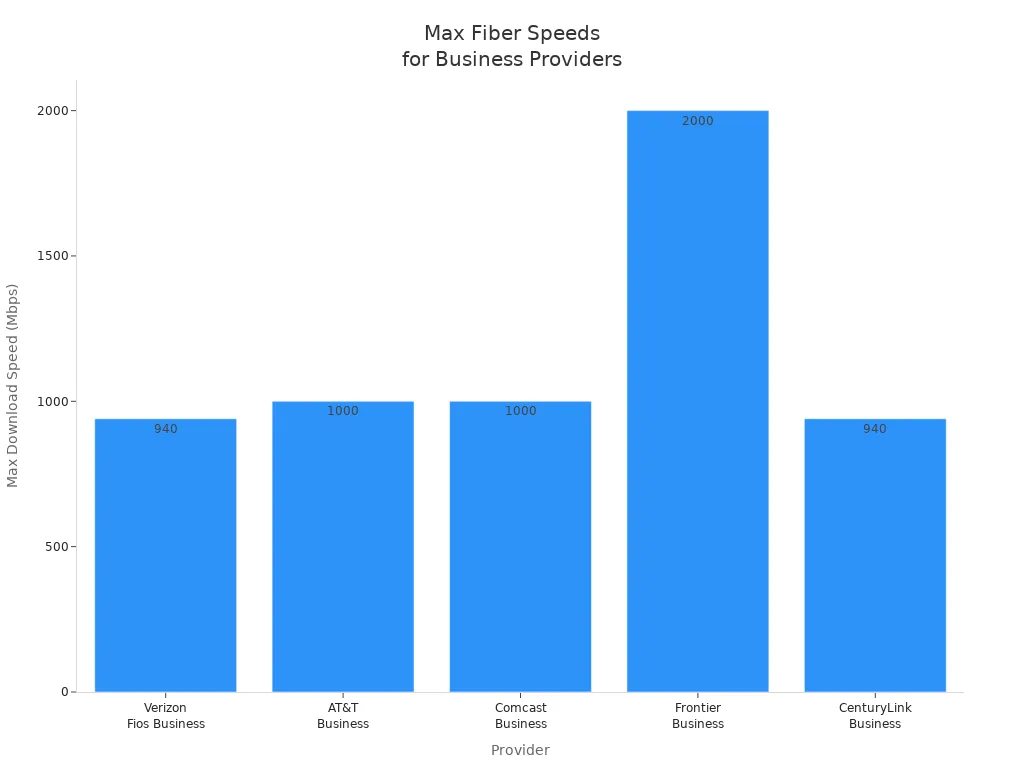
Here is a table showing top fiber optic cable speeds from business providers:
|
Provider |
Maximum Download Speeds |
Data Caps |
Starting Monthly Price |
|---|---|---|---|
|
Verizon Fios Business |
200–940 Mbps |
Unlimited |
$69.00 |
|
AT&T Business |
50–1,000 Mbps |
Unlimited |
$50.00 |
|
Comcast Business |
100 Mbps–1 Gbps |
Unlimited |
$69.95 |
|
Frontier Business |
500 Mbps–2 Gbps |
N/A |
$54.99 |
|
CenturyLink Business |
140–940 Mbps |
Unlimited |
$65.00 |
You can see the differences in fiber optic cable speeds for businesses in this chart:
Most people in the U.S. get average fiber-optic internet speeds of 204 Mbps for downloads and 74 Mbps for uploads. These speeds are much faster than DSL or cable internet. You get quicker downloads, smoother video calls, and better gaming.
|
Speed Type |
Average Speed (Mbps) |
|---|---|
|
Download |
204 |
|
Upload |
74 |
Fiber optic cable also gives you the lowest latency. You only get 5–20 milliseconds of delay. Cable has 15–30 ms, and DSL has 20–50 ms. This means your online actions happen almost right away.
|
Internet Type |
Latency (ms) |
Speed (Mbps) |
Availability |
|---|---|---|---|
|
Fiber |
5–20 |
100–1000+ |
25–40% |
|
Cable |
15–30 |
25–500 |
Widespread |
|
DSL |
20–50 |
1–35 |
Nearly universal |
|
4G Mobile |
30–50 |
10–50 |
Variable |
|
5G Mobile |
10–20 |
100–1000 |
Limited |
You get fast fiber optic cable speeds for streaming, gaming, or business. Fiber optic cable gives you high-speed internet with great reliability. Fiber optic technology is the best choice for fast, safe, and future-ready connections.
Fiber Optic Internet Speed vs. Other Types
Fiber optic internet is much faster than other types. It is also more reliable and works better. Fiber sends data quickly and has low latency. This makes it great for homes and businesses.
DSL Comparison
DSL uses copper phone lines for internet. These lines are not as fast or reliable. You may get slow downloads and uploads. Streaming and gaming can be hard with DSL. In 2024, the FCC said broadband should be at least 100 Mbps download and 20 Mbps upload. Most DSL plans do not reach these speeds.
- In the U.S., average DSL download speed is 209.01 Mbps.
- Average DSL upload speed is 61.98 Mbps.
- You can see the difference in the numbers:
|
Internet Type |
Download Speed (Mbps) |
|---|---|
|
DSL |
5-35 |
|
Fiber Optic |
250-1000 |
Fiber optic cable is up to 100 times faster than DSL. You get better video calls and faster downloads. Gaming works better too. Fiber-optic internet gives you the same speed for uploads and downloads.
Cable Internet Comparison
Cable internet uses coaxial cables. It is faster than DSL but slower than fiber. Most cable providers offer up to 1 or 2 Gbps. Upload speeds are much lower than download speeds.
|
Provider |
Average Speed |
Maximum Speed |
|---|---|---|
|
Spectrum |
N/A |
2 Gbps |
|
Xfinity |
N/A |
1.2 Gbps |
|
Xfinity |
N/A |
1 Gbps |
|
Internet Type |
Download Speed |
Upload Speed |
|---|---|---|
|
Cable Internet |
5 Mbps to 50 Mbps |
Varies, usually lower |
|
Fiber Optic Internet |
250 Mbps to 8 Gbps |
Same as download |
Fiber optic internet is 10 to 20 times faster than cable. You get quick downloads and smooth gaming. Streaming works without lag. Fiber supports many devices at once.
Satellite Internet Comparison
Satellite internet is good for rural areas. It has slower speeds and higher latency. Data travels far to satellites. Weather can make your connection worse.
|
Type of Satellite |
Average Latency |
Typical Speeds |
|---|---|---|
|
GEO Satellites |
~500 ms |
N/A |
|
LEO Satellites |
~50 ms |
N/A |
- Starlink's median latency went from 76 ms in Q2 2022 to 45 ms in Q1 2025.
- Starlink's LEO satellites have lower latency than GEO satellites.
- Starlink's technology works for real-time communication.
|
Feature |
Fiber Optic Internet |
Satellite Internet |
|---|---|---|
|
Speed |
Offers speeds of 1 Gbps, 10 Gbps, or higher |
Usually offers 25 Mbps to 200 Mbps |
|
Upload Speed |
Uploads and downloads are the same speed |
Uploads are slower than downloads |
|
Latency |
Very low latency |
High latency because data travels far |
|
Reliability |
Not affected by weather |
Weather can cause problems |
Fiber gives you fast and reliable internet. Satellite is okay for basic browsing. Fiber is best for streaming, gaming, and smart home devices. Fiber keeps your connection strong, even in storms.
Tip: If you want the fastest internet for work or fun, choose fiber. You will not get slowdowns or interruptions like with DSL, cable, or satellite.
Factors Affecting Fiber Optic Cable Speeds
Fiber optic cable gives very fast internet. But some things can slow it down. You should know these things to get the best speed.
Hardware and Equipment
Your devices matter for fiber optic speed. Old computers or phones may not go as fast. Devices need to work with gigabit speeds. Good Ethernet ports help too. You need a modern router for fiber internet. Routers with dual or tri-band and MU-MIMO work better.
- Get a new router for faster fiber speeds.
- Use devices that work with gigabit connections.
- Check your Ethernet cables; old ones can slow you down.
Provider Limits
Your internet provider sets your top speed. Providers have different plans with speed limits. Pick a plan that fits your needs. Some providers slow speeds when many people use the internet. They may also have data caps.
Tip: Look at your provider's speed promises. Compare them with fiber speed tests to make sure you get what you pay for.
Network Congestion
Network congestion can slow fiber speeds. This happens when lots of people use the internet at once. Fiber networks stay fast even with many users. Other internet types can drop to half speed during busy times. Fiber keeps full speed because it has more bandwidth.
|
Cause of Congestion |
Description |
|---|---|
|
Excessive Bandwidth Consumption |
Some users or devices use more bandwidth, slowing others down. |
|
Misconfigured Traffic |
Traffic needs to be sorted to stop congestion. |
|
Poor Subnet Management |
Too much traffic can make the network give out resources. |
|
Outdated Hardware |
Old devices can block data and slow things down. |
|
Unwanted Traffic |
Big uploads or ads can make the network slower. |
Single mode and multimode fiber types change speed and bandwidth. Single mode fiber has a small core. It sends more data farther with less loss. Multimode fiber has a bigger core. It sends more light modes but loses signal faster and does not go as far.
|
Fiber Type |
Core Diameter |
Light Modes |
Bandwidth Capacity |
Transmission Distance |
Attenuation Level |
|---|---|---|---|---|---|
|
Single Mode |
9 µm |
1 |
Unlimited |
Long |
Low |
|
Multimode |
50/62.5 µm |
Multiple |
Limited |
Short |
High |
Think about these things when picking fiber internet. This helps you get the fastest fiber optic speed for your home or business.
Fiber Internet for Everyday Use
Fiber internet makes using technology easier every day. You get faster speeds and better reliability. Your online activities work smoother. Fiber is great for streaming, gaming, and smart home devices.
Streaming and Video Calls
You can watch movies in 4K with no interruptions. Fiber optic cable gives you enough bandwidth for high-quality streaming. You do not get buffering. Your video stays clear, even if your family streams too. Fiber lines are underground. This keeps your connection stable. Outages happen less often.
|
Characteristic |
Description |
|---|---|
|
Speed |
Streaming 4K video uses up to 10 GB per hour. Fiber handles this easily. |
|
Low Latency |
Fiber has almost no lag. Video calls and streaming stay smooth. |
|
Reliability |
Underground fiber lines mean fewer problems. |
|
Multi-device Support |
Fiber lets many devices work at once without slowing down. |
For video calls, Zoom and Microsoft Teams need at least 20 Mbps download and 5 Mbps upload. Fiber-optic internet gives you more than these speeds. You do not worry about dropped calls or blurry video.
Tip: Fiber lets you stream, work, and talk to friends at the same time. You do not get slowdowns.
Gaming and Downloads
Online gaming needs low latency and fast speed. Fiber keeps lag low and ping under 20 ms. This helps you play better. You download big games and updates quickly. Fiber's connection stays strong, even if others use the internet.
- Fiber keeps latency and ping low for gaming.
- Fast data means less lag and fewer disconnects.
- You download new games or updates in minutes.
Smart Home Devices
Smart homes need good internet for cameras and speakers. Fiber supports many devices at once. Speed and performance do not drop. Smart speakers use less than 0.5 Mbps. High-definition cameras need 2–4 Mbps. Fiber handles all your devices. Your home stays connected and safe.
|
Device Type |
Bandwidth Requirement (Mbps) |
|---|---|
|
Smart Speakers |
< 0.5 |
|
Standard Definition Cameras |
1–2 |
|
High Definition Cameras |
2–4 |
With fiber, you can stream videos, play games, and use smart devices together. You get top performance and peace of mind for your connected home.
Fiber optic cable gives you the fastest internet you can get. You can stream videos without buffering. Games run smoothly with no lag. Downloads finish very quickly. Experts say fiber has many good points:
- Bandwidth: Fiber can handle data rates up to 10 Gbps or more.
- Speed: Data moves almost as fast as light.
- Low attenuation: The signal does not lose much strength, even far away.
With fiber, you get:
- Download speeds up to 10 Gbps for fast streaming and gaming.
- Very low latency, so multiplayer games work better.
- Upload and download speeds are the same, which helps with sharing files.
- Reliable connections with less chance of interference.
You can look up fiber choices in your area on BroadbandNow, HighSpeedInternet, or InMyArea by typing in your zip code. Picking fiber gives you a better online experience and gets you ready for the future.
FAQ
Why does fiber optic cable provide faster internet than other types?
Fiber optic cable sends data using light. Light moves almost as fast as possible. You get more bandwidth and less delay. This means downloads and uploads are much quicker. Fiber optic cable works better than copper or satellite.
Why should you choose fiber internet for your home or business?
Fiber internet gives you fast speeds and strong performance. Upload and download speeds are the same. Fiber optic cable lets many devices work together. You can stream, play games, and work from home with no lag.
Why do fiber optic cable speeds stay consistent during peak hours?
Fiber optic cable has lots of bandwidth. The network can handle many users at once. Your speed stays steady even when everyone is online. This is a big advantage for fiber optic cable.
Why is fiber optic technology considered future-proof?
Fiber optic cable can get faster with new equipment. You do not need to change the cables. You can expect better speeds as technology improves. Fiber optic cable is a smart choice for the future.
Why do fiber optic speed tests often show better results than other internet types?
Fiber optic cable gives low delay and fast speeds. The network uses advanced fiber optic cable. This means less signal loss and fewer problems. You get the best internet performance possible.