





G.657.A1 is a bend-insensitive single-mode fiber defined by ITU-T Recommendation G.657, designed for a minimum bend radius of 10 mm while remaining fully compliant with G.652.D. It is widely used in FTTH access networks, in-building cabling, and distribution patching - anywhere installers need better bend tolerance than standard fiber without sacrificing network interoperability.
This guide covers the technical specifications of G.657.A1 fiber, how it compares with G.657.A2 and G.652.D, where it performs best, and how to decide whether it fits your deployment.

What Is G.657.A1 Fiber?
G.657.A1 belongs to Category A of the ITU-T G.657 standard - the category optimized for reduced macrobending loss compared with G.652.D fiber, while retaining the same transmission and interconnection properties. According to the current edition of the standard (ITU-T G.657, August 2024), Category A fibers are a subset of G.652.D, meaning they can be deployed in any network where G.652.D is specified.
The "A1" subcategory specifically supports a minimum design bend radius of 10 mm. At that radius (one turn at 1550 nm), the maximum allowable macrobending loss is 0.75 dB; at a 15 mm radius with ten turns at 1550 nm, the limit is 0.25 dB. These numbers represent roughly a tenfold improvement over standard G.652.D fiber at equivalent bend radii.
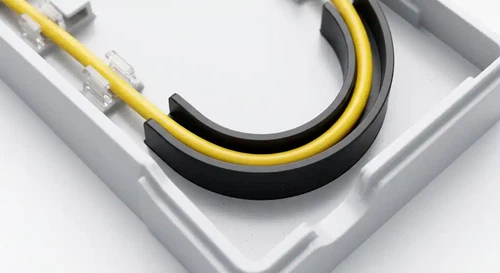
In practice, this means G.657.A1 handles the kind of routing that occurs in access distribution cabinets, riser pathways, wall-mounted terminals, and patching enclosures - scenarios where fiber must navigate corners and confined spaces that would push conventional single-mode fiber beyond its reliable bend tolerance.
G.657.A1 Technical Specifications at a Glance
| Parameter | G.657.A1 Value |
|---|---|
| Minimum design bend radius | 10 mm |
| Macrobending loss (1 turn, R=10 mm, 1550 nm) | ≤ 0.75 dB |
| Macrobending loss (1 turn, R=10 mm, 1625 nm) | ≤ 1.50 dB |
| Macrobending loss (10 turns, R=15 mm, 1550 nm) | ≤ 0.25 dB |
| Macrobending loss (10 turns, R=15 mm, 1625 nm) | ≤ 1.00 dB |
| Operating wavelength range | 1260–1625 nm (O, E, S, C, L bands) |
| Mode field diameter (1310 nm) | 8.6 ± 0.4 µm |
| Maximum attenuation (1310 nm) | ≤ 0.35 dB/km |
| Maximum attenuation (1550 nm) | ≤ 0.22 dB/km |
| G.652.D compliance | Full (subset of G.652.D) |
Source: ITU-T Recommendation G.657 (08/2024) and the ITU-T G.657 fibre informational flyer.
G.657.A1 vs G.657.A2 vs G.652.D: Key Differences
One of the most common questions from network planners is whether to specify A1, A2, or stay with standard G.652.D. The answer depends on the bend conditions your deployment actually involves - not on which fiber looks best on paper.
| Attribute | G.652.D | G.657.A1 | G.657.A2 |
|---|---|---|---|
| Minimum design bend radius | 30 mm | 10 mm | 7.5 mm |
| Macrobending loss (1 turn, R=10 mm, 1550 nm) | Not specified | ≤ 0.75 dB | ≤ 0.10 dB |
| Macrobending loss (10 turns, R=15 mm, 1550 nm) | Not specified for this radius | ≤ 0.25 dB | ≤ 0.03 dB |
| G.652.D compliant | Yes (is G.652.D) | Yes (full subset) | Yes (full subset) |
| Primary use case | Long-haul, metro, trunk | Access networks, in-building, FTTH distribution | Tight indoor terminations, compact ONT boxes, high-density data center patching |
The 2.5 mm difference between A1 (10 mm) and A2 (7.5 mm) may look small on a specification sheet, but it matters at the installation level. In a standard multi-dwelling unit (MDU) riser or a distribution cabinet with moderate cable density, A1's 10 mm radius is typically sufficient. The fiber can route around corners, through cable guides, and into splice trays without exceeding its loss limits.
A2 becomes the stronger choice when the fiber must coil tightly inside small wall-mounted ONT boxes, navigate compact outlet terminals, or survive the dense patching environment of a high-fiber-count data center where cable bends routinely fall below 10 mm. In the 2024 edition of the standard, ITU-T merged the former Category B2 into A2, reflecting the industry's shift toward A2 as the go-to option for these tighter environments.
For networks with straightforward routing - long outside-plant runs, duct-based trunk lines, or any path where fiber is unlikely to encounter bends below 30 mm - standard G.652.D remains perfectly adequate and is often the most cost-effective option.

Where G.657.A1 Fiber Is Used
FTTH Access Networks
G.657 fiber was originally developed to meet the demands of broadband optical access networks. The ITU-T standard explicitly links Category A fiber to FTTH deployment, where the high-density distribution of drop cables and the many handling points between the central office and the subscriber require fiber that tolerates repeated bending without unacceptable signal loss. G.657.A1 addresses this by providing roughly ten times better macrobending performance than G.652.D, according to the ITU-T informational material.
In-Building Routing and Riser Cabling
Inside buildings, fiber paths often pass through tight risers, turn through corridor ducts, and terminate in compact wall boxes. The ITU-T standard notes that limited space and frequent cable manipulation in these environments call for operator-friendly fiber with low bending sensitivity. G.657.A1 suits riser cabling, corridor distribution, and MDU vertical wiring - situations where a 10 mm bend radius provides enough margin for normal installation handling.
Distribution Cabinets and Patching Areas
Central office patch panels, street cabinets, and fiber distribution hubs involve dense cable management. When dozens or hundreds of fibers share a single enclosure, individual fibers inevitably take sharper bends around cable guides and splice organizers. A1 fiber reduces the risk of elevated attenuation in these environments without requiring the tighter (and sometimes more expensive) A2 grade.
Datacentre Network Cabling
The August 2024 revision of ITU-T G.657 formally extended the application space for Category A fiber to include datacentre networks. In structured cabling within racks and patch panels, bend-insensitive fiber helps maintain signal integrity even when cables are routed through tight cable management trays.

Benefits of G.657.A1 Fiber
Practical bend tolerance for most access deployments. G.657.A1 does not aim to be the most aggressive bend-insensitive fiber - that role belongs to G.657.B3 with its 5 mm minimum radius. Instead, A1 delivers enough bend resilience for the majority of access, distribution, and in-building scenarios, which is what makes it widely adopted.
Full G.652.D interoperability. Because A1 fibers are a subset of G.652.D, they splice and connect with existing G.652.D infrastructure without additional loss penalties. For operators upgrading portions of an existing network, this means A1 fiber can be introduced at the access end without replacing trunk fiber or changing splicing procedures.
Reduced installation risk. ITU-T documentation describes G.657 fiber as enabling more engineer-friendly installation with less rework, smaller cabinets, and tighter enclosures. In field conditions - where cable paths do not always match design drawings - this translates to fewer call-backs for attenuation issues caused by inadvertent bends during installation.
Full-spectrum operation. A1 supports the O, E, S, C, and L bands (1260–1625 nm), which means it works with current GPON, XGS-PON, and next-generation WDM-PON systems without wavelength restrictions.
How to Choose: G.657.A1, A2, or G.652.D?
Fiber selection should follow the deployment, not the other way around. Here is a practical decision framework:
Choose G.652.D when:
- Your cable routes are in ducts, trenches, or aerial spans with no tight bends below 30 mm.
- The network is predominantly long-haul or metro trunk.
- Budget optimization is the primary driver and bend tolerance is not a concern.
Choose G.657.A1 when:
- You are deploying FTTH distribution and drop networks where fiber passes through cabinets, risers, and wall-mounted hardware.
- Your cable routes include bends in the 10–15 mm range - common in distribution cabinets and indoor cabling.
- You need full backward compatibility with an existing G.652.D network.
- Installation crews work in moderately constrained spaces but not ultra-compact termination points.
Choose G.657.A2 when:
- Fiber must coil inside small ONT boxes, compact wall outlets, or high-density patch panels where bends routinely fall below 10 mm.
- You are building a high-fiber-count data center interconnect with very tight cable management.
- The deployment involves pre-connectorized assemblies or factory-terminated cable that must survive tight coiling during storage and handling.
A common procurement mistake is specifying A2 across an entire network "just in case," when only the last 50–100 meters of drop cable and the termination point actually encounter bends below 10 mm. A more cost-effective approach is to use A1 for the distribution segment and reserve A2 for the subscriber termination, where tight coiling is concentrated.
Can G.657.A1 Replace G.652.D?
Technically, yes - in any network where G.652.D is specified, G.657.A1 can be used as a direct replacement because it meets all G.652.D requirements while adding better bend performance. The ITU-T standard is explicit on this point: Category A fibers have the same transmission and interconnection properties as G.652.D.
Whether replacing G.652.D with A1 makes practical sense depends on the deployment. For long outside-plant trunk runs where the fiber never encounters tight bends, the upgrade to A1 adds cost without adding value. For access distribution, indoor cabling, and any path that enters a building or cabinet, the upgrade is often worthwhile because it reduces the risk of bend-related attenuation during and after installation.
FAQ
What bend radius does G.657.A1 support?
G.657.A1 is designed for a minimum bend radius of 10 mm. At that radius (one turn, 1550 nm), the maximum allowable macrobending loss is 0.75 dB. At a more moderate 15 mm radius with ten turns, the loss limit drops to 0.25 dB at 1550 nm.
Is G.657.A1 compatible with G.652.D?
Yes. G.657.A1 is fully compliant with G.652.D - it is defined as a subset of G.652.D in the ITU-T standard. This means A1 fiber can be spliced and connected to existing G.652.D fiber without additional loss or compatibility issues.
What is the difference between G.657.A1 and G.657.A2?
The primary difference is minimum bend radius: A1 supports 10 mm while A2 supports 7.5 mm. A2 also has significantly lower macrobending loss at equivalent radii - for example, only 0.10 dB per turn at 10 mm (1550 nm) compared to A1's 0.75 dB. Both are fully compliant with G.652.D. For a deeper comparison, see our guide on the differences between G.657.A1 and G.657.A2.
Is G.657.A1 suitable for FTTH?
G.657.A1 was specifically developed for FTTH and access network deployments. It handles the moderate bends found in distribution cabinets, building risers, and drop cable routing. For the subscriber termination point - where fiber coils inside small ONT boxes - some operators prefer A2 for its tighter bend tolerance.
When should I use G.657.B3 instead of G.657.A1?
G.657.B3 supports a minimum bend radius of just 5 mm and is intended for very short reach distances (under 1,000 m) at the end of access networks - particularly inside buildings, premises, and for optical interconnection in data centres. However, B3 fibers are not fully compliant with G.652.D (they are compatible but may differ in chromatic dispersion and PMD specifications), so they should only be used in short segments where extreme bend tolerance is essential.
Does G.657.A1 work for data centre cabling?
Yes. The 2024 edition of ITU-T G.657 explicitly extended the application space for Category A fibers to include datacentre networks. A1 is suitable for structured cabling and moderate-density patching. For very high-density 400G/800G environments with extremely tight cable management, A2 may be a better fit.