

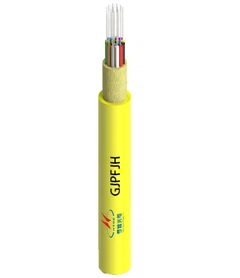


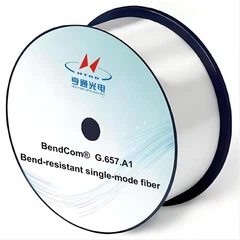
The conventional optical cable has a usage temperature range of -40°C to 70°C. In high-altitude or extremely cold regions, the requirements for the low-temperature performance of optical cables are even more stringent.
.
Why does the coating layer cause fiber losses in low-temperature environments?
Fiber optic cables consist of three main components, arranged from the innermost to outermost: the core, the cladding, and the coating layer. The core and cladding are primarily composed of silicon dioxide (SiO2). Their temperature performance is relatively stable, with a small coefficient of thermal expansion. In contrast, the coating layer is made of resin material, which has a much larger coefficient of thermal expansion compared to SiO2. Therefore, in low-temperature environments, the coating layer contracts more than the core, causing the fiber to be squeezed and stressed, resulting in micro-bending and additional losses.
Looking at it from the perspective of the coating layer's elastic modulus, in low-temperature environments, coating materials with smaller elastic moduli will reduce the stress applied to the fiber under the same contraction conditions. This, in turn, reduces the losses experienced by the fiber at low temperatures.
The composition of fiber optics and microbending losses are shown in the following diagram.


In addition to the material properties of the coating layer itself, the quality of the coating layer also significantly affects the additional attenuation of fiber optics at low temperatures.
1.Uniformity of the coating layer: In cases where the coating layer is uneven and the concentricity of the fiber optic coating is poor, uneven shrinkage of the coating layer is prone to occur in low-temperature environments, exacerbating the additional attenuation of the fiber optics at low temperatures.
2.Bubbles in the coating layer: The thermal expansion coefficient of gases is much greater than that of coating materials. Therefore, in low-temperature environments, the partial shrinkage of bubbles in the coating layer will exceed that of the coating layer itself. This phenomenon can cause the fiber optic to bend to the side of the bubble to a certain extent, resulting in significant additional losses.
3.Impurities in the coating layer: If impurities are introduced into the coating layer during the manufacturing process, differences in the thermal expansion coefficients of different materials will increase the losses of the fiber optics in low-temperature conditions.
In summary, the performance of fiber optics under low temperature conditions is influenced by various factors, including the quality of the coating layer, uniformity of the coating, presence of bubbles, and impurities within the coating layer. These factors can exacerbate additional attenuation and microbending losses in fiber optic cables operating in environments with low temperatures. Therefore, ensuring the quality and uniformity of the coating layer, as well as minimizing the presence of bubbles and impurities, is crucial for maintaining optimal performance of fiber optic systems in cold climates or high-altitude regions.