






Narinder Singh Kapany invented the first fiber optic cable in 1952, changing how you connect and communicate worldwide. This invention made it possible for light to travel through glass fibers, which led to faster and more reliable data transmission. By 1970, fiber optics could send over 65,000 times more information than copper wire. Today, nearly all long-distance communication relies on fiber optics, as shown in the table below:
|
Year |
Statistic |
|---|---|
|
1970 |
Modern fiber optics can send over 65,000 times more information than copper wire. |
|
2000 |
Over 80% of the world's long-distance communication cables are fiber-optic cables. |
|
2023 |
The fiber optics market is estimated to be worth $8.07 billion, increasing from $7.72 billion in 2022. |
|
2023 |
96% of global broadband connections will be faster than 10 Mbps, with 39% faster than 100 Mbps. |
|
2023 |
The fastest optical fiber speed record is 1.7 petabits of data over custom cables. |
Key Takeaways
- Narinder Singh Kapany invented the first fiber optic cable in 1952, revolutionizing global communication by allowing light to travel through glass fibers.
- Fiber optic cables transmit data at speeds up to 70% of the speed of light, offering faster and more reliable connections than traditional copper wires.
- Charles K. Kao's research in the 1960s made long-distance fiber optic communication practical by reducing signal loss, paving the way for modern telecommunications.
- Fiber optics are essential for various applications, including high-speed internet, cable television, and secure communication in industries like healthcare and defense.
- The fiber optics market is projected to grow significantly, driven by advancements in technology and increasing demand for high-speed data transmission.
Main Inventor: Narinder Singh Kapany

Early Life and Background
You can trace the roots of the fiber optic cable back to Narinder Singh Kapany's early curiosity and drive for discovery. Born on October 31, 1926, in Moga, Punjab, India, Kapany grew up with a passion for learning and a fascination with how light works. His journey toward inventing the fiber optic cable began with a strong educational foundation and a series of key milestones:
- Kapany completed his initial education at Agra University, where he developed a keen interest in physics.
- In 1948, he moved to London to attend Imperial College, where he studied optics under the guidance of Harold Hopkins.
- By 1952, he started groundbreaking research on transmitting light through flexible glass fibers.
- In 1953, Kapany achieved a breakthrough by successfully transmitting light through bent glass fibers. This experiment proved that optical signals could travel along a curved path, which was a pivotal moment for fiber optic technology.
Kapany's educational and professional journey set the stage for his later achievements. The table below highlights the major events that shaped his path:
|
Year |
Event |
|---|---|
|
1926 |
Born in Moga, India. |
|
1948 |
Moved to London to study at Imperial College. |
|
1952 |
Began investigating light transmission through flexible glass fibers. |
|
1954 |
Worked on his thesis at Stanford University, demonstrating light travel through glass fiber. |
|
1955 |
Received his doctorate and joined the faculty of the University of Rochester. |
Kapany's early life shows you how a strong educational background and a spirit of innovation can lead to world-changing discoveries.
The First Fiber Optic Cable
You benefit from Kapany's work every time you use the internet or make a phone call. In 1952, Kapany developed the first fiber optic cable by bundling thin glass threads together. He designed the cable so that the core and the shell had different refractive indices. The shell acted like a mirror, keeping the light inside the core, which was more transparent. This design solved the problem of light scattering and allowed signals to travel farther without losing strength.
Kapany's invention built on earlier optical experiments, but he was the first to show that you could transmit light through bent glass fibers. This discovery opened the door for fiber optic communication, which now forms the backbone of global telecommunications. Before Kapany, scientists struggled with rapid signal loss and unreliable transmission. His work provided a reliable way to send images and data over long distances with minimal loss.
Kapany's research in the 1950s marked a turning point. He demonstrated that fiber optic cables could carry light and images efficiently, making him known as the "Father of Fiber Optics."
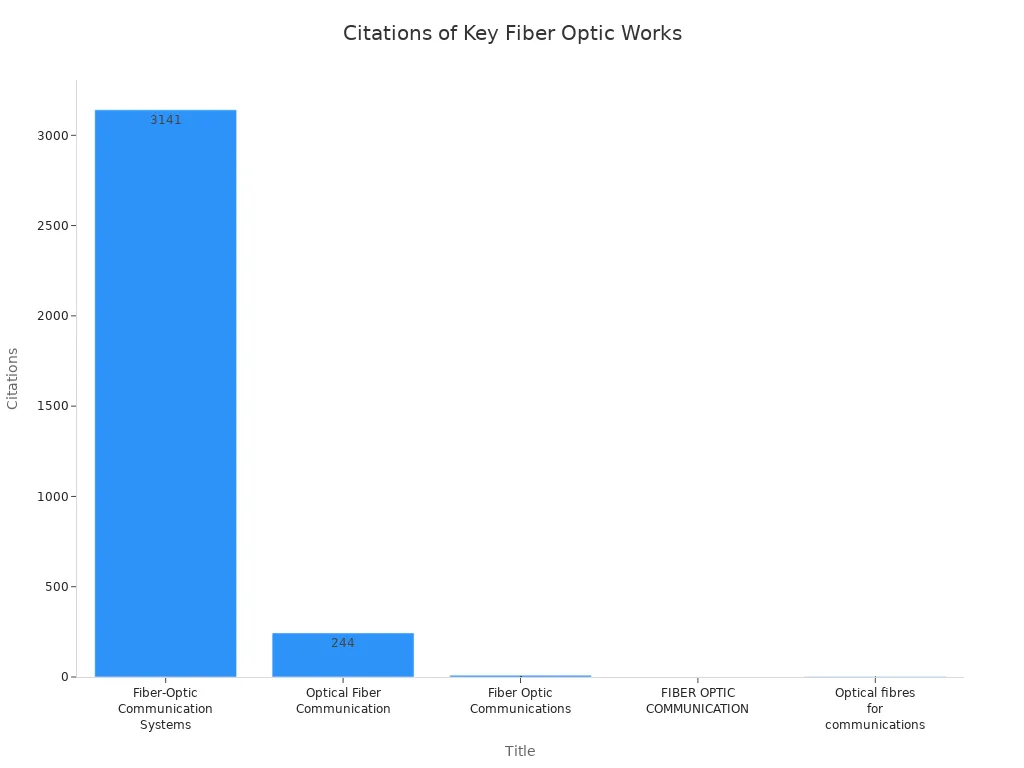
You can see the impact of his work in the most cited academic books and papers on fiber optic technology:
|
Title |
Citations |
Year |
Author |
|---|---|---|---|
|
Fiber‐Optic Communication Systems |
3141 |
2021 |
G. Agrawal |
|
Optical Fiber Communication |
244 |
2010 |
Z. Yasin |
|
Fiber Optic Communications |
10 |
2004 |
James N. Downing |
|
FIBER OPTIC COMMUNICATION |
0 |
2008 |
Temitope Abayomi Latunde |
|
Optical fibres for communications |
3 |
1973 |
D. Marcuse |
Kapany's work did not stop at the laboratory. He published a landmark paper in 1957, 'A Flexible Fiberscope, Using Static Scanning,' and secured over 100 patents related to fiber optics. He was the first to transmit an image through a bundle of glass fibers, proving the practical use of fiber optic cable.
You might wonder what challenges Kapany overcame. He had to develop strong, flexible glass fibers, prevent light leakage, and achieve high clarity in the glass. He also needed reliable light sources that could emit coherent light. These breakthroughs made fiber optic cables practical for real-world use.
Kapany's achievements earned him global recognition. Fortune Magazine named him one of the "Unsung Heroes of the 20th Century" in 1999. He received the Pravasi Bharatiya Samman in 2004 and, posthumously, the Padma Vibhushan in 2021, one of India's highest civilian honors.
Today, you rely on fiber optic cable technology for fast internet, clear phone calls, and streaming video. Kapany's invention changed the way you connect with the world, making communication faster, clearer, and more reliable.
Other Pioneers in Fiber Optic Cable Development
Charles K. Kao
You might wonder why fiber optic communication became practical for everyday use. Charles K. Kao played a key role in this transformation. In the 1960s, Kao showed that glass fibers could transmit information over long distances with very little signal loss. His research changed how you experience communication today.
- Kao's landmark paper in 1966 proposed using single-mode fiber for efficient transmission.
- He revealed that ultra-pure glass fibers could carry light for kilometers without losing strength.
- Kao's work led to the first fiber optic links in 1977, making fiber optic communication the backbone of global telecommunications.
- His innovations improved not only internet speed but also medical imaging, helping doctors diagnose patients more accurately.
- Kao's discoveries laid the foundation for modern fiber optic networks. You benefit from faster data transmission and clearer communication because of his vision.
Corning Glass Researchers
You rely on fiber optic cables every day, but making them practical required new materials and manufacturing techniques. Corning Glass researchers solved this challenge in the early 1970s.
They developed low-loss fibers using germanium-doped silica, which reduced light loss during transmission.
The outside vapor deposition (OVD) process allowed them to create fibers with even less signal loss.
By achieving a minimum loss of 4 dB/km, Corning made long-distance fiber optic communication possible.
Corning's team created pure silica glass by blasting core elements with flame jets, forming soot on spinning rods. This soot was consolidated in a furnace, bonding silica molecules tightly. The glass was then heated to 2,000°C and stretched into ultra-thin strands, which were sheathed in colored polymers for identification.
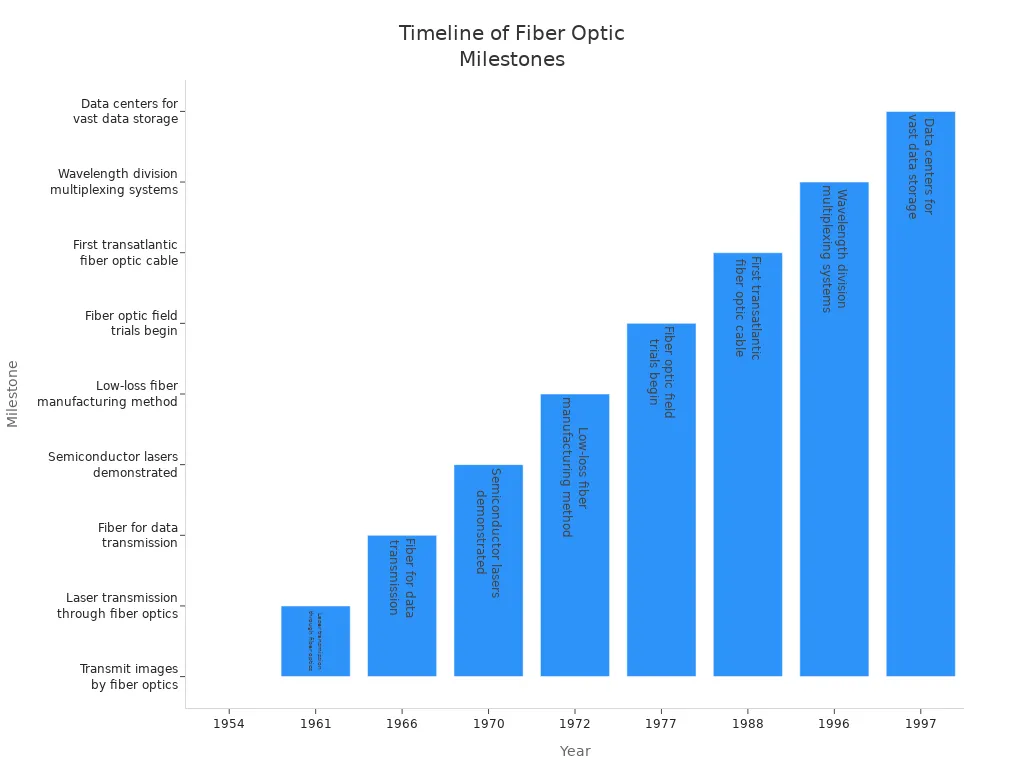
You can see the impact of these breakthroughs in the timeline below, which highlights major milestones in fiber optic cable development:
|
Year |
Milestone Description |
|---|---|
|
1954 |
Transmit images by fiber optics - Narinder Kapany and Harold Hopkins make bundles of fibers to transmit images. Abraham Van Heel suggests cladding the fibers to reduce attenuation. |
|
1961 |
Laser transmission through fiber optics - Elias Snitzer and Will Hicks demonstrate a laser beam directed through a thin glass fiber. |
|
1966 |
Using fiber for data transmission - Charles Kao reveals how to make low-loss fiber suitable for communications. |
|
1970 |
Semiconductor lasers demonstrated by Loffe Physical Institute and Bell Labs. |
|
1972 |
Low-loss fiber manufacturing method developed at Corning. |
|
1977 |
Fiber optic field trials begin with AT&T installing the first telecom link. |
|
1988 |
AT&T lays TAT-8, the first transatlantic fiber optic cable. |
|
1996 |
Wavelength division multiplexing systems introduced. |
|
1997 |
Data centers designed to store and distribute vast amounts of data. |
You can distinguish between inventing the fiber optic cable and enabling its use in communication technology. Kapany demonstrated the potential of fiber optic transmission. Kao and Corning Glass researchers made fiber optic communication practical by reducing attenuation and identifying high purity silica glass as the ideal material. Their work turned a scientific idea into a global solution for fast, reliable transmission.
Impact of Fiber Optic Cable
Revolutionizing Communication
You experience the benefits of fiber optic technology every day, whether you stream videos, make video calls, or use cloud services. Fiber optic cables have transformed data transmission by sending information as light pulses through thin strands of glass or plastic. This method achieves speeds close to 70% of the speed of light, far surpassing traditional copper cables. When you use fiber optic internet, you enjoy speeds from 250 Mbps to over 1 Gbps, which supports high-definition streaming and advanced telemedicine.
The shift from copper to optical fibers began in the 1970s. This change allowed the telecommunications industry to handle the explosive growth of the internet in the 1990s. Fiber optic cables now form the backbone of global communication networks, providing reliable, high-capacity connections across continents.
You can see the rapid growth in fiber optic usage in the following points:
The fiber optics market size in 2024 is projected at USD 8.6 billion, with a compound annual growth rate of 10.5% expected to reach USD 23.7 billion by 2034.
The demand for high bandwidth continues to rise due to IoT and 5G networks.
North America, Europe, and Asia-Pacific lead in fiber network expansion, driven by investments in infrastructure and innovation.
Fiber optic cables offer several advantages over copper:
Superior data transmission speeds and higher bandwidth.
Greater reliability and durability, reducing maintenance and downtime.
Signal integrity over long distances, which is essential for connecting remote locations.
Fiber optic cables maintain signal strength and clarity, even across oceans, making them the preferred choice for modern communication.
Everyday Applications
You rely on fiber optic cables in many aspects of daily life. Here are some common uses:
- Cable Television: Delivers high-quality video with minimal lag.
- Internet Systems: Provides fast, stable connections for homes and businesses.
- Telephone Networks: Supports clear calls, especially with 5G technology.
- Computer Networking: Enables quick file transfers and efficient email communication.
- Lighting: Used in decorative and functional lighting where high light transmission is needed.
ndustries also benefit from fiber optic technology:
- Railway systems use fiber optics for health monitoring, improving safety.
- Aerospace and defense sectors rely on fiber optics for secure, interference-free communication.
- Intelligent transportation systems use fiber networks to enhance traffic management and safety.
The future of fiber optic cables looks promising. Innovations in materials, such as advanced polymers and nanomaterials, will improve signal transmission and durability. New technologies like photonic integration and quantum communication are set to revolutionize how you connect and share information. The installation of new undersea cables and the growth of 5G networks will further expand global connectivity.
|
Region |
Adoption Rate Statistics |
|---|---|
|
North America |
In 2023, nine million homes were newly passed by network operators, marking the highest annual FTTH growth. |
|
Asia |
The Asia Pacific region had a revenue share of 28.8% in 2022, driven by advancements in IT and telecommunications. |
|
Africa |
Adoption is growing but hindered by infrastructure challenges and economic barriers. |
|
South America |
The market is expected to double subscriber numbers and increase homes passed by 150% between 2021 and 2026. |
|
Oceania |
Australia and New Zealand are making significant strides in fiber-optic network rollout. |
|
Urban Areas |
As of June 2023, urban areas had an average fiber access rate of 67.2% with a subscription rate of 13.5%. |
|
Rural Areas |
Rural areas had a 42.1% access rate with a subscription rate of 13.4% by June 2023. |
As you look to the future, expect fiber optic technology to support emerging trends like artificial intelligence, autonomous vehicles, and virtual reality, making your digital experiences faster and more reliable.
Narinder Singh Kapany invented the first fiber optic cable, but you benefit from the work of many pioneers.
|
Year |
Contributor(s) |
Contribution Description |
|---|---|---|
|
1880 |
Alexander Graham Bell, Charles Sumner Tainter |
Created the Photophone, an early precursor to fiber-optic communications. |
|
1954 |
Harold Hopkins, Narinder Singh Kapany |
Demonstrated light transmission through rolled fiber glass. |
|
1963 |
Jun-ichi Nishizawa |
Proposed optical fibers for communications and invented the PIN diode. |
|
1966 |
Charles K. Kao, George Hockham |
Reduced glass losses for practical fiber optic communications. |
|
1970 |
Corning Glass Works |
Developed low-loss optical fiber for communication. |
Fiber optic cables give you fast internet, secure connections, and reliable video calls. They support online learning, remote work, and medical advances. You see their value every day, showing how innovation shapes your world and inspires future breakthroughs.
FAQ
Why did Narinder Singh Kapany invent fiber optic cables?
You needed a better way to transmit light and images over long distances. Kapany wanted to solve problems with signal loss in earlier systems. His invention made communication faster, clearer, and more reliable.
Why are fiber optic cables better than copper wires?
You get much faster data speeds and less signal loss with fiber optic cables. Fiber optics also resist electromagnetic interference. This means you enjoy clearer calls and faster internet, even over long distances.
Why did fiber optic cables become popular for internet and communication?
You rely on fiber optic cables because they handle huge amounts of data quickly. As internet use grew, only fiber optics could keep up with demand for speed and reliability. This made them the top choice for global networks.
Why do fiber optic cables use glass instead of other materials?
You benefit from glass fibers because they transmit light with very little loss. Glass is strong, flexible, and can carry signals over miles without degrading. This makes it ideal for high-speed communication.
Why do experts call Narinder Singh Kapany the "Father of Fiber Optics"?
You see Kapany recognized as the "Father of Fiber Optics" because he first showed how to send light through bent glass fibers. His research proved the technology worked and inspired others to develop modern fiber optic networks.