



When you need reliable and fast data transmission, two characteristics set fiber optic cable apart: high bandwidth capability and low attenuation. High bandwidth capability means you can transfer large amounts of information quickly. The table below shows how fiber outperforms other cables in speed:
|
Cable Type |
Maximum Speed |
|---|---|
|
Fiber Optic |
Up to 1.02 petabits/second |
|
Commercial Fiber |
100 Gbps |
|
Consumer Fiber |
100 Mbps to 10 Gbps |
|
Traditional Cable |
Slower and inconsistent |
Low attenuation lets signals travel farther with less loss, which means you get clear, strong connections even over long distances. These features make fiber optic cable the smart choice for anyone who values high performance and efficiency.
Key Takeaways
- Fiber optic cables offer high bandwidth, allowing for fast data transmission. This capability supports multiple devices and applications without slowing down your network.
- Low attenuation in fiber optics means signals travel farther with less loss. This results in clearer connections over long distances, reducing the need for signal boosters.
- Upgrading to fiber optic cable is ideal for businesses experiencing growth or needing reliable long-distance communication. It ensures efficient data transfer and supports modern applications.
- While initial costs for fiber optic cables may be higher, they provide long-term savings through lower maintenance and greater durability, making them a smart investment.
- Fiber optic technology is future-proof, easily adapting to increasing data demands and new technologies, ensuring your network remains robust and efficient.
What Are Two Characteristics Of Fiber Optic Cable?
Fiber Optic Cable and High Bandwidth Capability
Bandwidth Definition
Bandwidth describes the maximum amount of data that a cable can carry over a specific period. In the context of fiber optic cable, bandwidth refers to the highest data transmission capacity, measured in Hertz (Hz) or bits per second (bps). This measurement determines how much information you can send through the cable at once. High bandwidth means you can support more devices, more applications, and more demanding tasks without slowing down your network.
Tip: If your business or home relies on streaming, video conferencing, or cloud computing, you need a cable with massive bandwidth to avoid lag and buffering.
|
Aspect |
Description |
|---|---|
|
Definition |
Bandwidth is the range of frequencies that can be transmitted through a channel. |
|
Measurement Technique |
Experimental measurements using controlled parameters like light launch angle and properties of devices. |
|
3 dB Frequency |
Defined as the frequency where the light signal is attenuated by 3 dB, indicating half the transmitter power. |
In fiber optic networks, you often see bandwidth measured in gigabits per second (Gbps) or even terabits per second (Tbps). Standard business fiber connections start at 1 Gbps, while advanced enterprise networks can reach 100 Gbps or more.
- 1 Gbps: Standard business fiber
- 10 Gbps: Enterprise-grade connections
- 100 Gbps: High-performance computing and data centers
- 400 Gbps: Advanced enterprise and service provider networks
Data Transmission Speed
Fiber optic cable stands out for its incredible speed. You can transmit data at rates that copper cables simply cannot match. The speed of light powers fiber optic technology, allowing you to move information almost instantly across great distances. This capability is essential for high-speed needs in modern offices, schools, and homes.
|
Technology Type |
Maximum Data Rate |
Distance Supported |
|---|---|---|
|
Singlemode Fiber |
Up to 800 Gb/s |
40 kilometers or more |
|
Multimode Fiber |
400 Gb/s |
100 meters |
|
Multimode Fiber |
10 Gb/s |
550 meters |
|
Using WDM Technology |
400 Gb/s |
40 kilometers or more |
|
Parallel Optics |
400 Gb/s |
40 kilometers or more |
|
Future Potential |
1.6 Tb/s and beyond |
N/A |
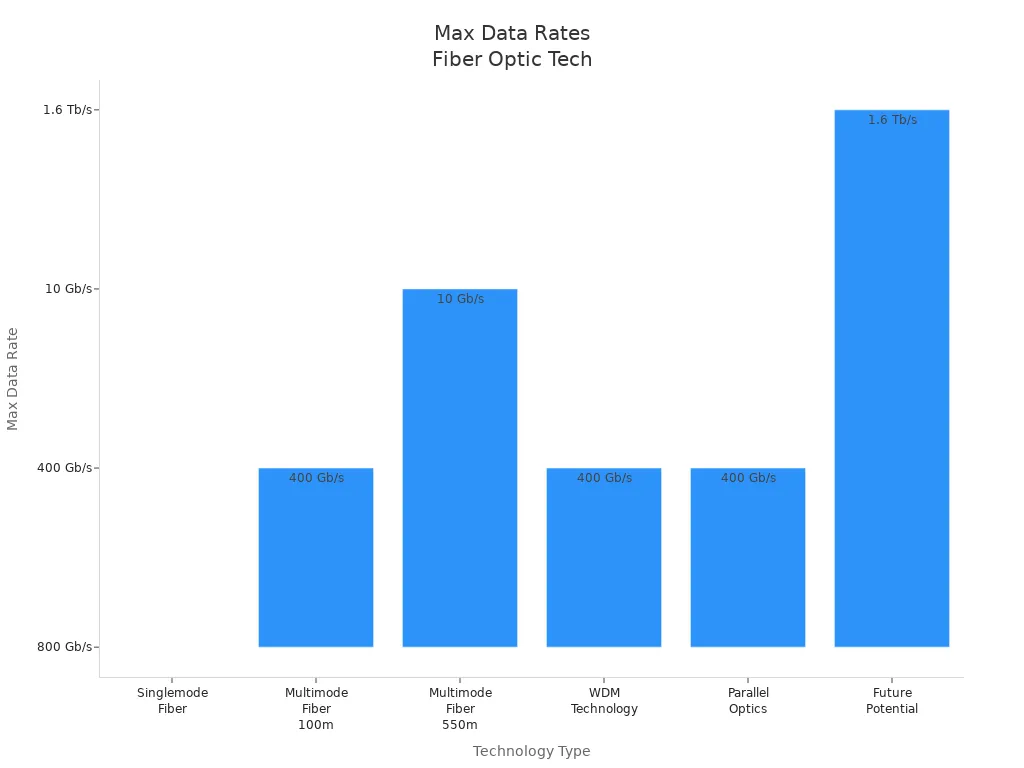
With these speeds, you can support everything from real-time video streaming to large-scale cloud computing. Fiber optic cable ensures your network never becomes a bottleneck, even as your data demands grow.
Comparison with Copper Cables
When you compare fiber optic cable to copper cable, the difference in bandwidth and speed becomes clear. Fiber uses pulses of light to transmit data, while copper relies on electrical signals. Light travels much faster than electricity, so fiber can transmit data at much higher speeds and over longer distances.
|
Metric |
Fiber Optic Cables |
Copper Cables |
|---|---|---|
|
Data Transmission |
High-speed, long-distance |
Moderate speed, short-distance |
|
Signal Loss |
Minimal over long distances |
Significant over extended spans |
|
Interference |
Immune to EMI and RFI |
Prone to electromagnetic interference |
Fiber optic cable loses only about 3% of its signal over distances greater than 100 meters. In contrast, copper cables can lose up to 94% of the signal over the same distance. This means you get a stronger, more reliable connection with fiber, especially in large buildings or campuses.
|
Feature |
Fiber Optic Cable |
Copper Cable (e.g., Cat6a) |
Winner |
|---|---|---|---|
|
Bandwidth Potential |
Extremely High (Tbps+ theoretically) |
Limited (Up to 10 Gbps typically, 40Gbps possible over very short distances with Cat8) |
Fiber |
- Fiber optic cable is the clear winner for massive bandwidth and high-speed needs. You can future-proof your network and handle new technologies like 5G and cloud computing without replacing your infrastructure.
- Fiber optics provide a future-proof foundation for networks, enabling seamless communication and faster file sharing.
- You experience fewer interruptions and smoother operations, which is essential for large-scale network management.
- Fiber optic cables may have higher initial costs but deliver better long-term value due to lower maintenance and higher durability.
- Fiber excels in long-distance data transmission without signal loss, making it ideal for large networks.
- Fiber technology adapts to advancements in speed and capacity, so you do not need a complete overhaul as your needs grow.
Note: If you want a network that can scale with your business or personal needs, fiber optic cable offers unmatched performance and reliability.
Low Attenuation in Fiber Optic Cable
What Is Attenuation?
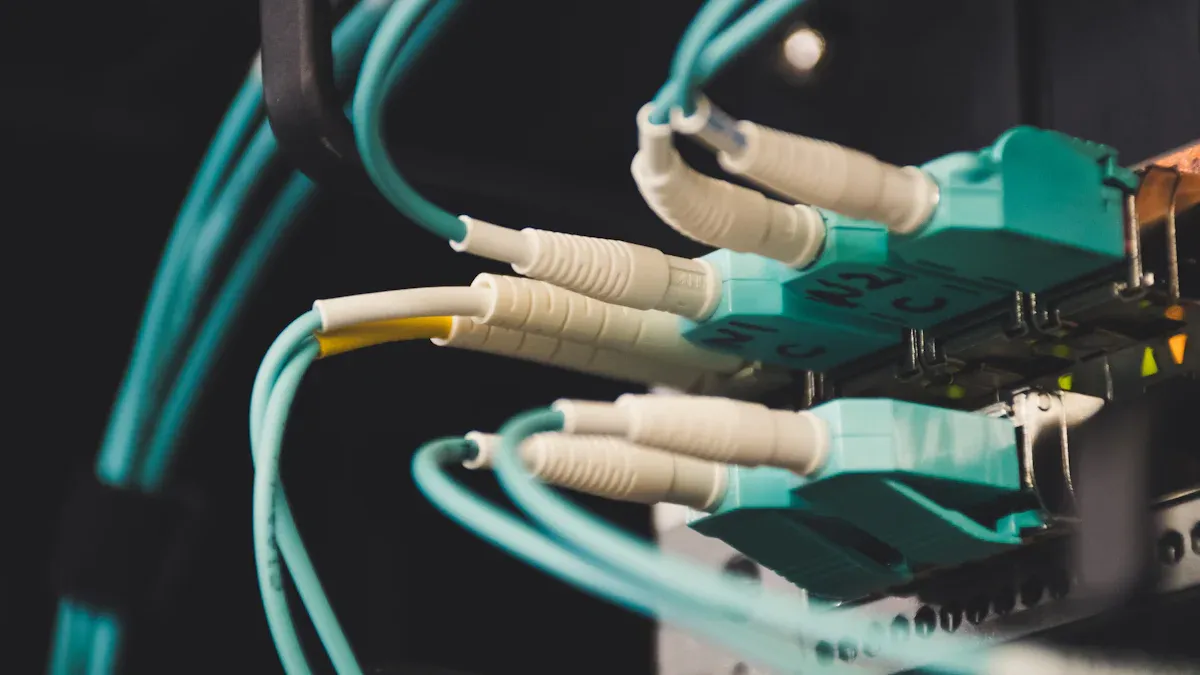
Attenuation describes the gradual loss of signals as they travel through a cable. In fiber optic cable, attenuation means the reduction of light or signal strength as it moves along the fiber. You measure this loss in decibels (dB). Two main types exist: intrinsic attenuation, which happens naturally within the glass, and extrinsic attenuation, which results from external factors like bending or poor connections. When you use fiber optic technology, you benefit from extremely low attenuation, which helps maintain strong signals over long distances.
Note: Lower attenuation means your signals stay stronger, so your data arrives with fewer errors and less need for signal boosting.
Signal Quality Over Distance
Attenuation directly affects how well your signals travel. If you use a cable with high attenuation, your signals weaken quickly, leading to poor data transmission and possible communication failures. Fiber optic cable stands out because it has much lower attenuation than copper cables. Here's what you need to know:
- Attenuation measures the reduction of signal power as signals move through the fiber.
- You measure attenuation in decibels per kilometer (dB/km).
- Causes include absorption by impurities and scattering inside the fiber.
- Over long distances, high attenuation can make it hard to recover the original signals.
With fiber, you see attenuation rates as low as 0.2 dB per kilometer. In contrast, copper cables lose much more signal strength over the same distance. This difference means you can send data farther without losing quality or speed. Low attenuation minimizes signal loss, which is essential for keeping your signals clear and reliable, even across cities or continents.
Real-World Applications
You see the benefits of low attenuation in many real-world scenarios. For example, internet service providers use fiber optic cable to deliver high-speed connections to homes and businesses miles apart. Data centers rely on fiber to transfer massive amounts of data between servers without signal degradation. In scientific research, labs have achieved data rates of over 100 terabits per second across standard fiber, thanks to minimal signal loss.
|
Application Area |
Benefit of Low Attenuation |
|---|---|
|
Long-distance internet |
Consistent, high-speed connections over many kilometers |
|
Data centers |
Reliable, high-volume data transfer between servers |
|
Scientific research |
Record-breaking data rates with minimal signal degradation |
|
Urban infrastructure |
Fewer repeaters needed, reducing maintenance and costs |
Low attenuation also means you need fewer repeaters or amplifiers along the route, which lowers installation and maintenance costs. Fiber optic cable offers additional advantages in durability and flexibility. While fiber can bend and flex during installation, you should avoid extreme stress, as it is more fragile than copper under heavy force. However, fiber resists electromagnetic and radio-frequency interference, so your signals remain stable even in environments with lots of electronic equipment.
Fiber optic cable also lasts longer because it resists corrosion and oxidation, unlike copper. This durability means you replace cables less often, saving time and money. You also help the environment, since fiber optic networks use less energy and generate less heat, reducing the need for cooling systems and lowering greenhouse gas emissions.
Tip: If you want a network that delivers reliable signals, supports high data volumes, and remains cost-effective over time, low attenuation in fiber optic cable gives you a clear advantage.
Choosing Fiber Optic Cable for Data Needs
When to Upgrade
You should consider upgrading to fiber optic cable when your current network struggles to keep up with growing data, video, and voice demands. If your business is expanding, or you need to transmit voice and video over long distances, fiber optic technology offers a reliable solution. Fiber excels in scenarios where efficient transmission is critical, such as centralized LANs in large buildings or industrial environments with high electromagnetic interference.
|
Scenario |
Description |
|---|---|
|
Business Expansion |
Supports more users and devices, improving productivity and customer experience. |
|
Long Range Transmission |
Maintains performance over distances where copper fails, especially beyond 300 feet. |
|
Centralized Fiber Optic LANs |
Enables efficient management and high-speed connections in large facilities. |
|
Industrial Networking |
Immune to interference, ensuring stable communication in challenging environments. |
Before upgrading, evaluate your budget, infrastructure compatibility, and provider availability. Work with experienced vendors to ensure a smooth transition.
Cost and Value
While the initial investment for fiber optic cable may be higher than copper, you gain significant long-term value. Fiber requires less maintenance, lasts longer, and delivers superior performance. Over time, the lower operational costs and reduced need for repairs make fiber a cost-effective choice. In many cases, the installed cost of fiber can match or even beat copper when you factor in future savings.
Tip: Fiber optic cable offers higher bandwidth, lower maintenance, and greater durability, making it a smart investment for any organization focused on efficient transmission of data, video, and voice.
|
Feature |
Fiber Optic Cables |
Traditional Cabling Solutions |
|---|---|---|
|
Bandwidth Capacity |
Significantly higher |
Limited bandwidth |
|
Maintenance Costs |
Lower long-term maintenance |
Higher long-term maintenance |
|
Durability |
High resistance to environmental factors |
More prone to wear and damage |
|
Security |
Enhanced due to difficulty in interception |
Less secure |
Future-Proofing Networks
Fiber optic cable stands out as a future-proof communication medium. Its scalability allows you to add more connections or increase bandwidth without major upgrades. The light weight and small size of fiber make installation easier and allow you to fit more cables in limited spaces. Fiber supports efficient transmission of large volumes of data, video, and voice, adapting to new technologies as they emerge.
- Fiber optic cables transmit data using light, enabling extremely high speeds and low latency.
- Wavelength Division Multiplexing (WDM) lets you send multiple data streams on a single fiber, increasing capacity.
- Fiber's immunity to electromagnetic interference ensures reliable communication, even in demanding environments.
- The long lifespan and minimal maintenance requirements mean your network remains robust and cost-effective for years.
If you want a network that grows with your needs and supports the latest applications, fiber optic cable provides unmatched flexibility and performance.
You gain a clear advantage when you choose fiber optic cable for your network. High bandwidth lets you move vast amounts of data quickly, reducing latency and supporting demanding applications. Low attenuation ensures your signal stays strong over long distances, which means fewer interruptions and lower maintenance costs.
- You benefit from reliable, secure, and efficient communication.
- Fiber supports future growth and adapts to new technologies.
For expert guidance, consult with fiber specialists or review resources that help you plan your upgrade and select the right cable for your needs.
|
Source |
Key Recommendation |
|---|---|
|
PC and Cable |
Consult with fiber optics experts and service providers to foresee obstacles and recommend best practices for integration. |
FAQ
Why does fiber optic cable improve network performance?
You experience better network performance because fiber optic cable supports higher speeds and lower latency. This technology allows you to transmit signals quickly and reliably. You avoid bottlenecks and interruptions, which helps your business or home run smoothly.
Why should you choose fiber optic cable for your network upgrade?
You should select fiber optic cable when you need a future-proof solution. This technology adapts to growing data demands. You gain superior performance, durability, and scalability. Your network remains efficient as new applications and devices emerge.
Why does low attenuation matter for network reliability?
Low attenuation ensures your network maintains strong signals over long distances. You avoid frequent signal loss and costly repairs. Your network delivers consistent performance, which supports critical operations and high-volume data transfers.
Why is fiber optic technology better for transmitting signals in busy environments?
Fiber optic technology resists electromagnetic interference. You maintain high network performance even in areas with heavy electronic equipment. This advantage keeps your network stable and secure, which is essential for demanding workplaces.
Why does fiber optic cable offer better long-term value?
You invest in fiber optic cable for lasting performance. This technology requires less maintenance and provides reliable network connectivity. You save money over time and support advanced applications without frequent upgrades.