






Underground Fiber Optic Cable Installation: Complete Process Guide?
Underground fiber optic cable installation involves burying fiber cables beneath the ground surface using methods like trenching, directional boring, or plowing. The process includes site assessment, excavation or boring, conduit placement, cable pulling with controlled tension, fusion splicing, and rigorous testing to ensure signal integrity.
Underground Fiber Installation Methods
Installing fiber optic cable underground isn't a one-size-fits-all operation. Contractors select from several distinct methods based on terrain, existing infrastructure, project scale, and budget constraints.
Traditional Open-Cut Trenching remains the most straightforward approach. A trencher excavates a continuous path 18-36 inches deep, conduit or cable gets placed in the trench, and soil is backfilled. This method offers precise depth control and works well when installing multiple cables simultaneously. The downside? It's disruptive, slower than alternatives, and requires surface restoration. Typical speeds: 300-500 feet per day in favorable conditions.
Vibratory Plowing dramatically increases installation speed in open areas. A specialized plow simultaneously cuts through soil and lays cable in a single pass, minimizing surface disturbance. The equipment vibrates to reduce soil compaction resistance, allowing for continuous operation. Rural fiber deployments favor this method-crews can install 1,000-2,000 feet daily on flat terrain. However, it cannot navigate around existing utilities and struggles in rocky or heavily rooted soil.
Horizontal Directional Drilling (HDD) solves the problem of crossing obstacles without surface disruption. A drill rig creates a pilot bore along a predetermined path, then pulls cable through the enlarged hole. This trenchless method excels under roads, waterways, or developed areas where trenching would be prohibitively expensive or disruptive. The trade-off is equipment cost-HDD requires skilled operators and can run $15-30 per foot compared to $3-8 for trenching.
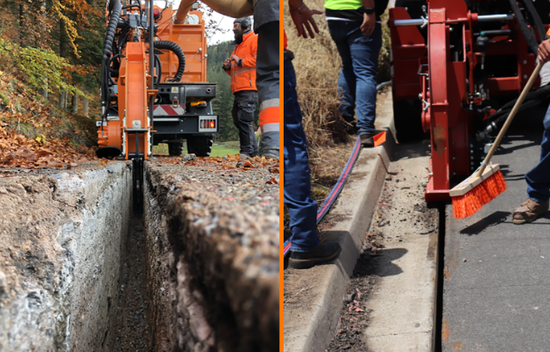
Micro-Trenching emerged as an urban solution, cutting narrow slots (1-2 inches wide, 8-15 inches deep) into pavement near curbs. After cable placement, crews fill the slot with specialized grout. Cities appreciate the minimal traffic disruption and faster permitting. Installation speeds reach 500-800 feet per day, though the shallow depth raises concerns about cable protection in freeze-thaw climates.
Air-Blown Fiber reverses traditional installation logic. Crews first install microducts, then use compressed air to "blow" lightweight fiber cables through the tubes later. This method shines for phased deployments or high-density urban networks where future capacity additions are certain. Initial duct installation costs more, but subsequent fiber additions become remarkably cheaper.
Impact Moling fills a niche for short runs under driveways or sidewalks. A pneumatic tool hammers through soil, creating a small-diameter bore. It's faster and cheaper than HDD for distances under 50 feet but offers less directional control.
Each method carries distinct cost profiles. Direct burial with plowing runs $3-6 per foot installed. Trenching with conduit costs $5-12 per foot. HDD jumps to $15-30 per foot but eliminates restoration expenses. Project managers often combine methods-plowing in open areas, HDD under roads, micro-trenching in urban zones-to optimize both cost and timeline.
Pre-Installation Planning and Site Assessment
The excavation machinery remains idle until planning work concludes. This phase determines project feasibility, identifies hidden obstacles, and establishes legal compliance-areas where shortcuts create expensive problems.
Utility Location stands as the non-negotiable first step. Every state requires calling 811 before digging, but smart contractors go further. Private locating services map utilities missed by public one-call systems-about 30% of strikes involve unmarked lines according to Common Ground Alliance data. Fiber paths must maintain minimum separation distances: typically 12 inches from power cables, 24 inches from gas lines. Conflicts force route redesigns or specialized boring techniques.
Permit Acquisition varies dramatically by jurisdiction. Rural county roads might require only a simple right-of-way permit processed in days. Urban installations can demand months-long approval processes involving multiple agencies-transportation, utilities, environmental protection. State highway crossings often trigger engineering reviews and bonding requirements. Budget 8-16 weeks for complex permitting scenarios.
Soil Analysis influences method selection and cost estimation. Clay soils compact easily, favoring trenching. Sandy soils collapse readily, necessitating wider trenches or immediate conduit placement. Rocky substrate increases equipment wear and slows progress-what takes one day in loam might consume three days in decomposed granite. Environmental surveys become mandatory near wetlands or protected habitats.
Route Optimization balances multiple factors. The shortest path isn't always cheapest-avoiding one HDD bore might justify 500 extra feet of trenching. Planners identify splice point locations (typically every 6,000-12,000 feet), access road crossings, and potential expansion routes. Professional designs include:
Detailed path maps with GPS coordinates
Cross-section drawings showing burial depth
Splice location diagrams with cable lengths
Equipment staging area identification
Traffic control plans where required
Depth Requirements follow local codes and cable type. National Electric Code suggests 24 inches minimum for residential areas, 30-36 inches under driveways, 48 inches under roadways. Regions with deep frost lines push cables to 42-48 inches. Direct-burial armored cable tolerates shallower placement than standard fiber in conduit. Agricultural areas add 6-12 inches to protect against plowing damage.
The planning phase typically consumes 15-25% of project timelines but prevents field delays that can double installation costs. Experienced contractors won't break ground without comprehensive site documentation.
Trenching Installation Process
Open-cut trenching gives installers maximum control over cable placement but demands careful execution across multiple stages.
Trench Excavation begins with marking the approved route using stakes or paint. Trencher selection depends on soil conditions and required dimensions. Ride-on trenchers handle long runs efficiently, cutting trenches 4-8 inches wide to depths of 48 inches. Walk-behind units navigate tighter spaces like residential yards. Rocky terrain might necessitate a rock saw attachment or even excavators with hydraulic hammers for extreme conditions.
Contractors maintain relatively straight trenches-excessive meandering complicates cable placement and wastes materials. The trench bottom should be smooth and level, free of large rocks that could create pressure points on cable or conduit. Where rocks are unavoidable, crews place 6-12 inches of bedding sand as a protective cushion.
Conduit Installation protects cable and enables future upgrades without re-excavation. High-density polyethylene (HDPE) conduit dominates fiber applications due to its flexibility, durability, and smooth interior wall that eases cable pulling. Common sizes range from 1.25 to 2 inches for single cables, up to 4 inches for multiple runs.
Conduit sections connect via couplings or heat fusion, creating a continuous protected pathway. Proper installation includes:
Maintaining minimum bend radius (typically 10-20 times conduit diameter)
Installing pull rope or tape for future cable placement
Sealing conduit ends to prevent dirt or moisture infiltration
Placing warning tape 12 inches above conduit before final backfill
Some installations use innerduct-smaller conduits within larger ones-creating a modular system for housing multiple fiber cables with segregated pathways.
Direct Burial skips conduit, placing armored fiber cable directly in the trench. This approach costs less initially but complicates repairs and upgrades. Direct-burial cables incorporate corrugated steel armor or dense polyethylene jackets rated for underground environments. Installation crews carefully manage cable pay-off from reels, avoiding twists or kinks. The cable should lie flat in the trench without tension.
Backfilling proceeds in stages. Initial backfill (9-12 inches) uses clean, compacted soil or sand, free of rocks. This protects the cable during subsequent filling. Warning tape-typically bright orange marked "FIBER OPTIC CABLE BELOW"-gets placed 12 inches below final grade. The remaining trench is backfilled with excavated soil, compacted in lifts to prevent future settling. Surface restoration matches original conditions: asphalt, concrete, sod, or gravel.
A standard trenching crew of 3-4 workers installs 300-600 feet daily in favorable conditions. Rocky soil, numerous utility conflicts, or urban congestion can reduce productivity to 100-200 feet per day. Material costs run approximately $8-15 per linear foot including conduit, cable, backfill, and restoration-labor adds another $12-25 per foot depending on regional wage rates and complexity.

Trenchless Installation Techniques
When surface disruption costs outweigh equipment expenses, trenchless methods become economically attractive despite higher per-foot installation rates.
Horizontal Directional Drilling starts with a pilot bore. The drill operator steers a drill head along a designed path using downhole transmitters and surface locating equipment that tracks position within inches. Drilling fluid (bentonite-based mud) lubricates the bit, removes cuttings, and stabilizes the borehole-essential in loose soils or under waterways.
After completing the pilot bore, typically 2-4 inches in diameter, the crew enlarges the hole by pulling back a reamer. Reamers range from 4 to 24 inches depending on the size and quantity of conduit being installed. Multiple reaming passes may be required to reach target diameter. The final pass pulls conduit through the bore, with swivels preventing rotation-induced damage.
HDD excels in specific scenarios: crossing beneath rivers (bores up to 8,000 feet are feasible), tunneling under highways without traffic closures, avoiding environmentally sensitive areas, or navigating around dense underground infrastructure. Successful HDD requires:
Detailed subsurface surveys to identify rock, existing utilities, and voids
Proper drilling fluid selection and pressure management
Real-time monitoring of drill head position and orientation
Contingency plans for inadvertent fluid returns (surface breaches)
Experienced operators-certification programs exist for HDD-specific training
Costs vary dramatically: $20-40 per foot for straightforward suburban bores, $60-150 per foot for complex urban or underwater installations. A typical 800-foot road crossing might cost $18,000-32,000 including mobilization, whereas equivalent trenching across the road could exceed $50,000 considering pavement restoration and traffic control.
Vibratory Plowing operates on different principles. A blade slices through soil while simultaneously feeding cable or conduit through a chute into the opening. Vibration reduces resistance, allowing continuous operation at walking speeds. The plow creates minimal surface disturbance-a 2-3 inch wide slot that closes naturally.
Modern plows install at depths up to 42 inches, with some heavy-duty models reaching 60 inches. Operators adjust depth on-the-go using hydraulic controls. Critical success factors include:
Pre-plowing to identify and clear obstacles 6-12 inches deeper than installation depth
Proper cable tensioning-too much tension damages fiber, too little causes snaking
Soil moisture management-wet clay clumps and clogs, dry hardpan resists cutting
Systematic documentation of installation path for future reference
Plowing shines in rural fiber-to-the-home deployments where thousands of feet of open terrain allow efficient operation. A skilled crew with appropriate equipment installs 1,200-2,000 feet daily, at costs of $3-7 per foot including equipment rental, materials, and labor.
Impact Moling serves niche applications-under driveways, beneath walkways, or through short obstacles. The pneumatic mole displaces soil rather than removing it, creating a compacted bore approximately 2-4 inches diameter. Typical runs stay under 100 feet; longer bores risk steering drift.
Contractors prefer moling for residential service drops where full HDD setup would be economically inefficient. Installation takes minutes to hours depending on distance and soil. Cost per foot appears high ($15-30) but total project costs remain low due to minimal equipment and labor requirements.
Cable Pulling and Placement
Moving fiber through conduit or placing it in trenches demands attention to mechanical stress limits that differ fundamentally from traditional copper cable installation.
Pulling Tension Management represents the critical success factor. Standard fiber optic cables tolerate 600-800 pounds pulling tension during installation-roughly half what equivalent copper cable withstands. Armored cables increase limits to 1,200-1,500 pounds, but exceeding manufacturer specifications causes:
Fiber strand breakage (immediate or latent failures)
Jacket deformation allowing moisture infiltration
Stress concentrations at connectors and splices
Reduced cable lifespan even if initial tests pass
Professional installations employ tension monitoring equipment-dynamometers or load cells-mounted between pulling rope and cable. When tension approaches 80% of maximum rating, crews pause, add intermediate pull points, or increase lubrication.
Pulling Methodology varies with installation length and geometry. Short, straight conduit runs (under 500 feet) might be pulled manually or with simple winches. Longer or complex routes require:
Figure-8 pulling for continuous reel payout while maintaining controlled tension
Mid-point assist placing a second pulling machine at intermediate manholes
Lubrication applying gel lubricants that reduce friction by 60-80%
Cable rollers at bends to prevent contact damage from conduit edges
A standard pull team positions one person at the reel monitoring payout, another at the pulling machine controlling speed (typically 20-40 feet per minute), and spotters at intermediate access points watching for snags. Communication via two-way radio coordinates the operation.
Bend Radius Requirements prevent fiber microbending-minute stress points that attenuate signals. During installation, most fiber cables require minimum bend radius of 20 times cable diameter under load, 10 times at rest. A 0.75-inch diameter cable needs 15-inch radius bends during pulling. Conduit sweeps and splice enclosure pathways must accommodate these minimums.
Direct Placement in trenches or by plow avoids pulling stress but introduces different challenges. Cable must be laid without twists-rotation causes figure-8 loops that create future maintenance nightmares. Proper technique maintains cable in a relaxed state, allowing it to conform naturally to trench contours. Excess cable at splice points (typically 15-50 feet) gets coiled and stored in designated locations for future access.
Slack Management balances competing needs. Too little slack prevents future repairs without re-excavation. Too much slack occupies vault space and complicates organization. Industry practice places 1-3% slack in each span-enough for temperature contraction (fiber has low thermal expansion but conduit expands/contracts) and repair needs, but not excessive.
A typical cable crew places 2,000-4,000 feet per day in pre-installed conduit, depending on access points and intermediate splices. Direct burial speeds match trenching or plowing rates. Material costs add $0.50-3.00 per foot for standard fiber cable, $2.00-8.00 for armored versions, plus consumables like lubricant, pulling grips, and warning tape.
Splicing and Termination
Fiber connections determine network performance. Poorly executed splices introduce signal loss, reflections, and reliability issues that undermine installation quality.
Fusion Splicing permanently joins fiber ends by melting them together. Modern fusion splicers automate the process: technicians strip cable jackets and buffer coatings, cleave fiber ends to precise perpendicular angles, then load fibers into the splicer. The machine aligns fiber cores (within 0.5 micrometers for single-mode fiber), applies an electric arc at 2,000°C for 2-3 seconds, and fuses the junction.
Quality fusion splices exhibit less than 0.05 dB insertion loss and 60+ dB return loss. The splicer estimates loss based on alignment and displays results immediately. Heat-shrink splice protectors seal and mechanically reinforce each splice point.
Mechanical Splicing provides field-repairable connections using precision alignment fixtures and index-matching gel. These produce 0.1-0.3 dB loss-acceptable for some applications but inferior to fusion splicing. Mechanical splices see limited use in permanent installations but serve well for temporary connections or emergency repairs.
Splice Enclosures protect fusion splice trays and organize cable management. Underground installations use buried splice closures rated IP68 (submersion protection) or dome-style closures in handholes and vaults. Each closure accommodates specific fiber counts-24, 48, 96, or more-with splice trays that maintain minimum bend radius throughout.
Proper closure installation includes:
Cable strain relief preventing tension transfer to splices
Fiber routing that avoids sharp bends or excessive stacking
Moisture sealing using cable port glands and gel sealants
Grounding of armored cables and metallic closure components
Documentation showing splice configuration and fiber assignments
Termination occurs at network endpoints-equipment rooms, customer premises, or distribution hubs. Technicians install connectors (LC, SC, or MPO types depending on equipment) via either:
Field-terminated connectors where technicians polish fiber ends after epoxy or mechanical attachment-time-consuming but customizable
Pre-terminated pigtails where factory-made connectors get fusion spliced to installation cable-faster and more consistent quality
Testing proves termination quality. Optical power meters measure insertion loss (typically 0.3-0.8 dB for quality connectors), while visual fault locators identify breaks or severe bends in fiber paths.
A two-person splice crew typically completes 48-96 fusion splices per day, including preparation, splicing, testing, and closure installation. More complex installations with larger fiber counts or difficult access reduce productivity. Splicing costs run $8-25 per splice depending on fiber count, location accessibility, and quality requirements.
Testing and Quality Assurance
Installation completion doesn't guarantee network readiness. Systematic testing identifies defects, verifies performance specifications, and documents baseline characteristics for future troubleshooting.
Optical Time Domain Reflectometer (OTDR) testing sends precisely timed light pulses into fiber, then analyzes backscatter and reflections. The resulting trace shows:
Total fiber length (confirming installation distance)
Location and loss of splices, connectors, and bends
End-to-end attenuation
Identification of breaks, cracks, or contamination
Return loss values indicating connection quality
Professional OTDR testing follows industry standards (TIA-455-8, IEC 61280-4-1) testing at multiple wavelengths-typically 1310nm and 1550nm for single-mode fiber, 850nm and 1300nm for multimode. Bi-directional testing eliminates directional measurement biases.
Insertion Loss Testing provides simpler pass/fail verification. A calibrated light source injects known optical power at one end while a power meter measures received power at the far end. The difference equals insertion loss, compared against installation specifications (commonly 0.35-0.5 dB per kilometer plus splice/connector losses).
Continuity Testing confirms fiber paths and polarity. Visual fault locators inject visible red laser light (650nm) bright enough to see through cable jackets at break points. This quick check identifies gross faults-broken fibers, disconnected cables, or incorrect connections-before detailed OTDR analysis.
Documentation Requirements transform test data into future maintenance tools. Complete fiber records include:
OTDR trace files for each fiber strand
Splice maps showing locations and loss values
As-built drawings with GPS coordinates
Fiber assignment schedules (which physical fiber carries which circuit)
Test certificates with pass/fail status
Modern installations deliver this documentation in digital formats-PDF reports, OTDR native files, and GIS-compatible maps. Some network operators require cloud-based documentation systems for enterprise-wide asset tracking.
Acceptance Criteria vary by application. Telecommunications carriers enforce stringent standards-maximum 0.05 dB splice loss, end-to-end attenuation within 90% of theoretical minimum. Enterprise networks allow more latitude-0.1 dB splice loss, meeting equipment optical budget with 3 dB margin.
Testing adds 10-20% to installation timelines but prevents expensive service failures. A fiber that tests at 0.2 dB above specification might function initially but fail prematurely as environmental factors degrade marginal connections. The few thousand dollars spent on proper testing prevents tens of thousands in future troubleshooting and repair costs.
Installation Costs and Timelines
Project budgeting requires understanding the multiple cost components and timeline factors that vary dramatically based on method selection and site conditions.
Cost Breakdown by Installation Method (per linear foot, 2025 data):
Trenching with Conduit:
Materials: $3-6 (conduit, cable, bedding, warning tape)
Labor/Equipment: $5-12
Surface Restoration: $2-8 (varies by surface type)
Total: $10-26 per foot
Vibratory Plowing:
Materials: $2-5 (cable, minimal surface disturbance)
Labor/Equipment: $3-8
Restoration: $0-2
Total: $5-15 per foot
Directional Boring (HDD):
Setup/Mobilization: $2,000-8,000 (fixed cost per bore)
Drilling: $15-40 per foot (varies with length and complexity)
Materials: $3-8 (conduit, cable)
Total: $20-50 per foot for typical 500-1,500 foot bores
Micro-Trenching:
Materials: $2-4 (cable, grout)
Equipment/Labor: $6-12
Total: $8-16 per foot
These costs exclude permitting ($500-5,000+), engineering/design (3-8% of construction cost), project management (5-10%), and utility locating ($300-2,000). A complete 5,000-foot installation might break down as:
Direct installation: $50,000-130,000
Indirect costs: $8,000-25,000
Contingency (10-15%): $5,800-23,250
Project total: $63,800-178,250
Labor Components represent 50-70% of total costs in most installations. Regional wage variations create significant cost differences-the same project costs 30-50% more in metropolitan areas versus rural regions. Prevailing wage requirements on government projects further increase labor costs.
Material Costs fluctuate with fiber count and cable specifications. Standard 12-strand single-mode cable runs $0.80-1.50 per foot. High-count cables (144+ strands) range from $4-12 per foot. Armored variants add 40-100% to base cable prices. HDPE conduit costs $0.40-1.20 per foot depending on diameter.
Timeline Factors affect project scheduling:
Planning/Design Phase: 2-8 weeks
Utility locates: 3-10 business days
Permitting: 1-12 weeks (jurisdiction dependent)
Engineering: 1-4 weeks
Installation Phase: Varies by method and conditions
Trenching: 300-600 feet per day
Plowing: 1,000-2,000 feet per day (open terrain)
HDD: 100-400 feet per day (setup-intensive)
Splicing: 50-100 splices per crew per day
Testing/Closeout: 2-5 days per project plus documentation
A typical 5,000-foot installation requires 3-6 weeks of field work using trenching methods, 1-3 weeks with plowing in favorable conditions, or 4-8 weeks combining multiple methods for complex routes. Weather delays, utility conflicts, and inspection requirements extend timelines by 20-40% beyond baseline estimates.
Hidden Costs frequently surprise project budgets:
Rock encountered during excavation: +30-100% of trenching costs in affected areas
Unexpected utility relocations: $5,000-50,000+
Additional traffic control: $200-1,000 per day
Nighttime/weekend work premiums: +25-50% labor costs
Restoration of premium surfaces: $15-40 per square foot for decorative pavers or stamped concrete
Experienced project managers build 15-20% contingency budgets to absorb these variations without derailing timelines or forcing scope reductions.
Frequently Asked Questions
How deep should fiber optic cable be buried?
Standard burial depth ranges from 24-36 inches for most applications. Residential areas typically require 24 inches minimum, while cables under driveways need 30 inches and roadway crossings demand 36-48 inches. Regions with deep frost penetration may specify 42 inches or more to prevent freeze-thaw damage. Agricultural areas often add 6-12 inches to protect against plowing equipment. Direct-burial armored cable can sometimes be placed 6-12 inches shallower than non-armored cable in conduit, though local codes vary.
Is conduit necessary for underground fiber installation?
Conduit isn't universally required but offers significant advantages. It protects cable from soil pressure, rodents, and inadvertent damage from future digging. More importantly, conduit enables cable replacement or upgrades without re-excavation-pull old cable out, pull new cable in. Many jurisdictions mandate conduit in specific situations: under roadways, in high-water-table areas, or anywhere codes require it. Direct-burial fiber cable incorporates enhanced protective features (steel armor, thick jackets) that reduce conduit necessity in stable environments. The decision weighs initial cost savings against long-term flexibility and protection needs.
How long does underground fiber installation take?
Project duration varies enormously with distance, method, and complexity. A simple 500-foot residential service drop using directional boring might complete in 2-3 days. A 5-mile rural fiber route using plowing could finish in 2-3 weeks of field work. Complex urban installations combining multiple methods, extensive permitting, and utility coordination might span 8-16 weeks from planning through final testing. Key timeline variables include weather conditions (frozen ground or heavy rain halts work), utility conflicts requiring coordination or relocations, rock requiring specialized equipment, and permit approval processes. Experienced contractors build buffer time into schedules-a project with 15 days of actual field work might span 4-6 weeks calendar time.
What causes underground fiber installation costs to vary so much?
Cost variation stems from method selection, site conditions, and regional factors. Installation method creates the largest spread: plowing in open terrain costs $5-15 per foot while directional boring under infrastructure runs $20-50 per foot. Soil conditions dramatically affect productivity-rocky substrate can triple excavation time. Urban work costs more than rural due to congestion, traffic control, utility density, and higher labor rates. Material specifications matter: 12-strand cable costs $0.80-1.50 per foot versus $4-12 for 144-strand. Permitting complexity, prevailing wage requirements, and whether existing conduit is available all shift totals. A straightforward rural installation might run $30,000 per mile while dense urban fiber could exceed $200,000 per mile for the same distance.
Planning Your Installation Project
Underground fiber installation success hinges on matching method to conditions. Projects crossing varied terrain often combine techniques-plowing through open fields, boring under roads, trenching in developed areas. This hybrid approach optimizes both cost and timeline.
Site assessment prevents expensive surprises. Thorough utility locating, soil testing, and permit research completed before equipment mobilizes saves multiples of their cost in avoided delays. The cheapest quote isn't always the best value-contractors who skip planning steps inevitably encounter field problems that consume contingency budgets and extend schedules.
Material selection requires balancing present needs against future expansion. Installing larger conduit costs marginally more upfront but might save complete re-installation when capacity needs grow. Armored cable adds 40-100% to material costs but eliminates conduit in suitable environments. These trade-offs deserve careful analysis based on specific site conditions and organizational plans.
Documentation often gets short-changed as projects rush toward completion, but comprehensive as-built records with OTDR test files and GPS coordinates prove invaluable. The few hours spent organizing documentation prevent days or weeks of troubleshooting future issues. Network operators report that installations with complete documentation average 60% faster repairs and 40% lower maintenance costs over their lifetime.
Weather and seasonal factors influence both scheduling and costs. Ground freezing prevents trenching and plowing in northern climates from December through March. Summer heat stresses crews and equipment. Shoulder seasons-spring and fall-offer optimal working conditions but create scheduling competition among projects. Smart project managers secure contractor commitments months ahead for preferred installation windows.
The installation phase represents just one element of deploying fiber networks, but it's the foundation. Cables buried with proper depth, tension control, and testing perform reliably for 20-30 years. Rushed installations cutting corners on planning or quality control create maintenance burdens that persist throughout the network's life. The extra week spent in careful planning and the extra dollar per foot for proper execution deliver returns measured in decades of reliable service.