






What are underground fiber optic cable installation standards?
Underground fiber optic cable installation follows specific standards that govern burial depth, testing methods, installation techniques, and safety requirements. These standards, established by organizations like the National Electrical Code (NEC), National Electrical Safety Code (NESC), and ANSI/TIA, ensure reliable network performance and long-term cable protection.
Burial Depth Requirements and Regulations
The depth at which fiber optic cables are buried directly impacts their protection from damage and environmental factors. Requirements vary based on location, cable type, and local regulations, with depths typically ranging from 18 to 48 inches.
Standard Burial Depths by Location
Residential areas require depths between 24 and 36 inches for most installations. This protects cables from landscaping activities and minor excavation work. Commercial and industrial zones demand deeper placement at 36 to 48 inches due to heavy machinery operation and frequent ground disturbance.
Roadside and right-of-way installations necessitate the deepest burial at 42 to 48 inches. This depth accommodates road maintenance, resurfacing projects, and heavy traffic loads. Rural or agricultural areas also require 48-inch depths to prevent damage from plowing equipment that penetrates deep into soil.
Regulatory Standards for Burial Depth
The NEC Article 830.47 specifies 18 inches as the minimum depth for direct burial of network-powered broadband communication systems, which includes fiber optic cables. However, this represents the absolute minimum, and most professional installations exceed this requirement.
The NESC provides more stringent guidance for utility-scale deployments. It mandates minimum depths of 0.9 meters (approximately 36 inches) under roads and 1.2 meters (approximately 48 inches) under railway lines. For general areas, the NESC requires at least 0.6 meters (24 inches).
International standards from IEC 60794-1-1 specify 0.6 meters as the minimum burial depth in general areas. CENELEC standards, applicable in Europe, require 0.8 meters in urban areas and 0.6 meters in suburban locations.
Factors Influencing Burial Depth
Soil composition significantly affects depth requirements. Sandy or loose soils may require deeper burial to prevent shifting or cable exposure over time. Compact or clay-based soils offer better stability and may allow slightly shallower installation while maintaining protection.
Climate conditions play a critical role in depth determination. In cold regions, cables must be buried below the frost line, which typically ranges from 24 to 48 inches depending on geographic location. This prevents damage from freeze-thaw cycles that cause ground heaving.
Proximity to existing utilities requires careful depth planning. The NEC 770.47(B) mandates 12 inches (300mm) separation between conductive fiber optic cables and power cables. This separation prevents electromagnetic interference and facilitates safe maintenance access.
Cable Types and Protection Systems
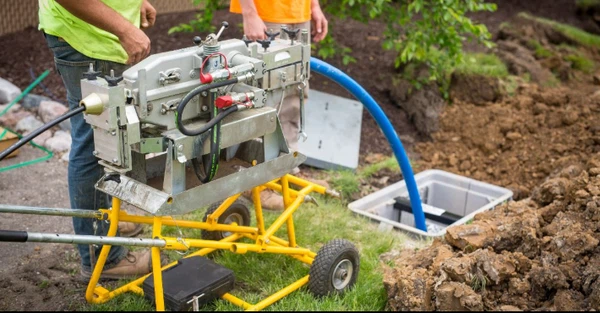
The choice between direct burial and conduit-protected installation affects both the burial depth requirements and long-term cable durability.
Direct Burial Cables
Direct burial fiber optic cables are engineered with enhanced protective features for underground placement without conduit. These cables typically incorporate corrugated steel armor (CSA) or dielectric armor to resist crushing forces up to 1000 N/cm.
Armored cables like GYTA53 feature steel tape armor and PE outer sheath, suitable for direct burial at depths of 24 to 48 inches. Water-blocking materials, including gel-filled loose tubes or water-blocking yarns, prevent moisture ingress that could degrade optical performance.
The maximum pulling tension for direct burial cables ranges from 600 to 2,700 Newtons depending on cable construction. Stranded loose tube designs typically support 600 lbF (2,700 N) maximum tension during installation, as specified by manufacturers like Corning.
Conduit-Protected Systems
Conduit installation allows for shallower burial depths, typically 12 to 36 inches, due to the additional mechanical protection. Schedule 40 PVC and HDPE conduits are standard choices, providing crush resistance while maintaining flexibility for thermal expansion.
The conduit inner diameter must not exceed a 65% fill ratio with a single cable installed. This prevents excessive friction during cable pulling and allows for potential future cable additions. For multiple cables, fill ratios must be calculated based on total cable cross-sectional area.
Innerduct systems provide additional organization within larger conduits. Multiple innerducts can be placed in a single conduit, with each innerduct housing separate cables. This configuration supports phased deployment and simplifies future maintenance or upgrades.
Installation Methods and Techniques
Three primary methods dominate underground fiber optic cable installation: traditional trenching, directional boring, and microtrenching. Each offers distinct advantages for specific applications and site conditions.
Traditional Trenching
Trenching involves excavating a continuous pathway for cable placement. Trenching machines cut paths ranging from 4 to 36 inches wide, with depths adjusted to meet burial requirements. This method provides the most straightforward installation but causes significant surface disruption.
The minimum trench depth for backfilled fiber optic cables is 36 inches (91 cm) according to Corning installation standards. Backfill soil depth should measure 9 to 12 inches (23-30 cm) above the cable, with warning tape placed 12 inches (30 cm) below the surface for future excavation safety.
Average installation rates for traditional trenching reach approximately 100 feet per day per crew. The process requires clearing land, excavating, cable placement, backfilling, and surface restoration. Trench shoring may be necessary for depths exceeding worker safety thresholds.
Vibratory Plowing
Vibratory plowing combines trenching and cable laying into a single operation. Specialized plowing equipment simultaneously opens a narrow trench and feeds cable to the desired depth. This method significantly increases installation speed for rural and open terrain deployments.
The plow blade must be marked to monitor consistent plowing depth throughout the installation. Operators should shut off vibratory plows immediately upon encountering underground obstacles to prevent cable or equipment damage. Grade changes along the cable path should be smoothed before plowing begins.
Horizontal Directional Drilling
HDD provides trenchless installation by drilling a pilot hole along a predetermined path, then enlarging it to accommodate conduit before pulling cable through. Experienced HDD teams can install up to 600 feet of cable per day, representing six times the productivity of traditional trenching.
The HDD process requires a steerable drill operated remotely using guidance systems that combine GPS, gyroscopes, and electromagnetic tracking. These systems ensure the borehole remains on course and reaches target endpoints with accuracy within ±0.05 meters for advanced systems.
Directional boring excels at navigating obstacles including roads, buildings, waterways, and existing utility infrastructure. However, it carries cross-bore risk-the potential to inadvertently penetrate existing buried utilities. Proper utility location using Call Before You Dig services and ground-penetrating radar is essential.
Microtrenching
Microtrenching creates narrow, shallow trenches typically 1 to 2 inches wide and 12 to 24 inches deep along road edges or sidewalks. The process involves sawing a precise groove, placing small-diameter microduct, and blowing fiber optic microcable into the duct using compressed air.
This method dramatically reduces surface disruption and accelerates deployment in urban environments. Microtrenching installation proceeds faster than traditional methods, with minimal traffic impact. The shallow depth does present durability concerns in areas with heavy surface activity.
Fiber optic microcables reduce 144-fiber cable diameter to approximately 0.5 inches, enabling installation in ducts less than half an inch in diameter. Air-assisted cable blowing can achieve installation distances exceeding one mile in a single continuous run.

Testing and Verification Standards
Comprehensive testing ensures installed fiber optic cables meet performance specifications and industry standards before network activation. Two testing tiers provide different levels of verification.
Tier 1 Testing: Optical Loss Testing
Tier 1 testing measures end-to-end insertion loss using an Optical Loss Test Set (OLTS). This method employs a calibrated light source at one end and a power meter at the opposite end to quantify precisely how much optical power emerges from the link.
Testing must occur at wavelengths appropriate to the fiber type. Multimode fibers are tested at 850nm and 1300nm, while singlemode fibers require testing at 1310nm and 1550nm. Industry standards specify that 1550nm testing best reveals stress losses in fiber.
Maximum channel loss limits are defined by TIA-568 and ISO/IEC standards based on link length and fiber type. For multimode OM3 fiber at 850nm, maximum loss equals 2.0 dB for horizontal links up to 90 meters. Backbone links allow 3.0 dB for distances up to 300 meters.
Encircled Flux (EF) compliant light sources are required for multimode testing to ensure repeatable, accurate measurements. EF compliance eliminates the need for mode conditioning launch cables and provides 100% confidence in measurement accuracy versus 95% for legacy test methods.
Bidirectional testing improves measurement accuracy by averaging readings from both ends of the link. This compensates for directional effects at connectors and splices. Testing should maintain the same fiber alignment throughout to ensure consistent results.
Tier 2 Testing: OTDR Characterization
Optical Time Domain Reflectometers (OTDRs) transmit high-power light pulses into fiber and measure backscattered light reflected from events along the cable. This creates a signature trace showing the loss contribution of individual connectors, splices, and cable segments.
OTDR testing provides detailed analysis that an OLTS cannot capture, including the precise location and loss of every event in the fiber link. This information proves invaluable for documentation, troubleshooting, and verifying that no unexpected splices or connections exist within the link.
Launch and receive cables must be used during OTDR testing to accurately measure end connectors. Without a receive cable, the far-end connector cannot be properly characterized. Launch cables should match the fiber type and connector style of the cable under test.
Multiple pulse widths enable OTDR testing across various cable lengths. Pulse widths ranging from 5 nanoseconds to 25 microseconds accommodate installations from short premises runs to long-haul outside plant cables. Dead zones at the near end require launch cables for accurate connector measurement.
Testing specifications require measurements at both standard wavelengths with results averaged from bidirectional testing. For spans under 64 kilometers optical distance, both 1310nm and 1550nm testing should be performed. Spans exceeding 64 kilometers may omit 1310nm testing.
Performance Acceptance Criteria
Splice loss measured via OTDR should not exceed 0.3 dB for fusion splices or 0.5 dB for mechanical splices. Connector insertion loss limits are specified at 0.75 dB maximum per connection point in TIA-568 standards, though this represents a conservative limit that quality installations easily surpass.
Reflectance measurements indicate the quality of physical connections. Return loss should exceed -50 dB for PC (Physical Contact) connectors and exceed -60 dB for APC (Angled Physical Contact) connectors. High reflectance values indicate poor endface geometry or contamination.
Cable attenuation coefficients verify cable quality. Multimode fiber should exhibit less than 3.0 dB/km at 850nm and less than 1.0 dB/km at 1300nm. Singlemode fiber should measure less than 0.5 dB/km at 1310nm and less than 0.4 dB/km at 1550nm.
Safety and Best Practices
Proper safety protocols protect both installation personnel and the integrity of the fiber optic cable during underground placement.
Pre-Installation Requirements
Comprehensive site surveys must identify all existing underground utilities, terrain challenges, and potential obstacles. Environmental Protection Agency studies may be required for installations affecting protected areas or waterways.
Utility coordination is mandatory before any excavation begins. Contact local Call Before You Dig services at least 48 to 72 hours before work commences. Obtain detailed maps of buried utilities and verify locations using ground-penetrating radar or electromagnetic locating equipment.
Route planning should minimize crossing of existing utilities while maintaining required separation distances. Document all utility locations, depths, and crossing points. Develop contingency plans for unexpected obstacles discovered during installation.
Installation Safety Measures
Cable handling requires attention to mechanical stress limits. Never exceed maximum pulling tension specifications, which typically range from 600 to 2,700 Newtons depending on cable construction. Use dynamometers during cable pulls to monitor tension in real-time.
Maintain minimum bend radius throughout installation. For horizontal cables with 2-4 fibers, TIA-568 specifies a 25mm bend radius after installation or 50mm under maximum pulling tension of 222 Newtons. Larger cables require bend radii of 10 times the outside diameter when unloaded, increasing to 15 times under tension.
Cable lubricants reduce friction and pulling force during conduit installation. Recommended products include Polywater and Hydralube, which are compatible with polyethylene cable jackets. Apply lubricant to both the pulling rope and cable as they enter the conduit, with additional applications at intermediate access points.
Fiber Safety Precautions
Optical fiber presents unique safety hazards during installation and maintenance. Never look directly into a fiber end that may be connected to a laser or LED light source. Even low-power sources can cause permanent eye damage when viewed through the eye's natural lens magnification.
Fiber shards from cleaving or broken cables can penetrate skin and are difficult to remove. Dispose of fiber scraps in designated puncture-resistant containers. Work surfaces should be dark-colored to make transparent fiber fragments visible.
Chemical exposure risks exist from cleaning solvents used during splicing and termination. Isopropyl alcohol and hexane require proper ventilation and personal protective equipment. Immediate medical attention should be sought for inhalation, ingestion, or significant skin contact.
Documentation and Compliance
Thorough documentation establishes accountability, facilitates future maintenance, and demonstrates regulatory compliance.
Required Documentation
As-built drawings must accurately reflect installed cable routes, depths, and locations. These should include GPS coordinates for splice enclosures, above-ground cabinets, and transition points between buried and aerial segments. Mark all cable entries into buildings and structures.
Test results documentation should include complete OTDR traces, optical loss measurements, and certification reports for every fiber in the cable. Save all traces in both electronic format and printed form. Include test equipment calibration certificates and technician certifications.
Cable labeling must identify cable type, fiber count, and source/destination information. Labels should be placed at all access points, splice enclosures, and transition locations. Use permanent, weather-resistant labels that remain legible throughout the installation's lifetime.
Regulatory Compliance Verification
Building codes and local regulations often specify minimum requirements beyond national standards. Verify compliance with municipal requirements for burial depth, utility separation, and restoration standards. Obtain all necessary permits before installation begins.
Right-of-way agreements must be secured for cables installed on public property or crossing private land. Maintain documentation of all easements, permissions, and franchise agreements. Some jurisdictions require annual reporting of underground infrastructure locations.
OSHA safety compliance includes proper trench protection, equipment operation certifications, and hazardous material handling procedures. All installation personnel should receive training on fiber optic safety hazards, including laser safety and proper handling of cleaning chemicals.
Frequently Asked Questions
What is the minimum burial depth required by the NEC for fiber optic cables?
The National Electrical Code Article 830.47 specifies 18 inches as the minimum depth for direct burial of fiber optic cables classified as network-powered broadband communication systems. However, most professional installations exceed this minimum, with typical depths ranging from 24 to 48 inches depending on location and local regulations.
Do all fiber optic cables require conduit protection?
Not all installations require conduit. Direct burial cables feature enhanced protective construction including steel or dielectric armor that enables installation without conduit at depths of 24 to 48 inches. Conduit-protected installations allow shallower burial at 12 to 36 inches while providing easier future access and additional mechanical protection.
What testing is required after fiber optic cable installation?
Industry standards require Tier 1 testing using an Optical Loss Test Set (OLTS) to measure end-to-end insertion loss and verify the link meets performance specifications. Tier 2 testing adds OTDR characterization to document the signature trace of each fiber, providing detailed loss analysis of individual components and facilitating future troubleshooting.
How does directional boring compare to traditional trenching for fiber installation?
Directional boring offers trenchless installation with minimal surface disruption, installing up to 600 feet per day compared to approximately 100 feet per day for traditional trenching. HDD excels at navigating obstacles and protected areas but requires specialized equipment and carries cross-bore risks if existing utilities aren't properly located beforehand.
Data Sources:
National Electrical Code (NEC) 2023 - Article 770 and Article 830
National Electrical Safety Code (NESC) 2025 Edition - Rule 354
ANSI/TIA-568.3-E - Optical Fiber Cabling and Components Standard, 2022
IEC 60794-1-1 - Optical Fibre Cables General Specifications
Corning Optical Communications - Installation Standards (SRP-005-012)
ISO/IEC 14763-3:2014 - Testing of Optical Fibre Cabling
Internal Linking Opportunities:
Fiber optic cable types and specifications
OTDR testing procedures and interpretation
Network infrastructure planning and design
Telecommunications safety standards and protocols