





Optical Patch Cord Types Explained: Single-Mode, Multi-Mode, Simplex, and Duplex

You face many choices when selecting fiber connectivity for your business. Single-mode, multi-mode, simplex, and duplex represent the four main Optical Patch Cord Types. Understanding these options helps you control costs, improve network performance, and support future growth. The right patch cord type increases reliability and maximizes your return on investment.
Key Takeaways
- Understand the four main types of optical patch cords: single-mode, multi-mode, simplex, and duplex. Each type serves specific purposes and fits different business needs.
- Choose single-mode patch cords for long-distance connections. They support high bandwidth and minimal signal loss, making them ideal for telecom and campus networks.
- Select multi-mode patch cords for short-range applications. They are cost-effective and easy to install, perfect for data centers and enterprise LANs.
- Use simplex patch cords for one-way data transfer. They are suitable for monitoring systems and sensors where bidirectional communication is not required.
- Opt for duplex patch cords when two-way communication is necessary. They enable simultaneous data transmission and reception, essential for most networking environments.
- Consider connector types and jacket materials when selecting patch cords. Ensure compatibility with your equipment and compliance with safety standards.
- Evaluate your network's distance and bandwidth needs. Match the right optical patch cord type to avoid bottlenecks and ensure optimal performance.
- Always verify certification and standards for your patch cords. This ensures reliability, interoperability, and compliance with industry regulations.
Optical Patch Cord Types Overview
Choosing the right Optical Patch Cord Types is essential for building a reliable and scalable network. You will encounter four main types: single-mode, multi-mode, simplex, and duplex. Each type serves a unique purpose and fits specific business scenarios.
Single-Mode
Single-mode patch cords use a very thin core, usually around 9 microns, to transmit a single ray of light. This design allows you to send data over long distances with minimal signal loss. You often see single-mode cables in telecom networks, campus backbones, and metropolitan area networks. These cables comply with standards such as ITU-T G.652 and IEC 60793-2-50, ensuring consistent performance.
Tip: Choose single-mode patch cords for applications that require high bandwidth and long-distance transmission, such as connecting buildings or data centers across a city.
|
Type |
Core Size |
Transmission Distance |
Typical Use Case |
Standard Reference |
|---|---|---|---|---|
|
Single-Mode |
9 µm |
Up to 40 km+ |
Telecom, WAN, MAN |
ITU-T G.652, IEC 60793 |
Multi-Mode
Multi-mode patch cords feature a larger core, usually 50 or 62.5 microns, which allows multiple rays of light to travel through the fiber. This structure supports high data rates over short distances, making it ideal for data centers, server rooms, and enterprise LANs. Multi-mode cables follow standards like ISO/IEC 11801 and TIA/EIA-568.
You benefit from lower costs and easier installation with multi-mode cables, but you should use them only for short-range connections-typically up to 550 meters for OM4 fiber.
Scenario Example: You need to connect switches and servers within the same data hall. Multi-mode patch cords provide the speed and flexibility you need without the expense of single-mode solutions.
|
Type |
Core Size |
Transmission Distance |
Typical Use Case |
Standard Reference |
|---|---|---|---|---|
|
Multi-Mode |
50/62.5 µm |
Up to 550 m (OM4) |
Data Center, LAN |
ISO/IEC 11801, TIA/EIA-568 |
Simplex
Simplex patch cords contain a single fiber strand and one connector at each end. This design supports one-way data transfer, which is perfect for applications like monitoring systems or sensors where you only need to send data in one direction.
Key Features:
One fiber, one direction
Lower cost and simpler installation
Used in unidirectional communication setups
Note: Simplex patch cords are not suitable for applications that require two-way communication, such as most networking or telecom systems.
|
Type |
Fiber Count |
Directionality |
Typical Use Case |
|---|---|---|---|
|
Simplex |
1 |
One-way |
Monitoring, Sensors |
When selecting Optical Patch Cord Types, you should also consider connector type (such as LC, SC, or ST), jacket material (PVC, LSZH, or OFNP), and polish type (PC, UPC, or APC). Each factor affects durability, safety, and signal quality. For example, LSZH jackets offer better fire safety for indoor use, while APC connectors provide the lowest return loss for long-distance links.
By understanding these differences, you can match the right patch cord to your business needs, ensuring long-term reliability and performance.
Duplex
Duplex patch cords play a vital role in modern fiber optic networks. You use them when your application demands two-way communication. Unlike simplex patch cords, which contain a single fiber strand, duplex patch cords feature two fiber strands bundled together. Each strand carries signals in opposite directions, enabling simultaneous transmission and reception.
You often see duplex patch cords in environments where devices must exchange data continuously. Examples include enterprise LANs, data centers, and telecom systems. Duplex patch cords support bidirectional communication, which is essential for most networking equipment, such as switches, routers, and transceivers.
Tip: Select duplex patch cords for any setup that requires both sending and receiving data, especially in mission-critical business networks.
Structure and Design
Duplex patch cords consist of two fibers, each terminated with connectors at both ends. Manufacturers typically use zipcord construction, which means the two fibers run parallel and can be separated if needed. You can choose from various connector types, such as LC, SC, or ST, depending on your equipment requirements.
|
Feature |
Description |
|---|---|
|
Fiber Count |
2 |
|
Transmission |
Two-way (bidirectional) |
|
Common Connectors |
LC, SC, ST |
|
Typical Use Case |
LAN, Data Center, Telecom |
You may select different jacket materials based on your installation environment. LSZH jackets offer low smoke and zero halogen emissions, which improve safety in indoor spaces. OFNP jackets meet strict fire safety standards for plenum areas. These choices help you comply with industry regulations and protect your infrastructure.
Why Duplex Patch Cords Matter
Duplex patch cords deliver several advantages for business networks:
Efficient Data Exchange: You achieve real-time communication between devices, which boosts productivity and reduces latency.
Scalability: Duplex patch cords support network expansion. You can add more devices without changing your cabling strategy.
Reliability: Two-way transmission ensures stable connections, which minimizes downtime and maintenance costs.
You should consider duplex patch cords when planning for future growth. They provide flexibility for upgrades and new deployments. You also reduce the risk of bottlenecks, which can impact business operations.
Note: Duplex patch cords comply with standards such as TIA/EIA-568 and ISO/IEC 11801. These standards guarantee performance and interoperability across different vendors.
Making the Right Choice
When evaluating Optical Patch Cord Types, duplex patch cords stand out for their versatility and reliability. You maximize your return on investment by choosing duplex solutions for environments that demand robust, two-way communication. You also simplify maintenance and ensure your network meets industry standards.
If you want to future-proof your infrastructure, duplex patch cords offer a smart, scalable solution. You support business continuity and position your organization for long-term success.
Single-Mode Patch Cords
Features
Single-mode patch cords deliver high-performance connectivity for demanding business environments. You rely on these cables for their precision and efficiency. Manufacturers design single-mode fibers with a narrow core, typically measuring 9 microns. This small diameter allows only one light path, which reduces signal loss and supports long-distance transmission.
|
Core Size |
Transmission Distance |
|---|---|
|
9µm |
Up to 40km or more |
You benefit from exceptional clarity and minimal attenuation, even across metropolitan or campus networks. Single-mode patch cords comply with international standards such as ITU-T G.652 and IEC 60793-2-50. These standards guarantee consistent performance and interoperability between vendors.
When you select single-mode patch cords, you choose between two main polish types for connectors:
UPC (Ultra Physical Contact):
Suitable for mid-range networks.
Cost-effective and compatible with many systems.
Delivers better signal integrity than older PC connectors.
APC (Angled Physical Contact):
Preferred for high-performance applications.
Features an 8° angled ferrule to minimize return loss.
Essential for high-speed, long-distance, or shared-bandwidth systems.
You often see LC, SC, and FC connectors in large-scale deployments. These options help you match your patch cords to your equipment and installation needs.
Applications
You use single-mode patch cords in scenarios where distance and bandwidth matter most. Telecom operators deploy these cables to connect central offices, base stations, and backbone networks. EPCs rely on single-mode patch cords for campus-wide infrastructure, ensuring seamless data flow between buildings.
Common application scenarios include:
- Metropolitan area networks (MAN)
- Long-haul telecom links
- Campus backbone connections
- Data center interconnects
Single-mode patch cords support high-speed protocols such as 10G, 40G, and 100G Ethernet. You achieve reliable performance for mission-critical systems, including financial trading platforms and healthcare networks.
Advantages
Single-mode patch cords offer several benefits for your business:
- Long Transmission Distance: You can transmit data up to 40 kilometers or more without significant signal loss.
- High Bandwidth: You support advanced services and future upgrades, including cloud computing and IoT.
- Low Maintenance Risk: You reduce downtime and service interruptions, which lowers operational costs.
- Compliance and Reliability: You meet industry standards, ensuring compatibility and long-term stability.
- Scalable Investment: You future-proof your network, maximizing ROI and minimizing the need for frequent replacements.
Tip: When you invest in single-mode patch cords, you secure your network's reliability and scalability. You address customer pain points by reducing maintenance risk and supporting long-term growth.
Optical Patch Cord Types like single-mode solutions help you build robust infrastructure for large-scale deployments. You gain confidence in your network's ability to handle increasing data demands and evolving business needs.
When to Choose
Selecting the right optical patch cord types for your business network requires careful consideration. You must evaluate your application needs, transmission distance, and future scalability. Single-mode patch cords deliver unmatched performance for long-haul and high-bandwidth environments. You should choose single-mode solutions when your network demands reliability, compliance, and minimal maintenance risk.
Key Decision Factors for Single-Mode Patch Cords:
- Long-Distance Transmission:If your network spans multiple buildings, campuses, or cities, single-mode patch cords provide the reach you need. You can transmit data over distances up to 40 kilometers or more without significant signal loss. This capability makes single-mode ideal for telecom operators and EPCs managing metropolitan area networks.
- High Bandwidth Requirements:When your business relies on advanced services like cloud computing, video conferencing, or real-time analytics, single-mode patch cords support high-speed protocols such as 10G, 40G, and 100G Ethernet. You ensure your infrastructure can handle future upgrades and increasing data demands.
- Compliance and Standards:You must meet industry standards to guarantee interoperability and performance. Single-mode patch cords comply with ITU-T G.652 and IEC 60793-2-50. These standards assure you of consistent quality and compatibility across vendors.
- Reduced Maintenance Risk:You minimize downtime and service interruptions by choosing single-mode patch cords. Their design reduces attenuation and signal degradation, which lowers operational costs and improves network reliability.
- Scalability and ROI:Investing in single-mode patch cords positions your organization for long-term growth. You avoid frequent replacements and support seamless expansion. This approach maximizes your return on investment and addresses common pain points in large-scale deployments.
Tip:
Always assess your network's growth potential. If you expect to expand or upgrade your infrastructure, single-mode patch cords offer the flexibility and reliability you need.
|
Criteria |
Single-Mode Patch Cord Advantage |
|---|---|
|
Transmission Distance |
Up to 40 km+ |
|
Bandwidth |
Supports 10G/40G/100G Ethernet |
|
Compliance |
ITU-T G.652, IEC 60793-2-50 |
|
Maintenance |
Low risk, minimal downtime |
|
Scalability |
Future-proof, easy to upgrade |
You should select single-mode patch cords when your business values long-term reliability, compliance, and scalability. This choice ensures your network remains robust and efficient, supporting mission-critical operations and delivering measurable business value.
Note:
Consult with your supplier to verify connector types (LC, SC, FC) and polish options (UPC, APC) that best fit your equipment and deployment scenario.
By choosing single-mode optical patch cord types, you address key business challenges and position your organization for sustained success in a competitive market.
Multi-Mode Patch Cords
Features
You rely on multi-mode patch cords for high-speed data transmission over short to medium distances. These cables use a larger core size, typically 50 or 62.5 microns, which allows multiple light paths. This design supports fast data rates and efficient signal transfer in environments like data centers and enterprise LANs.
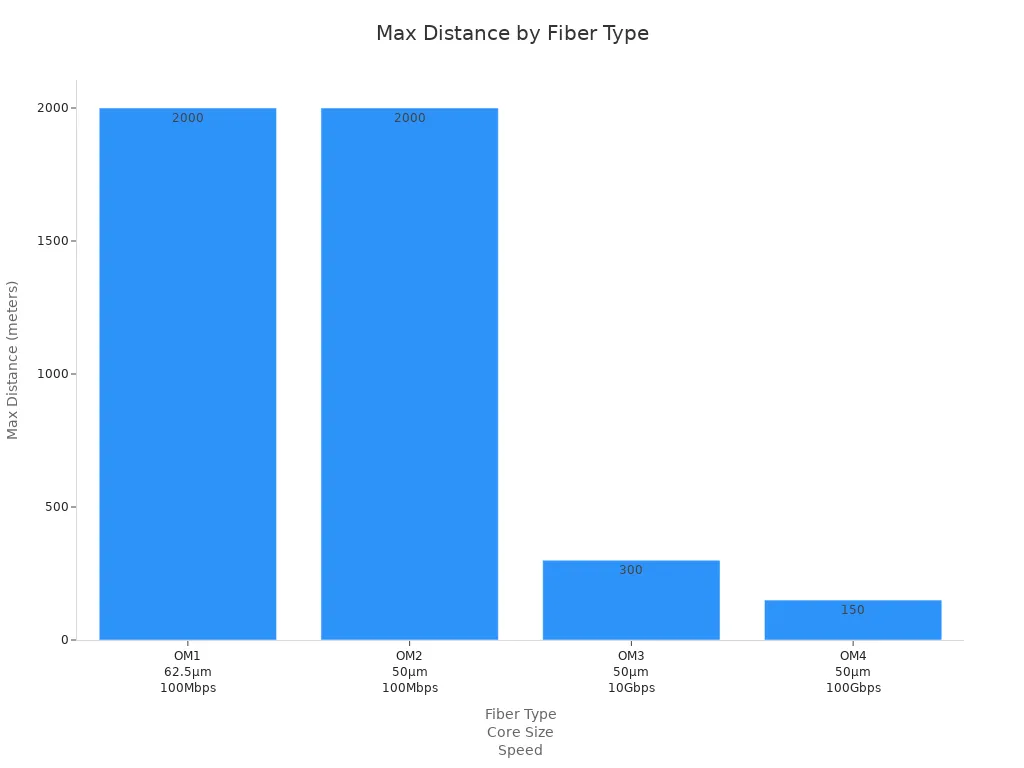
Multi-mode patch cords come in several fiber types, each with specific performance characteristics. The table below shows the standard core sizes and maximum supported distances for common multi-mode fibers in data center environments:
|
Fiber Type |
Core Size (microns) |
Max Distance (meters) at Speed |
|---|---|---|
|
OM1 |
62.5 |
2000 at 100Mbps |
|
OM2 |
50 |
2000 at 100Mbps |
|
OM3 |
50 |
300 at 10Gbps |
|
OM4 |
50 |
150 at 100Gbps |
You can choose from a variety of connector types, such as LC, SC, and ST, to match your equipment. Multi-mode patch cords also offer different jacket materials to meet safety and compliance needs:
- PVC jackets are standard but may emit toxic fumes in a fire.
- LSZH jackets are recommended for areas with higher fire hazards due to their lower toxicity and environmental benefits.
- OFNP jackets have the highest fire rating and produce minimal smoke, making them suitable for plenum spaces.
Tip: Always select the jacket material that matches your building's safety requirements and local regulations.
Applications
You often use multi-mode patch cords in data centers, server rooms, and enterprise networks. These cables excel in short-range connections, such as linking switches, storage devices, and servers within the same rack or across adjacent racks. Multi-mode patch cords also support high-speed protocols like 10G, 40G, and 100G Ethernet, making them ideal for modern IT infrastructure.
In campus environments, you deploy multi-mode patch cords for backbone links between wiring closets. Their cost-effectiveness and ease of installation make them a popular choice for expanding network capacity without major upgrades.
Multi-mode patch cords help you achieve reliable, high-speed connections in environments where distance does not exceed a few hundred meters.
Advantages
You gain several benefits when you choose multi-mode patch cords:
- Cost Efficiency: Multi-mode cables and transceivers are generally less expensive than single-mode options, reducing your initial investment.
- Easy Installation: The larger core size simplifies alignment and termination, which speeds up deployment and lowers labor costs.
- High Bandwidth for Short Distances: You can support demanding applications like virtualization, cloud computing, and real-time analytics within your facility.
- Flexible Compatibility: Multiple connector and jacket options allow you to tailor solutions for different environments and compliance needs.
- Proven Standards: Multi-mode patch cords comply with ISO/IEC 11801 and TIA/EIA-568, ensuring interoperability and consistent performance.
- When you evaluate Optical Patch Cord Types, multi-mode solutions stand out for their balance of speed, flexibility, and affordability in short-range business applications.
When to Choose
Selecting the right optical patch cord type can make or break your network's performance and cost efficiency. You should choose multi-mode patch cords when your business needs high-speed data transmission over short to medium distances. These cables deliver the best value in environments where you want to maximize bandwidth without overspending on infrastructure.
Key Scenarios for Multi-Mode Patch Cords:
Data Centers and Server Rooms:
You often need to connect switches, servers, and storage devices within the same rack or across adjacent racks. Multi-mode patch cords excel in these high-density environments. Their larger core size simplifies installation and reduces alignment errors, which speeds up deployment and lowers labor costs.
Enterprise LANs:
If your office or campus network requires fast, reliable connections between wiring closets or floors, multi-mode patch cords provide the bandwidth you need. You can support demanding applications like video conferencing, virtualization, and cloud access without the expense of single-mode solutions.
Cost-Sensitive Projects:
Multi-mode patch cords and transceivers cost less than single-mode options. You can achieve high performance for short-range links while keeping your project within budget. This makes multi-mode ideal for rapid expansions or upgrades.
Compliance and Safety Requirements:
You may need to meet strict building codes or fire safety standards. Multi-mode patch cords offer a range of jacket materials, such as LSZH and OFNP, to help you comply with regulations. You also benefit from proven standards like ISO/IEC 11801 and TIA/EIA-568, which ensure interoperability and reliability.
Tip:
Always match the fiber type (OM1, OM2, OM3, OM4) to your required data rate and distance. For example, OM4 supports 100Gbps up to 150 meters, making it perfect for modern data centers.
Decision Table: When to Choose Multi-Mode Patch Cords
|
Business Need |
Multi-Mode Patch Cord Advantage |
|---|---|
|
Short to medium distance |
High bandwidth, low cost |
|
High device density |
Easy installation, flexible routing |
|
Budget constraints |
Lower cable and transceiver costs |
|
Regulatory compliance |
Multiple jacket options, certified |
|
Future scalability |
Supports 10G/40G/100G upgrades |
You should avoid multi-mode patch cords for long-haul or outdoor links. Signal attenuation increases over distance, which limits their effectiveness beyond a few hundred meters. In these cases, single-mode patch cords provide better performance.
Why Multi-Mode Patch Cords Make Sense for B2B Buyers
You gain a competitive edge by choosing multi-mode patch cords for short-range, high-speed applications. You reduce capital expenditure, simplify maintenance, and ensure your network meets industry standards. This approach maximizes your ROI and addresses common pain points, such as downtime and compliance risks.
Note:
Consult with your supplier to verify compatibility with your network equipment and to select the right connector and jacket type for your installation.
By understanding when to choose multi-mode patch cords, you make informed decisions that support your business goals and long-term network reliability.
Simplex vs Duplex Patch Cords
Structure
You need to understand the physical differences between simplex and duplex patch cords before making a selection. Simplex patch cords contain a single fiber strand. This design supports unidirectional data transmission. You send data from one device to another without receiving information back on the same fiber. Duplex patch cords consist of two fiber strands joined together. Each strand handles data in opposite directions, enabling bidirectional communication.
- Simplex patch cords have one fiber strand for one-way transmission.
- Duplex patch cords have two fiber strands for two-way transmission.
- Simplex cables connect a transmitter to a receiver.
- Duplex cables allow devices to send and receive data simultaneously or alternately.
This structural difference impacts how you deploy optical patch cord types in your network. Duplex patch cords often use zipcord construction, which keeps the two fibers parallel and easy to separate if needed.
Use Cases
You must match the patch cord type to your application. Simplex patch cords work best in scenarios where you only need to send data in one direction. You see them in point-to-point connections, video streaming, security systems, and industrial monitoring. Duplex patch cords excel in environments that require continuous two-way communication, such as computer networking, telecom systems, and server connections.
|
Patch Cord Type |
Preferred Installation Scenarios |
Key Features |
|---|---|---|
|
Simplex |
Unidirectional communication, point-to-point links, video streaming, security systems, industrial processes |
Single channel, cost-effective, lower insertion loss |
|
Duplex |
Bidirectional communication, computer networking, telecom systems, server connections |
Two channels, simultaneous data transmission and reception |
You reduce costs and simplify installation with simplex patch cords in single-channel applications. Duplex patch cords provide reliability and scalability for business-critical networks.
Selection Criteria
You should consider several factors when choosing between simplex and duplex optical patch cord types:
Transmission Direction
If your application only requires one-way data flow, simplex patch cords offer a cost-effective solution. For two-way communication, duplex patch cords deliver the necessary bandwidth and reliability.
Fiber Count
Simplex patch cords use one fiber strand. Duplex patch cords use two. This impacts installation complexity and future scalability.
Installation Scenario
Use simplex patch cords for monitoring systems, sensors, or video feeds. Choose duplex patch cords for LANs, telecom links, and server interconnects.
Cost and Lifetime
Simplex patch cords cost less and have lower insertion loss. Duplex patch cords support more complex networks and offer longer service life due to their robust design.
Compliance and Standards
Duplex patch cords comply with standards such as TIA/EIA-568 and ISO/IEC 11801. These standards ensure interoperability and performance in enterprise environments.
Tip:
Always assess your network's communication needs before selecting optical patch cord types. Duplex patch cords provide future-proofing for expanding networks. Simplex patch cords help you control costs in single-channel installations.
You maximize ROI and reduce maintenance risk by choosing the right patch cord type for your business scenario. Reliable optical patch cord types support long-term network growth and minimize downtime.
Patch Cord Selection
Application Needs
Selecting the right patch cord starts with a clear understanding of your application requirements. You must evaluate the environment, the type of equipment, and the network's operational demands. Each factor influences the performance and longevity of your fiber optic infrastructure.
Consider the following key requirements when choosing patch cords for enterprise networks:
Connector type: Match the connector to your existing hardware for seamless integration.
Fiber mode: Decide between single-mode and multi-mode based on your network's distance and bandwidth needs.
Jacket material: Choose a jacket that meets safety and environmental standards for your installation site.
Bend radius: Ensure the patch cord can handle the physical routing without signal loss.
Length: Select the correct length to avoid slack or tension, which can impact performance.
Tip: Always review your network's layout and future expansion plans. This approach helps you avoid costly replacements and ensures your investment supports long-term growth.
Distance & Bandwidth
Transmission distance and bandwidth requirements play a critical role in patch cord selection. You must align your choice with the network's physical span and data throughput needs.
Single-mode fibers work best for long distances, often reaching thousands of meters or more. They support higher bandwidths, making them ideal for backbone links and inter-building connections.
Multi-mode fibers suit shorter distances, typically up to 300–400 meters. They offer cost-effective solutions for data centers, server rooms, and local area networks.
If your application demands high bandwidth over extended distances, single-mode fiber is the recommended option.
For shorter links and moderate bandwidth, multi-mode fiber provides reliable performance at a lower cost.
|
Fiber Type |
Recommended Distance |
Bandwidth Support |
Typical Use Case |
|---|---|---|---|
|
Single-mode |
Thousands of meters |
High (10G/40G/100G+) |
Campus, backbone, telecom |
|
Multi-mode |
300–400 meters |
Moderate to high (10G) |
Data center, LAN |
Note: Always match the fiber type to your network's current and future data needs. This strategy ensures you avoid bottlenecks and costly upgrades.
Connector Types
The connector type determines compatibility, installation ease, and network density. You should select connectors based on your equipment, environment, and future scalability.
- ST Connector: Used in both single-mode and multi-mode applications. Its bayonet-style design offers secure connections in legacy systems.
- SC Connector: Known for low cost and simple push-pull operation. Widely used in passive optical networks (PON) and enterprise backbones.
- LC Connector: Features a compact design with a smaller ferrule. Ideal for high-density installations in data centers and telecom racks.
- FC Connector: Recommended for environments with vibration or movement. While robust, it is gradually being replaced by SC and LC in modern networks.
- MPO/MTP Connector: Supports multi-fiber connectivity. Essential for high-density cabling and parallel optics in large-scale deployments.
|
Connector Type |
Key Features |
Typical Application |
|---|---|---|
|
ST |
Bayonet lock, legacy compatibility |
Industrial, legacy systems |
|
SC |
Push-pull, low cost |
PON, enterprise, telecom |
|
LC |
Small form factor, high density |
Data center, modern LAN |
|
FC |
Threaded, vibration resistant |
Industrial, test equipment |
|
MPO/MTP |
Multi-fiber, scalable |
High-density, backbone |
Tip: For new installations, LC and MPO/MTP connectors offer the best scalability and space savings. Always verify connector compatibility with your existing hardware to streamline deployment.
Jacket & Polish Types
You must evaluate jacket and polish types when selecting patch cords for your business network. These features directly impact safety, signal quality, and compliance. You improve network reliability and reduce maintenance risk by choosing the right combination.
Jacket Types
Jacket material protects the fiber and determines how well your patch cord performs in different environments. You encounter several options:
PVC (Polyvinyl Chloride):
You use PVC jackets in standard office or commercial settings. They offer flexibility and cost savings. However, PVC emits toxic fumes during a fire, which limits its use in sensitive areas.
LSZH (Low Smoke Zero Halogen):
LSZH jackets provide enhanced fire safety. You select LSZH for indoor installations, especially where people work or sensitive equipment operates. LSZH emits minimal smoke and no halogen gases, meeting strict building codes.
OFNP (Optical Fiber Nonconductive Plenum):
You require OFNP jackets for plenum spaces, such as air ducts or raised floors. OFNP meets the highest fire safety standards. You comply with regulations and protect your infrastructure in critical environments.
|
Jacket Type |
Fire Safety |
Typical Use Case |
Compliance Standard |
|---|---|---|---|
|
PVC |
Low |
Offices, commercial |
General purpose |
|
LSZH |
High |
Indoor, public spaces |
IEC 60332, EN 50267 |
|
OFNP |
Highest |
Plenum, air ducts |
NFPA 262, UL 910 |
Tip: Always check local fire codes before choosing a jacket type. You avoid compliance issues and ensure workplace safety.
Polish Types
Connector polish type affects signal loss and return loss. You must match polish type to your application for optimal performance.
PC (Physical Contact):
You find PC polish in legacy systems. It provides basic signal quality but higher return loss compared to modern options.
UPC (Ultra Physical Contact):
UPC polish delivers improved signal integrity. You use UPC for most enterprise and telecom networks. It supports high-speed data and reduces signal reflection.
APC (Angled Physical Contact):
APC polish features an 8-degree angled end face. You select APC for long-distance or high-bandwidth applications. APC minimizes return loss, which is critical for advanced optical networks.
|
Polish Type |
Return Loss (dB) |
Typical Use Case |
Compliance Standard |
|---|---|---|---|
|
PC |
≥ -40 |
Legacy, basic links |
IEC 61755-3-1 |
|
UPC |
≥ -50 |
Enterprise, telecom |
IEC 61755-3-2 |
|
APC |
≥ -60 |
Long-haul, high-speed |
IEC 61755-3-3 |
You improve network reliability and reduce downtime by selecting the correct polish type for your connectors.
You must consider jacket and polish types as part of your overall strategy for Optical Patch Cord Types. These choices help you meet safety standards, optimize performance, and support long-term ROI.
Checklist
You need a practical checklist to guide your patch cord selection process. This approach ensures you address all critical factors and avoid costly mistakes.
Define Application Needs:
Identify your network environment and operational requirements.
Determine Distance & Bandwidth:
Match fiber type to transmission distance and data rate.
Select Connector Type:
Ensure compatibility with existing equipment.
Choose Jacket Material:
Verify fire safety and compliance with local codes.
Pick Polish Type:
Optimize signal quality for your application.
Check Certification:
Confirm compliance with industry standards (IEC, TIA/EIA, NFPA).
Assess Cost & Delivery:
Balance initial investment with long-term maintenance and scalability.
Plan for Scalability:
Choose solutions that support future upgrades and expansion.
✅ You maximize ROI and minimize risk by following this checklist. You build a reliable, compliant, and future-proof network.
|
Selection Step |
Why It Matters |
What You Gain |
|---|---|---|
|
Application Needs |
Ensures suitability |
Reliable performance |
|
Distance & Bandwidth |
Prevents bottlenecks |
Optimal data flow |
|
Connector Type |
Guarantees compatibility |
Easy installation |
|
Jacket Material |
Meets safety standards |
Regulatory compliance |
|
Polish Type |
Reduces signal loss |
High network reliability |
|
Certification |
Verifies quality |
Peace of mind |
|
Cost & Delivery |
Controls budget |
Efficient procurement |
|
Scalability |
Supports growth |
Long-term ROI |
You address customer pain points and position your organization for success by using this checklist when evaluating Optical Patch Cord Types.
Industry Pain Points & Solutions
Supply Chain
You face several supply chain challenges when sourcing optical patch cord types for your business network. These issues can disrupt project timelines and increase costs. Common obstacles include:
Supply chain instability
Technical bottlenecks
Market competition
Labor shortages
Sustainability concerns
Tariffs impacting sourcing strategies
Supply chain instability often leads to unpredictable lead times and fluctuating prices. Technical bottlenecks can delay product development or limit access to advanced optical patch cord types. Market competition drives up demand, making it harder to secure reliable inventory. Labor shortages affect manufacturing capacity, while sustainability concerns push you to seek environmentally friendly solutions. Tariffs may force you to adjust sourcing strategies, impacting your budget and procurement plans.
Tip: Build strong relationships with reliable suppliers. You reduce risk by choosing partners who offer transparent communication, flexible logistics, and proven track records in delivering certified optical patch cord types.
Quality & Certification
Quality assurance and certification standards play a critical role in network reliability. You cannot afford to overlook these factors when selecting optical patch cord types for regulated industries or mission-critical applications. Studies show that 60% of patch cords fail to meet TIA's critical performance requirements. Another study found that 70% of patch cords do not meet return loss or crosstalk specifications. These failures can lead to costly downtime and troubleshooting.
The TIA recommends early swapping of patch cords during network maintenance, highlighting their importance in maintaining performance. You should always verify that your optical patch cord types comply with recognized certification standards. The table below lists key standards for regulated industries:
|
Certification Standard |
Description |
|---|---|
|
ITU-T G.652 |
Specifies characteristics of single-mode optical fibers for long-distance communication. |
|
IEEE 802.3 |
Governs Ethernet networking protocols for interconnectivity between fiber optic systems. |
|
CE Marking |
Indicates conformity with EU safety, health, and environmental protection standards. |
|
RoHS |
Restricts hazardous substances in fiber optic components to ensure safety and environmental protection. |
|
WEEE |
Regulates waste electrical and electronic equipment to promote recycling and safe disposal. |
You protect your investment and ensure network reliability by choosing patch cords that meet these certification standards.
ROI & Efficiency
Maximizing ROI and operational efficiency requires a strategic approach to sourcing optical patch cord types. You can use the following strategies:
Forward Planning: Anticipate future requirements and plan for upgrades. This ensures your network meets evolving demands and avoids costly retrofits.
Flexible Fiber Architecture: Maintain adaptability in your fiber network. You accommodate changes in technology and bandwidth needs without major disruptions.
After-sales support and warranty policies also influence the long-term value of your investment. The table below outlines typical warranty periods and testing policies for optical patch cord types and related products:
|
Product Type |
Warranty Period |
Testing Policy |
|---|---|---|
|
Indoor and outdoor fiber optic cables |
25 years |
Goods tested and provided with test reports before shipment. |
|
Indoor and outdoor fiber optic patch cords |
20 years |
Goods tested and provided with test reports before leaving the factory. |
|
PLC and FBT optical splitter |
20 years |
Goods tested and provided with test report before leaving the factory. |
|
Quality Issues Handling |
N/A |
Clear procedures for product analysis and responsibility for costs associated with defects. |
|
Customer Responsibility |
N/A |
If product mishandled, warranty void but negotiation possible for resolution. |
|
Third-party Testing |
N/A |
If customer disagrees with test report, they can seek third-party analysis at their own cost. |
You gain peace of mind and reduce maintenance risk by working with suppliers who offer comprehensive warranties and clear after-sales support. These policies help you resolve quality issues quickly and maintain network reliability over the product's lifetime.
Note: Always request test reports and verify warranty terms before finalizing your purchase. You safeguard your network and maximize ROI by prioritizing quality and support in your procurement strategy.
Applications & Case Studies
Data Centers
You face unique challenges when deploying optical patch cord types in data centers. High-density environments demand both performance and reliability. You often combine copper and fiber cables to optimize transmission for different applications. Hybrid solutions address multiple signal requirements, helping you balance speed and cost.
The following table summarizes common deployment scenarios, key considerations, and lessons learned from real data center projects:
|
Deployment Scenario |
Key Considerations |
Lessons Learned |
|---|---|---|
|
Hybrid Solutions |
Combine copper and fiber for optimal performance |
Hybrid designs address diverse transmission needs efficiently |
|
Patch Cord Design |
Select designs that minimize noise and environmental impact |
Proper design selection boosts reliability and data transmission quality |
|
Environmental Factors |
Evaluate temperature, moisture, and foot traffic in the data center |
Understanding conditions ensures resilient cable selection |
|
Post-Installation Testing |
Test for data leaks and performance issues after installation |
Regular testing identifies issues early, ensuring optimal transmission quality |
Tip: Always test your optical patch cord types after installation. Early detection of issues saves time and prevents costly downtime.
You improve ROI by selecting patch cords that match your data center's environment and operational needs. Regular testing and careful design choices reduce maintenance risk and support long-term scalability.
Telecom
Telecom networks rely on optical patch cord types to connect critical components such as switches and multiplexers. You need to maintain signal integrity over long distances to ensure high-quality communication. In these environments, you must focus on several key performance metrics:
- Transmission rate: Choose patch cords that support your required data speeds.
- Distance: Select single-mode patch cords for long-haul links.
- Security against interference: Use quality connectors and polish types to minimize signal loss.
- Bandwidth capacity: Ensure your patch cords meet current and future bandwidth demands.
You achieve reliable service by prioritizing these metrics. Optical patch cord types that comply with standards like ITU-T G.652 and TIA/EIA-568 guarantee interoperability and performance. You also reduce maintenance costs by investing in certified, high-quality patch cords.
You support business continuity and customer satisfaction by choosing patch cords that deliver consistent, secure, and high-speed connections.
Industrial Networks
Industrial environments present harsh conditions for optical patch cord types. You must address durability, safety, and performance in every deployment. The table below highlights how different patch cord types meet unique industrial requirements:
|
Type of Patch Cord |
Unique Requirement Addressed |
Application Context |
|---|---|---|
|
Armored Patch Cords |
Durability and resistance to damage |
Harsh environments, outdoor installations |
|
MPO/MTP Patch Cords |
High-density connections |
High-speed data transmission, backbone networks |
|
Waterproof Patch Cords |
Resistance to moisture and harsh conditions |
Outdoor or wet environments |
You protect your network by selecting armored or waterproof patch cords for industrial sites. These solutions withstand physical stress, moisture, and temperature changes. MPO/MTP patch cords enable high-speed, high-density connections in control rooms and backbone links.
Note: Always verify that your optical patch cord types meet relevant industry standards and environmental requirements. This approach ensures safety, reliability, and long-term ROI.
You gain peace of mind and reduce downtime by matching patch cord types to your specific industrial application. Careful selection supports efficient operations and protects your investment.
You gain a competitive edge when you understand the differences between Optical Patch Cord Types. Single-mode cables offer long-distance, high-bandwidth links, while multi-mode options provide cost savings for short runs. Simplex supports one-way data, and duplex enables two-way communication.
|
Aspect |
Singlemode OS2 |
Multimode Fiber |
|---|---|---|
|
Core Size |
9 µm |
50 or 62.5 µm |
|
Distance & Bandwidth |
40 km+, high bandwidth |
Up to 600 m, lower bandwidth |
|
Cost |
Higher |
More economical |
To make informed decisions, you should:
- Match connector and fiber types to your network.
- Measure cable lengths accurately.
- Choose jackets and polish for safety and performance.
- Balance quality with budget.
- Select reputable vendors with strong warranties.
- Careful selection improves reliability, reduces costs, and supports your business growth.
FAQ
Why should you choose single-mode patch cords for long-distance links?
Single-mode patch cords support long-distance transmission with minimal signal loss. You meet industry standards like ITU-T G.652. You ensure reliable, high-bandwidth connections for telecom and campus networks. This choice reduces maintenance risk and supports future upgrades.
Why do multi-mode patch cords cost less for short-range applications?
Multi-mode patch cords use a larger core, which simplifies alignment and lowers manufacturing costs. You save money on both cables and transceivers. For short-range links in data centers or LANs, you achieve high performance without overspending.
Why does jacket material matter when selecting optical patch cord types?
Jacket material affects fire safety, durability, and compliance. You must select LSZH or OFNP jackets for indoor or plenum spaces to meet building codes. The right jacket protects your network and ensures regulatory compliance.
Why do you need to match connector types to your equipment?
Connector compatibility ensures a secure, low-loss connection. You avoid installation errors and downtime by matching LC, SC, or MPO connectors to your devices. This step guarantees optimal performance and simplifies future maintenance.
Why is polish type important for optical patch cord types?
Polish type impacts signal quality and return loss. UPC and APC polishes reduce reflection and improve data integrity. You select the right polish to meet application needs, especially for high-speed or long-distance links.
Why should you verify certification and standards before purchasing?
Certification ensures your optical patch cord types meet industry requirements. You reduce the risk of failure and guarantee interoperability. Always check for standards like IEC, TIA/EIA, or RoHS to protect your investment.
Why do B2B buyers prefer duplex patch cords for business networks?
Duplex patch cords enable two-way communication, which is essential for most enterprise and telecom systems. You support simultaneous data transmission and reception. This choice increases reliability and supports network scalability.
Why is supplier reliability critical for large-scale optical patch cord deployments?
Reliable suppliers provide consistent quality, timely delivery, and strong after-sales support. You minimize project delays and reduce maintenance costs. Trusted partners help you meet project deadlines and maintain network performance.