





Optical Patch Cord Technology and Applications: From Manufacturing Process to Network Deployment
Optical Patch Cord technology connects network equipment and ensures fast, stable data transfer in modern infrastructures. You rely on high-speed transmission and consistent connectivity to support business operations and reduce downtime.
In 2022, the global optical fiber patch cord market reached about USD 1.9 billion and is expected to grow steadily through 2032.
By 2023, the fiber optic patch cord market size climbed to USD 3.5 billion, with forecasts showing it could hit USD 7.8 billion by 2032.
As a decision-maker, you must consider procurement strategies, product quality, and long-term ROI. You may ask: What is an optical patch cord? How is it manufactured? Which standards influence performance? Where do you deploy it? What impact does it have on your business?

Key Takeaways
- Optical patch cords are essential for fast and reliable data transfer in modern networks.
- Choosing the right type of patch cord, such as single-mode or multimode, impacts network performance and scalability.
- High-quality materials and standards compliance enhance the durability and reliability of optical patch cords.
- Proper cable management and labeling simplify troubleshooting and reduce downtime in network operations.
- Regular testing and maintenance of optical patch cords ensure optimal performance and longevity.
- Investing in armored or LSZH patch cords protects against environmental hazards and reduces maintenance costs.
- Understanding the manufacturing process helps in selecting high-quality patch cords that meet industry standards.
- Utilizing pre-terminated patch cords can speed up installation and improve overall network efficiency.
What Is an Optical Patch Cord?

Definition and Function
You encounter the term "Optical Patch Cord" frequently in network design and deployment. According to international standards organizations, a fiber-optic patch cord is a fiber-optic cable terminated with connectors on both ends. This design enables quick and easy connections to telecommunication equipment. You use these cords to link devices and transmit signals with high precision. They ensure fast and reliable data transfer, which is essential for modern communication systems.
Note: IEC 61754, ITU-T G.652, and IEEE 802.3 standards define connector types, fiber specifications, and performance benchmarks for patch cords. Leading brands like Corning and CommScope reference these standards in their technical white papers.
You must select the right type of patch cord for your network. Single-mode cords support long-distance transmission, while multimode cords work best for short distances. The choice of connector-such as LC or MPO-affects network functionality and scalability. High-quality materials and armored designs improve durability, especially in harsh environments.
Primary Functions of Optical Patch Cords:
- Link network devices and transmit data with high accuracy.
- Support fast, stable data transfer for business-critical operations.
- Enable flexible network expansion and quick equipment changes.
- Reduce downtime by providing reliable connections.
Types and Features
You have several options when choosing an Optical Patch Cord. Each type offers unique features for specific applications. The table below summarizes the most common types and their distinguishing characteristics:
|
Type |
Description |
Use Case |
|---|---|---|
|
Simplex Patch Cord |
Single fiber cable, data transmission in one direction. |
Ethernet switches, point-to-point links. |
|
Duplex Patch Cord |
Two fiber strands, supports send/receive. |
High-speed network devices, routers. |
|
ST Connector |
2.5mm ferrule, easy installation, single/multimode. |
Industrial, military networks. |
|
SC Connector |
Square, low cost, easy to install. |
PON, media converters. |
|
LC Connector |
Small ferrule, high-density installations. |
FTTX, patch panels. |
|
FC Connector |
Screw-on, vibration resistant. |
Environments with vibration, test equipment. |
|
MPO/MTP Connector |
Multi-fiber, high-density cabling. |
Data centers, backbone networks. |
|
Polish Types |
PC, UPC, APC minimize return loss. |
Chosen by application needs. |
|
Jacket Types |
PVC, LSZH, OFNP for different environments. |
PVC (indoor), LSZH (public), OFNP (pipes). |
Material, Cost, and Lifetime Comparison
|
Material Type |
Cost Level |
Typical Lifetime |
Application Scenario |
|---|---|---|---|
|
Standard PVC |
Low |
5-7 years |
Indoor, low-risk environments |
|
LSZH |
Medium |
7-10 years |
Public buildings, safety focus |
|
Armored |
High |
10+ years |
Industrial, outdoor, EPC sites |
Tip: You can reduce maintenance costs and downtime by choosing armored or LSZH patch cords for high-risk or public environments.
Impact on Network Performance
Your choice of Optical Patch Cord directly affects network performance metrics such as latency, bandwidth, and signal integrity. Connector type, cable length, and fiber mode all play critical roles.
Fiber optic connectors like SC and LC influence insertion loss and return loss. Low insertion loss and excellent return loss maintain signal integrity, which is vital for long-distance and high-speed applications.
LC connectors allow higher port density, supporting scalable network growth without sacrificing performance.
The length of the cable impacts latency. Longer cables increase round trip times, which can affect real-time applications.
The refractive index of the fiber slows down light compared to a vacuum, contributing to latency.
Single-mode fibers offer lower latency than multimode fibers, which is crucial for efficient telecom and data center networks.
Real-World Application Scenarios
Telecom Operators: Deploy single-mode patch cords with LC connectors for backbone networks, ensuring low latency and high bandwidth.
EPCs (Engineering, Procurement, Construction): Use armored patch cords in outdoor installations to minimize maintenance risk and extend service life.
Distributors: Stock a range of patch cord types and connector options to meet diverse client needs, referencing IEC and ITU standards for quality assurance.
Strategic Insight: Selecting the right Optical Patch Cord improves ROI by reducing replacement frequency and maintenance costs. You ensure reliable connectivity and future-proof your network infrastructure.
Optical Patch Cord Manufacturing Process

Material Selection
You start the manufacturing process by selecting materials that meet strict industry standards. The choice of materials directly impacts the durability, flexibility, and performance of each Optical Patch Cord. You must consider the application environment and required performance characteristics.
|
Material Type |
Characteristics |
|---|---|
|
Multi-mode optical fiber |
Short transmission distance (300-500 meters), indicated by orange or gray color. |
|
Stainless steel protective armor |
Solid tension resistance, side pressure resistance, bending resistance, and rat-bite resistance. |
|
High-strength aramid fiber |
Ensures no tensile strain on the optical fiber, providing high flexibility and small outer diameter. |
|
Flame-supporting coating |
Environmentally friendly, high-temperature resistant, and good bending performance. |
You often see multi-mode fibers in short-distance data transmission, while single-mode fibers serve long-haul networks. Stainless steel armor protects cables in harsh environments, such as outdoor or industrial sites. High-strength aramid fibers add flexibility and prevent breakage during installation. Flame-supporting coatings ensure safety in public buildings and meet fire-resistance standards.
Tip: You should verify that materials pass rigorous tests, such as Salt Fog, Airborne Contaminants, Immersion/Corrosion, and Groundwater Immersion. These tests confirm that patch cords maintain integrity and performance in challenging conditions.
Cable Cutting and Fiber Stripping
You must cut cables to precise lengths and strip fibers with great care. This step requires strict adherence to international standards, such as IEC and TIA/EIA, to ensure consistent quality.
Stripping multi-layer cables requires you to remove each layer individually.
You must avoid damaging the underlying fiber during the stripping process.
Progressive stripping maintains the integrity of the fiber and prevents micro-cracks.
The table below shows the standard stripped cable lengths for common connector types:
|
Connector Type |
Stripped Cable Length |
0.9mm Exposed Length |
|---|---|---|
|
LC ø2.0 |
32MM±2MM |
32MM±2MM |
|
LC ø3.0 |
34MM±2MM |
34MM±2MM |
|
SC ø2.0/ø3.0 |
27MM±2MM |
27MM±2MM |
|
MTRJ |
30MM±2MM |
30MM±2MM |
|
ST ø2.0/ø3.0 |
35MM±2MM |
35MM±2MM |
|
FC ø2.0/ø3.0 |
29MM±2MM |
29MM±2MM |
|
FDDI/ESCON |
5.5CM+2MM |
5.5CM+2MM |
|
MU |
26MM+2MM |
26MM+2MM |
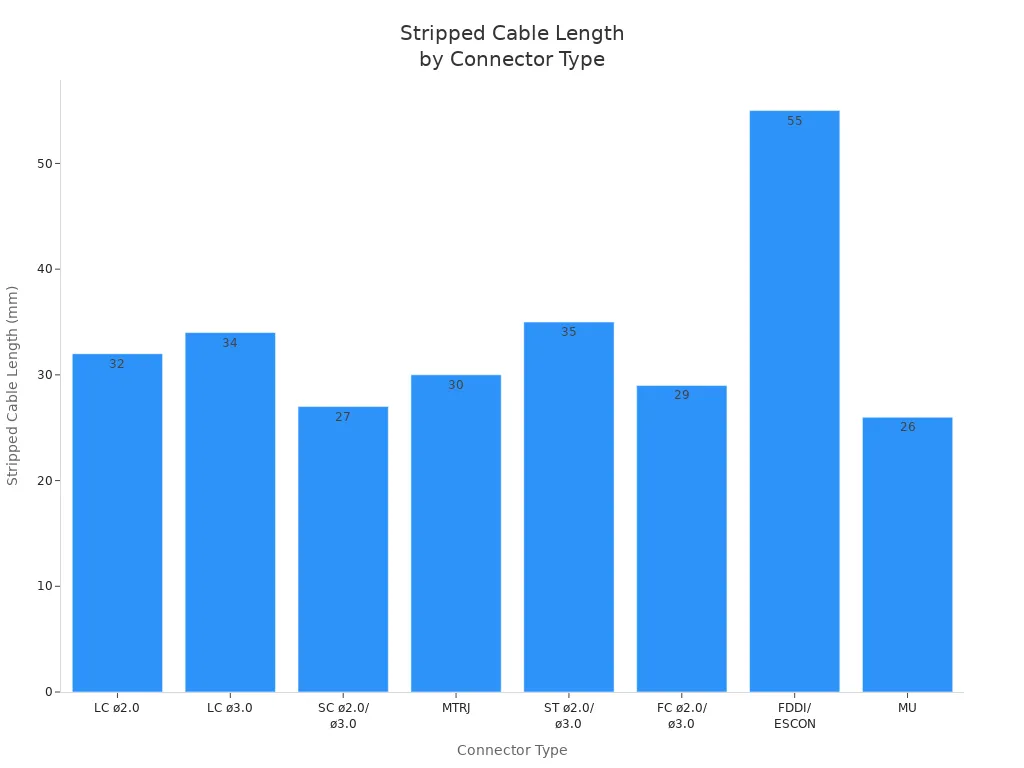
You should use automated production machines for stripping and cutting. These machines improve efficiency and reduce manual errors. Good stripping techniques prevent cracks and ensure strong, reliable connections. If you damage the fiber during stripping, you risk signal loss and network downtime.
Epoxy Application and Connector Assembly
You move to the next stage by applying epoxy and assembling connectors. This step determines the long-term reliability and signal quality of the Optical Patch Cord.
You must thoroughly mix and degas the epoxy to remove bubbles.
Clean the bonding surface and fiber with 99% isopropyl alcohol to eliminate oils and contaminants.
Use consistent mixing techniques for uniformity and strength.
If you skip proper epoxy application, you risk insufficient fill inside the connector. This can cause fiber breakage, especially in extreme temperatures. You should always validate your epoxy dispensing procedures to avoid costly failures.
You insert the stripped fiber into the connector ferrule, ensuring the epoxy fills the cavity completely. After curing, you polish the connector end-face to achieve low insertion loss and high return loss. High-quality manufacturing leads to low signal loss and minimal interference, which are critical for maintaining data integrity in network deployments.
Note: Premium-grade optical fibers and protective outer layers enhance durability and resistance to environmental stress. You ensure long-term reliability and reduce maintenance costs by following best practices in assembly.
Quality Control and Testing
You cannot afford to overlook quality control and testing in optical patch cord manufacturing. Every patch cord must meet strict international standards to guarantee reliable network performance and long-term ROI. You need to ensure that each product passes a series of rigorous tests before deployment.
Key Quality Control Procedures:
- Adherence to Standards: You must follow IEC 61755-3-31 and TIA-568 standards. These standards define the minimum requirements for optical patch cord performance and reliability.
- Core Performance Tests: You conduct Polarization Extinction Ratio (PER), Insertion Loss (IL), and Return Loss (RL) tests on every patch cord. These tests measure how well the cord transmits light and maintains signal quality.
- Endface Inspection: You use a 3D interferometer to check the connector endface geometry and cleanliness. This inspection ensures low signal loss and prevents contamination-related failures.
- Environmental Testing: You perform temperature cycling and mechanical stability tests. These tests confirm that patch cords can withstand harsh conditions, such as extreme heat, cold, and vibration.
Tip: You should always request test reports from your supplier. These reports provide proof of compliance with industry standards and help you avoid costly network downtime.
Typical Test Metrics and Pass/Fail Rates
|
Test Type |
Standard Reference |
Typical Duration |
Pass Rate (%) |
Acceptable Value |
|---|---|---|---|---|
|
Insertion Loss (IL) |
IEC 61755-3-31 |
30 seconds |
99.8 |
≤ 0.3 dB (single-mode) |
|
Return Loss (RL) |
TIA-568 |
30 seconds |
99.7 |
≥ 50 dB (APC) |
|
Endface Geometry |
IEC 61300-3-35 |
20 seconds |
99.9 |
No scratches/defects |
|
PER (Polarization) |
IEC 61300-3-40 |
1 minute |
99.5 |
≥ 25 dB |
|
Temperature Cycling |
IEC 61300-2-18 |
8 hours |
99.6 |
No performance drop |
|
Mechanical Stability |
IEC 61300-2-1 |
2 hours |
99.7 |
No fiber breakage |
You should pay close attention to insertion loss and return loss values. Low insertion loss and high return loss indicate excellent signal transmission. You also need to check the connector endface for scratches or contamination, as these defects can cause network failures.
Quality Control Checklist:
Inspect every patch cord for physical defects.
Test optical performance using calibrated equipment.
Verify compliance with IEC and TIA standards.
Review environmental test results for durability.
Document all test data for traceability.
📈 Note: High pass rates and strict adherence to standards reduce your maintenance costs and improve network uptime. You gain confidence in your procurement decisions and deliver better value to your clients.
Annotations/References:
IEC 61755-3-31: International standard for fiber optic connector performance.
TIA-568: North American standard for structured cabling.
IEC 61300 series: Test methods for fiber optic interconnecting devices.
Technological Advancements
Fiber and Connector Innovations
You see rapid progress in fiber and connector technology. Manufacturers now offer connectors that support higher speeds, greater density, and easier installation. These innovations help you optimize network layouts and reduce operational costs.
|
Connector Type |
Description |
|---|---|
|
SN® Connector |
Designed for 400G data centers, enables individual duplex fiber breakout, increases reliability, lowers cost |
|
LC Connector |
Compact, fits RJ-45 cutouts, meets industry standards |
|
LX.5 Connector |
Doubles fiber capacity in SC footprint, user-friendly |
|
MU Connector |
High-density, maintains optical performance |
|
MTP Patchcord |
Quick multifiber connections, precise alignment |
|
MT-RJ Connector |
Compact, doubles capacity in RJ-45 space |
|
SN-MT Connector |
Next-gen multifiber, increased density |
|
HE-XX Series Connector |
Built for harsh environments, reduces installation time |
|
SCF Push Cable |
Pre-terminated, easy subscriber connections |
|
Onanon Magnetic Connector |
Combines fiber optics and electrical connectivity for medical applications |
You can select from a wide range of connector types to match your deployment needs. For example, SN® and SN-MT connectors support high-density data centers, while HE-XX Series connectors withstand tough industrial conditions. These options give you flexibility and help future-proof your network.
- SN® Connector: Reliable, cost-effective for 400G data centers
- LC Connector: Compact, standard-compliant
- LX.5 Connector: Doubles fiber capacity
- MU Connector: High-density solution
- MTP Patchcord: Fast, precise multifiber connections
- MT-RJ Connector: Space-saving, doubles capacity
- SN-MT Connector: Next-generation density
- HE-XX Series Connector: Rugged, quick install
- SCF Push Cable: Easy for subscribers
- Onanon Magnetic Connector: Hybrid for medical use
Durability and Miniaturization
You benefit from new fiber designs that allow more connections in limited spaces. Slender fibers and reduced cladding diameters enable high-density cabling without sacrificing performance. These advancements are essential for modern data centers and telecom closets.
Recent fiber optic technology lets you pack more fibers into smaller cables. You maintain signal quality and integrity, even as you increase network density. Bend-insensitive fiber technology addresses installation constraints in compact environments, making deployment easier and safer.
|
Feature |
Percentage |
Description |
|---|---|---|
|
Bend-insensitive fiber technology |
46% |
Solves installation issues in tight spaces |
|
MPO/MTP connectors |
33% |
Meets high-speed data center demands |
|
Hybrid patch cords |
19% |
Combines fiber and copper for versatile connectivity |
|
Ruggedized jackets |
28% |
Supports military and industrial deployments |
|
Color-coded push-pull connectors |
22% |
Simplifies large-scale installations |
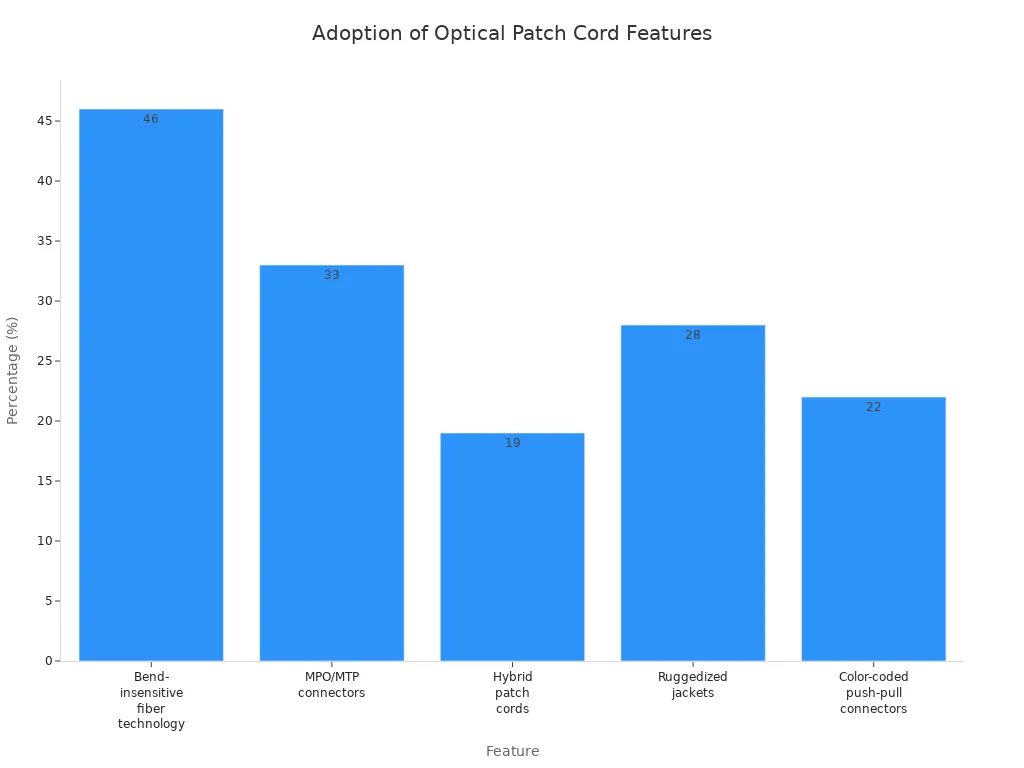
You see ruggedized jackets and hybrid patch cords supporting deployments in harsh environments. Color-coded connectors make large-scale installations faster and more reliable. These features help you reduce maintenance risk and improve long-term ROI.
Industry Standards
You rely on international standards to ensure product quality and network reliability. Organizations like IEC, TIA, and ISO/IEC update specifications for testing, connector types, and performance metrics. These standards guide you in selecting products that meet strict requirements.
ISO/IEC 14763-3 introduces reference-grade connector specifications. TIA-568.3-E changes fiber transitions and polarity methods, affecting how you design and deploy patch cords. You gain confidence in your procurement decisions by choosing products that comply with these standards. Consistent adherence to standards helps you avoid costly downtime and ensures your network performs at its best.
Optical Patch Cord Applications
Data Centers
You rely on Optical Patch Cord solutions to keep your data center running at peak efficiency. These cords connect hubs, switches, routers, and storage arrays, supporting the transmission of audio, video, and digital signals. You need patch cords that meet strict performance standards, such as ANSI/TIA-568-D and IEEE 802.3ae/802.3ba, to ensure reliable 10Gbps, 40Gbps, or 100Gbps Ethernet connections.
High-density environments demand OM3 and OM4 multimode patch cords, which comply with TIA-492AAAC and TIA-492AAAD. These cords deliver low insertion loss-Cablesys patch cords average 0.2dB, with 83% achieving ≤0.1dB-far exceeding the industry standard of 0.75dB. You benefit from this performance by reducing signal loss and maximizing uptime.
Tip: Use color-coded patch cords and structured cable management to simplify troubleshooting and speed up maintenance. This approach minimizes downtime and supports rapid scaling as your data center grows.
Common deployment strategies include:
Arranging patch cords in horizontal and vertical cable managers for airflow and accessibility.
Using pre-terminated cords for fast installation and consistent quality.
Labeling both ends of each cord to streamline port identification and reduce human error.
Telecom Networks
You depend on optical patch cords to transmit voice, video, and data signals across telecom networks. These cords interconnect equipment over short distances within telecom facilities or between buildings. You often deploy them in central offices, telecom closets, and outdoor cabinets.
Patch cords in telecom networks must withstand frequent reconfiguration and environmental changes. You select cords with robust jackets and connectors that meet IEC and TIA standards. This ensures stable performance, even in high-traffic or mission-critical applications.
Patch cords enable quick rerouting during network upgrades or repairs.
You use them to connect multiplexers, switches, and transmission equipment.
Proper cable management prevents tangling and signal interference, supporting long-term reliability.
Note: Investing in high-quality patch cords reduces maintenance costs and minimizes service interruptions, improving your network's ROI.
Enterprise Environments
You face unique challenges in enterprise networks, where flexibility and scalability are essential. Optical patch cords support high-speed data transmission and high-density cabling, allowing you to adapt to changing business needs.
|
Role/Strategy |
Description |
|---|---|
|
High-speed data transmission |
Patch cords enable fast, reliable connections for business applications. |
|
Support for high-density cabling |
You maximize rack space and simplify expansion. |
|
Flexible network configurations |
Patch cords let you reconfigure layouts as your organization grows. |
|
Planning and design |
Careful planning ensures efficient deployment and future scalability. |
|
Selection of fiber types and connectors |
Choosing the right type boosts performance and reduces costs. |
|
Optimization of wiring paths |
Organized cabling prevents signal loss and eases maintenance. |
|
Effective port management |
Labeling and tracking ports improves troubleshooting and uptime. |
|
Regular testing and maintenance |
Ongoing checks keep your network reliable and secure. |
You should plan your patch cord deployment with future growth in mind. Select fiber types and connectors based on distance and speed requirements. Optimize wiring paths to avoid congestion and signal degradation. Regular testing and clear labeling help you maintain network health and reduce downtime.
Pro Tip: Investing in quality patch cords and organized cable management pays off with lower maintenance costs and higher network availability.
FTTH Solutions
Fiber to the Home (FTTH) solutions rely on optical patch cords to deliver high-speed internet and reliable connectivity directly to residential and commercial buildings. You use optical patch cords to connect optical network terminals (ONTs), splitters, and distribution points. This approach ensures fast data transmission and supports modern digital lifestyles.
You face unique challenges when deploying FTTH networks in urban and rural environments. In cities, you must work within limited installation spaces and comply with strict building codes. High traffic density complicates logistics, and you need to protect cables while maintaining aesthetics. Environmental interference, such as electromagnetic noise, can affect signal quality. In rural areas, you deal with vast distances and harsh weather. Lack of infrastructure makes installation difficult, and remote locations create maintenance challenges.
|
Area |
Challenges |
|---|---|
|
Urban |
1. Space Constraints: Limited installation space for fiber cables. |
|
2. High Traffic Density: Complicated logistics due to dense city traffic. |
|
|
3. Cable Protection and Aesthetics: Need for compliance with building codes. |
|
|
4. Environmental Interference: High EMI affecting signal quality. |
|
|
Rural |
1. Geographical Challenges: Difficult installation due to vast distances and harsh weather. |
|
2. Infrastructure Availability: Lack of existing infrastructure complicates installation. |
|
|
3. Maintenance and Accessibility: Challenges in ongoing maintenance due to remote locations. |
You select optical patch cords with robust jackets and low insertion loss to overcome these challenges. Armored patch cords protect against rodents and physical damage in outdoor installations. LSZH (Low Smoke Zero Halogen) jackets meet fire safety standards in public buildings. You benefit from pre-terminated patch cords, which speed up installation and reduce errors.
Tip: Always verify that your optical patch cords comply with IEC 61754 and TIA-568 standards. This practice ensures reliable performance and minimizes future maintenance costs.
You deploy optical patch cords in FTTH networks using structured cable management and patch panels. You label each cord for easy identification and troubleshooting. You use color-coded cords to simplify installation and maintenance. These strategies help you reduce downtime and improve customer satisfaction.
You achieve long-term ROI by investing in high-quality optical patch cords. Durable materials and compliance with international standards lower replacement frequency and maintenance risk. You deliver reliable connectivity to end users and support business growth.
Annotations/References:
IEC 61754: Fiber optic connector interfaces
TIA-568: Commercial building cabling standard
ITU-T G.652: Characteristics of single-mode optical fiber
Corning, CommScope technical white papers on FTTH deployment
Benefits and Challenges
Advantages
You gain significant benefits when you deploy optical patch cords in your network infrastructure. These cables deliver high-speed data transmission, robust security, and long-term reliability. You can see the main advantages in the table below:
|
Advantage |
Description |
|---|---|
|
Security |
Fiber optic cables do not radiate signals, making interception difficult. Any tampering causes detectable signal loss. |
|
Longevity |
Fiber optic patch cords last over 100 years under normal conditions. You make a long-term investment. |
|
Scalability |
You can upgrade equipment to increase bandwidth without replacing cables. |
|
Environmental Resilience |
Fiber optics operate reliably in extreme temperatures and resist water damage unless physically harmed. |
|
Signal Integrity |
You transmit data over long distances with minimal loss. Fiber optics are immune to electromagnetic interference. |
Tip: You reduce maintenance costs and downtime by choosing optical patch cords. You also improve ROI through fewer replacements and upgrades.
You secure your network against unauthorized access. You support future growth with scalable infrastructure. You maintain stable performance in harsh environments. You deliver reliable connectivity for business-critical operations.
Common Issues
You may encounter several challenges when deploying optical patch cords. These issues can affect network performance, increase costs, and create operational risks. The following list highlights the most frequent problems:
Connector contamination leads to signal loss and network downtime.
Poor cable management causes tangling, making troubleshooting difficult.
Incorrect cable selection results in compatibility issues and reduced bandwidth.
Physical damage from rodents or environmental hazards shortens cable lifespan.
Regulatory compliance delays deployment in certain regions.
|
Issue |
Impact |
Risk Level |
|---|---|---|
|
Connector contamination |
Signal loss, downtime |
High |
|
Poor cable management |
Troubleshooting delays |
Medium |
|
Wrong cable selection |
Reduced performance, extra costs |
High |
|
Physical/environmental damage |
Increased maintenance, outages |
Medium |
|
Regulatory barriers |
Project delays |
Medium |
You can minimize these risks by following best practices and using quality products.
Solutions for Deployment
You overcome deployment challenges by applying proven strategies and leveraging industry expertise. You streamline installation and reduce risk with the following solutions:
Utilize existing infrastructure, such as utility poles, to run fiber optic cables efficiently.
Collaborate with local municipalities to create policies that simplify right-of-way access.
Engage experienced telecommunication contractors for professional installation and reduced error rates.
Work closely with regulatory agencies to ensure compliance and avoid project delays.
Assess broadband demand to prioritize deployment and maximize ROI.
🛠️ Note: You improve network reliability and reduce maintenance costs by selecting armored or LSZH patch cords for high-risk environments.
You achieve long-term value by investing in high-quality optical patch cords and following industry standards like IEC 61754 and TIA-568. You protect your network against physical and environmental threats. You ensure compliance and future-proof your infrastructure.
Selection and Installation Best Practices
Procurement Criteria
You need to make informed decisions when selecting optical patch cords for your network projects. Reliable procurement ensures long-term performance and reduces operational risks. Start by evaluating the supplier's reputation and technical expertise. Trusted manufacturers deliver consistent quality and support. Request quotes from multiple vendors to compare pricing and service levels. Ask about available technical support and training options. Consider your network's future growth to avoid costly upgrades.
Many buyers overlook hidden costs. You can avoid common mistakes by reviewing all cost factors before purchasing. The table below summarizes key criteria:
|
Cost Factor |
Description |
|---|---|
|
Maintenance and Update Costs |
Expenses for keeping cables operational and up-to-date |
|
Spare Parts Inventory |
Budget for extra parts to minimize downtime |
|
Technical Support |
Cost for help services, which varies by support level |
|
System Compatibility |
Investment in upgrades for seamless integration |
|
Material Costs |
Price for high-quality fiber materials |
|
Production Costs |
Expenses for manufacturing and assembly |
|
Equipment Depreciation |
Value lost from production machinery over time |
Check if the manufacturer is trusted and skilled
Ask for prices from different suppliers
Find out if they offer help and training
Think about how your network might grow
Tip: You improve ROI and network reliability by choosing certified products from reputable suppliers.
Installation Steps
You achieve optimal network performance by following a systematic installation process. Begin with careful planning. Document all administrative activities and submit change requests to ensure transparency. Inspect each patch cord for damage and cleanliness before installation. Use factory-terminated cords to guarantee performance.
Follow these steps for a successful installation:
- Planning: Document all necessary information and prepare for changes.
- Preparation: Inspect cords for physical damage and clean fiber end faces.
- Patching: Install cords on panels without delay, avoiding kinks and snags.
- Validation: Verify all connections for optimal performance.
Avoid excessive slack in patch cords to maintain a neat appearance
Ensure cords are the correct length and type for your application
Clean fiber end faces before installation to prevent signal loss
Use a fiber optic cleaner every time you unplug a connector
Make cleaning a habitual practice to ensure optimal performance
🛠️ Note: You reduce troubleshooting time and prevent signal degradation by maintaining organized cable management.
Maintenance and Troubleshooting
You sustain network uptime and performance by implementing effective maintenance and troubleshooting practices. Regular cleaning of connectors prevents contamination and signal loss. Apply strain relief measures to protect cables from physical stress. Conduct periodic inspections to identify wear or damage early. Maintain optimal temperature and humidity levels in your facility to prevent cable degradation.
Regularly clean connectors to prevent contamination
Implement strain relief to protect cables from physical stress
Conduct periodic inspections for wear or damage
Maintain optimal temperature and humidity levels
You realize significant cost savings and reliability improvements by following best practices. Fiber optic cables require less maintenance than copper alternatives, lowering long-term costs. Faster and more reliable data transmission boosts productivity and reduces downtime. High bandwidth capacity supports future expansion without expensive upgrades. Lower power consumption leads to reduced energy costs.
📈 Strategic Insight: You maximize ROI and network uptime by investing in quality products, systematic installation, and proactive maintenance.
FAQ
Why should you choose optical patch cords over copper cables?
Optical patch cords deliver higher bandwidth, lower latency, and better security than copper cables. You reduce electromagnetic interference and future-proof your network for high-speed data transmission.
Why do international standards matter when you select optical patch cords?
Standards like IEC 61754 and TIA-568 guarantee product quality and compatibility. You ensure reliable performance, simplify procurement, and minimize maintenance risk by choosing certified patch cords.
Why does connector type impact your network's ROI?
Connector type affects insertion loss, port density, and scalability. You maximize ROI by selecting LC or MPO connectors for high-density deployments, reducing downtime and upgrade costs.
Why is regular testing essential for optical patch cord reliability?
Routine testing detects signal loss, contamination, and physical damage. You maintain network uptime and avoid costly outages by following IEC and TIA testing protocols.
Why do you need armored or LSZH patch cords in harsh environments?
Armored and LSZH patch cords resist physical damage, rodents, and fire hazards. You protect your investment and comply with safety regulations in industrial or public settings.
Why should you invest in pre-terminated patch cords for large-scale projects?
Pre-terminated patch cords speed up installation and reduce human error. You achieve consistent quality, lower labor costs, and faster deployment in data centers and FTTH networks.
Why does cable management affect long-term network performance?
Organized cable management prevents tangling, simplifies troubleshooting, and reduces signal loss. You improve maintenance efficiency and extend the lifespan of your optical patch cords.
Why is supplier reliability critical for your procurement strategy?
Reliable suppliers provide certified products, technical support, and consistent inventory. You minimize downtime, control costs, and ensure long-term network stability.
📚 References:
IEC 61754, TIA-568, ITU-T G.652, Corning and CommScope technical white papers on optical patch cord deployment.