



Custom Patch Cords: Comprehensive Guide to Design, Applications, and B2B Procurement
Custom Patch Cords connect your network devices with precision and reliability. You gain tailored solutions that fit your enterprise's technical and operational demands. When you choose custom options, you optimize performance, minimize signal loss, and ensure high bandwidth.
You benefit from flexibility and scalability, as cords match your required lengths and reduce clutter.
Seamless compatibility with varied equipment streamlines integration.
Enhanced durability delivers reliable results, even in tough environments.
Consider your current network challenges and evaluate how custom patch cords can improve your procurement strategy.
Key Takeaways
- Custom Patch Cords provide tailored solutions that enhance network performance and reliability.
- Choosing custom lengths reduces clutter and optimizes installation, leading to better cable management.
- High-quality materials in custom cords minimize signal loss and improve data transmission speed.
- Custom Patch Cords are ideal for various industries, including data centers, telecommunications, and medical applications.
- Investing in custom solutions can lead to significant cost savings over time by reducing replacements and downtime.
- Proper organization and maintenance of custom patch cords ensure long-term reliability and performance.
- Selecting the right supplier is crucial; look for certifications and strong customer support.
- Custom patch cords support scalability, allowing your network to grow and adapt to changing business needs.
What Are Custom Patch Cords?
Custom vs. Standard Patch Cords
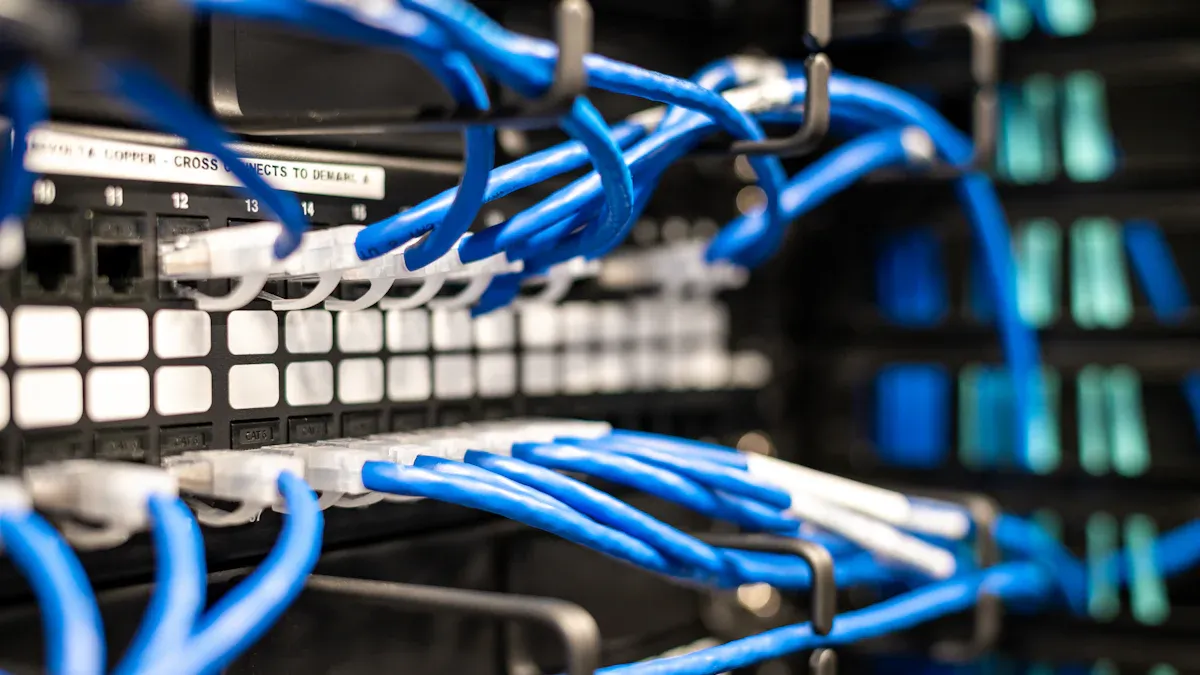
You encounter patch cords in almost every network environment. Custom Patch Cords differ from standard patch cords in several critical ways. Standard patch cords offer basic connectivity for general applications. Custom Patch Cords deliver tailored performance for demanding business environments.
Custom Patch Cords provide solutions that match your exact specifications, including length, connector type, and shielding. You gain flexibility and reliability that standard options cannot match.
The table below highlights the main differences between armored custom patch cords and standard patch cords:
|
Feature |
Armored Patch Cords |
Standard Patch Cords |
|---|---|---|
|
Durability |
High, resistant to damage and rodent bites |
Moderate, less resistant |
|
Construction |
Helical stainless steel tape, aramid layer |
Standard materials |
|
Elasticity |
Excellent, with a low bend radius |
Standard elasticity |
|
Insertion Loss |
Lower than standard |
Typically up to 0.35 dB |
|
Return Loss |
Higher than standard |
Usually below 50 dB |
|
Ideal Use Cases |
Harsh environments, industrial applications |
Typical networking needs |
Custom Patch Cords use advanced materials and construction techniques. You benefit from lower insertion loss and higher return loss, which means better signal quality and fewer transmission errors. Armored options withstand harsh conditions, making them ideal for industrial and outdoor settings.
Why Choose Custom Solutions?
You face unique challenges in your network infrastructure. Custom Patch Cords address these challenges by offering features that standard cords cannot provide. You select custom solutions for several reasons:
- You achieve optimal performance because custom cables meet your specific requirements.
- You improve connectivity and speed, which is essential for complex systems with multiple cables.
- You solve problems of availability when standard cables do not fit your project's size or specification needs.
- You increase durability and longevity by choosing cables designed for your environment.
- You realize cost savings over time, as custom cables reduce replacements and minimize system breakdowns.
Custom Patch Cords use high-quality materials that ensure better signal integrity. You experience reduced crosstalk, which maintains high-speed data transmission. Technologies like bonded-pair construction improve return loss and minimize wear, resulting in a stable network.
Role in Connecting Devices
You rely on patch cords to connect critical devices in your network. Custom Patch Cords link computers, switches, routers, and servers with precision. You ensure seamless communication and high-speed data transfer across your infrastructure.
Common use cases include:
- Data Centers: You connect servers, switches, and routers for high-speed data transmission.
- Telecommunications: You transmit voice, video, and data signals between equipment.
- Local Area Networks (LANs): You link devices within office buildings or campuses where high bandwidth is crucial.
- Industrial Applications: You connect electronic and optical devices in challenging environments.
The table below summarizes how Custom Patch Cords support different networking scenarios:
|
Use Case |
Description |
|---|---|
|
Local Area Networks (LANs) |
Patch cables connect devices like computers, switches, and routers within a LAN for efficient communication. |
|
Data Centers |
Essential for linking servers and networking equipment, ensuring high-speed data transmission. |
|
Telecommunications |
Used for transmitting voice, video, and data signals between equipment in telecom facilities. |
|
Industrial Applications |
Employed in various industrial settings for connecting electronic and optical devices. |
You improve network reliability and performance by choosing Custom Patch Cords. Fiber optic patch cables deliver unmatched speed and stability, especially as your network grows. Custom solutions adapt to your specific needs, supporting business growth and reducing risk.
Design Considerations
When you design network infrastructure, you need to match patch cord specifications to your business requirements. Custom Patch Cords give you the flexibility to select materials, connectors, and performance features that align with your operational goals. You can optimize for speed, durability, and compliance with industry standards.
Materials and Construction
Cable Types and Categories
You choose cable categories based on your network's speed and reliability needs. Each type offers unique benefits for different applications:
|
Type |
Material Used |
Description |
|---|---|---|
|
Cat 3 |
UTP |
For voice-only applications, used in telephone wiring. |
|
Cat 5e |
UTP |
Supports speeds up to Gigabit Ethernet at 100 MHz, enhanced to minimize crosstalk. |
|
Cat 6 |
UTP |
Supports Gigabit Ethernet at 250 MHz, ideal for business use. |
|
Cat 7 |
UTP |
Offers higher speeds for applications requiring bandwidth of 500 MHz, designed for better EMI resistance. |
You also find fiber optic options:
Single Mode Fibers: Low insertion loss, high return loss, suitable for long-distance, high-speed links.
Multimode Fibers: Custom lengths for flexible deployment in data centers and enterprise networks.
Connector Types
You select from a wide range of connector interfaces, such as RJ45, LC, SC, and MPO. High-quality connectors ensure secure, low-loss connections. IEC 61754 defines connector designs, so you can trust their compatibility and performance.
Shielding and Length
Shielded cables protect against electromagnetic interference (EMI), which is critical in industrial or high-density environments. You specify custom lengths to reduce slack and improve cable management. For harsh conditions, armored patch cords with tensile strength ≥70kN and salt spray resistance ≥500h deliver long service life, often exceeding 15 years.
Performance Specs
Bandwidth and Signal Integrity
Your choice of cable category directly impacts data rate and bandwidth. The table below compares key categories:
|
Cable Category |
Data Rate |
Bandwidth |
Reliability |
|---|---|---|---|
|
Cat 5e |
Up to 1 Gbps |
100 MHz |
Standard |
|
Cat 6 |
Up to 10 Gbps |
250 MHz |
Improved |
|
Cat 7 |
Up to 10 Gbps |
600 MHz |
High |
|
Cat 8 |
Up to 25-40 Gbps |
2000 MHz |
Very High |
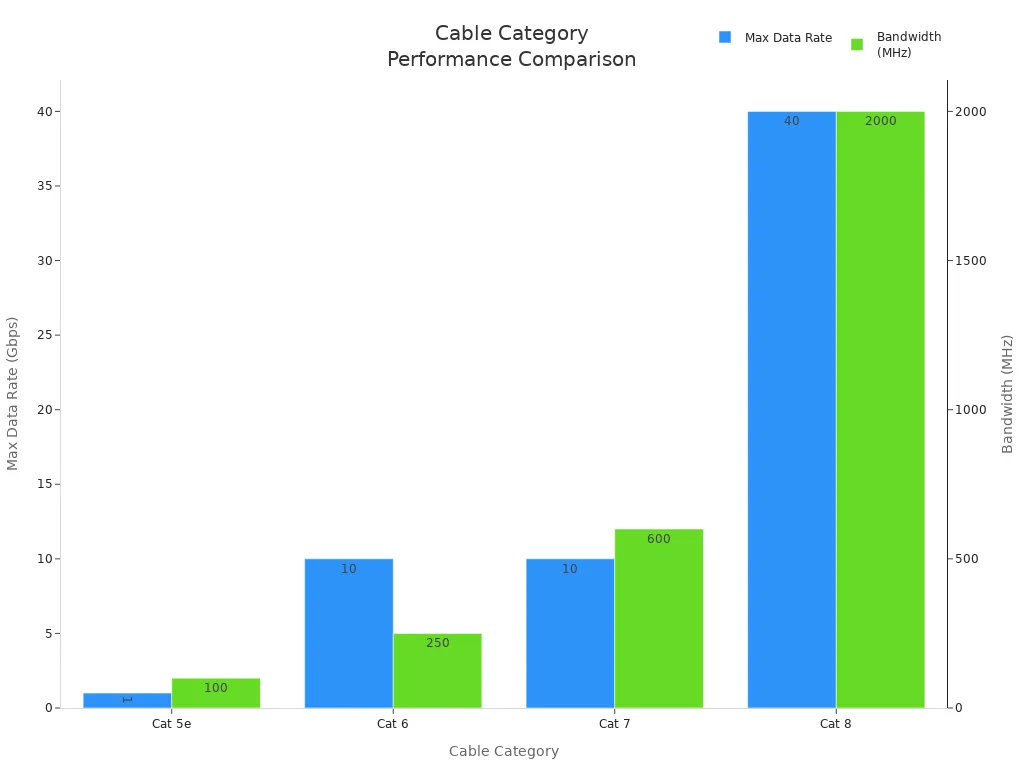
You need to consider bandwidth capacity, transmission distance, and environmental durability. The table below outlines critical specifications:
|
Specification |
Importance |
|---|---|
|
Bandwidth Capacity |
Determines the volume of data transmitted, impacting efficiency and speed of data transfer. |
|
Transmission Distance |
Ensures signal integrity and prevents data loss over varying distances. |
|
Environmental Durability |
Protects against temperature fluctuations, moisture, and physical disturbances. |
|
Compatibility |
Ensures adherence to existing network standards to avoid inefficiencies and system incompatibility. |
Durability and Compliance
You ensure compliance with ANSI/TIA-568 and ISO/IEC 11801 standards for installation and performance. Proper routing, protection, and termination techniques prevent damage and maintain signal quality. Equipment certification guarantees that your network supports required bandwidth and speed.
Customization Options
Branding and Labeling
You can enhance your brand presence with private labeling, adding your logo or company name to cables and packaging. You also select custom lengths and colors to match your organization's standards or simplify cable identification.
Packaging Choices
You choose packaging that fits your deployment needs, from bulk reels to individually labeled bags. Special features, such as shielded or flat cables, address unique installation environments.
Tip: Custom Patch Cords tailored to your specifications reduce risk, improve ROI, and support long-term network reliability.
Applications

Data Centers
You manage complex data centers that demand high-speed, reliable connections. Custom Patch Cords play a vital role in linking hubs, switches, routers, and telephones. You transmit audio, video, and digital signals between devices, supporting seamless operations. Data centers now require higher data rates, moving from 10G to 40G and 100G Ethernet. Fiber patch cords comply with IEEE standards such as 802.3ae and 802.3ba, meeting the need for speed and reliability.
You benefit from patch cords with low insertion loss. For example, Cablesys fiber patch cords average 0.2dB insertion loss, with most OM3 multimode patch cables testing below 0.16dB. These values surpass the industry average of 0.75dB, ensuring minimal signal degradation. OM3 and OM4 patch cords meet TIA-492AAAC and TIA-492AAAD specifications and exceed ANSI/TIA-568-D standards. You achieve stable performance and long-term reliability.
Tip: Choose patch cords with proven compliance and low insertion loss to maximize uptime and minimize maintenance costs.
Comparison Table: Data Center Patch Cord Selection
|
Criteria |
Standard Patch Cord |
Custom Patch Cord (OM3/OM4) |
|---|---|---|
|
Material |
Basic Copper/Fiber |
High-grade Fiber, Armored |
|
Cost |
Lower Initial |
Higher Initial, Lower TCO |
|
Lifespan |
5-7 Years |
10-15 Years |
|
Performance |
Meets Minimum Spec |
Exceeds Industry Standards |
Telecom operators and EPC contractors often select custom fiber patch cords for mission-critical deployments. You reduce risk and improve ROI by investing in cables that last longer and deliver consistent performance.
Telecommunications
You operate in environments where high-density connections are essential. Custom Patch Cords, especially MPO fan-out patch cords, help you distribute signals efficiently from a single trunk cable to multiple devices. You transition from an MPO connector to several individual connectors, which is ideal for telecom rooms and central offices.
- You reduce cable clutter and improve management.
- You ensure organized setups, which simplifies troubleshooting and upgrades.
- You support rapid deployment for new services or expansions.
Distributors value these cords for their flexibility and scalability. You can tailor cable lengths, connector types, and shielding to fit specific telecom infrastructure needs. You also benefit from improved cable management, which lowers operational costs and reduces downtime.
Material, Cost, and Lifespan Comparison for Telecom Use
|
User Type |
Material |
Cost Profile |
Lifespan |
|---|---|---|---|
|
Telecom Operator |
Armored Fiber |
Moderate-High |
10-15 Years |
|
EPC Contractor |
Custom Copper/Fiber |
Project-Based |
7-12 Years |
|
Distributor |
Mixed |
Bulk Pricing |
5-10 Years |
Note: Custom Patch Cords designed for telecom applications offer enhanced durability and support for evolving network standards.
Industrial Automation
You face demanding conditions in industrial automation. Custom Patch Cords produced with advanced manufacturing processes deliver superior durability. You rely on tailored designs that withstand vibration, moisture, and temperature extremes. Multi-stage testing, including tensile, environmental, and electrical assessments, ensures your cables perform under stress.
|
Feature |
Description |
|---|---|
|
Advanced Manufacturing |
You gain cables built for durability using specialized processes. |
|
Tailored Designs |
You receive cords engineered for reliability in industrial settings. |
|
Rigorous Testing |
You benefit from cables tested for tensile strength, environmental resistance, and electrical integrity. |
EPC contractors and distributors in industrial sectors prefer custom solutions for their reliability and long lifespan. You minimize downtime and maintenance costs by choosing cables that meet strict performance standards.
Tip: Select Custom Patch Cords with proven testing and certification for industrial automation to ensure uninterrupted operations.
Audio/Video & Broadcast
You work in environments where flawless signal transmission is non-negotiable. Custom patch cords play a critical role in professional audio, video, and broadcast systems. You demand cables that deliver consistent performance, especially during live events, studio productions, or large-scale installations. Custom patch cords ensure you meet these high standards by matching your exact technical requirements.
You often face challenges like signal degradation, latency, and physical wear. Standard cables may not provide the reliability or speed you need. Custom patch cords solve these issues by offering tailored lengths, specialized shielding, and premium connectors. You gain the flexibility to route cables efficiently, reduce clutter, and maintain organized racks or control rooms.
Tip: Choose custom patch cords with robust construction for outdoor broadcasts or high-traffic studio environments. You minimize downtime and avoid costly interruptions.
The table below summarizes why custom patch cords outperform generic options in audio/video and broadcast applications:
|
Benefit |
Description |
|---|---|
|
Optimal Performance |
Custom cables are designed to meet specific application needs, ensuring ideal performance. |
|
Connectivity and Speed |
High-quality custom cables enhance connectivity and speed, preventing performance issues. |
|
Durability and Longevity |
Custom cables are built to withstand harsh conditions, leading to longer lifespan compared to generic cables. |
|
Cost Savings |
Investing in custom cables reduces the likelihood of system breakdowns and replacement costs. |
You see the impact immediately. Custom patch cords help you deliver crisp audio and clear video signals, even over long distances or in challenging environments. You also benefit from color-coded jackets and labeling, which simplify troubleshooting and speed up setup during time-sensitive projects.
Medical & Specialty
You operate in industries where precision and safety are paramount. Medical and specialty sectors require custom patch cords that meet strict regulatory and operational standards. You rely on these cables for critical equipment such as MRI machines, heart monitors, and defibrillators. Functionality is vital for the correct operation of medical devices.
Custom patch cords for medical use must address several specialized requirements:
- Sterilization readiness: You need cables that resist cleaning agents and disinfectants, ensuring safe reuse.
- Biohazard protection: You prevent contamination in sensitive environments by choosing cables with protective coatings.
- Signal accuracy: You ensure clean, interference-free transmission for critical medical equipment.
You also require patch cords that are easily replaceable or sterilizable. Manufacturers design these cables to endure repeated sterilization processes without losing functionality. This durability supports uninterrupted patient care and reduces the risk of equipment failure.
Note: Custom patch cords in medical and specialty applications help you meet compliance standards, protect patients, and maintain operational efficiency.
You gain peace of mind knowing your custom patch cords support the highest levels of performance and safety. You reduce long-term costs by investing in cables that last and perform reliably in demanding environments.
Custom Patch Cords Procurement

Business Requirements
You need to define your business requirements before you start the procurement process. Clear requirements help you avoid costly mistakes and ensure your network runs smoothly. You must consider the technical specifications, operational needs, and long-term goals for your enterprise.
The table below outlines key requirements you should evaluate:
|
Key Requirement |
Description |
|---|---|
|
Custom Lengths |
Tailored lengths prevent clutter and optimize performance by eliminating signal loss. |
|
Quality Assurance |
Ensure products meet international standards and undergo rigorous quality control. |
|
Supplier Flexibility |
Suppliers should offer customization options and be willing to adapt to specific needs. |
|
Customer Support |
Choose suppliers that are responsive and easy to communicate with. |
You should also focus on installation efficiency and SKU compatibility. Custom lengths reduce excess cable and simplify installation. Quality assurance guarantees that your patch cords meet standards like ISO/IEC 11801 and ANSI/TIA-568. Supplier flexibility allows you to adapt to changing project requirements. Responsive customer support helps you resolve issues quickly and keeps your operations running.
Tip: Define your requirements in detail. This step reduces risk and improves ROI for your network investment.
Supplier Selection
Selecting the right supplier is critical for B2B buyers. You must evaluate suppliers based on their certifications, manufacturing capabilities, and product range. Reliable suppliers help you avoid delays, ensure compatibility, and maintain high network performance.
The table below lists important criteria for supplier evaluation:
|
Criteria |
What to Check |
|---|---|
|
Certifications |
ISO 9001, CE, RoHS, UL, REACH |
|
Manufacturing Capacity |
In-house production, automated testing, mass customization |
|
Product Range |
LC, SC, FC, ST, MPO/MTP; OM1–OM5, OS2; simplex, duplex, armored, etc. |
|
Technical Support |
Pre-sales consultation, post-sales technical service, quick response time |
|
Customization Services |
OEM/ODM options, laser printing, custom labels, specific fiber lengths |
|
Testing and Quality Control |
IL/RL testing report with each shipment, 3D interferometer testing |
|
Global Shipping Ability |
Export experience, delivery guarantees, packaging that meets international needs |
|
Reference Projects & Clients |
Case studies, client testimonials, successful deployments |
You should check for certifications like ISO 9001 and RoHS to ensure compliance and safety. Manufacturing capacity affects delivery cycles and order volume. A broad product range ensures SKU compatibility with your existing infrastructure. Technical support and customization services help you solve problems and meet unique project needs. Testing and quality control protect your investment by guaranteeing performance. Global shipping ability and reference projects show the supplier's reliability and experience.
Note: Choose suppliers with proven track records and strong technical support. This decision reduces risk and improves long-term value.
Order Process
You can streamline your procurement by following a clear order process. Most suppliers offer online tools to help you customize and place orders efficiently.
Here is a typical order process for custom patch cords:
- Use an online custom cable builder to start your order.
- Select specifications, including cable type, connector, and length.
- Place your order for manufacturing in the supplier's facility.
- Receive the finished product, shipped quickly to your location.
- Review the shipment for quality, including custom printing or labeling if requested.
- Confirm delivery and installation, ensuring accessibility for your business.
Custom Patch Cords are built to your specifications, including printing on sleeves or labels. The manufacturing process is completed in a timely manner, and delivery is made to various locations. You benefit from quick turnaround times and reliable shipping, which minimizes downtime and supports project schedules.
Tip: Communicate your requirements clearly during the order process. This step ensures you receive the right products and avoid installation delays.
Cost and Volume
You need to understand how cost and order volume shape your custom patch cord procurement strategy. Cost is not just about the price per unit. You must consider the total value delivered to your business. When you order custom patch cords, several factors influence your final cost and lead times.
- Size of the patch cord: Larger cords require more materials. You pay more for longer or thicker cables.
- Type of patch cord: Different designs, such as armored, fiber optic, or shielded, have unique material and labor costs. Specialized connectors or advanced shielding increase the price.
- Quantity ordered: Bulk orders drive down the price per unit. You benefit from economies of scale when you purchase in larger volumes.
|
Factor |
Impact on Cost |
Impact on Lead Time |
|---|---|---|
|
Size of Patch Cord |
Higher material cost |
May require longer production time |
|
Type of Patch Cord |
Specialized labor/materials |
Custom designs may extend lead time |
|
Quantity Ordered |
Lower unit price in bulk |
Large orders may increase lead time, but suppliers often prioritize bulk clients |
You gain cost savings when you plan your orders strategically. Bulk purchasing reduces your per-unit cost and streamlines logistics. You also secure better terms from suppliers when you commit to higher volumes. However, you must balance your need for inventory with your available storage space and project timelines.
Tip: You maximize ROI by forecasting your network needs and consolidating orders. This approach helps you negotiate better pricing and avoid supply shortages.
You should always request detailed quotes from suppliers. Ask for breakdowns of material, labor, and shipping costs. Compare pricing models for different order volumes. This analysis helps you make informed decisions and avoid hidden expenses.
Common Pitfalls
- You face several risks when procuring custom patch cords for your business. Avoiding these pitfalls protects your investment and ensures reliable network performance.
- You must ensure quality assurance, especially when buying fiber optic components in bulk. Poor quality leads to network failures and costly downtime.
- You need to verify that all products meet industry standards. Certifications such as ISO-9001, GR-20, GR-326, IEC 60794-2-20, and IEC 61753-021-3 guarantee performance and reliability.
- You should demand compliance documentation from your supplier. This step reduces risks in your supply chain and supports long-term network stability.
- You must implement proper storage and inventory management. Damaged cables or lost inventory disrupt your operations and increase costs.
- You benefit from inventory tracking systems. These tools help you monitor stock levels and prevent shortages.
- You should organize storage with labeled racks and bins. This practice streamlines retrieval during installations and reduces installation time.
- You need to conduct regular audits. Audits identify slow-moving inventory and help you optimize storage space.
|
Pitfall |
Why It Matters |
How to Avoid |
|---|---|---|
|
Poor Quality Assurance |
Leads to failures and downtime |
Insist on certifications and testing |
|
Non-compliance with Standards |
Risks reliability and compatibility |
Request documentation and standards |
|
Inadequate Inventory Tracking |
Causes shortages and delays |
Use tracking systems and audits |
|
Disorganized Storage |
Increases installation time and damage |
Label and organize storage areas |
Note: You reduce risk and improve ROI by choosing certified suppliers and maintaining organized inventory systems.
You protect your network investment by staying proactive. You avoid common pitfalls through careful planning, supplier vetting, and robust inventory management. This approach ensures your custom patch cords deliver long-term value and reliable performance.
ROI and Value

Cost Savings
You want to maximize your investment in network infrastructure. Custom Patch Cords help you achieve significant cost savings over the product lifecycle. While the initial price of a custom solution may be slightly higher, you benefit from lower total cost of ownership (TCO) due to reduced replacements, fewer failures, and less downtime. When you select the right patch cord type for your environment, you avoid unnecessary expenses and extend the lifespan of your network.
The table below compares the cost difference and TCO savings between standard and custom patch cords:
|
Patch Cord Type |
Cost Difference |
Total Cost of Ownership (TCO) Savings |
|---|---|---|
|
SC |
Negligible |
N/A |
|
LC |
Lower per-port |
20–30% lower over 5 years |
You see the greatest savings with LC connectors, where custom solutions can lower your TCO by up to 30% over five years. This reduction comes from fewer replacements, less troubleshooting, and minimized network disruptions. You also save on labor costs, as custom lengths and labeling simplify installation and maintenance.
Tip: A one-time investment in custom patch cords delivers long-term financial benefits, especially for large-scale or mission-critical networks.
Network Performance
You depend on reliable, high-speed connections to keep your business running smoothly. Custom Patch Cords improve network performance by matching your exact technical requirements. You choose the right fiber type, cable construction, and connector to optimize data transmission and minimize signal loss. This tailored approach ensures your network operates at peak efficiency.
Custom Patch Cords support higher bandwidth and better signal integrity. You experience fewer transmission errors and less crosstalk, which means faster data transfer and more stable connections. You also benefit from improved compatibility with your existing infrastructure, reducing the risk of bottlenecks or mismatched components.
- You select fiber types tailored to your network needs, enhancing performance.
- You use cable construction optimized for your environment, such as armored or indoor/outdoor designs.
- You ensure connector types match your equipment, guaranteeing seamless integration.
- You choose jacket materials that improve durability and handling.
Note: When you invest in custom solutions, you unlock the full potential of your network and support future growth.
Downtime Reduction
You know that network downtime can be costly and disruptive. Custom Patch Cords help you reduce downtime by streamlining troubleshooting and maintenance. Proper labeling, precise lengths, and organized packaging make it easier to identify and resolve issues quickly. You spend less time diagnosing problems and more time keeping your business connected.
The following list highlights how custom patch cords minimize downtime:
- Properly labeled and organized cables allow for quick fault identification.
- Reduced time spent on diagnosing network issues.
- Minimized server downtimes, ensuring seamless connectivity.
You also benefit from features like tailored cable lengths, which reduce clutter and prevent accidental disconnections. According to industry research, one minute of downtime can cost your business approximately $5,600. By investing in cable management systems and custom patch cords, you drastically cut troubleshooting time and speed up recovery from network issues.
|
Customization Aspect |
Benefit |
|---|---|
|
Fiber Type |
Tailored to specific network needs, enhancing performance |
|
Cable Construction |
Optimized for environment (armored, indoor/outdoor) |
|
Connector Types |
Ensures compatibility with existing infrastructure |
|
Jacket Materials |
Improves durability and handling |
|
Length |
Reduces excess cabling, minimizing clutter |
|
Labeling |
Facilitates easier troubleshooting |
|
Packaging |
Streamlines installation process |
Tip: Reducing downtime not only saves money but also protects your reputation and keeps your customers satisfied.
Scalability
You need a network that grows with your business. Custom patch cords provide the flexibility and scalability you require to expand your infrastructure without costly overhauls. When you invest in tailored cabling solutions, you prepare your organization for future growth and changing technology demands.
Custom patch cords allow you to modify your network quickly. You can add new devices, upgrade equipment, or reorganize your workspace without disrupting existing connections. Patch panels play a key role in this process. You use patch panels to manage connections efficiently, making it easy to adjust configurations as your needs evolve. This approach supports seamless expansion and minimizes downtime.
Fiber patch panels offer even greater scalability. You rearrange patch cables to accommodate new servers or switches, eliminating the need for extensive rewiring. This method saves you time and reduces labor costs. You maintain high performance while adapting to new requirements.
Consider these advantages of scalable custom patch cord solutions:
- You expand your network by adding or moving connections with minimal effort.
- You reduce installation time when deploying new hardware or upgrading systems.
- You avoid unnecessary expenses by reusing existing infrastructure.
- You maintain organized cabling, which simplifies troubleshooting and future upgrades.
|
Scalability Feature |
Benefit for Your Business |
|---|---|
|
Modular Patch Panels |
Easy to add/remove connections |
|
Custom Cable Lengths |
Fit any layout, reduce clutter |
|
Flexible Connectors |
Support diverse equipment |
|
Rearrangement Ability |
Quick adaptation to new requirements |
Tip: Choose custom patch cords and modular patch panels to future-proof your network. You gain the ability to scale up or down as your business changes.
Telecom operators, EPC contractors, and distributors all benefit from scalable solutions. You respond to market demands faster and support new services with minimal disruption. You also reduce risk by maintaining a network that adapts to growth, mergers, or technology upgrades.
Scalability drives long-term value. You avoid the expense and complexity of replacing entire cabling systems. Instead, you build a foundation that supports innovation and business expansion. Custom patch cords empower you to meet today's needs and tomorrow's opportunities.
Management and Maintenance
Proper management and maintenance of custom patch cords ensure your network delivers consistent performance and reliability. You protect your investment and reduce operational risks by following best practices for organization, administration, and ongoing reliability-especially in fiber optic environments where precision matters most.
Organization
You need a structured approach to organizing custom patch cords in large-scale deployments. Well-organized cables prevent confusion and make troubleshooting faster. When you plan your cable layout, you avoid tangled cords and accidental disconnections.
Consider these best practices for organizing your patch cords:
- Plan each change with a documented request. Keep your records up to date.
- Inspect each cord for damage and cleanliness before installation.
- Avoid kinks and excessive force during patching. This preserves cable integrity.
- Complete a final visual inspection after patching. Update your documentation to reflect changes.
A clear organizational system saves you time and reduces errors. You can quickly identify and replace faulty cords, which keeps your network running smoothly.
Administration
Effective administration of custom patch cords directly impacts your ability to manage and troubleshoot your network. Poor cable management can increase troubleshooting time by up to 60%. You risk longer downtimes and higher costs if you let cables become congested or disorganized.
"The technician who maintained the cabling system said that the incorrect patch was made because he couldn't tell what he was doing at the patch panel because of the 'mess of all those cables everywhere.'"
Physical management issues account for about half of all network problems and downtime. You minimize disruptions by keeping cables labeled, documented, and neatly routed. Avoiding congestion also extends the lifespan of your network equipment by over 30%.
You gain better control and faster response times when you maintain clear records and visual order.
Reliability
You want your custom patch cords to deliver long-term reliability. Proactive management plays a key role. Use high-quality network monitoring tools to track traffic and signal quality. These tools help you spot minor issues before they become major failures.
Routine inspections are essential. Clean fiber connectors, test signal strength, and check equipment status regularly.
Handle cables with care. Avoid bending them beyond their rated radius or scratching connectors. Small mistakes can lead to big performance issues.
- Monitor network health with reliable tools.
- Schedule regular inspections and cleaning.
- Train staff on proper cable handling techniques.
By investing in these maintenance strategies, you reduce downtime, extend the life of your network, and protect your business from costly disruptions.
Tip: Consistent management and maintenance of custom patch cords support your network's performance and reliability, ensuring you meet your business goals.
Custom Patch Cords offer you affordable, durable, and highly personalized solutions for your business network. You maximize ROI by ordering in bulk and selecting designs that match your brand identity.
- You maintain color and texture over time, even in harsh environments.
- You boost team spirit and unity among employees.
- You reduce costs and improve marketing potential with scalable options.
You should align your procurement strategy with your business goals and consult with industry experts or trusted suppliers for tailored advice.
FAQ
Why should you choose custom patch cords over standard cables?
Custom patch cords give you precise lengths, better durability, and tailored connectors. You reduce clutter, improve network reliability, and meet specific business needs. You gain long-term value and lower total cost of ownership.
How do custom patch cords improve ROI for B2B networks?
You save money by reducing replacements and downtime. Custom patch cords match your exact requirements, which streamlines installation and maintenance. You boost network performance and support future growth.
What industries benefit most from custom patch cords?
You see the greatest impact in data centers, telecommunications, industrial automation, broadcast, and medical sectors. Custom patch cords solve unique challenges and help you meet strict standards in demanding environments.
How do you ensure quality when ordering custom patch cords?
You should request certifications like ISO 9001 and ANSI/TIA-568. Ask for testing reports and compliance documentation. Reliable suppliers provide quality assurance and support, which protects your investment.
Can you order custom patch cords in bulk for large projects?
You can place bulk orders for custom patch cords. Suppliers offer volume discounts and faster production for large quantities. You optimize costs and ensure consistent quality across your network.
What customization options are available for patch cords?
You select cable type, length, connector, shielding, color, and labeling. You can add branding or choose special packaging. These options help you match your technical and operational needs.
How do custom patch cords reduce network downtime?
You use labeled, organized cables that simplify troubleshooting. Custom lengths prevent tangles and accidental disconnects. You resolve issues faster, which keeps your business running smoothly.
What should you look for in a custom patch cord supplier?
You need suppliers with strong certifications, proven experience, and responsive support. Look for flexible customization, reliable shipping, and positive client testimonials. You reduce risk and improve long-term value.
Note: For more details, consult industry standards such as ANSI/TIA-568, ISO/IEC 11801, and IEC 61754. Trusted sources include BICSI, IEEE, and manufacturer documentation.