





With the rapid development of modern data centers, cloud computing, and 5G networks, the demand for high-density, high-performance fiber optic connectivity solutions is growing. Among the various types of fiber optic connectors, the LC Uniboot connector has gained widespread popularity due to its compact design and efficient cabling capabilities. With technological advancements, the LC Uniboot Plus connector has emerged as an upgraded version, providing enhanced features for network deployment. This article will provide an in-depth comparison of the characteristics, performance, and applicable scenarios of these two connectors.
LC Uniboot Connector
The LC Uniboot connector is an innovative fiber optic connector design that integrates the two fibers of a traditional duplex LC connector into a single outer boot. This uniboot design reduces overall cabling volume by up to 43%, significantly improving cable management efficiency and enhancing the heat dissipation of the cabling system.
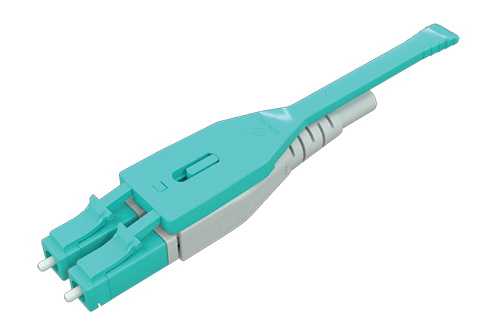
Core Features
The LC Fiber Optic Connector adopts a dual-fiber, compact uniboot structure, encapsulating both transmit and receive fibers within the same outer boot, eliminating the need for dual-link cables. The push-pull tab design makes insertion and removal operations more convenient, allowing easy connection and disconnection even in high-density environments. This connector supports both single-mode and multi-mode fibers. The uniboot design simplifies cable management and reduces cabling clutter.
LC Uniboot Plus Connector
The LC Uniboot Plus connector is a significant upgrade based on the LC Uniboot connector, featuring the same single-boot dual-fiber design with a 1.25mm ferrule, but with a more optimized structure, making it the smallest duplex connector. It is specifically designed to meet the demands of more stringent network environments. This enhanced connector not only retains the original uniboot advantages but also introduces multiple performance improvements.
Enhanced Design Features
The LC Uniboot Plus connector maintains the compact uniboot design while significantly enhancing cable retention capability and pull force protection performance. The improved mechanical structure can withstand greater tensile forces, effectively preventing accidental disconnection and fiber damage. It provides better support for Bend-Insensitive Fiber, offering advantages in space-constrained, high-density deployment environments. In terms of optical performance, the LC Uniboot Plus achieves lower insertion loss and return loss, ensuring high-quality and stable signal transmission. The optimized internal structure design also improves the connector's durability and long-term reliability.

LC Uniboot Connector vs LC Uniboot Plus Connector Comparison
Cable Retention and Pull Force Protection
In terms of cable retention capability, the LC Uniboot Plus connector demonstrates clear advantages. The enhanced clamping mechanism provides stronger grip, effectively preventing fiber detachment during daily operations or accidental pulling. In contrast, while the standard LC Uniboot connector also possesses basic cable retention functionality, it faces higher risks in high-intensity usage environments. The LC Uniboot Plus's pull force resistance can withstand higher tensile loads, which is particularly advantageous in scenarios requiring frequent insertion and removal and harsh environmental conditions.
Fiber Support Types
The LC Uniboot Plus connector offers broader support in terms of fiber compatibility. In addition to supporting standard single-mode and multi-mode fibers, it has been optimized for bend-insensitive fiber. Bend-insensitive fiber allows smaller bend radii without causing significant signal loss, providing greater deployment flexibility in high-density cabling environments. While the standard LC Uniboot connector can also work with various fiber types, its performance in supporting bend-insensitive fiber is not as outstanding as the Plus version.
Size and Space Aspects
Both connectors adopt the uniboot design and perform excellently in space saving. The only difference is that the LC Uniboot Plus has more refined upgrades in detailed design, with optimized dimensions that enable higher port density within the same space. This minor size optimization provides significant advantages in large-scale data center deployments where space saving is most critical. Both can effectively reduce cable clutter, with the LC Uniboot Plus's more compact design making airflow management on high-density panels more efficient.
Push-Pull Tab Design
Both connectors feature a push-pull tab design, simplifying insertion and removal operations. The LC Uniboot Plus upgrade features a smoother latch mechanism, requiring less operating force while maintaining a secure connection and high convenience. It increases durability for long-term use, reducing wear caused by repeated insertion and removal.
Insertion Loss and Return Loss
In terms of optical performance metrics, the LC Uniboot Plus performs better. Its insertion loss can typically be controlled within a lower range, with some high-end models even achieving below 0.15dB. For return loss, the LC Uniboot Plus exceeds -50dB, effectively reducing signal reflection. In comparison, while the standard LC Uniboot connector can meet most application requirements, it may be slightly insufficient in scenarios with extremely high performance demands. These optical performance improvements are crucial for 40G, 100G, and even higher-rate network transmission.

Cost and Performance Comparison
Cost-Effectiveness of LC Uniboot Connector
The unit price of the LC Uniboot connector is typically 10% to 25% lower than the Plus version. For large-scale deployment projects, this price difference can accumulate into considerable cost savings. When performance adequately meets application requirements, choosing the standard LC Uniboot can leave more budget margin for other network components or services. Its mature supply chain and wide market availability also make procurement and restocking more convenient, shortening project delivery cycles. For cost-sensitive projects or applications where performance requirements are not extremely stringent, the LC Uniboot offers excellent cost-effectiveness.
Return on Investment of LC Uniboot Plus Connector
While the LC Uniboot Plus has a slightly higher initial cost, from a long-term Total Cost of Ownership (TCO) perspective, its enhanced reliability and durability reduce failure rates, lowering maintenance costs and losses from network interruptions. In high-density environments, its superior space efficiency may allow you to deploy more ports within the same rack space, increasing the economic value of space utilization. Lower insertion loss means better signal quality, which can reduce the need for signal amplification equipment, further lowering overall costs. For mission-critical applications or systems requiring long-term stable operation, the value brought by the high performance and high reliability of the LC Uniboot Plus far exceeds its price premium.
Future Trends
With the continuous evolution of high-speed network transmission, 400G Ethernet has been widely deployed in large data centers, while 800G and 1.6T technologies are rapidly maturing. The LC Uniboot Plus connector, with its excellent optical performance, demonstrates stronger adaptability in these ultra-high-speed applications. In the coming years, we will see more connector designs optimized for ultra-low insertion loss and ultra-low return loss to support longer distances and higher transmission rates. As coherent optical technology is applied to data center internal interconnections, performance requirements for connectors will further increase, creating greater market space for high-performance connectors like the LC Uniboot Plus, which will gradually replace the LC Uniboot connector.
FAQ
Q: Can convert the polarity of LC Uniboot connectors in the field?
A: Yes, most LC Uniboot connectors feature a polarity reversal mechanism. You can typically reverse polarity by rotating the duplex connector body 180 degrees or using the built-in polarity flip feature. However, LC Uniboot Plus connectors often have improved polarity reversal mechanisms that are easier to operate and more secure. Always refer to the manufacturer's instructions for the specific model.
Q: Are LC Uniboot and LC Uniboot Plus connectors backward compatible with standard duplex LC connectors?
A: Yes, both LC Uniboot and LC Uniboot Plus connectors use standard LC 1.25mm ferrules and are fully compatible with standard LC duplex adapters and equipment ports.
Q: Can I mix LC Uniboot and LC Uniboot Plus connectors in the same network?
A: Yes, you can mix both types in the same network as they share the same optical interface standards.
Q: Which connector should I choose for a 25G/100G data center spine-leaf architecture?
A: For 25G/100G deployments, LC Uniboot Plus is recommended due to its superior optical performance (lower insertion loss) and better support for bend-insensitive fiber