

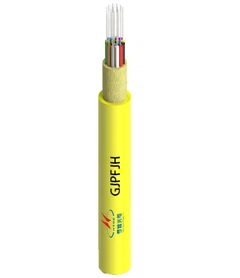


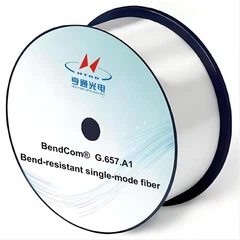

Hydrogen-induced attenuation is an increase in optical loss that can occur when molecular hydrogen reaches silica optical fiber and either produces temporary absorption or reacts with defect sites in the glass. It is a real long-term reliability consideration in some cable environments, but it should not be treated as a universal failure mode for outdoor fiber networks. Modern fiber design and appropriate cable construction have substantially reduced the risk in normal terrestrial applications.
The engineering question is therefore not simply whether a cable contains gel, metal, or water-blocking material. It is whether the complete cable system can generate or admit enough hydrogen, for long enough, to affect the installed fiber. That assessment should consider the fiber category, cable components, moisture exposure, metallic elements, external hydrogen sources, sealing, and the expected service environment.
What Is Hydrogen-Induced Attenuation?
Hydrogen molecules are small enough to diffuse through many cable materials and eventually enter silica glass. Once hydrogen reaches the fiber, two broad effects need to be distinguished. Molecular hydrogen can produce absorption features while hydrogen is present in the glass, and some of this contribution can decrease if the exposure is removed. Hydrogen can also react with susceptible defect sites in silica and create OH-related absorption, which may produce more persistent attenuation changes.
This distinction matters because "hydrogen loss" is not automatically synonymous with permanent cable failure. The severity and reversibility depend on the fiber design, hydrogen concentration, temperature, exposure time, and the chemical mechanism involved.

Where Can Hydrogen in an Optical Cable Come From?
Hydrogen inside a cable can originate from more than one pathway. The most relevant mechanisms are associated with cable materials, moisture and metallic components, or an external hydrogen-rich environment.
Moisture and metallic elements
In cable constructions that contain metallic armor, strength members, tapes, or other metal components, moisture can create conditions for corrosion or galvanic reactions that generate hydrogen. Current ITU guidance for terrestrial optical cables specifically notes that hydrogen may be generated in the presence of moisture and metallic elements. For this reason, the corrosion system, water barrier, sheath integrity, and interaction between different materials should be evaluated together rather than treating steel armor alone as the problem.
For buried routes, cable selection should therefore reflect soil conditions and the required mechanical protection. A direct-bury fiber optic cable may legitimately require metallic protection in one project and a non-metallic structure in another. The correct choice depends on crush, rodent, lightning, grounding, corrosion, and environmental requirements.
Cable compounds and polymeric materials
Some cable components can release small amounts of hydrogen under particular ageing, temperature, or chemical conditions. It is not accurate, however, to assume that every traditional filling gel is a major hydrogen source. Formulations differ, and some cable filling systems can also contain hydrogen-scavenging ingredients. Material qualification should be based on supplier data and appropriate ageing tests rather than on a simple "gel versus dry" rule.
For a broader view of the functions and selection of jackets, tapes, filling compounds, strength members, and other components, see the fiber optic cable material guide.
External hydrogen and moisture ingress
Cables can also be exposed to hydrogen generated outside the cable, particularly in specialized industrial, downhole, high-temperature, pressurized, or chemically aggressive environments. Poor closure or sheath sealing is not a direct hydrogen source by itself, but moisture ingress can accelerate corrosion and material interactions that increase hydrogen generation. For splices and transitions, sealing quality therefore remains part of the hydrogen-control strategy.
Why 1383 nm Matters More Than 1310 nm or 1550 nm
A common technical error is to describe 1310 nm and 1550 nm as the principal OH absorption peaks caused by hydrogen. They are important transmission windows, but the best-known water/OH absorption feature in standard single-mode fiber is around 1383 nm.
The current ITU-T G.652 Recommendation specifies, for G.652.D fiber, a maximum attenuation coefficient of 0.40 dB/km at 1383 ± 3 nm after hydrogen ageing. The same Recommendation notes that the hydrogen-ageing type test for B-652.D fiber is performed in accordance with IEC 60793-2-50. The latest IEC 60793-2-50 covers class B single-mode fiber product specifications, including B-652 fiber categories.
This does not mean that hydrogen has no influence at other wavelengths. Molecular hydrogen and hydrogen-related reactions can create additional spectral features, and system impact ultimately depends on the operating band and link budget. For practical qualification of modern G.652.D fiber, however, the 1383 nm region is a key reference point and should not be replaced by a generic statement about "OH peaks at 1310 and 1550 nm."

Is Hydrogen a Common Cause of Failure in Terrestrial Fiber Cables?
Hydrogen is an important design consideration, but its risk should be stated in proportion to the application. Recent ITU guidance for terrestrial optical cables notes that hydrogen generation becomes a problem only in limited cases when appropriate fiber and cable design are used. That is consistent with the evolution of modern low-water-peak single-mode fiber and improved cable materials.
The practical implication is that project teams should avoid two opposite mistakes: ignoring hydrogen in environments where it can accumulate, and treating it as the dominant cause of attenuation in every ageing outdoor cable. Bending, mechanical strain, damaged sheaths, poor splices, connector contamination, water-related damage, and installation defects can also reduce optical margin.

How to Diagnose Suspected Hydrogen-Induced Attenuation
Hydrogen-related loss should be diagnosed with evidence rather than inferred from cable age alone. A useful investigation normally combines several observations:
- Compare current attenuation with commissioning or acceptance-test records.
- Measure attenuation at the operating wavelengths and, where the fiber specification and test equipment allow, examine the 1383 nm region or a broader spectral attenuation trace.
- Check whether the increase is distributed along the fiber or concentrated at a splice, bend, closure, or damaged cable section.
- Compare neighboring fibers in the same cable and, if possible, fibers in adjacent cable sections.
- Inspect the route for moisture ingress, corrosion, sheath damage, flooding, abnormal temperature, or external hydrogen exposure.
- Review the fiber category and the manufacturer's hydrogen-ageing qualification data.
An OTDR is valuable for locating reflective events, localized excess loss, and changes along a span, but an OTDR trace by itself does not prove that hydrogen is the root cause. A broader fiber optic cable testing program should combine OTDR results with insertion-loss or attenuation measurements, product specifications, and environmental evidence.
Targeted Cable Design Measures to Reduce Hydrogen Risk

1. Specify modern fiber with verified hydrogen-ageing performance
Fiber selection is the first control layer. For conventional terrestrial single-mode networks, G.652.D single-mode fiber is designed with low water-peak performance and includes a hydrogen-ageing requirement around 1383 nm. Project specifications should reference the applicable fiber category and test requirements instead of relying only on nominal attenuation at 1310 nm and 1550 nm.
2. Select low-hydrogen-generation cable materials
Jackets, filling compounds, tapes, binders, coatings, and other cable components should be selected as a system. The goal is to minimize materials or material combinations that can generate hydrogen during long-term ageing. IEC TR 62690, Hydrogen effects in optical fibre cables - Guidelines, provides a dedicated industry reference for evaluating hydrogen effects in single-mode fiber cables.
3. Control moisture and corrosion pathways
Moisture barriers, sound sheath construction, qualified splice closures, and corrosion-conscious metallic design can reduce conditions that generate hydrogen. In wet or aggressive environments, armor and other metallic components should be selected with the complete corrosion system in mind. Stainless steel can be appropriate in some designs, but it is not a universal answer for every buried project.
For routes with persistent soil moisture or demanding mechanical exposure, compare the available underground fiber optic cable structures and determine whether metallic or non-metallic protection better fits the project risk profile.
4. Use hydrogen-absorbing materials when the risk justifies them
ITU-T L.126 and related cable guidance recognize hydrogen-absorbing materials as one method for controlling hydrogen concentration inside a cable. A hydrogen scavenger is a material formulated to react with or capture hydrogen; it should not be confused with ordinary water-swellable powder or water-blocking tape, whose primary function is to limit water migration.
The ITU-T L.126 method for estimating hydrogen concentration in optical fibre cables is useful when a design requires a more formal assessment of hydrogen build-up.
5. Understand what an all-dry cable changes-and what it does not
All-dry cable designs remove conventional flooding or filling gel from parts of the cable structure and use dry water-blocking elements instead. This can simplify handling and remove one potential material source, but it does not make a cable automatically immune to hydrogen. Metallic corrosion, other polymeric materials, external hydrogen, and sealing conditions can still matter.
Where dry construction is desirable for installation or maintenance reasons, the engineering benefit should be evaluated together with the cable's complete material system. An overview of this construction approach is available in the site's article on all-dry ADSS fiber optic cable.
Which Applications Need the Most Attention?
Hydrogen control deserves closer review when a cable is expected to operate in an environment with a credible hydrogen source or with conditions that promote hydrogen generation. Examples include wet metallic cable structures, certain long-term buried installations, industrial sites with external hydrogen, high-temperature environments, and other specialized deployments.
For ordinary FTTx, access, duct, aerial, and terrestrial backbone networks using modern qualified fiber, hydrogen should be one item in a broader reliability assessment rather than an assumed future failure. Cable structure, water blocking, mechanical design, installation quality, splice protection, optical margin, and environmental exposure should all be reviewed together.
FAQ
Can hydrogen permanently damage optical fiber?
It can cause persistent attenuation changes when hydrogen reacts with susceptible sites in the glass, but not every hydrogen-related loss mechanism is permanent. Molecular hydrogen absorption can be partly reversible when exposure is removed. The actual behavior depends on the fiber and exposure conditions.
What wavelength is most associated with hydrogen ageing in G.652.D fiber?
The key qualification region is 1383 ± 3 nm. ITU-T G.652 specifies the attenuation requirement at this wavelength after hydrogen ageing for G.652.D fiber.
Are all-dry optical cables immune to hydrogen?
No. Removing filling gel eliminates one potential material contribution and can provide installation advantages, but hydrogen can still come from metallic corrosion, other materials, or the external environment.
Is water-swellable tape a hydrogen absorber?
Not necessarily. Standard water-swellable materials are designed to block water migration. Hydrogen-absorbing or hydrogen-scavenging materials require a formulation specifically designed for hydrogen control.
Can OTDR testing alone confirm hydrogen-induced attenuation?
No. OTDR can help locate distributed or localized loss, but root-cause confirmation normally requires comparison with baseline data, wavelength-dependent attenuation measurements, product specifications, and environmental or material evidence.
Conclusion
Hydrogen-induced attenuation is best managed as a materials-and-environment engineering problem, not as an inevitable ageing mechanism. Modern low-water-peak fiber, careful component selection, moisture and corrosion control, qualified closures, and hydrogen-scavenging measures where justified can keep hydrogen-related optical loss within acceptable limits over the cable's service life.
For procurement and network design, the most useful requirement is not "choose a hydrogen-proof cable," but to define the actual exposure, fiber category, cable construction, qualification tests, and allowable long-term attenuation. That approach produces a more reliable specification for FTTx trunks, power communication networks, buried backbones, and other long-life optical infrastructure.