

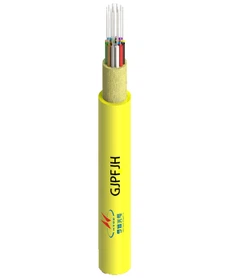



A slotted core fiber optic cable uses a grooved core structure to organize and protect individual optical fibres, fibre bundles, or ribbons. Instead of placing the fibres inside separate loose tubes, the fibres are positioned in slots formed around a cylindrical core that usually incorporates a metallic or non-metallic central strength member. This construction can provide a robust mechanical package for duct, tunnel, direct-buried, and high-fibre-count network applications when the cable design is matched to the installation conditions.
The slotted-core concept is recognized in ITU-T L.100 for duct and tunnel optical fibre cables and ITU-T L.101 for directly buried optical fibre cables. Both describe optical fibres or fibre ribbons located in helical or reverse-oscillating (SZ) slots on a cylindrical core, typically with a central strength member.

What Is a Slotted Core Fiber Optic Cable?
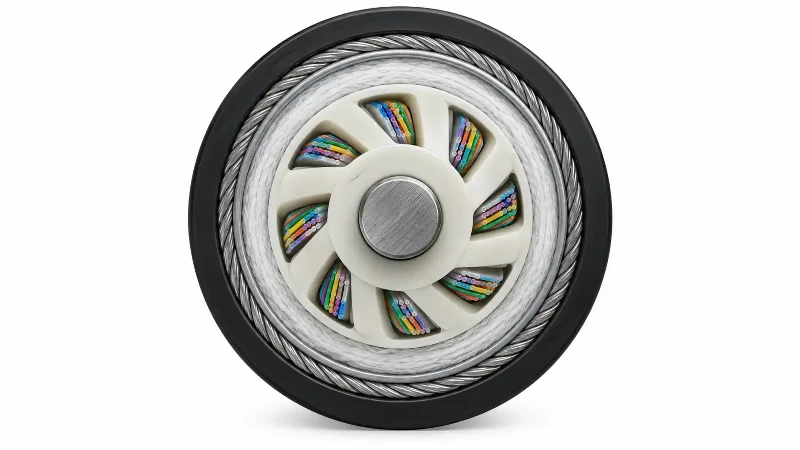
In a slotted-core cable, the core is generally produced from a suitable polymer material and formed with longitudinally progressing helical or SZ slots. Optical fibres, fibre bundles, or ribbons are laid into these slots. The groove geometry helps keep the fibres in defined positions while providing space for controlled fibre excess length and small relative movements inside the cable.
Unlike a loose tube fiber optic cable, the fibres are not primarily protected by individual buffer tubes. Instead, the slotted core itself becomes a major part of the cable's internal mechanical structure. Depending on the application, the complete cable may also include water-blocking materials, strength elements, tapes, armour, and one or more outer sheaths.
For ribbon-based designs, the slots can accommodate multiple fibre ribbons and support compact high-count constructions. A typical product example is a ribbon slotted-core cable.
How a Slotted Core Cable Is Constructed
- Central strength member: usually metallic or non-metallic, helping the cable withstand tensile loads and maintain structural stability.
- Slotted polymer core: a cylindrical core formed with helical or SZ slots. The exact material, dimensions, and slot geometry depend on the cable design.
- Optical fibres or ribbons: positioned directly in the slots rather than inside separate loose tubes.
- Water-blocking materials: yarns, tapes, compounds, or other materials may be used to limit longitudinal water migration.
- Protective layers: sheath, armour, and other protective elements are selected according to duct, tunnel, direct-buried, or other installation requirements.
The use of armour is not an inherent requirement of every slotted-core cable. Crush resistance, tensile performance, cable diameter, and environmental protection depend on the complete cable construction rather than on the slotted core alone.
Key Advantages of Slotted Core Fiber Optic Cables
1. Mechanical Protection Against External Pressure
One reason for placing fibres inside slots is to reduce the direct transfer of external pressure to the optical fibres. ITU-T L.100 and L.101 both describe the slotted-core arrangement in this context. In practical cable design, the slotted core works together with the sheath, armour where used, cable dimensions, and other structural elements to achieve the required crush performance.
This makes slotted-core construction relevant to installations where mechanical loading must be carefully controlled, including certain duct fiber optic cable and underground cable designs.
2. Controlled Fibre Excess Length and Temperature Behaviour
Slotted-core geometry can be designed to maintain controlled fibre excess length. This allows limited relative movement between the fibres and the surrounding cable structure as the cable expands, contracts, bends, or experiences tensile loading. The design objective is to keep fibre strain and microbending within acceptable limits.
Actual temperature performance must be verified for the specific cable by test. Temperature range, cycle conditions, attenuation change, and acceptance criteria should come from the applicable specification or product test report rather than from the cable category alone. For a broader overview of qualification methods, see fiber optic cable testing.
3. High Fibre-Count Potential
Modern ribbon-based slotted-core designs can achieve high fibre counts within a relatively compact cable cross-section. The density advantage is especially relevant when flexible or rollable ribbon technology, optimized slot geometry, and smaller-diameter fibres are used together.
However, high fibre density should not be treated as an automatic property of every slotted-core cable. Fibre diameter, ribbon format, slot dimensions, excess fibre length, armour, and sheath design all affect the final cable diameter. Where high-count mass-fusion architectures are required, a broader range of ribbon fibre optic cable designs should also be considered.
4. Integrated Water-Blocking Options
Water-blocking yarns, tapes, compounds, or other materials can be incorporated into the slots or surrounding cable layers. The objective is to limit longitudinal water penetration and prevent moisture migration along the cable core. The exact water-blocking system should be selected and tested according to the cable specification and installation environment.
Limitations and Engineering Trade-Offs
Slotted-core cable is not automatically the best choice for every optical network. Its value depends on fibre count, installation method, mechanical requirements, access strategy, splicing method, manufacturing capability, and total project cost.
- More specialized manufacturing: maintaining slot geometry, fibre excess length, and core dimensional stability requires controlled production processes.
- Product cost can be higher: some high-count or highly protected slotted-core designs may cost more than simpler loose-tube constructions, although actual procurement cost depends on specification and volume.
- Access and preparation differ from loose-tube cable: technicians need the correct stripping tools and procedures to avoid damaging fibres in the slots.
- Performance is design-specific: crush, tensile, temperature, water-blocking, and bend performance must be checked against the actual product specification.
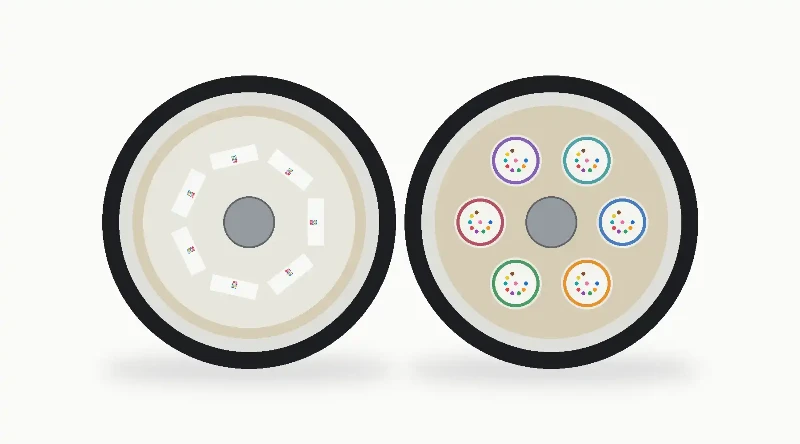
Slotted Core Cable vs. Loose Tube Cable
| Comparison Point | Slotted Core Cable | Loose Tube Cable |
|---|---|---|
| Fibre arrangement | Fibres, bundles, or ribbons are placed in slots in a central core. | Fibres or ribbons are placed inside buffer tubes. |
| Main internal protection concept | The grooved core helps organize fibres and limit direct external pressure on them. | Buffer tubes provide space that isolates fibres from external stress. |
| High fibre-count potential | Well suited to some compact ribbon-based high-count designs. | Also available in high-count designs, but cable size and density depend on tube and fibre configuration. |
| Splicing | Ribbon versions can support mass fusion splicing. | Can use single-fibre or ribbon splicing depending on cable design. |
| Mid-span access | Depends strongly on slot design and cable preparation method. | SZ-stranded loose-tube designs can offer convenient mid-span access. |
| Manufacturing complexity | Requires accurate control of slot geometry and fibre placement. | Uses established buffer-tube extrusion and stranding processes. |
| Typical selection logic | Consider when compact ribbon density, slotted-core protection, or specific mechanical design goals justify the construction. | Often selected as a versatile general-purpose outdoor cable architecture. |
In practice, the choice should be based on a project specification rather than on a single claimed advantage. A network designer should compare fibre count, required cable diameter, crush and tensile ratings, operating temperature, water penetration requirements, splicing workflow, mid-span access needs, installation method, and lifecycle cost.
Typical Applications
Backbone and Metropolitan Networks
Slotted-core cables can be used in high-capacity backbone and metropolitan transmission networks where mechanical protection, stable fibre management, or high-count ribbon configurations are important. They are particularly relevant when duct space is limited and the selected cable can provide the required fibre count within the available pathway.
Duct and Tunnel Installations
ITU-T L.100 covers optical fibre cables installed by pulling methods in duct and tunnel applications and includes slotted core as one of the recognized cable elements. For these projects, cable selection should consider pulling tension, bend radius, crush loads, water penetration, and tunnel-specific installation conditions.
Direct-Buried Networks
ITU-T L.101 also includes slotted-core construction for directly buried optical fibre cables. Direct burial exposes a cable to soil pressure and other mechanical and environmental loads without the protection of a duct, so the complete cable construction must be designed and qualified for the site conditions. For related deployment options, see direct-bury fiber optic cable.

Installation and Handling Considerations
- Use stripping and opening tools that are appropriate for the cable design, and control cutting depth carefully.
- Do not assume the slot wall can be cut deeply without risk; fibres may lie close to the opening area.
- Follow the manufacturer's specified minimum bending radius during installation and splicing.
- Keep installation pulling tension within the cable's rated limit.
- For direct-buried or high-load projects, verify crush, impact, water penetration, temperature, and tensile requirements before installation.
- For ribbon designs, confirm the intended ribbon identification and mass-fusion splicing procedure before field preparation.
When Is a Slotted Core Cable Worth Choosing?
A slotted-core fiber optic cable is worth considering when the project requires a combination of high fibre count, compact cable geometry, robust fibre organization, and mechanical protection suited to duct, tunnel, or direct-buried environments. It is less useful to select the construction simply because it is described as "high reliability." The better approach is to match the cable's tested ratings and installation features to the actual route conditions.
For procurement, specify the required fibre count, fibre type, ribbon format if applicable, cable outer diameter, tensile rating, crush rating, operating and installation temperature range, water penetration requirement, bend radius, sheath or armour configuration, and applicable test standards. This turns a general structural preference into a verifiable engineering requirement.
FAQ
What is a slotted core fiber optic cable?
It is an optical cable in which individual fibres, fibre bundles, or fibre ribbons are positioned in helical or SZ slots formed in a cylindrical core, usually around a central metallic or non-metallic strength member.
What does SZ slotted core mean?
SZ refers to reverse-oscillating stranding. Instead of running continuously in one helical direction, the slot path periodically reverses direction. This construction is recognized in ITU-T recommendations for optical fibre cables.
Is slotted core cable suitable for direct burial?
It can be. ITU-T L.101 includes slotted core as a recognized cable element for directly buried optical fibre cables. Suitability still depends on the complete cable construction and whether its mechanical and environmental ratings meet the project specification.
Is every slotted core cable armored?
No. Slotted core describes the internal core arrangement, not a mandatory armour configuration. Armour, sheath thickness, water-blocking system, and other protection layers vary by product and application.
Is slotted core always denser than loose tube?
No. Modern ribbon slotted-core designs can achieve very high fibre density, but final density depends on fibre diameter, ribbon design, slot geometry, excess fibre length, protective layers, and cable outer diameter. A direct product-to-product comparison is more useful than a category-wide assumption.
What is the main difference between slotted core and loose tube cable?
The main difference is how the fibres are organized and protected inside the cable. Slotted-core designs place fibres or ribbons in grooves within a central core, while loose-tube designs place them inside polymer buffer tubes with internal space for strain isolation.
Conclusion
Slotted-core construction is a proven optical cable architecture for applications that need controlled fibre placement, mechanical protection, and potentially high fibre counts. Its engineering value is strongest when the complete cable design is selected against measurable requirements such as crush resistance, tensile performance, temperature behaviour, water penetration, cable diameter, splicing method, and installation environment. For critical communication links, those verified characteristics are more meaningful than broad claims about "superior" performance.