





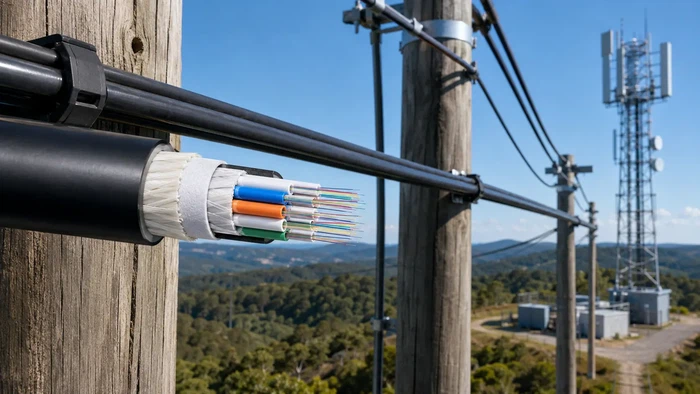
Gel-free dry core loose tube optical fiber cable is a modern cable design that replaces traditional petroleum-based filling gel with dry water-blocking materials such as water-blocking yarn and water-blocking tape. This design simplifies field operations, reduces cable weight, and improves fusion splicing efficiency - making it a preferred choice for aerial fiber optic cable installations and high-fiber-count network deployments.
In this guide, we explain how gel-free cable works, compare it to gel-filled alternatives, and help you determine the right cable type for your project.
What Is a Gel-Free Dry Core Loose Tube Optical Fiber Cable?
In a conventional loose tube fiber optic cable, each buffer tube is filled with a thixotropic gel compound. This gel serves as a moisture barrier and provides cushioning for the optical fibers inside. While effective, gel filling introduces drawbacks during installation and maintenance - particularly the need to clean gel from fibers before fusion splicing.
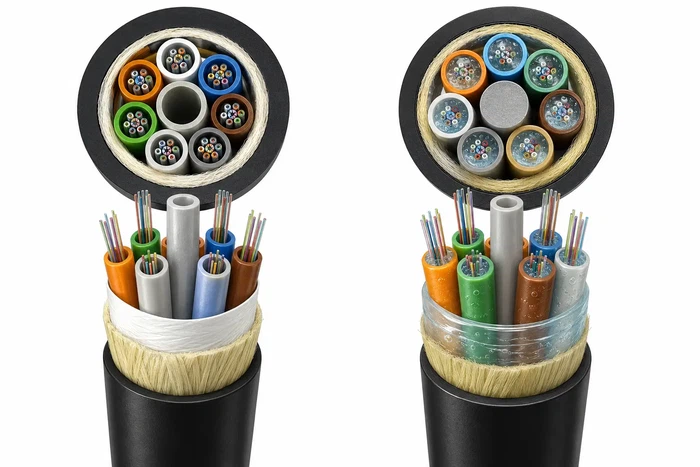
A gel-free dry core loose tube cable eliminates this gel. Instead, it relies on high-performance water-blocking yarn wound around or between the fibers inside each loose tube, combined with water-blocking tape applied around the cable core. These dry materials swell on contact with moisture, forming a barrier that prevents longitudinal water penetration - achieving similar water-blocking performance without the complications of gel.
The loose tubes themselves are typically extruded from polybutylene terephthalate (PBT) or polypropylene (PP). PBT offers excellent dimensional stability, low moisture absorption, and strong creep resistance, making it well suited for outdoor and aerial environments. PP provides good hydrolysis resistance, which can be advantageous in hot, humid climates where long-term chemical stability of the tube material matters. Both materials maintain consistent mechanical properties over wide temperature ranges, as required by the IEC 60794 series of optical fiber cable standards.
Gel-Free vs Gel-Filled Fiber Optic Cable
The choice between gel-free and gel-filled cable affects installation workflow, cable weight, and long-term maintenance. Here is a practical comparison:
| Feature | Gel-Free (Dry Core) Cable | Gel-Filled Cable |
|---|---|---|
| Water-blocking method | Water-blocking yarn and tape (super-absorbent polymer) | Thixotropic filling compound (petroleum-based gel) |
| Splice preparation | Fibers are clean and ready for splicing immediately after buffer tube access | Requires solvent cleaning to remove gel residue before splicing |
| Cable weight | Typically 10% to 30% lighter than equivalent gel-filled designs (varies by fiber count and cable structure) | Heavier due to gel mass inside each buffer tube |
| Splice preparation time | Reduced - no gel wiping step required | Longer - each fiber must be individually cleaned |
| Environmental considerations | No gel residue or solvent waste during field operations | Gel waste and cleaning solvents require proper disposal |
| Water penetration performance | Meets industry standards when using quality water-blocking yarn and tape | Well-established water-blocking track record |
| Best suited for | Aerial installations, high-fiber-count cables, projects requiring fast splicing turnaround | Direct-buried and duct applications where gel provides additional mechanical cushioning |
The weight reduction in gel-free cables becomes especially significant in aerial deployments. Lighter cable means lower mechanical load on poles and support hardware, which can reduce infrastructure costs and simplify tensioning calculations. For high-fiber-count cables - 96 fibers and above - the time savings from eliminating gel cleaning across dozens of fibers per splice point can substantially reduce total project installation time.
Key Features of Dry Core Loose Tube Cable
Faster fusion splicing workflow. Without gel to clean, technicians can access and prepare fibers more quickly. In a 144-fiber cable, for example, this can save considerable time at each splice closure, because every fiber in every buffer tube can be handled cleanly without solvent application. For a detailed overview of the splicing process, see our guide on fusion splicing fiber optic cable.
Lightweight, non-metallic construction. Many gel-free loose tube cables use an all-dielectric design with FRP (fiberglass-reinforced plastic) central strength members and non-metallic sheath materials. This eliminates electrical conductivity, making the cable suitable for installation in high-voltage environments - such as along power transmission lines - without risk of induced currents or lightning attraction. The non-metallic design also contributes to lower overall cable weight. Learn more about FRP strength members in fiber optic cables.
Reliable longitudinal water blocking. Super-absorbent polymer (SAP) materials used in water-blocking yarn and tape expand rapidly on contact with moisture, forming a gel-like seal within the cable core. When properly designed and manufactured, these dry water-blocking systems meet the longitudinal water penetration requirements of IEC 60794 and equivalent national standards. For further reading on water-blocking technology, see our comprehensive guide to water-blocking tape.
Stable tube material performance. PBT loose tubes offer strong crush resistance and dimensional stability across a wide temperature range, typically from −40 °C to +70 °C. PP tubes add hydrolysis resistance - meaning the tube material resists chemical degradation when exposed to moisture over long periods - which is particularly relevant for cables deployed in tropical or high-humidity regions.
Typical Applications
Aerial network deployment. Gel-free cable is widely used in self-supporting and lashed aerial installations. The reduced weight lowers sag and wind load on spans between poles, and the all-dielectric option (such as ADSS-type designs) can be installed on existing power line infrastructure. See our full range of aerial fiber optic cable products.
FTTx backbone and distribution networks. In fiber-to-the-home and fiber-to-the-building projects, gel-free cable accelerates splicing at distribution points, where dozens or hundreds of fibers may need to be terminated in a single session.
Campus and enterprise networks. For campus backbone links between buildings, the lightweight and non-metallic properties of dry core cable simplify both aerial and duct-based installation.
Rural broadband expansion. Long-span aerial deployments in rural areas benefit from both the weight savings and the simplified field splicing that gel-free cable provides, especially where skilled labor and equipment access are limited.
GYFY Cable Structure: An Example of Gel-Free Design
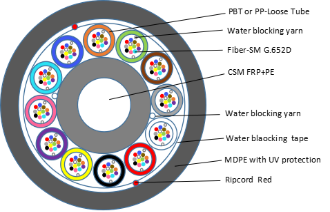
The GYFY designation refers to a non-metallic, gel-free stranded loose tube cable - a common structure for outdoor gel-free applications. In a typical GYFY-144F cable, the structure from center to outer sheath includes the following layers:
- FRP central strength member - provides tensile and compressive strength to the cable core without introducing metallic components.
- Stranded loose tubes (PBT or PP) - each tube contains up to 12 optical fibers (e.g., 12 tubes × 12 fibers = 144 fibers). No gel is present inside the tubes; water-blocking yarn fills the space between fibers.
- Water-blocking yarn between tubes - applied in the interstices between stranded loose tubes to prevent water migration along the cable core.
- Water-blocking tape - wrapped around the stranded core assembly as an additional moisture barrier.
- FRP or aramid yarn strength elements - positioned between the core wrap and outer sheath for additional tensile reinforcement.
- Polyethylene (PE) outer sheath - provides mechanical protection, UV resistance, and environmental sealing.
This all-dielectric, gel-free structure meets the requirements of outdoor aerial and duct installations while keeping overall cable diameter and weight to a minimum. For more on fiber optic cable structure, see our detailed technical guide.
How to Choose the Right Gel-Free Optical Cable
When specifying a gel-free dry core loose tube cable for your project, consider the following factors:
Fiber count and tube configuration. Determine the total fiber count required and whether standard loose tube (up to 12 fibers per tube) or ribbon-in-tube designs better suit your splicing approach. Higher fiber counts benefit more from the gel-free advantage, as the time savings per splice multiply across more fibers.
Installation environment. For aerial installations, prioritize lightweight, all-dielectric designs with appropriate span ratings. For duct applications, ensure the cable outer diameter is compatible with your duct infrastructure. For direct burial, gel-filled cable may still be preferred due to the additional mechanical cushioning that gel provides around the fibers.
Tube material selection. PBT is the standard choice for most outdoor applications. If your deployment is in a hot, humid climate with long expected service life, PP tubes with enhanced hydrolysis resistance may be worth evaluating.
Water-blocking performance verification. Request water penetration test results per IEC 60794-1 or equivalent standards. Reputable manufacturers will provide test data confirming longitudinal water-blocking performance under specified pressure and duration conditions. Learn more about fiber optic cable testing procedures.
Compliance and certification. Verify that the cable meets applicable international standards (IEC 60794, ITU-T G.652 for single-mode fiber) and any regional requirements such as RoHS or CPR compliance where relevant.
FAQ
Q: Does Gel-Free Cable Provide The Same Water Protection As Gel-Filled Cable?
A: Yes, when manufactured with quality super-absorbent polymer (SAP) water-blocking yarn and tape, gel-free cables meet the same longitudinal water penetration standards as gel-filled designs. The key is the quality and quantity of SAP material used, as well as proper cable manufacturing processes.
Q: Is Gel-Free Cable More Expensive Than Gel-Filled Cable?
A: Material costs can be slightly different depending on the water-blocking yarn and tape used, but overall pricing is generally comparable. The real cost advantage of gel-free cable often appears during installation, where reduced splice preparation time translates to lower labor costs - especially on large-scale projects with high fiber counts.
Q: Can Gel-Free Cable Be Used For Direct Burial?
A: Gel-free cable can be used in duct installations underground. For direct-buried applications without conduit, many engineers still prefer gel-filled or armored cable designs that provide additional mechanical protection and moisture resistance in direct soil contact. The choice depends on soil conditions, cable armor, and project specifications.
Q: What Fiber Counts Are Available In Gel-Free Loose Tube Cable?
A: Gel-free dry core loose tube cables are available in a wide range of fiber counts, commonly from 2 fibers up to 288 fibers or more. High-fiber-count designs (96F, 144F, 288F) are where the operational benefits of gel-free construction are most apparent.
Q: How Does Gel-Free Cable Perform In Extreme Temperatures?
A: With PBT or PP loose tubes and properly engineered excess fiber length, gel-free cables typically perform within a rated temperature range of −40 °C to +70 °C. Temperature cycling tests per IEC 60794 verify that fiber attenuation remains within specification across this range.
Get a Quote for Gel-Free Fiber Optic Cable
Hengtong is an established fiber optic cable manufacturer with production facilities equipped for both gel-free and gel-filled cable lines. Founded in 2010, Hengtong supplies optical cable to telecom operators, network contractors, and project integrators across multiple regions.
For gel-free dry core loose tube cable, Hengtong offers custom fiber optic cable configurations including custom fiber counts, tube materials (PBT or PP), sheath options, and cable markings. All products undergo factory testing in accordance with IEC 60794 requirements, covering mechanical, environmental, and optical performance parameters.
To discuss your project requirements or request a product datasheet, contact our engineering team directly.