






5G-A is not 6G. 5G-A (also written as 5G-Advanced) is the second major phase of 5G defined by 3GPP, starting from Release 18. 6G is the next mobile generation, with its first specifications expected in 3GPP Release 21. Many of the technologies first studied in 5G-A - such as integrated sensing, AI in the network, and non-terrestrial access - are now being carried into the 6G research phase. In that sense, 5G-A acts as a practical bridge between today's 5G networks and tomorrow's 6G systems.
This article explains what each technology is, how they connect on the 3GPP and ITU timelines, where they actually differ, and what the bridge means for operators, enterprises, and the broader connectivity supply chain.
What Is 5G-A (5G-Advanced)?
5G-A is the marketing name for the 5G-Advanced phase of the 5G standard. It is built on top of the original 5G releases (Release 15 to Release 17) and is being defined across 3GPP Release 18, Release 19, and the 5G-Advanced part of Release 20. Release 18 was frozen in June 2024 and is widely treated as the first formal 5G-Advanced release.
The 5G-Advanced work explicitly covers areas such as RAN enhancements, AI/ML in the network, evolved RedCap (Reduced Capability) devices, non-terrestrial networks (NTN), positioning, security, management, and operational support. In simple terms, 5G-A makes the existing 5G network smarter, more energy-efficient, more accurate, and capable of new services like immersive XR calls, low-altitude drone connectivity, industrial IoT, and ambient or "passive" IoT.
5G-A is also tightly linked to the deeper rollout of 5G Standalone (SA) infrastructure, because most advanced features (network slicing, deterministic networking, advanced positioning) only work properly on a 5G SA core.
What Is 6G?
6G is the next generation of mobile communications. The international name for it is IMT-2030, confirmed by the ITU Radiocommunication Assembly in 2023. The high-level vision is captured in Recommendation ITU-R M.2160, the global framework for IMT-2030.
ITU defines six usage scenarios for 6G:
- Immersive communication (an evolution of eMBB)
- Hyper reliable and low-latency communication (HRLLC)
- Massive communication (an evolution of mMTC)
- Ubiquitous connectivity
- AI and communication
- Integrated sensing and communication (ISAC)
Around these sit four design principles: sustainability, security and resilience, connecting the unconnected, and ubiquitous intelligence. 6G is therefore not just "faster 5G" - it is positioned as a network that natively combines connectivity, sensing, computing, and AI across terrestrial and non-terrestrial coverage.
Is 5G-A the Same as 6G?
No. 5G-A and 6G belong to two different generations and two different parts of the 3GPP roadmap.
5G-A is normative work inside the 5G standard. It improves 5G networks operators have already deployed (or are still deploying). 6G is being defined first as a series of study items in Release 20, followed by full normative specifications in Release 21. The actual 6G radio interface, core architecture, and protocols will be different from those of 5G NR.
The reason the two are often discussed together is overlap in time and content. Many candidate 6G technologies are first incubated in 5G-A so that the industry can validate them on commercial networks before they become formal 6G specifications.
How 5G-A Serves as a Bridge to 6G
The bridge role is structural, not just rhetorical. Several specific mechanisms link the two:
1. Shared standardization vehicle. 3GPP Release 20 is explicitly split into two tracks. About half of the work continues 5G-Advanced normative specifications; the other half consists of non-normative 6G studies that will feed into Release 21. The body itself describes Rel-20 as a "transitional bridge between two generations."
2. Technology incubation. Capabilities such as integrated sensing and communication, AI/ML for network operation, and satellite-based NTN access are first introduced in 5G-A. They are tested on real networks and devices, and the lessons feed directly into 6G design choices.
3. Deployment continuity. 6G is being designed assuming a 5G Standalone foundation. Operators that upgrade to 5G SA and then to 5G-A are effectively building the platform their future 6G services will run on, which reduces both the cost and the risk of the eventual 6G migration.
4. Spectrum and physical infrastructure. WRC-23 identified candidate spectrum bands (for example 4 400–4 800 MHz, 7 125–8 400 MHz, and 14.8–15.35 GHz) for study under WRC-27 as potential 6G bands. At the same time, 5G-A densification is driving new fiber backhaul and fronthaul deployments for 5G base stations that will, in most cases, also serve future 6G sites.
5G-A vs 6G: Key Differences
The table below summarizes the practical differences in scope, status, and capability targets.
| Dimension | 5G-A (5G-Advanced) | 6G (IMT-2030) |
|---|---|---|
| Generation | Second phase of 5G | Next mobile generation |
| 3GPP releases | Release 18, 19, and the 5G-Advanced track of Release 20 | Studies in Release 20; first specifications in Release 21 |
| Status (early 2026) | Release 18 frozen (June 2024); Release 19 freeze underway; Release 20 5G-A work targeting 2027 freeze | Use case and requirement studies running in Rel-20; normative work expected to start in Rel-21 |
| Air interface | Same 5G New Radio, enhanced | New 6G radio interface, designed from scratch but interworking with IMT-2020 |
| Core scenarios | Enhances eMBB, URLLC, mMTC; adds XR, low-altitude UAV, industrial IoT, passive IoT | Adds AI and communication, ISAC, ubiquitous connectivity to the IMT scenario set |
| AI in the network | AI/ML features added through network functions such as NWDAF | AI is a native usage scenario, not an add-on |
| Sensing | Initial ISAC studies and trials | Integrated sensing as a core 6G usage scenario |
| Non-terrestrial access | Enhanced NR NTN and IoT NTN; smartphone-direct-to-satellite trials | Designed for ubiquitous connectivity across terrestrial and non-terrestrial layers |
| Commercial timeline | First commercial 5G-A services launched in 2024–2025; broader rollout 2025–2030 | Commercial deployments expected after 2030 |

3GPP Timeline from 5G-A to 6G
The cleanest way to see the bridge is through the 3GPP release schedule. Note that some dates are still moving as work progresses; the Release 21 timeline in particular is a checkpoint, with a final decision targeted for June 2026.
| 3GPP Release | Role | Status / Target |
|---|---|---|
| Release 15–17 | First 5G specifications: NR, 5G core, NTN and RedCap introduced in Rel-17 | Frozen |
| Release 18 | First 5G-Advanced release: AI/ML, NTN enhancements, XR, energy savings, positioning | Frozen, June 2024 |
| Release 19 | Second 5G-Advanced release: deeper ISAC, NTN, RedCap evolution, AI-driven mobility | Freeze underway in 2025–2026 |
| Release 20 | Dual-track release: final 5G-Advanced normative work + first 6G studies (use cases, requirements, scenarios, key technologies) | Stage-1 of 5G-A frozen June 2025; full 5G-A protocol freeze targeted March 2027; ASN.1/OpenAPI freeze targeted June 2027; 6G studies running in parallel |
| Release 21 | First 6G release: normative 6G specifications | Detailed timeline to be agreed by June 2026; ASN.1 freeze no earlier than March 2029, with first commercial 6G deployments expected after 2030 |
The key observation is that during 2024–2029, 5G-A and 6G work proceed in parallel inside 3GPP. This is the literal sense in which 5G-A is "the bridge."
Key Technologies Shared by 5G-A and 6G
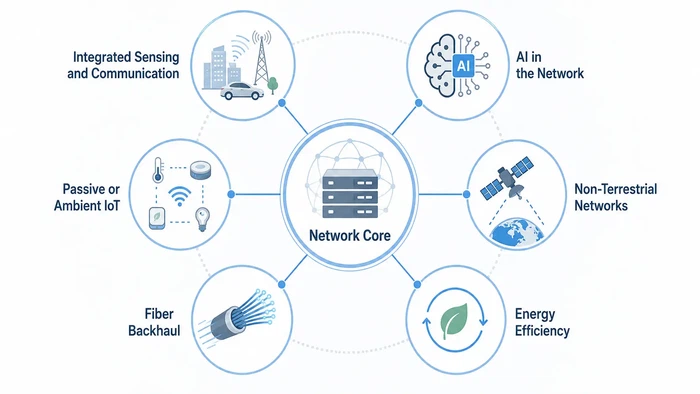
Several technology threads run from 5G-A directly into 6G. They are worth understanding because they explain where today's 5G-A investment becomes tomorrow's 6G capability.
Integrated sensing and communication (ISAC). 5G-A introduces initial ISAC studies - for example, using base stations to detect drones in low-altitude airspace. In 6G, ISAC becomes one of the six core usage scenarios, with the network natively able to sense its environment.
AI in the network. In 5G-A, AI/ML is added through specific network functions such as the Network Data Analytics Function (NWDAF) and through AI-assisted RAN procedures (CSI feedback, beam prediction, mobility). In 6G, AI is treated as a native scenario - both the workload the network must carry and the way the network itself is operated.
Non-terrestrial networks. 5G-A enhances NR NTN and IoT NTN, including features that improve smartphone-direct-to-satellite uplink coverage. 6G's "ubiquitous connectivity" scenario builds on this to target a single, integrated terrestrial and non-terrestrial layer.
Energy efficiency and sustainability. Both 5G-A and 6G are explicitly framed around lowering energy per bit. ITU lists sustainability as one of the four overarching design principles of IMT-2030.
Passive and ambient IoT. 5G-A introduces support for very-low-power devices that need little or no battery. The same direction is extended in 6G as part of "massive communication."
What This Means for Operators and Enterprises
For most decision-makers, the right reading of the 5G-A-to-6G bridge is not "wait for 6G," but "use 5G-A to prepare."
Operators. According to GSMA Intelligence, more than half of operators expect to deploy 5G-Advanced commercial networks within roughly two years of solutions becoming available, and by November 2025 the GSA had identified seven operators that had launched 5G-Advanced services, with many more in trials. Operators that already run 5G Standalone cores can adopt 5G-A features incrementally and use the same footprint as the eventual 6G base layer.
Enterprises. Use cases that 5G-A is designed for - XR collaboration, industrial automation, low-altitude logistics, large-scale ambient IoT - are also use cases that 6G will continue to serve. Enterprises adopting 5G-A connectivity now are, in most cases, building the same internal capability set they will need in the early 6G era.
Infrastructure suppliers. 5G-A densification, 6 GHz mid-band rollout, and the eventual 6G higher-band layers all depend heavily on dense, high-quality fiber. Both 5G-A and 6G base stations rely on robust fronthaul and backhaul, which is why 6G-ready optical fiber and aerial fiber optic cable are increasingly specified to meet the bandwidth and latency expected of next-generation networks. Data center interconnect is similarly affected: AI-heavy 6G workloads will further raise the requirements on data center connectivity solutions.

FAQ
Q: Is 5G-A Really 6G?
A: No. 5G-A is the advanced phase of 5G defined in 3GPP Release 18 onward. 6G is the next generation, with first specifications expected in 3GPP Release 21.
Q: When Will 6G Arrive?
A: 3GPP plans to start the first 6G normative specifications in Release 21. The detailed timeline is to be confirmed by June 2026, ASN.1 freeze is no earlier than March 2029, and commercial 6G deployments are widely expected after 2030.
Q: Will 5G-A Be Replaced By 6G?
A: Not immediately. 5G-A networks are designed to keep operating for many years alongside early 6G. ITU explicitly states that IMT-2030 is expected to interwork with existing IMT systems.
Q: What Are The Main Capabilities Of 5G-A That 6G Will Inherit?
A: Integrated sensing and communication, AI/ML in the network, non-terrestrial network access, energy efficiency, and ambient/passive IoT all start in 5G-A and are extended natively in 6G.
Q: Do Operators Need To Deploy 5G-A Before 6G?
A: Strictly speaking, no - but practically, yes. 6G is being designed on top of a 5G Standalone foundation, and most 5G-A features (slicing, advanced positioning, AI-assisted operations) are the same capabilities operators will need to monetize early 6G services.