





What is a CS Fiber Connector?
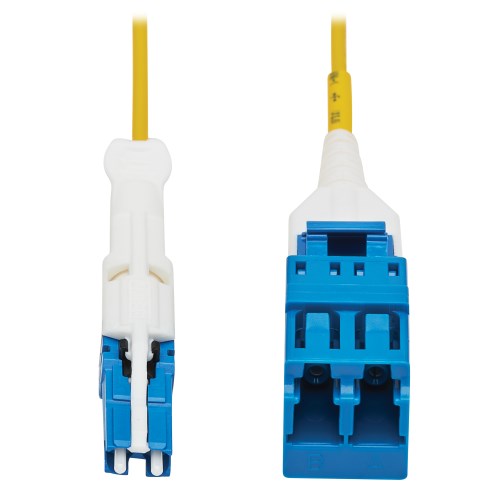
The CS fiber connector is a middleware component that complies with IEEE 802.3bs standards, featuring a compact design with a dual-fiber push-pull configuration (easy to operate and stable). It is specifically designed as a high-density, very small form factor (VSFF) optical fiber connector for modern high-density network environments. With ferrule and housing dimensions smaller than conventional connectors, CS connectors can double the density of patch panels compared to LC duplex connectors, effectively improving airflow within racks. Compatible with duplex fibers up to 2.0/3.0mm in diameter. Supports 200G and 400G Ethernet transmission.

Core Technical Specifications of CS Connectors
Versatility
CS connectors strongly support multiple data formats and communication protocols to ensure smooth integration across different systems.
Compact Size
CS connectors employ an innovative miniaturized design, measuring 6.2mm x 10.8mm with a ferrule diameter of 1.25mm. This size is similar to traditional LC connectors but more compact overall, enabling higher port density within the same space. The duplex design supports both single-mode and multi-mode fiber versions.
Transmission Performance
CS connectors support 200G and up to 400G Ethernet transmission, delivering high-speed, low-latency data transfer in high-bandwidth applications. Suitable for battery-powered edge devices and 5G small cell base stations, effectively extending device battery life.
Convenient Operation
The push-pull latch design of CS connectors enables quick and convenient insertion and removal operations. This user-friendly design not only improves installation efficiency but is particularly suitable for scenarios requiring frequent equipment maintenance and upgrades in compact spaces.
Advantages of CS Fiber Connectors
High-Density Deployment
The ultra-small form factor design of CS connectors is one of their most significant advantages. Their compact design enables higher port density in space-constrained environments, maximizing space utilization. This characteristic is particularly practical in space-limited venues such as data centers and telecommunications hubs, significantly improving space efficiency.
Low Power Consumption and High Energy Efficiency
CS connectors are perfectly compatible with low-power optical transceivers, with overall power consumption reduced by more than 30% compared to traditional connectors. They feature lower insertion loss and higher return loss, ensuring efficient and reliable high-speed data transmission.
Reliability and Durability
CS connectors employ robust housings and reliable latch mechanisms, capable of operating normally within a temperature range of -40°C to +85°C, with excellent vibration resistance, dust protection, and water resistance, maintaining stable performance in various harsh environments. Suitable for demanding application scenarios such as Industrial Internet of Things (IIoT), outdoor deployment, and autonomous driving.
Excellent Cost-Effectiveness
Compared to traditional high-density connectors, CS connectors reduce overall deployment costs by approximately 20% while providing the same or superior performance. Their standardized design and broad compatibility further reduce maintenance costs and upgrade difficulty.
Primary Application Scenarios for CS Connectors
Edge computing infrastructure
5G network deployment
Industrial Internet of Things (IIoT)
Autonomous driving technology
Medical equipment connections
Future Development Trends of CS Fiber Connectors
Higher Rate Support
CS connectors are currently evolving toward 800G transmission rates. Next-generation CS connectors will adopt more advanced optical design and signal processing technologies to meet the transmission requirements of ultra-high-speed networks.
Photonic Integration Technology Convergence
The combination of CS connectors with photonic integrated circuits (PIC) is an important development direction. This convergence will further improve data transmission efficiency, promote miniaturization and high integration of network equipment, and pave the way for large-scale application of silicon photonics technology.
Environmental Adaptability
With growing demand for outdoor and extreme environment applications, higher protection ratings will be needed, such as IP67 or even IP68 protection levels. This can further expand the application of CS connectors in special fields such as marine engineering, polar scientific research, and military communications.
Intelligent Management Functions
Next-generation CS connectors may integrate intelligent monitoring chips to achieve real-time monitoring of connection status, fault warning, and performance optimization. This will significantly improve network management efficiency and reduce maintenance costs.

CS Connector Selection Considerations
Single-Mode CS Connectors: Smaller core size, minimal signal loss, providing higher bandwidth and data rates, suitable for long-distance transmission (over 10 kilometers), primarily used in data center interconnection, metropolitan area networks, and telecommunications backbone networks.
Multi-Mode CS Connectors: Larger core diameter, subject to intermodal dispersion, suitable for short-distance high-speed transmission (within 500 meters), lower cost, commonly used for internal data center connections and enterprise campus networks.
Key Performance Parameters
Focus on the following parameters:
Insertion loss: Quality products ≤0.3dB
Return loss: Single-mode ≥50dB, multi-mode ≥26dB
Repeated mating cycles: ≥500 times
Operating temperature range: Select appropriate temperature grade based on application environment
FAQ
Q: Are CS connectors backward compatible with LC connectors?
A: No.They use a different ferrule size (1.25mm vs 1.6mm) and different fiber positioning, so CS and LC connectors cannot mate with each other.
Q: What equipment changes are needed to deploy CS connectors?
A: New patch panels and adapters - CS-specific hardware required
New patch cords - CS connector patch cables needed
Transceivers - Must support CS connector interface
Q: How do CS connectors compare to SN connectors and MDC connectors?
A: CS connectors:
1.25mm ferrule
Higher density than LC
Industry standard (backed by major vendors)
SN connectors:
Similar small form factor concept
Competing standard with less market adoption
Also aims for higher density
MDC connectors:
Multi-fiber design (8 or 16 fibers)
Even higher density than CS
More complex deployment
Q: When should I choose CS over MPO/MTP connectors?
A: duplex connectivity (not parallel optics)
easier troubleshooting than MPO
need higher port density than LC but simpler than MPO
doing gradual migration from LC infrastructure