





OPGW Tension Clamp as a critical load-bearing fitting in the OPGW accessory system, the installation quality of tension clamps is directly related to line operation safety, OPGW fiber performance, and project lifespan. During installation, a seemingly standard crimping operation with a hydraulic crimping tool pressure deviation of 5 bar may lead to loosening of the preformed armor rods after six months; the importance of OPGW tension clamps is not merely simple mechanical fixation, but protection of the optical fiber's life. Combined with years of transmission line construction and operation experience, this article will provide detailed insights into the importance of tension clamps in OPGW cable systems.
Structure and Function of Tension Clamps
Core Functions
Tension clamps primarily perform the following functions:
Tension Transfer: Reliably transfer the mechanical tension of OPGW to the tower structure
Fixed Positioning: Ensure accurate positioning and stable fixation of OPGW at tension towers
Protection Function: Protect the optical fibers inside OPGW from damage through reasonable grip force distribution
Electrical Connection: In some designs, also serve as electrical grounding function
Typical Structure
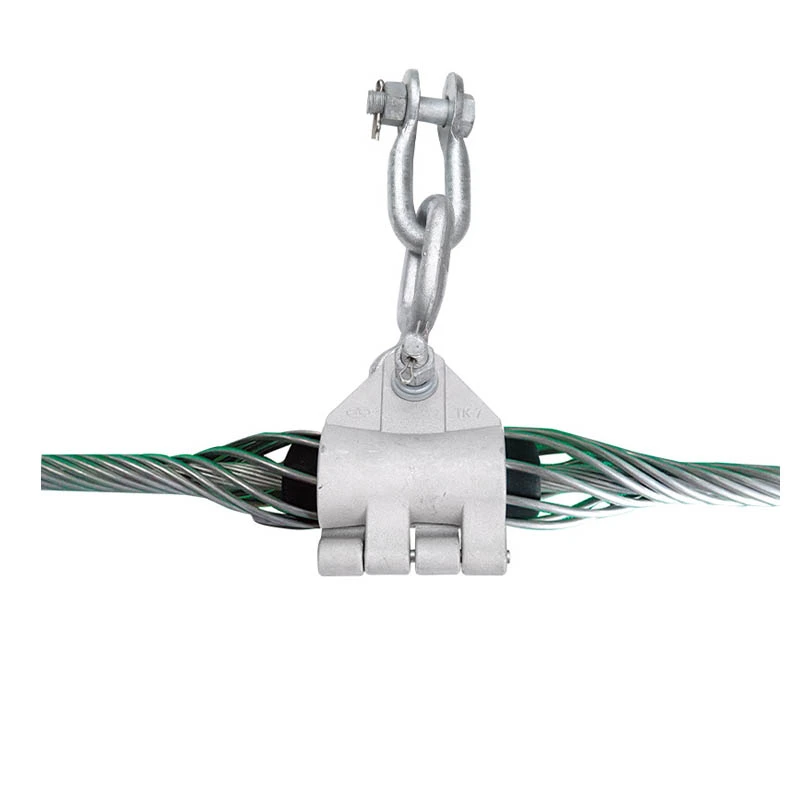
Standard OPGW tension clamps typically include preformed armor rods or armor rods, tension clamp body, U-shaped hanging rings or suspension fittings, vibration dampers and supporting accessories.
Problems Solved by Tension Clamps in OPGW
Force Distribution
It should be noted that ordinary steel strand ground wires can be directly clamped and fixed with clamps, but OPGW cable cannot. If directly clamped, the enormous grip force will flatten the outer aluminum-clad steel wires of OPGW, changing the cross-sectional shape; transfer pressure to the OPGW fiber unit, causing optical fiber micro-bending and breakage; and generate fatigue cracks at stress concentration points. The tension clamp achieves this through the combined design of preformed armor rods + clamp body, where the preformed armor rods disperse the grip force over a longer gripping length, the clamp body converts concentrated force into axial friction force, and the grip force gradient design gradually decreases from the center toward both ends.
Dynamic Stress Absorption
Since transmission lines are not in a static state and need to face environmental conditions such as wind-induced vibration, dancing, and temperature differences, if the fixed point is rigid, dynamic stress will act directly on the OPGW fibers. Tension clamps can effectively absorb high-frequency micro-vibrations through the elastic cushioning of preformed armor rods, and appropriate grip force design allows micro-displacement of the OPGW cable to avoid stress concentration, working together with vibration dampers to form a complete vibration reduction system.
Fiber Optic Cable Installation of Tension Clamps
① Before installing the inner armor rods, thread the preformed armor rod tension clamp assembly through the heart-shaped ring and make it parallel to the OPGW cable. There are stranding color marks on the preformed armor rods. Mark the point where the OPGW cable contacts this color mark as a positioning mark for installing the inner armor rods.
② Install the inner armor rods. Align the stranding installation color mark of the inner armor rods (the color mark farther from the wire end) with the mark made on the OPGW cable. Wind the inner armor rods simultaneously from the center toward both ends. To facilitate reinstallation, some pitch at the end can be left unwound temporarily.
③ After completing the first group, align the second group with the first group of armor rods. Wind 4-6 pitches of the second group of armor rods on the OPGW cable to loosen the end armor rods, then wind the remaining inner armor rods in sequence according to the reference. The inner armor rods must not cross and should be evenly spaced.
④ After all inner armor rods are wound, simultaneously twist all inner armor rods with both hands to the end to position them. All inner armor rod ends should be aligned with a deviation not exceeding 50mm.
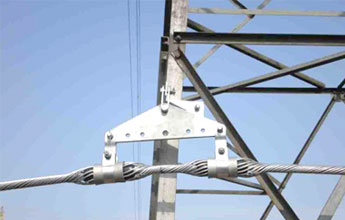
⑤ Install the outer armor rod tension clamp. Align the stranding color body of the outer armor rods with the stranding installation color mark of the inner armor rods, and simultaneously wind the two branches of the preformed armor rods from the color mark. The gap between the two branches should be uniform, and all wires must be tightly fastened in place.
Installation Quality Inspection
Visual Inspection
OPGW surface has no obvious indentations, twisting, or damage
Tension clamp installation position is accurate with no deviation
Preformed armor rods are wound uniformly and tightly with no looseness
All connection points are secure and reliable
Dimensional Measurement
Installation position deviation does not exceed ±10mm
Clamp grip length meets design requirements
Preformed armor rod length meets specification requirements
Mechanical Performance Inspection
Perform torque retest on bolt-type clamps
Conduct sampling grip force tests when necessary
Optical Performance Testing
After installation completion, optical fiber performance testing should be conducted:
Optical Time Domain Reflectometer (OTDR) testing to confirm no fiber breakage or abnormal attenuation
Compare with pre-installation test data; attenuation increase should be ≤0.05dB
Common Problems and Causes
Preformed Armor Rod Installation Problems
Common problems include looseness, detachment, or uneven winding of preformed armor rods. Poor fitting between preformed armor rod ends and OPGW, resulting in steps or gaps. This is generally caused by improper winding tension control, incorrect direction, inaccurate starting point positioning, or mismatch between preformed armor rod model and OPGW.
Abnormal Tension Clamp Grip Force
Common problems include inconsistent crimp depth, missed or over-crimping at some crimp points, deviation of clamp installation position from marking line exceeding 20mm, and abnormal attenuation increase at this point detected by OTDR testing after six months of operation. The root causes lie in incorrect hydraulic crimping tool pressure settings or pressure fluctuations, uncalibrated or improperly used torque wrenches, and incomplete OPGW surface cleaning where oil contamination affects friction.
OPGW Bending Radius Violations
Common problems include "dead bends" and sharp angles at drop wire turning points; excessively small bending radius when coiling spare cable; and excessively sharp OPGW bending at splice box inlet/outlet. The root causes lie in incorrect judgment of bending radius during fiber optic cable installation; excessive spacing of drop wire clamp installation (exceeding 2m); and unreasonable spare cable rack design with excessively small coiling diameter.


