





What is Cat7 Cable?
Cat7 cable is a shielded twisted pair cable specifically designed for high-performance Ethernet networks requiring speeds of 1 Gbps and above. These cables are primarily used for direct connections between network components such as servers, switches, and computing devices. Defined by the ISO/IEC 11801 Class F specification, Cat7 maintains full backward compatibility with Cat6, Cat6A, Cat5e, and Cat5 cabling standards and equipment.
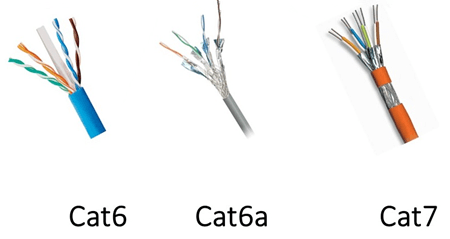
The core feature of this category 7 ethernet cable is its comprehensive shielding architecture. Not only does each pair of twisted wires have independent foil shielding, but the entire cable also has an overall shield layer. This dual shielding design enables Cat7 to operate at frequencies up to 600 MHz, support 10 Gbps Ethernet transmission, and provide exceptional resistance to electromagnetic interference (EMI) and crosstalk.

Cat7 Cable Application Scenarios
Category 7 network cable provides high-performance backbone networks for connecting routers, switches, modems, and terminal devices in local area networks of various scales and complexity levels. In enterprise network environments, Cat7 is particularly suitable for:
Data Centers and Server Rooms: In high-density rack environments where multiple cables run closely parallel, the comprehensive shielding of Cat7 significantly reduces alien crosstalk (interference between adjacent cables). This ensures each cable maintains 10 Gbps performance without degradation due to signal leakage from surrounding cables.
Core Network Equipment Interconnection: When connecting core switches, distribution layer switches, and high-performance servers, cat 7 network cable provides reliable 10 Gigabit Ethernet connections. Excellent shielding ensures signal transmission remains stable and reliable even in equipment rooms dense with electrical devices.
Mission-Critical Applications: For applications with extremely high requirements for network latency and reliability-such as financial trading systems, medical information systems, and real-time control systems-the low latency and high signal integrity of Cat7 provide additional performance assurance.
Manufacturing and Industrial Facilities: In factory floors, variable frequency drives, motor controllers, welding equipment, and other heavy electrical equipment generate intense electromagnetic interference. The dual shielding architecture of Cat7 effectively blocks these interferences, ensuring stable operation of industrial automation networks, SCADA systems, and PLC communications.
Smart Home Systems: Modern smart homes may contain dozens or even hundreds of connected devices-smart lighting, security cameras, door locks, sensors, voice assistants, smart appliances, etc. Cat7 provides reliable backbone connections between the control hub (smart home server or gateway) and various area access points, ensuring the responsiveness and stability of smart home systems.
Practical Considerations: Cat7 cable is thicker, stiffer, and heavier than Cat6 or Cat6A, making installation complex in space-constrained areas, tight bends, or narrow conduits. For typical home internet use (web browsing, social media, SD/HD streaming), Cat6 is more than sufficient, and the additional cost of Cat7 may not bring perceptible performance improvements.

Key Features and Technical Specifications
Standards and Classification: Cat7 follows ISO/IEC 11801 and belongs to Class F cabling, establishing strict performance standards these cables must meet.
Frequency/Bandwidth: Supports up to 600 MHz (higher than Cat6's 250 MHz and Cat6A's 500 MHz), delivering better signal quality, lower error rates, and stronger interference resistance.
Certification Test Metrics: Must pass multiple tests including insertion loss, return loss, near-end/far-end crosstalk (NEXT/FEXT), and PSELFEXT to ensure actual deployment performance meets standards.
Transmission Capability: Standard support for stable 10 Gbps (10GBASE-T) within 100 meters, with cat 7 speed reaching a maximum of 10,000 Mbit/s.
Distance Limitations: Consistent with other Ethernet copper cables, the channel maximum is 100 meters (328 feet); structured cabling typically recommends permanent links ≤90 meters with approximately 10 meters reserved for patch cords at both ends. Beyond 100 meters typically requires repeater equipment or switching to fiber optics.
Structure and Shielding: 4 pairs of twisted wires; each pair has independent foil shielding plus overall outer shielding (braided or foil), simultaneously suppressing internal crosstalk and external electromagnetic interference, suitable for high-noise or high-density cabling environments.
Conductors and Jacket: Commonly uses oxygen-free copper; permanent installations typically use 23 AWG (lower attenuation), patch cables commonly use 26 AWG. Outer jacket can be PVC or LSZH, with the latter more suitable for locations with high fire and smoke toxicity requirements (such as data centers and public buildings).
Different Types of Cat7 Cable
|
Item |
Typical Designation |
Structure/Shielding Points |
Frequency/Performance Points |
Applicable Scenarios |
Notes |
|
1 |
Cat7A (Enhanced) |
Usually stronger shielding, thicker and stiffer |
Up to approximately 1000 MHz; short distances may support higher bandwidth (e.g., 40GbE possible within 50m) |
High-density data centers, laboratories, forward-looking cabling |
High cost, difficult construction; Cat7 sufficient for most conventional scenarios |
|
2 |
Cat7 RJ45 Termination |
Mostly shielded RJ45 (metal shell), continuous with cable shielding |
Plug-and-play convenience; compatible with common device ports |
Device to information point/switch to server connections |
True high-quality features: metal shielded connector, gold-plated contacts, good strain relief, thicker gauge, clear jacket printing |
|
3 |
Cat7 UTP |
Unshielded (conceptually contradicts Cat7 requirements) |
Difficult to meet Cat7/Class F standards; may run 10G under ideal conditions but poor interference resistance |
Only suitable for ordinary environments with low interference resistance requirements |
Mostly Cat6/Cat6A UTP mislabeled; don't choose if you want true Cat7 performance |
|
4 |
Cat7 F/UTP |
Overall single-layer foil shielding covering four pairs; pairs not individually shielded |
Between UTP and full shielding; better external EMI suppression |
Office environments near lighting/small motors, wanting enhanced EMI protection |
Strictly speaking doesn't meet Cat7 requirements; more practical to purchase as Cat6A F/UTP |
|
5 |
Cat7 STP/FTP |
Usually refers to each pair having shielding: STP commonly braided; FTP commonly foil |
Pair shielding significantly reduces crosstalk, beneficial for high frequency/10G |
Enhanced stability in strong interference, dense cabling |
Pair shielding only doesn't necessarily equal true Cat7: may lack overall shielding |
|
6 |
SFTP / SSTP |
Pair foil shielding + overall braided shielding; SSTP may have double braiding |
Strong suppression of both internal and external interference |
Dense racks, near industrial equipment, near MRI/X-ray, broadcasting/radar environments |
Must be properly grounded (at least one end, ideally both); most expensive, stiffest |
Cat6 vs Cat7 Cable Performance Comparison
Basic Similarities
Twisted Pair Design: Both Cat6 and Cat7 use four pairs of twisted copper wires as their basic structure. The twisted pair design is the core interference resistance mechanism of Ethernet cables. By making the effects of external electromagnetic fields on the two conductors tend to be equal, interference cancels out during differential signal transmission.
100-Meter Distance Support: In standard applications, both Cat6 and Cat7 support a maximum channel length of 100 meters. For Gigabit Ethernet (1 Gbps), both can reliably operate over the full distance. Cat6 can also support 10 Gigabit Ethernet at distances up to 55 meters, although this is not its primary design target.
RJ45 Compatibility: In actual deployment, both Cat6 and Cat7 primarily use RJ45 connectors (although the Cat7 standard formally specifies GG45), ensuring broad compatibility with existing network equipment. This means both types of cables can plug into standard network ports without special adapters.
Major Performance Differences
Frequency and Bandwidth represent the most fundamental technical difference. Cat6 operates at 250 MHz, while Cat7 reaches 600 MHz-2.4 times the frequency capability. Higher frequency support means:
Faster data transfer rate potential
Lower bit error rates during high-speed transmission
Greater signal quality margin, making cables more tolerant of installation imperfections
Maximum Speed: The cat 7 specifications list a nominal maximum of 10,000 Mbit/s (10 Gbps), while Cat6's nominal maximum is 1,000 Mbit/s (1 Gbps). It should be clear that:
Cat6 can run 10 Gbps at short distances (up to 55 meters), but this is not its certified specification
Cat7 reliably guarantees 10 Gbps over the full 100-meter distance
Actual speeds also depend on network equipment capabilities (NICs, switches)
Shielding Architecture is the core differentiating feature of Cat7:
Cat6 Shielding Situation:
Cat6 is primarily available in UTP (unshielded) form, especially in the North American market
Shielded versions of Cat6 (F/UTP or S/UTP) only have overall shielding, with individual pairs unshielded
Relies on twisted pair geometry and pair spacing to suppress crosstalk
Cat7 Shielding Requirements:
Each pair of cables must have independent foil shielding (F)
The entire cable must have overall shielding (S or F)
Standard configuration is S/FTP or F/FTP
This dual shielding is a mandatory requirement for Cat7
The comprehensive shielding of Cat7 provides external EMI suppression and lower internal crosstalk while simultaneously offering significantly reduced alien crosstalk (interference between adjacent cables), with the ability to maintain performance in dense cable bundles.
|
Item |
Cat6 |
Cat7 |
|
Standards/Certification |
ISO/IEC 11801 Class E; 1Gbps/100m; 10Gbps approximately 37-55m; relatively lenient requirements |
ISO/IEC 11801 Class F; 10Gbps/100m; stricter specifications; more comprehensive testing |
|
Installation/Handling |
Softer and lighter; easy to thread; lenient bending requirements; simple termination |
Thicker, stiffer, and heavier; occupies space; stricter bending requirements; termination requires maintaining shielding continuity; more dependent on professional installation |
|
Cost |
Bulk approximately $0.15-0.30/meter; 2-meter patch cord approximately $5-15 |
Bulk approximately $0.40-0.80/meter; 2-meter patch cord approximately $15-35; mainly due to dual shielding and complex craftsmanship |
When to Use Cat6, When to Use Cat7
Choose Cat6 when:
Primary need is Gigabit Ethernet (1 Gbps)
Installation environment is clean (office buildings, residences) with few interference sources
Budget is limited, need cost-effectiveness
Need flexibility and ease of installation
Distance is within 55 meters and may consider 10 Gbps in the future (using Cat6)
Choose Cat7 when:
Need certified 10 Gbps over full 100-meter distance
High electromagnetic interference environments (factories, data centers, medical facilities)
Dense cable installations (server racks, wiring closets)
Mission-critical applications with extremely high reliability requirements
Long-term future-oriented investment (15-20 year service life)
Cat6A as a Middle Option: Cat6A is often a better compromise-certified to support 10 Gbps over the full 100-meter distance (same as Cat7), price between Cat6 and Cat7, and easier to install than Cat7. Shielded versions provide good EMI protection. For most applications requiring 10 Gbps, Cat6A provides the best cost-effectiveness.
Actual Performance Considerations
Choosing Cat7 over Cat6 won't automatically make your network faster. Actual network cable cat 7 speed depends on:
Network equipment specifications (NICs, switches, routers)
The slowest component among all components
Internet service provider bandwidth
Software and application network optimization
If your switch and NIC only support Gigabit Ethernet, using a Cat7 cable won't get you 10 Gbps-you'll still be limited to 1 Gbps. The value of Cat7 is that it ensures the cable itself doesn't become a bottleneck. The shielding and higher specifications of Cat7 provide greater margin, enabling it to maintain rated performance under non-ideal conditions.
FAQ
Q: Must Cat7 use RJ45 connectors?
A: In actual deployment, many Cat7 cables still use RJ45 for compatibility with common device ports (although GG45 was specified in the standard). When purchasing pre-made cat 7 patch cable products like 50 ft cat 7 ethernet cable or 100 ft cat 7 ethernet cable, you'll typically see "shielded RJ45 (metal shell)" connectors.
Q: What's the difference between F/UTP, STP/FTP, and S/FTP (SFTP)?
A: Can be understood by shielding level:
F/UTP: Only overall foil shielding, pairs not individually shielded (better external EMI suppression, but internal crosstalk more dependent on twist rate)
STP/FTP: Usually emphasizes "pair shielding" (braided or foil), but not necessarily overall shielding
S/FTP (common for true Cat7): Pair foil shielding + outer braided shielding, strong suppression of both internal and external interference, suitable for dense racks/industrial/medical and other strong interference environments
Q: Are shielded cables always better than unshielded?
A: Not necessarily. Shielded cables have advantages in strong interference/dense cabling situations; but they're thicker and stiffer, more particular about termination, and involve grounding issues.
Q: What is the maximum transmission distance?
A: Consistent with common Ethernet copper cables, the cat 7 max length is 100 meters for channels. Engineering commonly recommends permanent links ≤90 meters with approximately 10 meters total reserved for patch cords at both ends. Beyond 100 meters, generally consider repeater equipment or switch directly to fiber optics.