





Single Mode Fiber Cable: Structure, Types, Performance, and Complete Guide to Applications
Single Mode Fiber Cable is a strong choice for fast data. It works well for sending data far away. You use it when your business needs steady links over long distances. It can connect cities, countries, or even continents. Many companies pick this cable for big networks. It is used in telecom backbones, office parks, and factories. This cable does not need much fixing. It is very dependable.
|
Type |
Core Size |
Data Rate |
Distance |
Applications |
|---|---|---|---|---|
|
OS1 |
8-9µm |
Up to 10G |
Up to 10km |
Local loops, LANs, campus links |
|
OS2 |
8-9µm |
Up to 100G |
Up to 200km |
Backbone, outdoor, long haul |
Key Takeaways
- Single Mode Fiber Cable works well for sending data far. It is great for linking cities and countries together.
- This cable can handle lots of data. It lets data move at speeds up to 100 Gbps or even more. Fast data is important for today's networks.
- Single Mode Fiber has low signal loss. It keeps connections strong and clear. This works even for distances over 140 kilometers.
- Picking the right Single Mode Fiber is important. OS1 is good for indoor use. OS2 is better for outdoor use. This helps your network work well.
- Single Mode Fiber does not need much fixing. This saves time and money for repairs. It is helpful for businesses.
- The cable has a thin core and strong layers. This makes it tough and helps it work well in hard places.
- Using Single Mode Fiber gets your network ready for upgrades. Your network can grow as your business grows.
- Buying certified Single Mode Fiber from trusted suppliers is smart. It makes sure you get good quality and meet industry rules.
What Is Single Mode Fiber Cable?

Single Mode Fiber Cable helps send data far without problems. It is good for fast and steady links between offices or cities. The cable has a very thin glass core. Only one light path goes through it. This keeps the signal strong and clear, even over long distances.
Note: International rules, like ITU-T G.652, guide how Single Mode Fiber Cable is made. These rules make sure cables work well with your network gear. They also help meet world quality standards.
|
Attribute |
Description |
|---|---|
|
Standard |
G.652 |
|
Type |
Single-mode optical fiber (SMF) |
|
Core Size |
8 or 9 microns (μm) |
|
Standard Wavelengths |
1,310 nm and 1,550 nm |
|
Developed by |
International Telecommunication Union (ITU-T) |
|
Focus |
Geometrical, mechanical, and transmission attributes of single-mode fiber |
Key Features
There are many good things about using Single Mode Fiber Cable:
- You can send data up to 140 kilometers with no big signal loss. Some cables can go over 200 kilometers.
- The cable can handle very high bandwidth, up to 100 Gbps or more. This lets you move lots of data fast.
- The thin core, about 9 microns, helps stop signal loss and noise. Your network stays safe and steady.
- You do not need to fix the cable often. It is strong and lasts a long time. This saves money and time on repairs.
- The cable meets world standards. It works with many kinds of equipment and systems.
Comparison with Multimode Fiber
You might wonder how Single Mode Fiber Cable is different from multimode fiber. Here is a simple chart:
|
Feature |
Single-Mode Fiber |
Multimode Fiber |
|---|---|---|
|
Core Diameter |
9 microns |
50 to 100 microns |
|
Distance Capabilities |
Up to 140 kilometers |
Up to 2 kilometers |
|
Bandwidth Capacity |
Up to 100 Gbps and beyond |
10 Gbps to 400 Gbps |
|
Cost |
Slightly more expensive |
Slightly less expensive |
|
Applications |
Long-distance networks, high-bandwidth applications |
Shorter-distance applications, cost-sensitive applications |
You use Single Mode Fiber Cable for long and fast links. It is best for big networks, data centers, and large campuses.
Multimode fiber is for short links, like inside buildings or small networks. It costs less but cannot send data as far.
Single Mode Fiber Cable loses less signal. You get better network performance and fewer issues.
If you want a cable that will last and grow with your needs, Single Mode Fiber Cable is a smart choice. You spend less on fixing it, avoid network problems, and support fast growth.
Single Mode Fiber Cable Structure

How a single mode fiber cable is built affects how well it works. Each layer helps protect the signal and keeps the cable safe. These layers let the cable work in tough places. Knowing about these parts helps you pick the right cable. You can also save money on repairs later.
Core and Cladding
The core sits in the middle of the cable. It is a thin glass strand. Silica and germanium dioxide make up the core. The core bends light so it stays inside. Around the core is the cladding. Cladding uses pure or fluorine-doped silica. It has a lower refractive index than the core. This keeps light inside by bouncing it back.
|
Material |
Type |
Refractive Index Description |
|---|---|---|
|
Silica |
Core |
Higher refractive index due to dopants like GeO₂. |
|
Fluorine-doped |
Cladding |
Lower refractive index to confine light in the core. |
|
Pure Silica |
Cladding |
Used in fibers with Ge-doped cores. |
Single-mode fiber sends light through one thin path. This lowers signal loss and stops interference. It is important for phone lines, internet, and data centers. It lets data move fast and far.
This design helps keep signals clear and quick. You get less delay and less signal mess. This is important for businesses that need fast data.
Coating and Jacket
After the cladding, there is a coating. The coating protects the glass from scratches and water. It is made from a soft plastic. This plastic absorbs shocks and stops tiny cracks.
The jacket covers all the layers. It is the first shield against the outside world. Jackets use strong materials like PVC or LSZH. This layer keeps out dirt, chemicals, and water. You can use the cable in rough places without worry.
Other parts like buffer coatings and strength members help too. They protect the cable from bending and pulling. The jacket keeps the cable safe from damage and wetness. This makes sure the cable works well even in hard places.
Strengthening Elements
Inside the cable, there are strong parts. These help the cable resist pulling and twisting. Aramid yarn, called Kevlar, is used a lot. It makes the cable strong but not heavy.
- Aramid yarn stops the cable from stretching or breaking.
- It also protects from crushing and bending.
- Cladding and buffer stop damage from bending or stretching.
- The glass core can move a little to handle heat and stress.
|
Component |
Contribution to Signal Integrity |
|---|---|
|
Cladding |
Bounces light back into the core and stops signal loss. |
|
Coating |
Shields the fiber from hits and bends that can hurt signals. |
|
Strengthening Fibers |
Keep the fiber strong so data moves well. |
|
Outer Jacket |
Protects the fiber from weather and damage. |
Picking a cable with strong parts means it will last longer. You will have fewer problems and spend less on fixing it. Your network will work well for many years.
Types of Single Mode Fiber Cable
When picking fiber for your network, you should know the main types. This helps you choose the right cable for your needs. The two most used types are OS1 and OS2. There are also special cables for tough places.

OS1 vs OS2
OS1 and OS2 are the main single mode fiber types. You see OS1 mostly inside buildings. OS2 is made for outside and long distances. They are built differently and work in different ways.
|
Feature |
OS1 Fiber |
OS2 Fiber |
|---|---|---|
|
Construction |
Tight-buffered (indoor) |
Loose-tube (outdoor) |
|
Attenuation |
~1.0 dB/km |
~0.4 dB/km |
|
Max Distance |
Up to 10 km |
Up to 200 km+ |
|
Standards |
G.652.A/B |
G.652.C/D |
|
Water Peak |
Present |
Low/Zero |
|
Bend Sensitivity |
Moderate |
Low |
|
Speed Support |
Up to 10GbE |
Up to 100GbE |
|
Environment |
Indoor |
Indoor/Outdoor |
|
Future-Proofing |
Limited |
Excellent |
OS1 fiber has a tight-buffered design. You use it inside buildings. It works up to 10 kilometers and loses more signal. OS2 fiber has a loose-tube design. You use it outside or for long distances. It works over 200 kilometers and loses less signal.
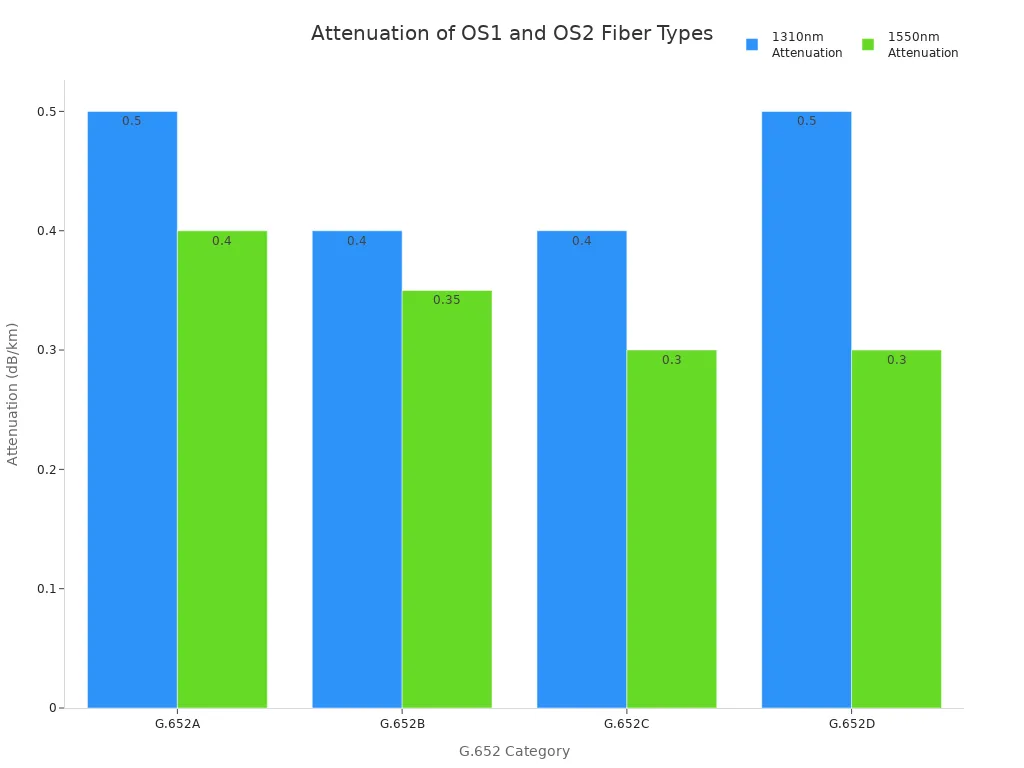
OS2 fiber works better for long links. It loses less signal and can go faster. OS1 is good for short runs inside.
Specialized Types
Some cables are made for very hard places. Submarine cables go under the sea to connect continents. Military cables can handle rough use. Each cable has features for its job.
|
Cable Type |
Water Depth (m) |
Description |
|---|---|---|
|
Submarine Lightweight Fiber Optic Cable (LW) |
1000-8000 |
Used on sandy seabeds, no armor, placed on the surface. |
|
Submarine Lightweight Protective Fiber Optic Cable (LWP) |
1000-8000 |
Metal tape armor for rough seabeds. |
|
Submarine Single Layer Armored Fiber Optic Cable (SA) |
20-1000 |
Single steel wire layer for rocky terrain. |
|
Submarine Double Armored Fiber Optic Cable (DA) |
Shallow waters |
Two or more steel wire layers for rocky geology. |
Tip: If your project faces bad weather, water, or lots of stress, pick a cable with more protection. This helps stop problems and saves money on repairs.
Choosing the Right Type
You need to match the cable to your job. Think about these things:
Distance: OS2 is best for far runs. OS1 is for short, indoor runs.
Bandwidth: OS2 can go faster and is good for upgrades.
Attenuation: Less attenuation means less signal loss.
Cable Construction: Loose-tube is for outside. Tight-buffered is for inside.
Environment: Pick armored or water-safe cables for tough places.
If you want a network that lasts and grows, pick a cable that fits your needs for distance, speed, and strength. This helps you avoid repairs and keeps your network working well. You save money and get a strong connection.
Performance of Single Mode Fiber Cable

Bandwidth and Speed
Your business needs a network that can grow. Single mode fiber cable gives you very fast speeds and lots of bandwidth. It is used by big companies, data centers, and phone companies. This cable can handle the fastest data rates in the world.
|
Bandwidth (Gb/s) |
Application Type |
|---|---|
|
1 |
LAN |
|
10 |
LAN |
|
25 |
LAN |
|
40 |
LAN |
|
50 |
LAN |
|
100 |
LAN |
|
200 |
LAN |
|
400 |
LAN |
|
800 |
LAN |
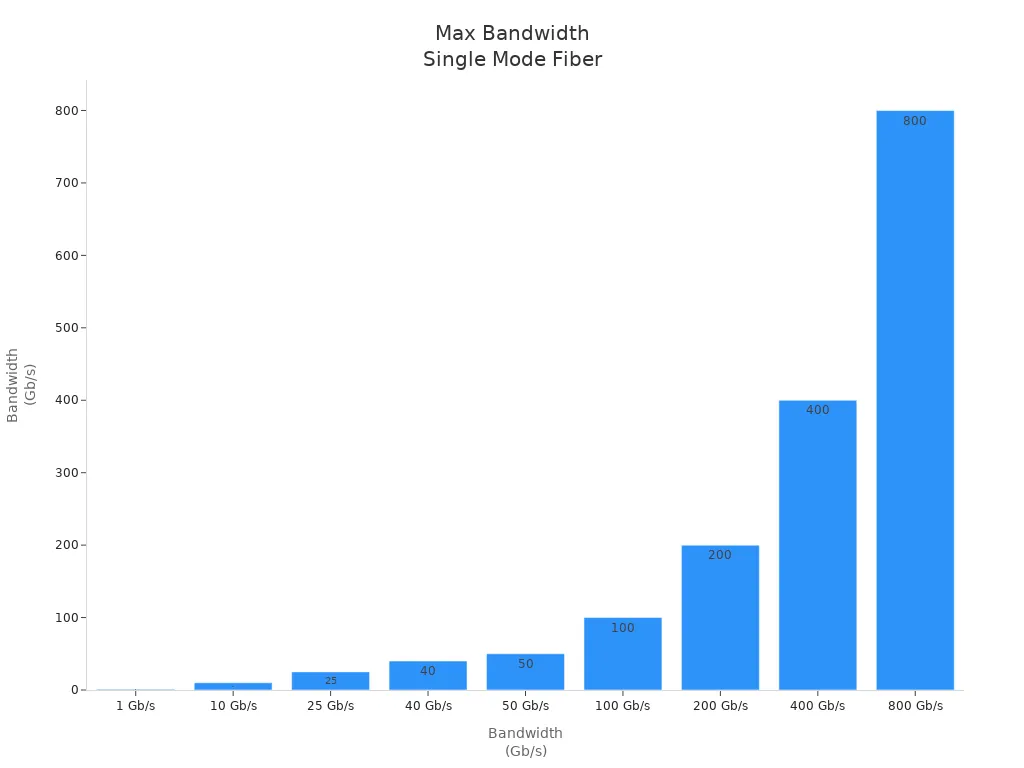
You can get speeds from 1 Gbps to 800 Gbps. The speed depends on your network and equipment. Most networks use 10GbE, 40GbE, or 100GbE. If you use DWDM, you can send many signals at once. Each signal can be 10GbE or 100GbE. This means you can add more data without changing the cable. Your network can grow as your needs change.
Tip: Using single mode fiber cable helps your network get ready for new upgrades and technology.
Attenuation and Distance
Attenuation tells you how much signal is lost as it travels. Less attenuation means your signal stays strong for longer. Single mode fiber cable has very low attenuation, especially at 1310 nm and 1550 nm.
|
Fiber Type |
Wavelength (nm) |
Maximum Attenuation (dB/km) |
|---|---|---|
|
OS1 |
1310 |
1 |
|
OS1 |
1550 |
1 |
|
OS2 |
1310 |
0.4 |
|
OS2 |
1550 |
0.4 |
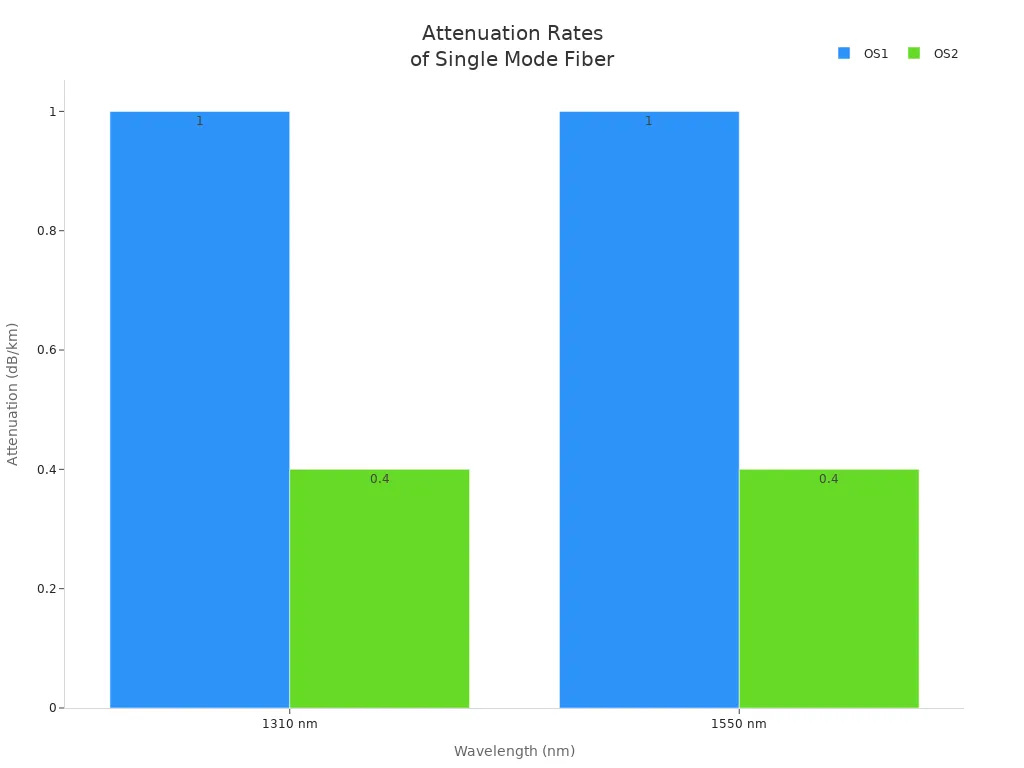
You can use single mode fiber cable for 100 kilometers or more. You do not need to boost the signal for most links. Telecom networks often use cables for 80-100 kilometers without help. Some cables can go 160 kilometers or even more than 200 kilometers. This means you need fewer repeaters and spend less on repairs.
|
Source |
Maximum Distance (km) |
Notes |
|---|---|---|
|
Walsun |
Up to 100 km or more |
General capability of single mode fiber |
|
CP Tech Mall |
80-100 km |
Typical in telecommunications networks |
|
Optcore |
Around 160 km |
Some fibers support over 200 km |
Note: Low attenuation and long distance mean you need fewer devices, have less downtime, and save money on your network.
Performance vs Multimode Fiber
You want a network that works well over any distance. Single mode fiber cable is better than multimode fiber for long and fast links.
|
Feature |
Single Mode Fiber |
Multimode Fiber |
|---|---|---|
|
Bandwidth Capability |
Higher due to no modal dispersion |
Lower due to modal dispersion |
|
Signal Loss |
Minimal, ideal for long distances |
Higher, limiting effectiveness over distance |
|
Core Size |
Small core size |
Larger core size |
|
Distance Capability |
Supports much longer distances |
Best for shorter-distance applications |
Single mode fiber uses a small core and laser light. This gives you very high bandwidth and low signal loss.
Multimode fiber has a bigger core. It loses more signal and cannot go as far.
You can use single mode fiber for city, regional, or even country links. Multimode fiber is best for short runs inside buildings.
Industry Standards: Groups like ITU (G.652, G.657), IEC, and IEEE make rules for single mode fiber cable. These rules make sure cables work safely and with all network gear.
If you want a network that is easy to care for and lasts, single mode fiber cable is the best choice. You will have less downtime, spend less on repairs, and your business can keep growing.
Applications of Single Mode Fiber Cable

Telecommunications
Telecommunications networks help people and businesses talk worldwide. Single Mode Fiber Cable is the main part of these networks. It sends fast data, voice, and video over long distances. Telecom companies pick this cable because signals stay clear and strong. Even when the cable goes across continents, there is little signal loss.
You find single mode fiber in undersea cables and city networks. It is also used in rural broadband projects. The cable follows strict international rules. This means it works well with new equipment. You pay less for repairs and the cable lasts a long time. This lowers downtime and helps you get more value.
Why do telecom companies prefer single mode fiber?

Tip: If you buy single mode fiber, your network stays safe for years. You fix it less often and keep customers happy.
Data Centers
Data centers need strong and fast connections. Single Mode Fiber Cable lets servers and storage share data quickly. It helps with cloud computing and big data work. You can send data over 40 kilometers without losing quality. This is important for linking many data centers.
Here is a table showing single mode fiber benefits for data centers:
|
Advantage |
Description |
|---|---|
|
Bandwidth |
Handles lots of data, good for busy jobs. |
|
Transmission Distance |
Sends data up to 40Gb over long distances with little loss. |
|
Cost Efficiency |
Saves money compared to multimode cables over time. |
You get these benefits:
- Huge bandwidth for cloud and AI work.
- You save money because you need fewer repeaters.
- Upgrading to faster speeds is easy as your business grows.
Note: Single mode fiber helps your network handle more data as time goes on. You avoid slowdowns and keep everything working well.
Industrial and Medical Uses
Factories, labs, and hospitals can be tough places. Single Mode Fiber Cable sends data safely for machines and control systems. It does not get messed up by electrical noise. This makes it great for military and industrial networks.
You use single mode fiber for:
- Factory automation: Connects machines for quick checks.
- Medical imaging: Links devices for fast and clear results.
- Military communications: Gives safe links with no interference.
- Scientific research: Runs tools in hard conditions.
Key benefits for industrial and medical applications:
- It does not get affected by electrical noise or rough places.
- The cable lasts long and needs little fixing.
- Data stays safe and clear for important jobs.
Callout: If you pick single mode fiber, your systems work well even in hard places. You have less downtime and keep important data safe.
Case Studies
Single mode fiber cable works well in big projects. You can see its value in real-life examples. These stories show why companies pick single mode fiber for long-term use.
Howard County Community College Health Science Building
Schools need strong connections for learning. FiberPlus, Inc. put in Corning ClearCurve single mode fiber to make a Passive Optical Network (PON). This network links telecom rooms and classrooms together. Students and staff get fast and steady data. The cabling follows strict rules, so there is less downtime and fewer repairs.
The PON system helps handle lots of data and is ready for upgrades. You spend less on fixing things and your network is ready for new tech.
Howard Community College Campus Backbone
Campuses need smooth data across all buildings. FiberPlus set up two new 24-strand Single Mode Air Blown Fiber Optic backbones. These connect the main frame to the campus data center. You get fast links and little signal loss.
|
Project Feature |
Benefit for Your Business |
|---|---|
|
Air Blown Fiber |
Fast to install, easy to upgrade |
|
24-Strand Backbone |
Good for growth and backup |
|
Structured Cabling |
Reliable and meets standards |
You have less downtime and easier network care. The backbone lets you add new buildings or services without big changes.
These stories show why single mode fiber cable is great for business projects. You get a network that lasts, meets rules, and fits your needs. You save money on repairs and get more value. When you choose single mode fiber, you help your business grow and stay strong.
Selecting Single Mode Fiber Cable
Picking the right Single Mode Fiber Cable is important. It helps your business network work well for a long time. You need a cable that fits what your network needs. It should also fit your budget and follow industry rules. If you choose the right cable now, you will not have to fix it often. This saves you money and keeps your network running.

Key Criteria for B2B Buyers
There are some things you should think about when picking fiber cable. Each thing can change how well your network works. It also affects how easy it is to take care of your network.
|
Criteria |
Description |
|---|---|
|
Optical Fiber Type |
Pick the fiber type that works best for your job. |
|
Distance Requirements |
Make sure the cable can send data as far as you need. |
|
Cable Jacket |
Choose a jacket that keeps out water or chemicals. |
|
Connector Types |
Pick connectors that fit your equipment and are easy to use. |
|
Cost |
Find a good balance between price and quality. |
You should also think about how fast your network needs to be. The cable jacket material is important too. Make sure the connectors work with your gear. Check that the cable can reach everywhere you need. These choices help you build a network that is strong and can grow.
Tip: Always pick cable features that fit your project and future plans.
Cost and ROI
Buying good fiber cable costs more at first. But you save money later because you do not have to fix it much. For example, a factory switched to fiber optic internet. Their workers got 76% more done. They also had 50% less network downtime. This shows that the right cable can help your business.
- Your team can work faster and get more done.
- Less downtime means your business keeps moving.
- Fewer repairs mean you spend less money over time.
If you pick a cable that lasts, you get more value for your money. Your network will stay strong as your business gets bigger.
Supplier and Certification
You should buy cables from suppliers who follow strict rules. Certified cables are safe and work well with your systems. Look for these important certifications:
|
Certification |
Description |
|---|---|
|
IEC 60794 |
Sets rules for cables used inside and outside. |
|
Telcordia GR-20 |
Makes sure cables work well outside for a long time. |
|
ICEA S-87-640 |
Standard for cables used outside for communication. |
|
UL Certification |
Checks that connectors and parts are safe from fire. |
|
RoHS |
Makes sure cables do not have harmful chemicals. |
You should also see if the supplier can deliver fast. It is good if they have many cable types and help after you buy. Tools like OptiFiber Pro OTDR and CertiFiber Pro help you test your network quickly.
Note: Certified cables and good suppliers keep your network safe and lower your risk.
Trends and Innovations
New Technologies
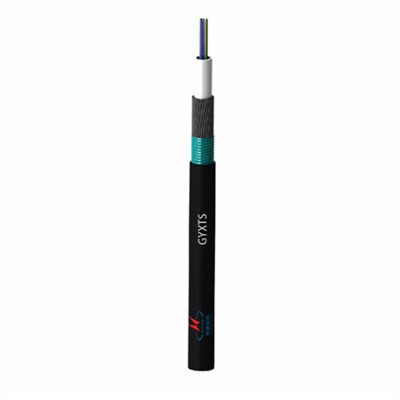
Single mode fiber cable changes fast. Makers use smart materials and new coatings now. These help cables last longer and let you check their health quickly. New designs give faster data speeds and more bandwidth. Eco-friendly ways to make cables help the planet and keep performance high.
|
Advancement Type |
Description |
|---|---|
|
Faster Data Speeds |
People want single mode optical fiber for faster data. |
|
Smart Materials |
New coatings make cables tough and let you watch fiber health. |
|
Sustainability Practices |
Green production keeps cables strong and helps the environment. |
|
Market Growth |
More people use single mode optical fiber as tech and data needs grow. |
These new ideas help your network work better. You fix cables less and can grow your business more. Smart materials help you find problems before they stop your network. Eco-friendly ways show you care about the earth.
Tip: If you buy new single mode fiber cable, your network will last longer and cost less over time.
Market Developments
Single mode fiber cable is getting more popular. More telecom companies and EPCs use fiber optic cables for new jobs. Building more telecommunication networks makes demand go up. 5G networks need strong fiber optic cables for backhaul and fronthaul. Data centers and cloud services also need fast data.
- New fiber optic technology makes networks work better.
- More telecommunication networks mean more single mode fiber cables are needed.
- 5G networks need lots of fiber optic cables.
- Data centers and cloud services need fast data cables.
You might want to know how fast the market grows. The single mode optical fiber market will go from USD 2.9 billion in 2025 to USD 13.0 billion by 2035. The growth rate is 16.2% each year. From 2025 to 2030, the market grows steadily:
- 2025 to 2026: 17.2% more (from USD 2.9 billion to USD 3.4 billion)
- 2026 to 2027: 14.7% more (to USD 3.9 billion)
- 2027 to 2028: 17.9% more (to USD 4.6 billion)
- 2028 to 2029: 15.2% more (to USD 5.3 billion)
- 2029 to 2030: 17.0% more (to USD 6.2 billion)
You see why single mode fiber cable is a good choice. The market grows because people need fast and steady connections. You fix cables less and save money. You also follow rules and get ready for new upgrades.
Note: Learning about new trends and ideas helps you pick the best network. You get ahead and make your money go further.
Single Mode Fiber Cable gives you very fast speeds and is very reliable. It works well almost anywhere and keeps your data safe. You do not need to fix it often.
- You can send lots of data far away.
- The connection stays strong, even in tough places.
- You can make your network bigger as your business grows.
- To get your network ready for the future:
- Look at what you have now.
- Think about what you need and how you want to grow.
- Pick good suppliers and use certified products.
If you test your network often and take care of it, it will work well.
References:
ITU-T G.652, G.657 Standards
IEC 60794, Telcordia GR-20, ICEA S-87-640
Market data: 2025-2035 single mode fiber forecasts
FiberPlus, Inc. project case studies
Industry white papers on fiber optic performance and reliability
FAQ
Why should you choose single mode fiber cable for your business network?
Single mode fiber cable lets your network run fast and far. It does not need much fixing. Your network can grow as your business grows. This cable helps you avoid problems and saves money. You pay once and use it for many years.
Why does single mode fiber cable last longer than other options?
Makers use tough materials and follow strict rules for this cable. It does not break easily from bending or water. It can handle hot and cold places. This means you fix it less and your network lasts longer.
Why do telecom operators prefer single mode fiber cable?
Telecom companies want strong and fast links. Single mode fiber cable works well over long distances. It can carry lots of data at once. It meets world rules and works with many networks. This helps give good service and saves money.
Why is single mode fiber cable considered low maintenance?
You get fewer signal problems with this cable. Its strong build keeps it safe from damage. You do not have to fix it often. This keeps your network working well and saves time.
Why does single mode fiber cable offer better ROI for B2B projects?
You buy the cable once and do not replace it often. It is ready for new tech and upgrades. You have less downtime and spend less on repairs. This helps your business grow and saves money in the long run.
Why is compatibility important when selecting single mode fiber cable?
Your network needs to work with many devices. Single mode fiber cable follows world rules like ITU-T G.652. This makes it easy to add new gear and grow your network.
Why should you consider certified suppliers for single mode fiber cable?
Certified suppliers sell cables that pass tough tests. You get safe and high-quality products. This lowers the chance of problems and keeps your network safe. It also helps you follow the rules.
Why does single mode fiber cable reduce downtime in critical applications?
The cable keeps signals strong over long distances. It does not break or lose signal often. This is important for places like telecom and data centers. Your network stays up and running when it matters most.