

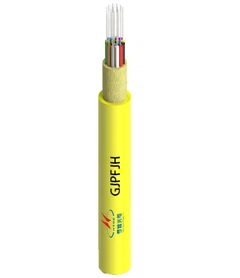


In today's world of explosive data growth, global data generation per second has exceeded 500,000 GB, pushing traditional single-core fiber transmission capacities close to the Shannon limit. Multi-core fiber (MCF), by integrating multiple independent transmission channels within a single fiber, transforms the "single-lane road" into a "three-dimensional cloverleaf interchange," emerging as a key technology to break through capacity bottlenecks. This article unveils the mysteries of this revolutionary technology through three dimensions: technical characteristics, core advantages, and typical application scenarios.
I. Core Features of Multi-Core Fiber
Three-Dimensional Spatial Multiplexing Architecture
Multi-core fibers arrange multiple independent cores (typically 4–19) within a standard cladding diameter of 125 μm. For example, a seven-core fiber adopts a hexagonal close-packed structure, compressing the center-to-center spacing to 30 μm (equivalent to one-third the diameter of a human hair), achieving a 5–10x increase in core density compared to traditional fibers.

Space Division Multiplexing (SDM) Technology
By partitioning transmission channels along the spatial dimension, each core independently carries distinct signals. Combined with mode multiplexing (supporting multiple optical modes per core) and wavelength division multiplexing (C+L band expansion), this creates a "space × mode × wavelength" three-dimensional multiplexing system, theoretically boosting capacity by 100x.
Ultra-Low Crosstalk Design
The trench-assisted structure is employed: annular trenches etched between cores with depths of 2–5 μm and a refractive index lower than the cladding. Coupled with heterogeneous core layouts (varying core diameters/refractive index profiles), this suppresses adjacent core crosstalk to -50 dB/km or lower (equivalent to signal leakage of less than 0.001%).
Intelligent Compatibility
Seamless integration with single-core fiber systems is enabled via fan-in/fan-out (FIFO) devices, achieving efficient coupling between multi-core and single-core fiber arrays with insertion loss controlled below 0.3 dB, ensuring compatibility with existing optical communication equipment.
II. Core Advantages of Multi-Core Fiber
|
Comparison Metric |
Traditional Single-Core Fiber |
Multi-Core Fiber |
Improvement |
|
Transmission Capacity |
40 Tbps per channel |
7 cores × 3 modes × 80 wavelengths = 1.68 Pbps |
42x |
|
Core Utilization |
Single-point transmission |
Spatial parallel transmission |
8x higher area efficiency |
|
System Energy Consumption |
3.5 W per Tbps |
1.2 W per Tbps |
66% reduction |
|
Deployment Cost |
Requires multiple fibers |
Single fiber replaces multiple |
70% cost savings |
Key Technical Advantages:
Breaking the Shannon Limit: Expanding capacity through spatial dimensions, with experimental records reaching 10.66 Pbps (equivalent to transmitting one year's worth of global voice calls in one second).
Space Efficiency: Reduces fiber count in data center racks by 80%, alleviating cabling congestion.
Enhanced Reliability: Inherent channel redundancy from independent multi-core transmission ensures system availability of 99.9999%.
III. Typical Application Scenarios
1. Hyperscale Data Centers
Challenge: AI computing clusters require microsecond-level latency interconnection across tens of thousands of GPUs, with traditional fiber cabling reaching kilometers per rack.
Solution: Seven-core fibers enable all-optical backplane networks, supporting 256 GPUs per fiber. Test results:
Server-to-server latency reduced from 3.5 μs to 0.8 μs
Cable weight decreased by 62%, cooling energy consumption lowered by 45%
Case Study: A global cloud provider deployed MCF in its Tokyo data center, accelerating AI model training by 4.3x.
2. Transoceanic Submarine Cable Systems
Value Proposition: Single MCF cables replace traditional multi-fiber bundles, enhancing reliability and reducing deployment costs.
Innovations:
Hengtong Fiber's double-armored seven-core submarine cable withstands tensile forces up to 100 kN and operates reliably at 8,000-meter depths for 25 years.
Integrated distributed fiber sensing monitors seabed earthquakes (0.1 με precision) and temperature fluctuations (±0.05°C).
Commercial Deployment: The Asia-America next-gen submarine system uses MCF, achieving 800 Tbps per fiber bandwidth with 35% lower construction costs.
3. 6G Mobile Fronthaul Networks
6G Requirements: Terahertz (0.1–10 THz) base station densities will reach 10–100 per km², demanding ultra-high-capacity fronthaul.
Solutions:
Hollow-core MCF: Achieves 0.2 dB/m ultra-low loss in THz bands.
Orbital Angular Momentum (OAM) multiplexing: Enables 12 OAM modes per core, boosting spectral efficiency to 256 bit/s/Hz.
Field Tests: In Purple Mountain Laboratory's 6G trial network, MCF successfully carried 1 Tbps wireless signal transmission with a bit error rate below 1E-15.
4. Quantum Communication Backbone Networks
Unique Advantage: MCF independently isolates quantum and classical channels, solving co-fiber interference challenges.
Performance:
Quantum bit error rate (QBER) <0.6%
Key generation rate increased to 15 kbps@500 km
National Project: China's "Beijing-Shanghai Quantum Network" upgrade reduced relay nodes by 40% and improved key distribution efficiency by 300% using MCF.
IV. Future Outlook: From "Multi-Core" to "Intelligent Core"
With advancements in 3D photonic integration and AI-empowered optical networks, MCF is evolving toward:
Multi-Dimensional Multiplexing: Combining OAM and polarization states with existing 7-core designs to target 100 Pbps per fiber.
Self-Sensing Networks: Embedded fiber sensors for real-time stress, temperature, and deformation monitoring, creating "transmission + sensing" smart infrastructure.
Green Energy Breakthroughs: Leveraging MCF's density to achieve 1 Tbps/W energy efficiency, supporting carbon neutrality goals.
Conclusion: Redefining the Dimensions of Optical Communication
Multi-core fiber represents not just a technological breakthrough but a paradigm shift in harnessing spatial dimensions. From seabeds to cloud infrastructures, and from classical to quantum communications, MCF is redefining the physical boundaries of optical networks. With China leading in international standards (11 ITU/IEC standards) and core technologies (e.g., 30 μm core spacing control), MCF will underpin next-gen infrastructure for 6G, the metaverse, and computing networks. In this journey to "expand capacity through space," every fiber is weaving a more interconnected, three-dimensional digital future.
References
ITU-T G.654.3: Multi-core optical fibre characteristics
Hengtong Fiber. Space Division Multiplexing Technology White Paper, 2023.
Nature Photonics. "10.66 Pb/s transmission using multi-core fiber", 2022.