

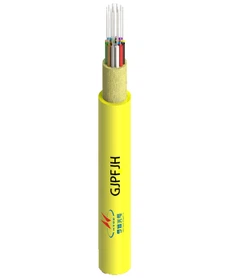



When to Use Indoor Fiber Optical Cable?
We pulled Corning 024EU4-31131-A3 cable (24-fiber OM4 tight-buffered, OFNP rated) through a Morris County data center last September. Three days into termination work, the fire marshal walked in and asked to see the plenum rating certificate. Contractor had it, no problem. But the guy in the next bay over? He'd run what looked like the same yellow cable - turned out to be outdoor-rated OSP. Inspector red-tagged the whole installation.
That's a $28,000 mistake right there. Outdoor cable in a plenum space fails NEC 770.113, and there's no waiver. You pull it all out and start over.
Indoor fiber isn't about being physically "inside" - it's about meeting building codes for fire and smoke. I'm going to walk through what I actually spec for different jobs, what it costs (real numbers from my last six projects), and where you can't use indoor-rated cable even if it's technically indoors.
What OFNP/OFNR/OFNG Actually Means
The fire ratings are what matter for code compliance. OFNP passes UL 910 steiner tunnel test - that's for plenum spaces where your HVAC return air flows. Most commercial buildings built after '95 or so have plenum ceilings, so you're looking at OFNP most of the time.
I use CommScope 760196943 (12-fiber OM4 OFNP distribution) for typical office jobs. Graybar had it at $1.63/foot last month on a 2000-foot reel. That same cable in OFNR rating would run about $1.28/foot, but here's the thing - nine times out of ten, the architect isn't 100% sure if a space is plenum or not until the mechanical drawings are final. I just default to OFNP and don't think about it.
OFNR is for vertical riser shafts between floors. UL 1666 test spec. Honestly? I almost never specify OFNR anymore. The cost delta is maybe $0.35/foot, and if you accidentally run OFNR in a plenum space, you're doing a re-pull. Not worth the risk.
OFNG is general-purpose, lowest fire rating. You'll see it in some residential work or areas definitively not in air handling. I did a warehouse job in Edison two years ago where we used Belden 10GXS12 OFNG cable (12-fiber OM3) because the entire building was concrete and steel - no plenum anywhere. Cost was $0.89/foot from Anixter. Saved about $8,000 on cable cost for that project.
The LSZH (low smoke zero halogen) version adds cost - I've seen anywhere from $0.18 to $0.55 more per foot depending on fiber count. We did a hospital wing addition where spec required LSZH on everything. That was Panduit cable, I forget the exact part number, but it was around $2.10/foot for 24-fiber OM4 OFNP LSZH versus $1.73/foot for the standard PVC jacket version. Client paid for it because it was in the spec.

OM3, OM4, or Single-Mode?
For a standard office building backbone, I default to OM4 multimode. Corning ClearCurve OM4 50/125µm is what I've been using lately - part number varies by fiber count but it's the bend-insensitive stuff. Costs about 40% more than standard OM4 but worth it when you're snaking cable through tight J-hook runs.
OM4 gives you 400 meters at 10Gb/s, which covers any reasonable building. We did a 6-story in Princeton, longest run was maybe 310 feet from basement MDF to 6th floor IDF. OM4 worked fine. If I'd used OM3 (300m max at 10Gb), I'd have been cutting it close with slack and routing.
The jump to OM5 doesn't make sense for most commercial buildings. I spec'd it once for a pharma lab that wanted to future-proof for short-wave wavelength division multiplexing. That was $2.47/foot for CommScope 24-fiber versus $1.68/foot for OM4. They had budget for it, so why not. But typical office building? No point.
Single-mode (OS2 9/125µm) is for longer distances or if you're planning for 100Gb+ in the future. I use it on campus backbone runs between buildings - that's outdoor cable territory, different discussion - but also for any intra-building run over 400 meters. Did a warehouse distribution facility in Cranbury, building was 880 feet long. Ran Corning SMF-28 Ultra single-mode, indoor OFNP rated. Think it was around $1.18/foot for 12-fiber.
The LC transceivers for single-mode are more expensive though. 10GBASE-LR modules run $180-$280 each versus $45-$75 for 10GBASE-SR multimode. For that warehouse job, we spent an extra $3,200 on transceivers but saved having to put an intermediate IDF in the middle of the building. Total cost worked out better with single-mode.
Distribution vs. Breakout vs. Pre-Term - What I Actually Use
Tight-buffered distribution cable is my default for building backbones. Each fiber has a 900µm buffer coating, and they're all bundled under one outer jacket. You terminate individual fibers in a patch panel or splice enclosure.
For a 4-floor office building last year, we pulled two runs of CommScope 760196943 (12-fiber OM4 OFNP) from the basement to each floor. Cost was $1.63/foot, call it $2,100 for cable to wire four floors with 200 feet of vertical rise plus routing slack. Field-terminated with LC connectors in wall-mount enclosures - those ran about $215 each for a 12-port unit from Corning.
Bend radius on standard distribution cable is 10x the outer diameter during pulling, 5x for static installation. That 12-fiber CommScope cable is about 9.4mm OD, so you need 94mm (3.7 inches) during the pull and 47mm (1.85 inches) once it's secured. We've had fibers crack when installers made tight 90-degree bends around j-hooks. OTDR showed it as a spike around 0.8-1.2dB loss at the bend location.
Breakout cable is easier to route to individual locations but costs more. Each fiber is in its own sub-jacket, so you can peel them apart. I used Panduit FX9ERLNSNSNM024 (12-fiber OM4 breakout, OFNP) on a lab renovation where we needed to fan out fibers to equipment racks in different rows. That cable was $2.67/foot from Graybar last March. For the same 200-foot run, I would've spent $534 versus $326 for distribution cable - $208 difference per run.
Pre-terminated trunk cables eliminate field termination labor but you need to know exact lengths. We used a bunch of these on a data center buildout - Belden FX Brilliance trunks with MTP connectors on each end. Those were 24-fiber OM4, varying lengths from 15 feet to 85 feet. The 85-foot assemblies cost around $847 each.
Here's where pre-term makes sense: if your labor rate for field termination is high (union labor in Manhattan can be $125/hr loaded rate), and you have predictable point-to-point distances. We saved about $11,000 in labor on that data center by using pre-term, but we spent $8,500 more on cable. Still came out $2,500 ahead.
If you're doing building backbone with uncertain routing or future flexibility needs, stick with distribution cable and field termination. You can't just cut down a pre-term assembly if your measurements were off.

Data Center Racks - Where Most of My Fiber Goes
Last project was a colo expansion in Piscataway, 40 racks in two rows. Customer wanted 10Gb connectivity between all racks and dual connections to core switches at the end of each row.
We ran Corning 024EU4-31131-A3 (24-fiber OM4 OFNP distribution cable) in overhead cable tray. From each rack top to the cable tray was about 8 feet, then longest run rack-to-rack was maybe 65 feet. Call it 75-80 feet total per connection with routing slack.
Used LC duplex connectors, field-terminated with fusion splicing to Corning UniCam pigtails. Each splice runs about $22 in labor from our termination subcontractor, or I could've had them do mechanical splices at $11 each, but fusion gives you better loss numbers (0.08dB average versus 0.3-0.5dB for mechanical).
Total insertion loss rack-to-rack was testing at 0.25-0.35dB including two connector pairs and 75 feet of cable. That's well under the 1.5dB Cisco budget for 10GBASE-SR.
The ClearCurve OM4 was necessary because cable routing at the top of racks is tight. We had some 2-inch radius bends going through horizontal cable managers. Standard OM4 would probably show loss there, but ClearCurve is spec'd down to 7.5mm radius. Cost premium was about $0.62/foot over standard OM4 - that adds up (we used about 4,200 feet total), but client didn't want to take chances with loss issues.
Could we have used OM3? Technically yes, 10GBASE-SR is rated for 300m on OM3. But OM4 costs maybe $0.11 more per foot and gives you 400m distance capability. No-brainer for me.
Office Building Backbone - When Fiber Actually Makes Sense
I did a 6-story law firm office in Morristown, two IDF closets per floor, basement MDF. Total of 13 locations to cable (12 IDFs + MDF). Architect wanted redundant paths, so we ran two separate 24-fiber OM4 cables from MDF to each IDF.
Cable was CommScope 760197146 (24-fiber OM4 OFNP, standard OM4 not bend-insensitive). Anixter pricing at the time was $2.07/foot on a 3,000-foot reel. Longest run was basement to 6th floor - about 290 feet of conduit path. We used almost all 3,000 feet by the time you account for slack and routing.
Each IDF got a Corning CCH-CP03 splice enclosure ($187 each from Graybar) and we spliced to LC pigtails. Termination crew charged $21 per splice, so that's $21 x 48 splices x 12 locations = $12,096 just in splice labor. Plus another $8,400 for materials (pigtails, splice enclosures, patch panels).
Total fiber infrastructure cost:
Cable: 3,000 ft @ $2.07/ft = $6,210
Termination labor: $12,096
Materials/hardware: $8,400
Pull labor/installation: $6,800
Testing/documentation: $2,100
Total: $35,606
Compare that to copper Cat6A backbone with same layout: would've been around $18,500 all-in. So why did client pay the premium for fiber?
Two reasons: (1) They wanted 10Gb backbone capacity right away for heavy CAD file transfers, and (2) 25-year lifecycle cost. Fiber doesn't degrade like copper. You pull it once and forget about it. Copper has crosstalk and impedance issues that can develop over time, especially with multiple re-terminations.
Was it necessary? Probably not for 90% of their users. But the engineering department moves 15-20GB CAD files daily, and they didn't want bottlenecks. When you're billing $450/hr, waiting on file transfers is expensive.
Manufacturing Floor - Where Indoor Cable Gets Questionable
Pharmaceutical plant in Somerset County, they needed fiber between clean room and equipment room. Clean room is climate controlled, but the cable route went through a mechanical chase above production that hits 95-105°F in summer (even though it's "indoors").
First installation used standard CommScope indoor OFNP cable. Worked fine for about 14 months. Then started getting link flaps on three of the fibers during hot days. OTDR showed elevated loss at a spot where cable was zip-tied to a j-hook in the hot chase - turned out the PVC jacket was getting soft enough that slight movement was causing micro-bends.
Re-pulled with Corning indoor/outdoor rated cable (TeraSPEED A/I, can't remember exact part number). Indoor/outdoor stuff is rated to 80°C operating temp and has stiffer jacket. Been solid for 2+ years since. Cable cost about $0.41/foot more, so that re-pull cost client around $1,850 in cable plus $4,200 in labor to re-pull 280 feet through ceiling.
Lesson: if your cable route goes through any space that might exceed 70°C, even if it's technically "indoors," use indoor/outdoor rated cable. The cost delta isn't worth the risk of having to re-pull later.
Connectors - LC, SC, or MTP?
I use LC connectors for 95% of installations now. They're small (1.25mm ferrule), widely supported, and every switch manufacturer has LC ports. Corning UniCam LC connectors run about $11.50 each for the connector body plus pigtail. You need two per circuit (duplex), so $23 per link for connector materials.
SC connectors (2.5mm ferrule) were standard 10-15 years ago. Still see them in telco applications and some legacy installs. I'll use SC if customer already has SC patch panels and wants to match existing infrastructure. But for new work? LC all the way. SC connectors cost about the same ($10-$13 each), but they're bulkier and you can't fit as many in a patch panel.
MTP/MPO connectors are for high-density data center work - 12 or 24 fibers in a single connector. We used Corning MTP connectors on that colo expansion, part number... I'd have to look it up, but they were around $78 each for 12-fiber male connectors. MTP-to-MTP trunk cables connect to cassettes that break out to LC patch cords.
The thing with MTP is you need to get polarity right. There's Method A, B, and C for how fibers map through the connection. I always use Method B (straight-through) with Type B cassettes because it's simplest. Screw up polarity and half your links won't work - I've seen that happen twice on subcontractor work. Not fun to troubleshoot.
For field termination, I have three options:
Fusion splicing to pigtails - This is what I do for permanent building backbones. Fusion splicer costs around $15,000-$18,000 for a decent Fujikura unit (our company owns two), or you hire a termination subcontractor at $20-$25 per splice. Loss is typically 0.05-0.12dB per splice. Takes about 4-5 minutes per splice including cleaving and testing.
Mechanical splicing - Cheaper in labor ($10-$15 per splice) but higher loss (0.3-0.5dB). I use this for temp installations or when cost is tight. 3M Fibrlok connectors are common. Loss variability is the problem - sometimes you get 0.3dB, sometimes 0.6dB. If you're close on your loss budget, fusion is safer.
Field-installable connectors - These are snap-on connectors like Corning UniCam or Panduit OptiCam. No splicing, you strip the fiber and insert it into the connector. Takes about 10-12 minutes per connector once you get the hang of it. Loss is typically 0.3-0.6dB.
I used UniCams on a school district project where we needed to terminate in multiple IDF closets and didn't want to drag a fusion splicer around to 8 different buildings. UniCam connectors were about $17.50 each from Graybar. Labor to install was maybe $18-$22 per connector (our technician rate). Tested OK - most were in the 0.35-0.45dB range for insertion loss.
The trade-off: field-installable saves on equipment cost and is faster for small jobs, but fusion splicing gives you lower, more consistent loss. For anything permanent or loss-critical, I fusion splice. For temp or quick additions, field-installable is fine.
Testing - Don't Skip This Part
Every installation gets tested. I use a Fluke OptiFiber Pro OTDR for anything over 100 feet, and a basic light source/power meter (LSPM) set for shorter runs.
The OTDR cost us around $12,500 used from eBay (new ones are $18,000-$22,000). It shows you exactly where problems are - bad splice at 47 meters, micro-bend at 153 meters, whatever. The OTDR sends a pulse down the fiber and measures reflections to build a trace showing loss at every point.
For that law firm job, we found three fibers showing elevated loss - 0.78dB, 0.92dB, and 1.1dB when budget was 0.5dB max. OTDR traces showed the problem was right at a fusion splice location in one of the 3rd floor IDF enclosures. Opened it up, re-spliced those three fibers, loss dropped to 0.11dB, 0.14dB, and 0.09dB. Ten minutes of work saved a potential problem down the road.
Basic acceptance testing with LSPM just tells you total insertion loss end-to-end. We use a Fluke SimpliFiber Pro for this - cost was maybe $1,800. It's quick (2 minutes per fiber pair), but if you fail, you don't know where the problem is. Still better than nothing.
Test limits I use:
Multimode OM4: 0.50dB maximum for up to 300 feet including two connector pairs
Single-mode OS2: 0.75dB maximum for up to 1000 feet including two connector pairs
These are more conservative than TIA-568 allows (which is 0.75dB for MM and 1.0dB for SM), but I'd rather have margin.
Common Problems I've Found During Testing
Dirty connectors - This is 70% of high-loss failures. Fiber end-face looks fine to the naked eye but under inspection scope you see dust, oils, or scratches. Clean with 99% IPA and lint-free wipes. We use Sticklers fiber optic cleaning pads, about $24 for a pack of 50.
Never blow on a fiber. Your breath has moisture and oils. I caught a tech doing this once - had to re-clean all his terminations.
Bend radius violations - Found this on a subcontractor's work in Trenton. They'd pulled cable around a 1-inch radius corner at a cable tray turn. OTDR showed 1.4dB spike at that location. Had to re-route the cable with a larger radius. The cable jacket wasn't even showing damage, but the fiber inside was stressed.
Bad fusion splice - Happens maybe 1 in 50 splices with our equipment/technician skill level. Usually shows as 0.4-0.8dB loss versus normal 0.08-0.15dB. Re-cleave and re-splice fixes it.
One time we had a whole batch of bad splices - like 8 out of 12 on one cable termination. Turned out the cleaver blade was dull. Replaced blade, re-did all the splices, problem solved. That's why you test everything.
Polarity reversal - More common with MTP cables. Fibers are swapped somewhere so transmit on one end connects to transmit on the other end (should be transmit-to-receive). Link won't come up. You either swap fibers in the patch cord or re-terminate one end depending on where the problem is.
When You Can't Use Indoor Cable (Even If It's Inside)
Underground conduit between buildings - Even if the conduit is "sealed," don't use indoor cable. We learned this one the expensive way on a community college campus in 2018. Ran CommScope indoor OM4 through PVC conduit between two buildings, about 180 feet. Contractor swore the conduit was watertight.
Eighteen months later, moisture got in. Indoor cable jacket doesn't have water-blocking gel like outdoor cable does. Jacket swelled, aramid strength members degraded, and eventually the jacket split. Had to pull it all out and replace with Corning outdoor cable. Cost to re-pull that 180 feet: $8,900 including new cable and labor.
Now if it's between buildings and goes underground, it gets outdoor cable. Period. Doesn't matter what the contractor says about the conduit.
Hot spaces over 70°C - Already mentioned the pharma plant, but this one bites people regularly. "Indoor" cable is typically rated 0°C to 70°C. Above that, PVC jackets get soft and you risk micro-bending or jacket deformation.
Check the full cable route, not just the endpoint. A cable going from an air-conditioned server room to another air-conditioned office might route through an attic or mechanical chase that hits 90-110°F in summer.
Areas with chemical exposure - Depends on the chemical, but standard PVC and LSZH jackets aren't resistant to a lot of industrial solvents. We did a petrochemical facility where they wanted fiber in their process monitoring building. That building had occasional hydrocarbon vapor from the process areas.
We ended up speccing industrial-grade cable with chemical-resistant jacket - I think it was AFL HyperScale with a TPU (thermoplastic polyurethane) jacket. Cost about $2.85/foot for 12-fiber versus $1.63/foot for standard indoor cable. But it's rated for gasoline, diesel, hydraulic oil exposure. That client didn't want to take chances.
Cost Reality Check - Recent Project Numbers
These are real numbers from my last three projects (Q2-Q4 2024), New Jersey/Pennsylvania area:
Small office - 3 floors, 6 IDF locations
Cable: 1,200 ft CommScope 12-fiber OM4 OFNP @ $1.63/ft = $1,956
LC pigtails and connectors: 144 terminations @ $11.50 = $1,656
Splice enclosures and patch panels: $960
Pull labor: 2 days @ $950/day = $1,900
Fusion splice labor: 144 splices @ $22 = $3,168
Testing/documentation: $850
Total: $10,490
That's for the fiber infrastructure only. Doesn't include switches, patch cords, or horizontal copper cabling to desks.
Medium office - 6 floors, 12 IDF locations, redundant backbone
Cable: 3,800 ft CommScope 24-fiber OM4 OFNP @ $2.07/ft = $7,866
LC pigtails and connectors: 576 terminations @ $11.50 = $6,624
Splice enclosures and hardware: $2,880
Pull labor: 6 days @ $1,150/day = $6,900
Fusion splice labor: 576 splices @ $21 = $12,096
Testing/documentation: $2,450
Fire stopping: $1,180
Total: $39,996
Labor rates here are for our crew (non-union, Central NJ). Union labor in New York metro area runs 40-60% higher.
Data center - 40 racks
Cable: 4,200 ft Corning ClearCurve OM4 OFNP @ $2.29/ft = $9,618
Pre-term MTP trunk assemblies: $14,200
LC pigtails and cassettes: $8,340
Cable management: $3,650
Installation labor: 8 days @ $1,280/day = $10,240
Testing/documentation: $3,180
Total: $49,228
Add 15-20% contingency because there's always something - extra cable needed for routing issues, additional fire stopping, whatever.
Buying and Working With Distributors
I buy most cable through Graybar or Anixter because they stock it locally and I can pick up same-day if needed. Pricing is usually within 5-8% of each other. For big jobs (5,000+ feet), I'll sometimes go direct to CommScope or Corning and save 10-15%, but then you're waiting 3-4 weeks for manufacturing lead time.
Don't buy cable from Amazon or random online sellers unless you're 100% sure it's genuine and has proper fire ratings. I've heard stories about counterfeit "plenum" cable that's actually OFNG with fake markings. If the fire marshal catches that, you're pulling everything out. Not worth saving $200.
Pre-terminated assemblies I usually buy from L-com or Fiber Instrument Sales. They custom-make to your spec'd length. Costs more than field termination if you have the equipment, but turnaround is quick (1-2 weeks) and quality is consistent.
For termination labor, I either use our in-house crew or subcontract to a local termination specialist. Subcontract rates around here (Central NJ) are $20-$25 per fusion splice, $18-$22 per field-installable connector. Union labor in NYC metro area can be $40-$50 per splice.
What I'd Recommend for Most Buildings
If you're planning fiber for a standard office building:
Go with OM4 multimode for backbone unless you have runs over 400m. Cost difference from OM3 is negligible and OM5 is overkill for most applications.
Use OFNP rating even if you think you don't need it. The $0.30-$0.40/foot premium is insurance against having to re-pull if spaces get reclassified.
Field-terminate with fusion splicing for permanent installations. Yes it requires equipment investment or subcontractor, but you get better loss numbers and more reliability.
Plan for 50% spare capacity in fiber count. If you think you need 12 strands, pull 24. You can't easily add fiber later without disrupting operations.
Test everything before you button it up. OTDR for runs over 100 feet, LSPM at minimum for shorter runs. Finding a bad splice during testing costs 10 minutes. Finding it six months later during production costs hours of troubleshooting.
I'm not trying to sell you on fiber if copper works fine for your application. Plenty of buildings run perfectly well on Cat6A backbone and never need fiber. But if you're going to do fiber, do it right the first time. The cost to fix it later is always 3-5x the cost to do it correctly from the start.
Pricing and product info based on projects in New Jersey/Pennsylvania area, late 2024. Your market may differ. Verify all cable fire ratings with manufacturer data sheets and local code authority before purchase.