

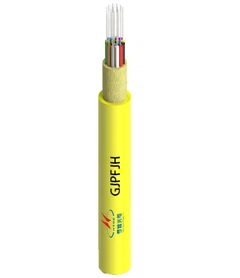


FTTH drop cable looks like the simplest part of a fiber network. It is thin, lightweight, and easy to overlook next to backbone cables, distribution cables, and patch cord assemblies. Yet in real deployments, this small cable is responsible for a large share of installation complaints and after-sales tickets.
The reason is its position. The drop cable is the last-mile link between the access network and the subscriber, so it is bent around corners, pulled through conduits, fixed along walls, and stripped by hand at the termination point. When the cable structure does not match the route, the consequences rarely appear on day one. They surface weeks or months later as signal instability, cable breakage, slow termination, sheath cracking, or repeat site visits.
Choosing the right cable is therefore not a price decision. It is a matching exercise between cable construction and the actual installation environment. This guide walks through fiber type, strength member, sheath, form factor, route-based selection, common sourcing mistakes, and what to confirm before placing a bulk order.
What Is FTTH Drop Cable?
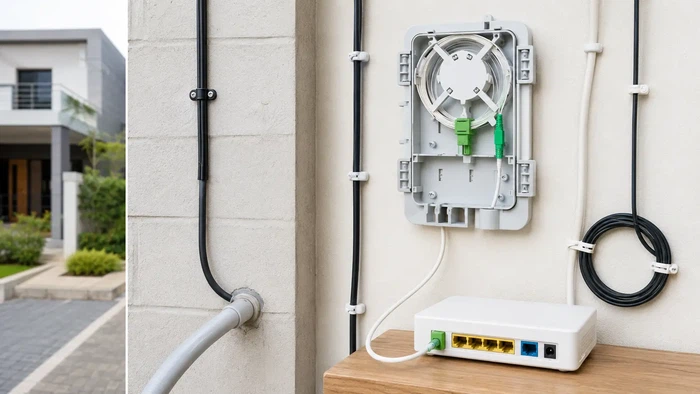
FTTH drop cable is the fiber optic cable used in the final section of a fiber-to-the-home network. It connects a distribution point, terminal box, or optical distribution network (ODN) to the subscriber side - a home, apartment, office, or ONT/ONU terminal. Our own FTTH drop cable range, for example, covers indoor, outdoor, aerial, and duct variants for exactly these scenarios.
Typical uses include indoor wall and conduit routing, outdoor building entry, aerial pole-to-house drops, and short fiber extensions from a terminal box. Although it represents a small fraction of total network length, the drop cable directly shapes installation speed, bending behaviour, long-term durability, and the experience the subscriber actually sees.
Why FTTH Drop Cable Causes So Many Project Complaints
Most drop cable complaints trace back to a single root cause: the cable construction does not fit the route it was installed on. Two cables can look identical on a quotation sheet while differing in fiber grade, strength member, sheath compound, and production consistency.
The problems installers and operators report most often are fiber breakage during pulling or tight bending, an attenuation increase after bending through cramped routing, sheath cracking after months of outdoor exposure, inconsistent stripping during field termination, weak wall fixing, and indoor cable failing once it is exposed to UV and weather. None of these is visible from the cable's appearance, which is why "drop cable is basically all the same" is a costly assumption for any sourcing team.
Are All FTTH Drop Cables the Same?
No. The meaningful differences sit below the surface: fiber type, strength member, cable form factor, sheath material, flame-retardant rating, UV resistance, mechanical protection, and intended indoor or outdoor use. Each of these changes how the cable behaves during installation and how stable it stays after deployment.
For a buyer, the useful question is not only "what is the price per metre?" but "will this construction reduce installation problems and after-sales risk on this specific route?" The sections below break down each decision factor.
Fiber Type: G657A1 vs G657A2 in FTTH Drop Cable
Fiber grade is the single most important choice, because drop cables are routed through corners, wall edges, and narrow indoor pathways where the bend radius is hard to control. For this reason, FTTH drop cables almost always use bend-insensitive single-mode fiber rather than standard G652.D.
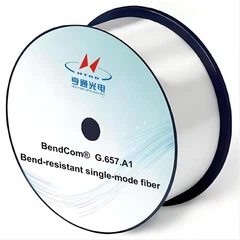
Both common options sit inside the same standard family. According to the ITU-T G.657 classification for bend-insensitive single-mode fibre and cable, Category A fibres remain compatible with existing G652.D networks, with A2 specified for tighter bending performance than A1. In practice that means G657A1 handles general routes with a controlled bend radius, while G657A2 fiber tolerates smaller bend radii with lower bending loss.
The selection logic is straightforward:
- Use G657A1 when the route is simple, the bend radius can be maintained, installation conditions are controlled, and cost control is a priority on a large volume.
- Use G657A2 for apartment corridors, door-frame routing, wall-corner fixing, and ONT-side indoor runs - situations where installers working at speed may not always hold an ideal bend radius. The extra bending margin reduces field-induced attenuation and the follow-up complaints that come with it.
The point is to match fiber grade to the bending conditions of the route, not to the lowest fiber price.

Strength Member: FRP or Steel Wire?
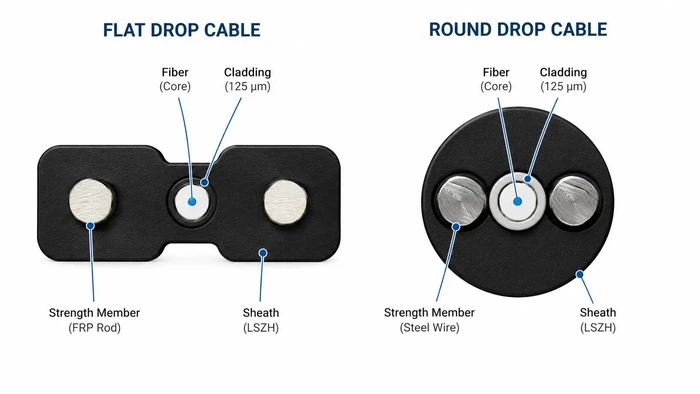
The strength member carries the tensile load during pulling and fixing so the fiber itself is not stressed. FTTH drop cables typically use either FRP (fiberglass-reinforced plastic) or steel wire.
| Strength member | Main advantage | Best suited for | Limitation to weigh |
|---|---|---|---|
| FRP | Lightweight, fully non-metallic, corrosion-resistant | Indoor routing, general FTTH installation, sites that require a non-metallic cable near power or for lightning safety | Lower tensile capacity than steel in comparable structures |
| Steel wire | Higher tensile strength and crush resistance | Outdoor and aerial drops, longer spans, routes needing stronger mechanical protection | Heavier, stiffer, metallic - not ideal where a dielectric cable is required |
For aerial pole-to-house runs the decision goes beyond "steel is stronger." Span length, installation tension, and whether the cable is genuinely self-supporting all matter. A purpose-built self-supporting butterfly drop cable with an integrated messenger is engineered for that tension, whereas a plain steel-wire drop is not automatically suited to every aerial span.
How Sheath Material Affects FTTH Drop Cable Durability
The sheath looks like a plain plastic jacket, but it governs both stripping behaviour at termination and survivability over the cable's life. Poor sheath consistency makes stripping unstable during field termination, which increases labour time and the risk of nicking the fiber coating - a defect that may pass initial testing and fail later.
The right compound depends on the environment:
- Indoor routes usually call for a flexible jacket and, in buildings where fire codes apply, a flame-retardant or low-smoke zero-halogen (LSZH) jacket material. Where flame propagation is a concern, buyers can ask whether the jacket is verified against IEC 60332 flame-propagation testing rather than relying on a generic "flame-retardant" label.
- Outdoor routes need a UV-stabilized PE sheath that resists sunlight, moisture, and temperature cycling. A black jacket is not proof of outdoor rating; UV stabilization and the specific compound are what determine whether the cable survives years of exposure.
A cheaper sheath lowers the unit price but tends to raise installation time and maintenance cost, so it is best evaluated against the full project rather than the cable line item alone.
Indoor vs Outdoor FTTH Drop Cable: Can One Type Cover Both?
Using one cable for everything is tempting but rarely ideal, because indoor and outdoor cables are optimized for opposite priorities.
| Item | Indoor drop cable | Outdoor drop cable |
|---|---|---|
| Main priority | Flexibility, easy routing, flame-retardant performance | UV resistance, tensile strength, weather durability |
| Typical route | Indoor walls, conduits, apartments, terminal-to-ONT | External wall, aerial span, building entry, exposed runs |
| Sheath focus | LSZH or flame-retardant compound | UV-stabilized PE |
| Risk if misused | May degrade under outdoor UV and moisture | Often too stiff or over-specified for tight indoor work |
Where a single run crosses from outside into the home, a true indoor-outdoor cable designed for that transition is the cleaner answer than forcing an indoor cable outdoors or an outdoor cable indoors.
Flat Drop Cable vs Round Drop Cable: Which Fits Your Route?
There is no universally "better" form factor; each suits a different fixing method.
| Cable type | Best for | Main advantage | Limitation to weigh |
|---|---|---|---|
| Flat (butterfly) drop cable | Wall fixing, residential subscriber connection, indoor/outdoor facade routing | Easy to clip along walls, clear cable orientation, fast to manage | Less uniform all-around protection under some crush conditions |
| Round drop cable | Duct pulling, routes needing more mechanical protection | Balanced all-around protection, better suited to pulling through ducts | Less convenient for flat wall fixing |
Flat drop cable dominates residential FTTH because it is simple for installers to fix and route. When a run goes into a duct or needs stronger circumferential protection, a round indoor-outdoor drop cable is usually the more reliable choice. Match the form factor to the fixing method, not to habit.
Choosing FTTH Drop Cable by Installation Route
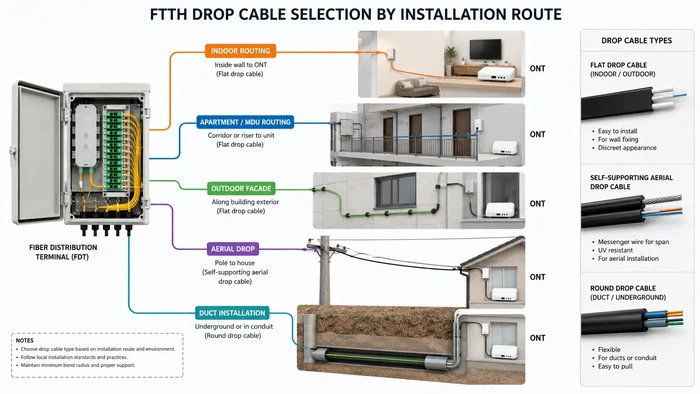
Last-mile routing is where selection becomes concrete. The same project can contain several route types, each pointing to a different construction:
| Installation route | Key stress | Recommended construction |
|---|---|---|
| Terminal box to ONT (indoor) | Tight bends, frequent handling | Flat cable, G657A2 fiber, flexible LSZH jacket |
| Apartment corridor / MDU riser fixing | Corners, door frames, fast deployment | G657A2 fiber, stable sheath, easy stripping |
| External wall / facade routing | UV, moisture, temperature cycling | UV-stabilized PE sheath, FRP or steel member |
| Aerial pole-to-house drop | Span tension, wind load | Self-supporting cable with messenger, steel member |
| Duct installation | Pulling tension, abrasion | Round drop cable with good crush resistance |
| Bulk installer stock | Mixed routes | Balanced flat cable, common fiber grade, consistent production |
How to Choose the Right FTTH Drop Cable: A Decision Checklist
Before requesting a quotation, confirm the real installation conditions, then work down this list:
- Environment - indoor, outdoor, or transition? This drives sheath compound first.
- Bending - tight corners or complex indoor paths point to G657A2.
- Strength member - FRP for lightweight non-metallic runs; steel for aerial and high-tension routes.
- Sheath - LSZH or flame-retardant indoors; UV-stabilized PE outdoors.
- Form factor - flat for wall fixing, round for ducts and stronger protection.
- Fiber count and dimension - 1, 2, or 4 core, sized to match clips, terminal boxes, and connectors.
- Installation convenience - stripping, bending, and fixing all affect labour cost, not just material cost.
- Total cost - weigh rework, complaints, and maintenance against unit price across the whole project.
Common Mistakes When Buying FTTH Drop Cable
Most sourcing problems are predictable. The recurring ones are choosing on unit price alone, ignoring the bend-radius demands of the actual route, using indoor cable outdoors, assuming any black jacket is UV-rated, skipping a stripping test on a sample, and leaving the strength-member requirement undefined so the supplier picks the cheapest option. Each of these saves money on the quotation and loses it during installation.
Why the Cheapest Drop Cable Often Costs More
Large-volume procurement must control cost, but the lowest unit price frequently moves the cost downstream. Lower-grade compounds, weaker strength members, and looser production tolerances tend to produce more breakage during pulling, slower stripping, higher attenuation after bending, shorter outdoor service life, and more replacement visits. A cable that is a few cents cheaper per metre is not necessarily cheaper at the project level. The better test is whether the cable reduces installation risk, failure rate, and long-term maintenance - if it does not, the lowest price is not the best price.
What to Confirm Before a Bulk Order
Clear specifications prevent the most expensive misunderstandings - the ones discovered after a container arrives. Before committing to volume, confirm the datasheet (fiber type, fiber count, form factor, strength member, sheath compound, cable dimension, tensile load, minimum bend radius, packing length, and print marking) and then validate it on a sample.
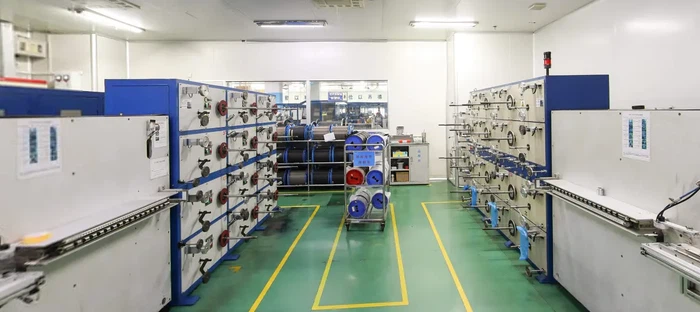
A practical pre-order sample check covers stripping consistency, bending behaviour at the specified radius, tensile handling, cable-diameter uniformity, and sheath surface and print quality. Reviewing the supplier's cable testing process and asking for the test report - not only a certificate number - closes the gap between the quoted spec and the delivered product. If the project terminates at the subscriber side, decide early whether a field-spliced cable or a pre-terminated (pre-connectorized) drop cable fits your deployment speed and skill mix.
FAQ
Q: What Is FTTH Drop Cable Used For?
A: It provides the last-mile connection between the fiber access network and the subscriber, linking distribution points, terminal boxes, or ODN equipment to homes, apartments, offices, and ONT/ONU devices.
Q: Is G657A2 Better Than G657A1 For FTTH Drop Cable?
A: G657A2 tolerates tighter bend radii with lower bending loss, which helps on complex indoor and corridor routing. G657A1 is sufficient for simpler routes where the bend radius is controlled. Both belong to the ITU-T G.657 Category A family and are compatible with G652.D networks.
Q: Can Indoor Drop Cable Be Used Outdoors?
A: Not unless it is specifically rated for outdoor exposure. A standard indoor jacket is not built to withstand UV, moisture, and temperature cycling over time. For mixed runs, use an indoor-outdoor cable designed for the transition.
Q: What Sheath Material Is Best For Outdoor FTTH Drop Cable?
A: A UV-stabilized PE sheath. Confirm the UV rating explicitly rather than assuming a black jacket is weatherproof.
Q: Should I Choose An FRP Or Steel Strength Member?
A: Choose FRP for lightweight, non-metallic, flexible indoor runs. Choose steel wire when higher tensile strength or stronger mechanical protection is needed, such as outdoor and aerial drops - while also checking span length and self-supporting design for aerial use.
Q: What Fiber Counts Are Common For FTTH Drop Cable?
A: 1, 2, and 4 core are the usual options, with customization available. Match the count and cable dimension to the terminal box, clips, and connector type.
Q: What Is The Minimum Bend Radius For FTTH Drop Cable?
A: It depends on the fiber grade and cable construction, so confirm it on the datasheet. Bend-insensitive G657 fiber is specified precisely for routes where small radii are unavoidable.
Q: Can FTTH Drop Cable Be Pre-Terminated?
A: Yes. Pre-connectorized drop cables and drop patch cords reduce field splicing and speed up deployment, which is useful where skilled splicing labour is limited.
Final Thoughts
The drop cable is the smallest cable in an FTTH network and one of the most visible parts of the subscriber experience. A sound choice matches the route's bending demands, tensile load, sheath environment, and the installer's workflow - not just the price. Specify it against the real installation route, validate a sample before bulk, and the same cable that once generated complaints becomes the part of the network nobody has to think about.
If you are scoping cable for indoor routing, outdoor deployment, aerial drops, or bulk installer stock, aligning the construction with each route is the difference between a smooth rollout and a stream of return visits - the same principle that guides large-scale FTTH project deployment.