





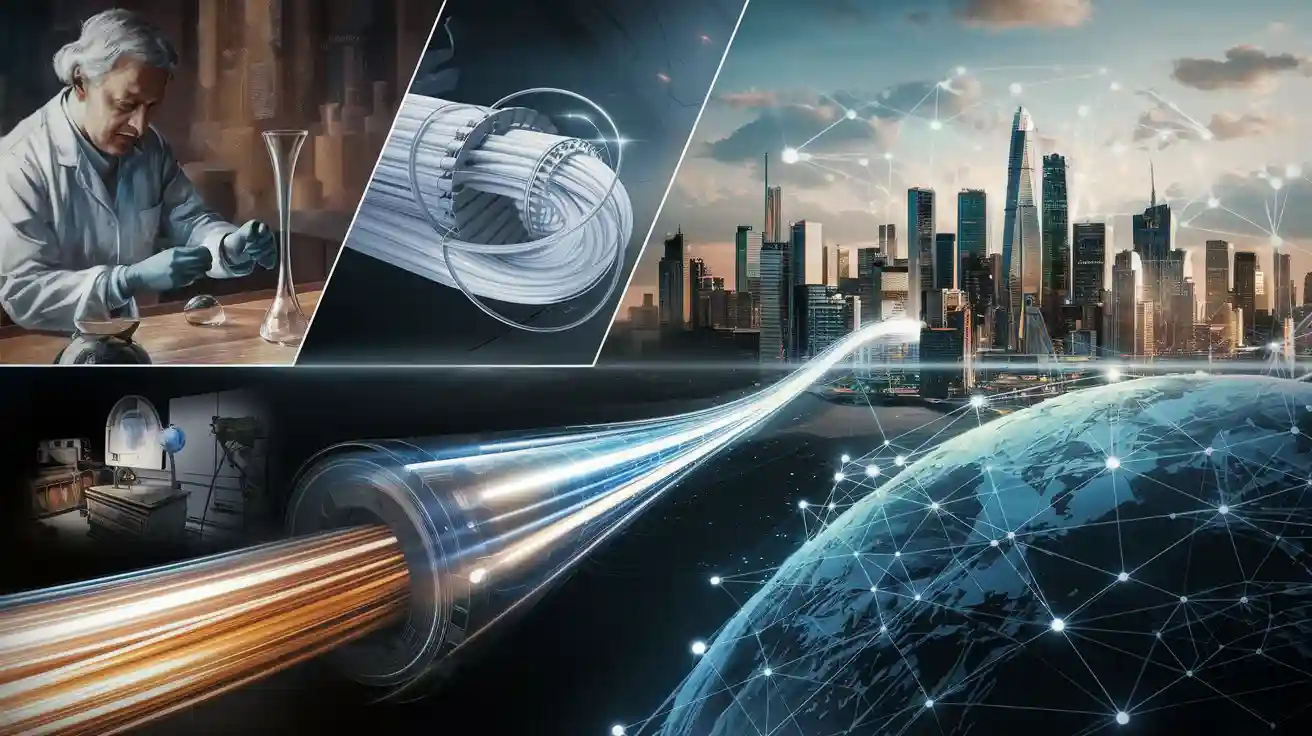
You live in a world where optical fiber helps your internet work fast and well. It also helps your phone calls and your digital life every day. The History of Optical Fiber Communication shows how smart ideas changed simple light. These changes made light the main part of modern connections.
Imagine this journey through time:
- In 1880, Alexander Graham Bell made the Photophone.
- By 1948, Claude Shannon showed how far communication could go.
- In 1966, Charles Kao proved glass could send signals across cities.
- In 1987, David Payne's team made optical fiber amplifiers.
- By 1996, wavelength-division multiplexing helped global data traffic grow fast.
- In 2019, engineers reached record-breaking bandwidth.
|
Statistic Description |
Value |
Year |
|---|---|---|
|
Global fiber optic components market growth |
USD 22.43 billion to USD 45.80 billion |
2022 to 2030 |
|
Investment in telecommunications infrastructure |
Big |
N/A |
|
Impact on internet speed and reliability |
Very good |
N/A |
Key Takeaways
- Optical fiber communication started with tests using light and glass. These tests led to inventions like the photophone by Alexander Graham Bell in 1880.
- Important changes, like low-loss fiber and laser technology, made fast internet possible. Data can now travel far with little signal loss.
- Fiber optic cables took the place of copper wires. They have more bandwidth, are more reliable, and cost less to maintain. This makes them very important for communication today.
- The world market for optical fiber is growing fast. More people want high-speed internet. New technology like 5G and IoT also helps this growth.
- Learning about the history of optical fiber shows us how it changed communication. It also helps us think about new ideas for technology in the future.
History of Optical Fiber Communication

Early Concepts
The history of optical fiber communication started with early light and glass experiments. Long ago, people learned that glass could bend and reflect light. Some old glass pieces worked almost as well as gold mirrors. These finds show that ancient people tried to use glass for moving light. In the 1790s, the Chappe brothers in France made the first optical telegraph. They built towers with lights to send secret messages far away. This system did not use glass fibers, but it was the first time light helped people talk over long distances.
By the late 1800s, inventors tried to guide light through solid things. In 1880, Alexander Graham Bell made the photophone. This device sent sound using a beam of light. It showed that light could help people talk to each other. In 1895, Henry Saint-Rene made bent glass rods to move pictures. This was an early step toward television. These ideas helped start the history of optical fiber communication.
|
Year |
Event Description |
|---|---|
|
1790s |
Chappe brothers invent the optical telegraph using light signals. |
|
1880 |
Bell patents the photophone, an optical telephone system. |
|
1895 |
Saint-Rene designs bent glass rods for guiding light images. |
|
1930 |
Heinrich Lamm transmits an image through a bundle of optical fibers. |
Medical and Scientific Uses
Optical fiber communication grew quickly in medicine. In 1888, doctors in Vienna used bent glass rods to shine light inside the body during surgery. This let doctors see inside without making big cuts. By the early 1900s, scientists put clear fibers together to send pictures. In 1930, Heinrich Lamm sent a picture through a bundle of glass fibers. He wanted to make medical pictures better.
Medical researchers kept making the technology better. In 1952, Professor Harold H. Hopkins started working on fiber optic endoscopes. By 1957, Basil Hirschowitz and his team tested the first one at the University of Michigan. These endoscopes let doctors see clear pictures inside the body. This made surgeries safer and more exact. Sending clear pictures through thin, bendy fibers changed medicine and science.
Note: Fiber-optic endoscopes made surgeries less invasive. You heal faster and get better answers from doctors because of this.
|
Application Type |
Description |
|---|---|
|
Minimally Invasive Surgeries |
Fiber-optic endoscopes allow doctors to see inside the body with minimal disruption. |
|
Medical Imaging |
High-resolution images transmitted through optical fibers improve diagnostics and surgery. |
Key Inventors
A few important inventors helped the history of optical fiber communication grow. Heinrich Lamm, a German medical student, was first to send a picture through glass fibers in 1930. He wanted to use this for medical pictures. The Chappe brothers made the first optical telegraph in the 1790s. They helped start using light to send messages.
In the mid-1900s, Narinder Singh Kapany showed how to send light through glass fibers. He also made up the name "fiber optics." Charles Kao, called the "father of fiber optics," proved that very pure glass could send light far with little loss. His work made modern optical fiber communication possible. Robert Maurer, Donald Keck, and Peter Schultz at Corning Glass Works made the first low-loss optical fiber in 1970. Their work let signals travel farther without getting weak, so global networks could work.
|
Inventor |
Contribution |
|---|---|
|
Heinrich Lamm |
First to transmit images through fiber bundles for medical use. |
|
Chappe brothers |
Invented the optical telegraph, using light for long-distance communication. |
|
Narinder Singh Kapany |
Demonstrated light transmission through glass fibers; coined "fiber optics." |
|
Charles Kao |
Proved high-purity glass fibers could carry signals over long distances. |
|
Maurer, Keck, and Schultz |
Developed the first low-loss optical fiber, enabling practical communication networks. |
Each new idea built on the last one. The history of optical fiber communication shows how simple tests led to the networks you use today. Each inventor added something special and helped the technology grow step by step.
Breakthroughs in Optical Fiber

Low-Loss Fiber
You get fast internet because scientists fixed light loss. Early fibers lost a lot of light. This made sending signals far away very hard. Charles Kao learned that pure glass could carry signals far. His idea was a big change. At Corning Glass Works, Robert Maurer and William Shaver worked on this idea. They tried to make glass lose less light. Maurer knew about low-temperature physics. He learned how light moved inside glass. The Corning team made a new process called flame hydrolysis. This process made germanium-doped fibers. These fibers lost less than 20 decibels per kilometer. Now, data can travel across cities and oceans.
|
Technology |
Light Loss (dB/km) |
Year Introduced |
|---|---|---|
|
Early Glass Fiber |
>1,000 |
1960s |
|
Germanium-Doped Fiber |
<20 |
1970 |
|
Modern Optical Fiber |
<0.2 |
2020s |
Laser Transmission
Lasers help you talk and use the internet fast. Before lasers, light sources were not strong or fast. Lasers gave people better control over signals. They helped send more data with fewer mistakes. Fiber optics and lasers work together in modern networks. You now have systems that move information quickly and clearly. Lasers also made it easier to read signals. This made every message better.
- Lasers give better control and help find signals.
- New fiber-optic systems can carry more data far away.
- Communication is now faster and more reliable.
Scientific Advances
Every time you use the internet, you see science at work. Engineers made vertical-cavity surface-emitting lasers, or VCSELs, with quantum dots. These lasers work at 1,550 nanometers. This is the best wavelength for sending data far. Scientists used new ways to grow crystals and balance strain. These methods made lasers work better. They also made tunnel junctions to help light get out. These changes made fiber optics useful for everyone.
Quantum dot VCSELs made optical fiber communication much better. This new laser works at 1,550 nanometers. That is important for sending data far in telecommunications. Quantum dots make lasers more efficient and use less power. This makes fiber optic systems easier for everyone to use.
Now, you get faster speeds, lower costs, and better service. Fiber optics went from a lab idea to something you use every day.
Commercialization and Adoption

First Commercial Systems
The first big test of fiber optic cables happened in 1977. AT&T put a 2.4-kilometer cable in Chicago. This cable could carry almost six hundred phone calls at once. People got clearer calls and fewer dropped calls. In 1983, Bell Laboratories did even more. They sent six thousand calls through a 161-kilometer cable. These early cables changed how people talked to each other. The industry started using less copper wire. People got more bandwidth and paid less money.
- AT&T started the first fiber optic cables in Chicago in 1977.
- Bell Laboratories sent six thousand calls over 161 kilometers in 1983.
- Fiber optic cables took the place of copper, giving better speed and reliability.
Global Expansion
Fiber optic cables spread fast around the world. Now, homes, schools, and businesses have high-speed internet. The market for optical communication systems was $15.53 billion in 2024. Experts think it will grow to $29.52 billion by 2032. The fiber optics market will go from $3.2 billion in 2024 to $6.8 billion by 2029. People use this technology when they stream videos or join online classes.
Major regions lead the way in using fiber optic cables:
|
Region |
Key Highlights |
|---|---|
|
North America |
U.S. has 87.4% of the market; government helps bring fiber to rural areas. |
|
Asia Pacific |
Japan covers over 90% of homes; smart cities and IoT need more fiber optic cables. |
|
China |
Big spending on 5G and digital projects; fiber optic cables grow in cities and countryside. |
|
South Korea |
Very fast internet; government helps more people get fiber optic cables. |
You can find fiber optic cables in data centers, cities, and country areas. This technology gives people high bandwidth and strong connections.
|
Region |
Key Statistics |
|---|---|
|
North America |
Over 1.35 million miles of fiber optic cables; 870 data centers use strong networks. |
|
Europe |
325,000 km of new fiber optic cables; 430 cities ready for 5G with fiber optic cables. |
|
Asia-Pacific |
98% of homes in South Korea have fiber; 760,000 new 5G towers in China use fiber optic cables. |
|
Middle East |
UAE covers 95% of homes; Saudi Arabia adds 44,000 km of fiber optic cables. |
|
Africa |
19% more undersea cable landings, with 10 new fiber optic cables in 2023. |
Competing Technologies
Some people wondered if fiber optic cables were better than other choices. Fixed wireless was cheaper at first, but fiber optic cables were better in the long run. Fiber optic cables do not need much fixing and last a long time. People get faster speeds, more bandwidth, and better service.
|
Factor |
Optical Fiber |
Fixed Wireless |
|---|---|---|
|
Initial Capital Costs |
Higher because of building costs |
Lower, mostly for equipment |
|
Ongoing Operational Costs |
Lower, not much replacement needed |
Higher, needs more replacement |
|
Total Cost of Ownership (30 years) |
About the same |
About the same |
|
Long-term Value |
Better because it can grow |
Needs more upgrades |
People pick fiber optic cables for the best speed and bandwidth. Fiber optic cables send more data than copper or wireless. They have low delay, can go far, and do not get interference. Fiber optic cables also save energy and space in data centers.
- Best speed and bandwidth
- Very reliable and low delay
- Can send data far
- Not bothered by interference
- Saves energy and space
Phone companies spent money on fiber optic cables to build the world's internet. Now, people use fiber optic cables for streaming, gaming, and cloud computing. Fiber optic cables are the top choice because they give high bandwidth and support your digital life.
Optical Fiber in Modern Networks

Internet Backbone
You use the internet every day, but you might not know that fiber optic cables are the main part of the world's internet. These cables run under the ocean and connect different continents. Almost all internet traffic between countries travels through these cables. They help the biggest phone and internet networks work well. Fiber optic networks move huge amounts of data with almost no signal loss. This is why your internet is fast and reliable. Schools, businesses, and governments need this technology to keep everything online.
- Fiber optics are the base for internet connections everywhere.
- Undersea cables carry almost all the world's internet data.
- Companies and schools use fiber to make their networks ready for the future.
Data Centers
Data centers help run your favorite websites and apps. Fiber optic cables let these places move data super fast. You get quick information because fiber connects all the computers and devices inside. This makes everything faster and more dependable for everyone.
- Fiber makes connections stronger and more reliable.
- Fiber optic cables send data much faster than copper.
- High bandwidth lets data move quickly with little delay.
- Fiber links join data centers together and connect them to the cloud.
|
Medium |
Projected Cost per Mbps by 2026 |
|---|---|
|
Fiber Broadband |
$9 |
|
Fixed Wireless |
$21 |
|
LEO Satellite |
$33 |
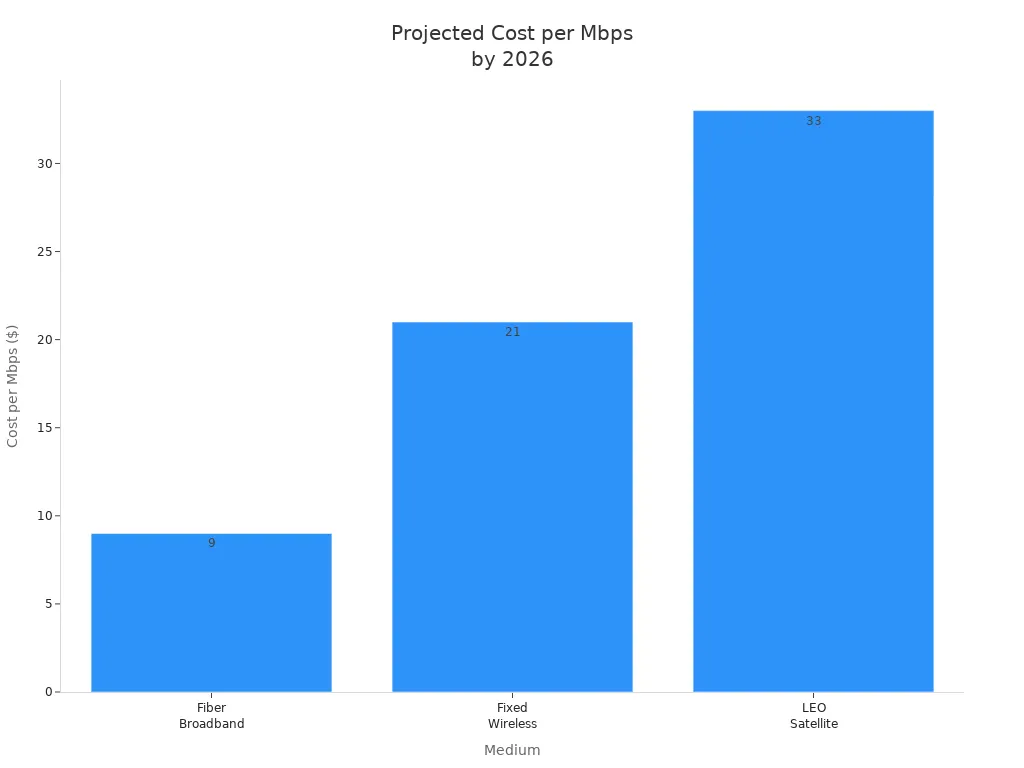
Fiber optic cables give you the same fast speed for uploads and downloads. They do not get much interference and have a delay of less than 5 milliseconds. Over time, fiber costs less to run, so it is the best choice for data centers.
Everyday Impact
You see the good things about fiber optic cables every day. Fast internet lets you watch movies in HD, join video calls, and play games online without problems. Doctors use fiber to talk to you with video visits. Working from home is easier because fiber gives homes and offices fast, steady internet.
- Fiber to the Home (FTTH) brings fast internet right to you.
- You use IP telephone and IPTV services that run on fiber.
- Fiber helps with cloud syncing, video calls, and online classes.
Note: Fiber optic cables give you faster internet, better connections, and more ways to stay in touch with others.
Future Trends

Emerging Technologies
New technology will change how we talk and share data. These changes will give you faster and safer connections. People want more bandwidth for things like streaming and gaming. We need better ways to send lots of data. Some new ideas are making this possible:
- New materials, like special plastics and nanomaterials, make cables stronger and signals clearer.
- Photonic integration puts many optical parts on one chip. This makes networks faster and safer.
- Quantum communication uses new ways to keep your data safe.
- IoT integration lets fiber connect billions of devices. This helps smart homes and smart cities work better.
- 5G networks use fiber optic cables for very fast and low-delay service.
- These changes will help more people get high bandwidth in more places.
|
Year |
Market Value (USD Billion) |
CAGR (%) |
|---|---|---|
|
2024 |
8.57 |
N/A |
|
2025 |
9.07 |
N/A |
|
2030 |
11.96 |
5.71 |
The market for new telecom solutions keeps getting bigger. This shows how much people need fast and reliable connections.
Challenges Ahead
There are some problems as networks get bigger. It is hard to keep up with all the new data. You need to find ways to handle more traffic and new uses. Here are the main problems you might see:
|
Challenge |
Description |
|---|---|
|
Increasing bandwidth demands |
More data means we need better ways to send it. |
|
Cost-effective deployment |
We must find ways to bring fiber to more places without spending too much. |
|
Network security |
We need strong security to stop hackers and keep data safe. |
|
Compatibility and standardization |
All the parts of the network must work together. |
|
Maintenance and upgrades |
We have to fix problems and make networks better over time. |
You need to solve these problems to keep networks strong. Fast internet is not enough. Security, cost, and reliability matter too.
Importance of History
Learning about the past helps you understand new technology. The story of optical fiber shows why new ideas are important. Each big step changed how people connect. Knowing this helps you make good choices about what to build next. When you know what happened before, you can plan for a better future.
Remember: The history of telecommunications helps you make smart choices. It shows you how to use new technology and build strong networks.
You have learned how optical fiber changed your connections. This technology began with simple ideas. Now, it gives you fast and reliable communication everywhere. You use these improvements every day. When you know this history, you see why new ideas are important. You can thank the inventors who made your digital life possible. You can also look forward to more progress in the future.
FAQ
Why do you need optical fiber for modern communication?
You need optical fiber because it sends data much faster than copper wires. Fiber optic cables use light to move information. This gives you high bandwidth and low signal loss. It helps your internet, phone, and streaming work well.
Why does optical fiber provide better internet speed?
Optical fiber uses light to send signals. Light moves very fast and does not get weak over long distances. You get faster speeds and better connections than with old technology.
Why did optical fiber replace copper cables in many networks?
Fiber replaced copper because it gives more bandwidth and less interference. Fiber optic cables last longer and need less fixing. They help homes and businesses handle more data.
Why is optical fiber important for future technologies?
You need optical fiber for things like 5G, smart cities, and cloud computing. Fiber lets you move data quickly and connect many devices. It helps you use new services and ideas.
Why is optical fiber considered secure for data transmission?
Optical fiber is hard to tap without someone noticing. Light signals do not leak out easily. This keeps your data safe for banks, hospitals, and government networks.