





G652D, G657A1, and G657A2 are the three most commonly deployed single-mode fibers today. They share the same 9/125 μm physical dimensions, but their bending performance is very different. That difference determines where each one belongs in your network.
Comparison at a Glance
| Parameter | G652D | G657A1 | G657A2 |
|---|---|---|---|
| ITU-T Standard | G.652.D | G.657.A1 | G.657.A2 |
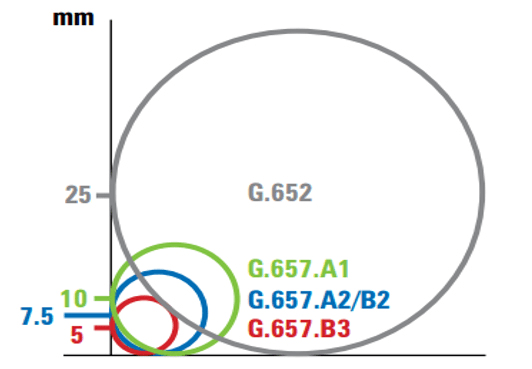
| Minimum Bend Radius | 30 mm | 10 mm | 7.5 mm |
| Macrobend Loss at 1550 nm (10 mm radius, 1 turn) | ≤ 0.5 dB | ≤ 0.75 dB | ≤ 0.1 dB |
| Attenuation at 1310 nm | ≤ 0.35 dB/km | ≤ 0.35 dB/km | ≤ 0.35 dB/km |
| Attenuation at 1550 nm | ≤ 0.21 dB/km | ≤ 0.21 dB/km | ≤ 0.21 dB/km |
| Compatible with G652D? | - | Yes, fully | Yes, fully |
| Relative Cost | Lowest | Moderate | Higher (typically 15–30% above G652D) |
All three fibers share the same mode field diameter (8.6–9.5 μm at 1310 nm) and core/cladding geometry, which is why they splice to each other without any special handling. The real differentiator is bend performance.
G652D: The Standard Fiber for Long-Distance Networks
G652D has served as the industry's workhorse single-mode fiber for more than three decades. It still dominates trunk-line and metro installations globally, and for good reason: low attenuation over distance, predictable splicing behavior, and full backward compatibility with all earlier G.652 fiber. If nobody specifies a fiber type on a long-haul project, G652D is almost always what gets pulled.
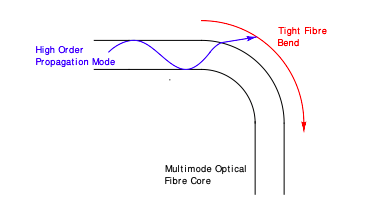
Where it runs into trouble is bending. The minimum bend radius sits at 30 mm, roughly the diameter of a tennis ball. On a straight duct run or an outdoor aerial span, that is never an issue. Route it through a compact wall-mount enclosure or around the corner of a patch panel, though, and signal loss starts climbing. Each tight turn becomes a leak point where light escapes the core.
For projects where the cable path stays relatively straight, G652D remains the most cost-effective, most widely available option on the market. It is not going away. But it was never built for the tight quarters of indoor cabling, and that gap is exactly what the G657 family was designed to fill.
G657A1: Bend-Insensitive, Backward-Compatible
Usually at the building entry point, cables start navigating risers, turning corners in hallways, and passing through smaller enclosures. G657A1 was designed for this transition zone.
The minimum bend radius drops to 10 mm, which is enough to wrap the fiber around a standard pencil without exceeding loss limits. For most building-entry scenarios, standard wall-mount boxes, and typical fiber distribution hubs, that clearance handles the job. G657A1 is also the standard fiber inside many PLC splitter modules, so if your network uses passive optical splitters, you are likely already running A1 fiber at some point in the chain.
At 10 mm radius, macrobend loss at 1550 nm can still reach 0.75 dB per turn. For a route with just one or two moderate bends, that is acceptable. But when cables have to pass through multiple tight corners inside small distribution boxes, behind wall plates, or within high-density fiber trays, the loss stacks up. That is where G657A2's advantage comes into play.
G657A2: The Current Standard for FTTH and High-Density Deployment
G.657.A2 fiber is engineered for applications where cabling must perform reliably in confined or complex routing environments, such as home broadband networks, server facilities, and other space-limited deployments. With improved flexibility and reduced signal degradation under sharp bends, it outperforms conventional single-mode options like G.657.A1 and G.652.D in demanding installation conditions. At the same time, it preserves interoperability with G.652.D infrastructure and enables stable, efficient data transmission for network speeds from 1G through 400G.
The numbers make the gap with G657A1 hard to ignore. At 1550 nm with a 10 mm bend radius and a single turn, G657A2 allows a maximum loss of 0.1 dB. G657A1 at the same radius allows 0.75 dB. And G657A2 pushes the minimum bend radius further down to 7.5 mm, opening up routing options that simply are not possible with A1.
What is FTTH?
FTTH is a broadband access solution that connects homes through optical fiber instead of conventional copper-based last-mile lines. By bringing fiber directly to residential users, it enables more stable network performance and much higher data capacity. This technology also supports balanced upstream and downstream speeds, making it ideal for bandwidth-intensive activities such as ultra-HD streaming, online gaming, video conferencing, and connected home systems. In a typical FTTH drop cable path, the fiber enters a building, routes up a riser, turns into a hallway, passes through a wall-mount box, then runs along the baseboard to reach the optical network terminal. That route can easily include five or more bends tighter than 15 mm. With G657A1, each bend chips away at the link budget. With G657A2, the cumulative loss from all those bends may still stay under 0.5 dB.
How to Choose?
Attenuation per kilometer, chromatic dispersion, PMD: all essentially identical across these three fibers. The only real variable is how tight your bends are.
| Your Project Scenario | Recommended Fiber | Why |
|---|---|---|
| Long-haul backbone or metro trunk | G652D | No tight bends. Lowest cost, proven over decades. |
| FTTH distribution network (feeder and distribution segments) | G652D or G657A1 | Moderate bending at splice closures. G657A1 adds margin for tighter spots. |
| FTTH drop cable (building entry to subscriber) | G657A2 | Multiple tight bends through risers, hallways, and wall plates. |
| Data center patch cords and high-density patching | G657A2 | Dense trays and small-radius panel guides. Prevents cumulative bend loss. |
| Micro cable / air-blown fiber in narrow ducts | G657A2 | Small duct diameter forces tight curves that match A2's 7.5 mm radius. |
FAQ
Q: Can I Mix G652D, G657A1, And G657A2 On The Same Link?
A: Yes. All three share the same core/cladding geometry and compatible mode field diameters, so you can fusion-splice any combination with a standard single-mode splicer. Typical splice loss stays under 0.05 dB. In practice, plenty of FTTH networks run G652D on the trunk, G657A1 on the distribution segment, and G657A2 on the drop, all spliced together on one continuous path.
Q: G657A1 Or G657A2 For FTTH?
A: For drop cables, G657A2. The indoor cable path almost always hits multiple tight bends where A2's lower macrobend loss keeps the link budget healthy. G657A1 works for the outdoor distribution portion where bends are gentler. Some operators have standardized on A2 for the entire access network just to keep one fiber type in stock.
Q: Is G652D Being Phased Out?
A: No. It is still the best choice for long-haul and metro trunk routes where bending is not a factor.
Q: How Much More Does G657A2 Cost?
A: Roughly 15–30% above G652D, depending on manufacturer and order volume. On FTTH and indoor jobs, reduced rework and fewer bend-related failures tend to make up the difference.