







When fire breaks out in a subway tunnel, a data hall, or a high-rise riser, two things determine whether the network keeps working long enough to evacuate people and coordinate response: how quickly the cable feeds the flame, and how long the fiber path stays optically intact. These are different problems, and they map to different cable classes - flame-retardant and fire-resistant - with different standards, materials, and construction.
This guide explains how flame-retardant optical cables are specified, where the line sits between flame-retardant and fire-resistant designs, which test standards actually matter, and how Hengtong builds its fire-rated optical cable range around four verifiable properties - flame retardancy, low smoke, halogen-free behaviour, and fire resistance - for tunnels, data centers, underground utility galleries, and industrial sites.
What Is a Flame-Retardant Optical Cable?
A flame-retardant optical cable is a fiber cable engineered so that, if ignited, it self-extinguishes once the external flame source is removed and does not propagate fire along its length. The flame retardancy comes from two design choices: a sheath compound formulated with flame-suppressing additives (commonly aluminium or magnesium hydroxide), and a cable architecture - sheath thickness, mica or glass tape layers, water-blocking elements - that limits oxygen access to combustible materials.
Flame retardancy does not mean the cable keeps transmitting during a fire. That is a separate property called fire resistance, defined by a different family of standards, and it requires extra construction such as a mica-glass tape layer around the fibers or buffer tubes.
Flame-Retardant vs. Fire-Resistant Optical Cable: Two Different Goals
The terms are often used interchangeably in product literature, but they describe two different fire-safety goals.
- Flame-retardant (FR / FRT) cables are designed to slow flame spread along the cable run, reducing the chance that the cable itself becomes a fire propagation path. They are tested under standards such as IEC 60332-1-2 (single vertical cable) and IEC 60332-3 (bunched cables on a vertical ladder).
- Fire-resistant optical cables are designed to maintain optical transmission for a defined period while exposed to direct flame - typically used for fire alarm rings, emergency communications, tunnel SCADA, and circuit integrity in life-safety systems. They are tested to IEC 60331-25 for optical fibre circuit integrity, with more demanding profiles available under BS 6387 categories C, W and Z.
A single cable can carry both properties. Hengtong's premium tunnel-grade specifications combine IEC 60332-3 flame-spread compliance, IEC 60331-25 circuit integrity, and BS 6387 CWZ - together with LSZH materials for smoke and acid-gas behaviour. For deciding which property a given application actually requires, our reference on when to specify fire-resistant cables walks through the engineering logic.
Why LSZH Sheaths Matter in Confined Spaces
In a tunnel fire or a data center incident, occupants are far more often harmed by smoke and toxic combustion products than by the flames themselves. Halogenated polymers - historically PVC - burn into dense black smoke and release halogen acid gases (HCl, HBr) that are corrosive to lungs, electronics, and structural steel.
Low-smoke zero-halogen (LSZH) sheath compounds replace halogenated polymers with mineral-filled polyolefins. They are not "non-toxic" in the absolute sense - every burning polymer releases something - but they materially reduce smoke density and acid-gas emission. The relevant verification tests are IEC 61034 (smoke density under defined burning conditions) and IEC 60754-1 and IEC 60754-2 (halogen acid gas content, and pH and conductivity of evolved gases). For a deeper material-level discussion, see our notes on LSZH jacket materials and how they behave under fire.
For metro tunnels, airport terminals, hospitals, and major data centers, LSZH is increasingly a baseline requirement rather than an upgrade option. Hengtong applies LSZH compounds across its full flame-retardant range rather than treating LSZH as a higher-tier option, so smoke density and acid-gas behaviour are controlled at the material level rather than added as a coating.

The Key Fire Safety Standards for Optical Cables
The following standards do most of the heavy lifting in fire-safety procurement specifications. They are published and maintained by the International Electrotechnical Commission and the
British Standards Institution, with national equivalents in China, the EU, and elsewhere.
Flame spread - IEC 60332-1-2 and IEC 60332-3
IEC 60332-1-2 is the basic single-cable vertical flame test: a 600 mm sample is clamped vertically and exposed to a defined flame; the burn damage must not extend more than 50 mm below the upper support. IEC 60332-3 is the harder bunched-cable test, in which multiple cables are stacked on a 3.5 m vertical ladder and ignited from below. Categories A, B, C and D differ in non-metallic material loading and flame application time. Bundled tests are far closer to real installation conditions in cable trays, where the "chimney effect" between cables sharply increases fire propagation risk. Cables intended for tray installations should always declare which IEC 60332-3 category they have passed.
Circuit integrity - IEC 60331-25 and BS 6387 C/W/Z
IEC 60331-25 is the dedicated procedure for optical fibre circuit integrity under fire. A cable sample is exposed to a ribbon-burner flame at around 750 °C - typically for 90 to 180 minutes - while attenuation change is monitored on the live fibres. The test fails if attenuation rises beyond the manufacturer's declared limit during the burn and a subsequent cooldown period.
BS 6387 is more demanding and combines three separate tests on three samples:
- Category C: 950 °C flame applied for 3 hours while the cable carries its rated current.
- Category W: 650 °C flame for 15 minutes, then flame plus water spray for a further 15 minutes (simulating fire with sprinkler activation).
- Category Z: 950 °C flame combined with mechanical shock from a steel bar striking the mounting panel every 30 seconds (simulating structural impact during a fire).
A "BS 6387 CWZ" cable has passed all three. This is the specification you want for subway tunnels, road tunnels, and any installation where structural collapse, water from suppression systems, and sustained flame can all occur in the same incident.
Smoke and acid gases - IEC 61034 and IEC 60754
IEC 61034 measures smoke density (light transmittance) when a 3 m³ chamber is filled with combustion products from a burning cable sample. IEC 60754-1 and -2 measure halogen acid gas content and the pH and conductivity of evolved gases. These are the tests that back any credible "low-smoke" or "zero-halogen" claim.
China's GB 31247-2014 and the B1 class
In China, the mandatory standard for combustion performance of cables and optical cables is GB 31247-2014, Classification for burning behaviour of electric and optical cables. This is GB 31247, not GB/T 31247 - it is a mandatory standard, not a recommended one. The four grades, from highest to lowest, are A, B1, B2 and B3.
B1-class optical cable must meet stricter limits than IEC 60332-3 Category B on flame spread (≤ 1.5 m vs ≤ 2.5 m), peak heat release, total heat release, smoke production rate, and combustion droplet behaviour, in addition to specified smoke toxicity and acid gas classifications. B1 has become a routine specification in densely occupied buildings, civil aviation hubs, and high-grade data centers under GB 51348-2019, the electrical design standard for civil buildings. Hengtong's high-flame-retardant series achieves Class B1 grading under GB 31247-2014, qualifying it for use in these high-occupancy and high-value facilities.
For project teams who need to map IEC, BS, and GB requirements against the same cable design, our overview of optical cable testing and certification may be useful.
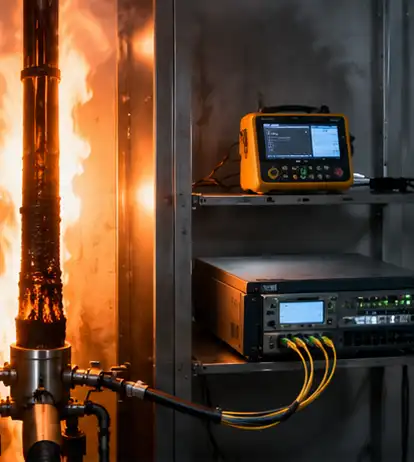
Hengtong's Fire-Rated Optical Cable Construction
Fire performance is only part of the picture in tunnels, mines, and underground galleries. The same cable usually faces mechanical risk: impacts, abrasion, rodent attack, and water ingress. A flame-retardant LSZH sheath in isolation does not protect against any of these. Hengtong's tunnel- and gallery-grade designs combine fire-safety construction with mechanical reinforcement in a single cable.
A typical premium flame-retardant and fire-resistant optical cable uses a four-layer protective architecture:
- Mica-glass tape applied directly over the fibres or loose tubes, maintaining optical integrity at 750–950 °C and supporting IEC 60331-25 and BS 6387 circuit-integrity ratings.
- Longitudinally applied aluminium tape over the cable core, providing both a fire barrier and a moisture barrier - the inner layer of the double-armor design.
- Corrugated or flat steel tape armor over the aluminium tape, for crush resistance, impact resistance, and rodent protection - the outer armor layer.
- Double LSZH outer sheath, formulated for low smoke and zero halogen acid gas under combustion.
The constructions operate across a standard range of –40 °C to +70 °C, with extended-temperature variants available up to +85 °C and +105 °C for specific industrial and tunnel applications. They are designed to be moisture-resistant, corrosion-resistant, and rated for the tensile and lateral compression forces encountered during tunnel pulling and ducted installation. The detailed structural and material trade-offs are covered in our reference on optical cable armor layers, materials and naming codes.

Hengtong Fire Resistant Fiber Optic Cable
As a global leader in optical fiber communications, Hengtong Group has pioneered advanced fire resistant fiber optic cable solutions that maintain signal integrity even under extreme fire conditions. With over 50 patented technologies in optical fiber cable innovation and manufacturing facilities across multiple continents, Hengtong delivers fire resistant fiber optic cable systems that protect lives and preserve mission-critical communications when it matters most.
Where Hengtong Flame-Retardant Optical Cables Are Deployed
Rail transit and subway tunnels
Signaling, communication-based train control, tunnel CCTV, PA, and emergency telephone systems all run on fibre. Inside a tunnel, smoke management is as critical as flame propagation control - there is nowhere for smoke to vent. Hengtong's subway-tunnel cables are specified to BS 6387 Category C (950 °C, 3-hour circuit integrity) and IEC 60331-25, alongside IEC 60332-3 bundled-cable flame propagation, IEC 61034 smoke density, and IEC 60754 acid gas compliance, in a double-armored LSZH construction. They are deployed across metro and high-speed rail communications projects in China through Hengtong's rail transit cabling solutions.
Data centers and high-rise buildings
Data centers care about three things in a cable fire: flame propagation along trays, smoke density (HVAC re-circulation), and corrosive gases that can attack electronics long after the fire is out. LSZH flame-retardant constructions, often in plenum or riser variants depending on local code, are now the default for inter-row, end-of-row, and inter-floor links. In high-density AI fabrics, this is being layered on top of MPO/MTP and high-fibre-count ribbon designs. For densely occupied facilities under GB 51348-2019, Hengtong supplies its B1-class flame-retardant series, qualified to GB 31247-2014; for international projects, selected product lines also carry UL certification for deployment in UL-aligned markets. See our reference page on data center fibre optic cabling for the broader context.
Underground utility tunnels and cable galleries
Combined utility tunnels carry power, communications, water, and gas pipelines together. A fault in one system can ignite cables in another. Hengtong's armor-reinforced variants - longitudinal aluminium tape plus corrugated steel tape, with stainless steel tape options for high-pressure rodent environments - are designed to resist impact, abrasion, and rodent attack while maintaining circuit integrity for SCADA, gas-leak monitoring, and infrastructure control links in flammable surroundings.
Industrial, mining and energy sites
In coal mines, oil and gas facilities, and chemical plants, optical cable selection is driven by ignition risk in flammable atmospheres, mechanical robustness, and applicable certifications. Selected Hengtong armored fire-resistant constructions hold Chinese coal mine safety certification, qualifying them for use in underground coal mining communication and monitoring systems. The same fire-rated, armored design principle extends to other industrial and energy installations where flammable atmospheres and mechanical hazards coexist.
How to Choose the Right Fire-Rated Optical Cable
A workable selection sequence for engineering and procurement teams:
- Define the fire-safety goal. Is the cable simply not to feed the fire (flame-retardant), or must communications survive the fire (fire-resistant)? Many critical projects need both.
- Pin down the smoke and acid-gas requirement. LSZH is non-negotiable for enclosed public spaces, tunnels, and most data centers. If GB 31247 B1 or CPR B2ca is in the spec, anchor on that early.
- Choose the bundled-test category. For trays and risers, decide which IEC 60332-3 category (A, B, C or D) the project requires, based on cable density and non-metallic loading.
- Add mechanical and environmental requirements. Armor, anti-rodent, water blocking, temperature range. Hengtong's standard range covers –40 °C to +70 °C, with +85 °C and +105 °C variants for specific industrial applications.
- Match fibre count and type. G.652.D and G.657.A1/A2 for FTTx and access; OM3, OM4, OM5 multimode for short-reach data center links; high-count ribbon for spine and AI fabrics.
- Verify third-party test reports against the exact installation standard cited - not just the standard family.
Why Hengtong
Hengtong has been engineering special optical cables for more than two decades and operates with in-house control across the value chain - optical fibre drawing, jacket compound formulation, cable design, manufacturing, and fire testing. That vertical integration is what allows project-specific test reports rather than nameplate certifications alone: attenuation traces from IEC 60331-25 burns, char-height records from IEC 60332-3 bundled tests, smoke density measurements per IEC 61034, and acid-gas results per IEC 60754, all referenced to the actual cable construction being supplied.
The range covers Class B1 high-flame-retardant and fire-resistant series under GB 31247-2014, BS 6387 CWZ and IEC 60331-25 tunnel-grade products, UL-certified product lines for international deployment, and MA-certified armored constructions for coal mining. Construction families are organized by application - single-jacket loose tube, double-jacket double-armored, FRP strength-member fire-resistant, and center-tube - so each design can be matched to the specific standards and mechanical conditions of the project, with formulation and process choices balancing fire safety, link performance, and total installed cost.
FAQ
Q: Is LSZH the same as fire-resistant?
A: No. LSZH describes the sheath compound's behaviour - low smoke and no halogen acid gas under burning conditions. Fire resistance is about the cable continuing to transmit during a fire, and is verified by IEC 60331-25 or BS 6387. A cable can be LSZH without being fire-resistant, or fire-resistant without being LSZH, though most modern critical-application cables are both.
Q: What does B1 flame retardancy actually mean?
A: B1 is the second-highest grade under China's GB 31247-2014 (A is the highest). It limits flame spread to ≤ 1.5 m on the bundled-cable test, with caps on peak heat release rate, total heat release within 1200 s, fire growth rate (FIGRA), peak smoke production rate, and total smoke. It also requires specified ratings for smoke toxicity, corrosivity, and combustion droplet behaviour. B1 is materially more demanding than IEC 60332-3 Category B on flame spread (1.5 m vs 2.5 m) and introduces additional heat-release and smoke metrics that IEC 60332-3 does not assess.
Q: Is IEC 60332 the same as BS 6387?
A: No. IEC 60332 measures flame propagation - whether the cable continues to burn. BS 6387 measures circuit integrity under flame, water, and mechanical shock - whether the cable continues to work. Most tunnel and life-safety specifications require both families, plus IEC 61034 and IEC 60754 for smoke and acid gas.
Q: For a data center, is fire-resistant cable required everywhere?
A: Usually no. The dominant requirement in modern data centers is LSZH flame-retardant cable in plenum and riser pathways, plus a GB 31247 B1 or CPR Cca/B2ca classification where local code requires it. Fire-resistant (circuit-integrity) cable is generally reserved for fire alarm, EPO, and emergency communications circuits, where the link must keep working long enough to support evacuation and response.
Q: Can a standard flame-retardant cable be used in subway tunnels?
A: Only if it is also fire-resistant (IEC 60331-25 or BS 6387 C/W/Z) and LSZH. Tunnel codes typically require both flame-spread limits and a defined period of circuit integrity for the systems that have to remain operational during evacuation.
Q: What is the operating temperature range of Hengtong fire-rated optical cables?
A: Standard fire-rated and flame-retardant constructions operate from –40 °C to +70 °C. Extended-temperature variants are available up to +85 °C and +105 °C for specific tunnel, industrial, and energy applications. The full environmental specification - moisture resistance, corrosion resistance, tensile load, and lateral compression - is matched to the target deployment.
Talk to an Engineer
If your project specification calls out IEC 60332, IEC 60331-25, BS 6387 CWZ, or GB 31247 B1, our engineering team can map those requirements to a concrete cable construction and provide the test reports and project case references procurement teams typically need. Contact us with your application, environment, and target standards, and we will come back with a candidate design and certification scope.