





Fiber Optic Cable Design: Principles, Standards & Materials
You want your connection to work well and make money. Fiber Optic Cable Design is very important for this. If you use good design and strong materials, you will have fewer problems. You will also get more work done. For example:
A factory switched to fiber optic internet and got 76% more work done.
The same factory had half as many network problems.
People who buy supplies help make more money by knowing how design affects speed and strength. They also think about how long things last. You can check money results, see if customers are happy, and use cost checks to see if things work well.

Key Takeaways
- Fiber optic cables make networks work better. This helps people get more done and have fewer problems.
- Knowing how signals move keeps data strong and fast.
- Picking good materials for fiber optic cables stops signal loss. It also makes cables last longer.
- Following rules from around the world and the country keeps fiber optic setups safe and reliable.
- Using cables with low attenuation lets data go farther. It also keeps the quality high.
- Buying top fiber optic cables can save money later. It also makes networks work better.
- Using water-blocking methods keeps cables safe from wetness. This helps cables last longer.
- Making cables that can grow lets networks get bigger later. This does not cost a lot more.
Fiber Optic Cable Design Principles
Fiber Optic Cable Design has a main goal. It must send data fast and without many errors, even in hard places. Each cable part works together to keep your network safe and working well for a long time. The core, cladding, coating, strength members, and outer jacket all help protect your cables.

Signal Transmission
The most important job of a fiber optic cable is to send light signals far with little loss. This helps your data move quickly and stay correct.
Attenuation Factors
Attenuation means losing signal strength. You want to keep this low so your network stays strong. Many things can cause attenuation:
- Structure of Fiber Optic Cables: The core, cladding, and coating help guide light and keep it safe from outside problems.
- Total Internal Reflection: This keeps light inside the core so signals can travel far without leaking out.
- Types of Fiber Optic Cables: Single-mode fibers are best for long distances. Multi-mode fibers work better for short runs.
- Attenuation and Signal Loss: Things like absorption, scattering, and bending can make your signal weaker. Using good materials and smart design helps stop these problems.
- Dispersion: Light pulses can spread out and cause mistakes. Picking the right cable helps control this.
- Signal Modulation and Data Transmission: Changing electrical signals into light lets data move correctly.
- Optical Amplifiers and Repeaters: These tools make your signal stronger for very long trips.
Tip: Pick cables with low attenuation to help your network work better and reach farther.
Here's how different materials change signal loss and how well your cable works:
|
Material Type |
Effect on Signal Attenuation and Performance |
|---|---|
|
Core |
The core must be pure. If it has water or dirt, it can absorb light and lose signal. |
|
Cladding |
The cladding keeps light inside the core and stops it from scattering. |
|
Coating |
The coating protects the cable and keeps the signal safe as it travels. |
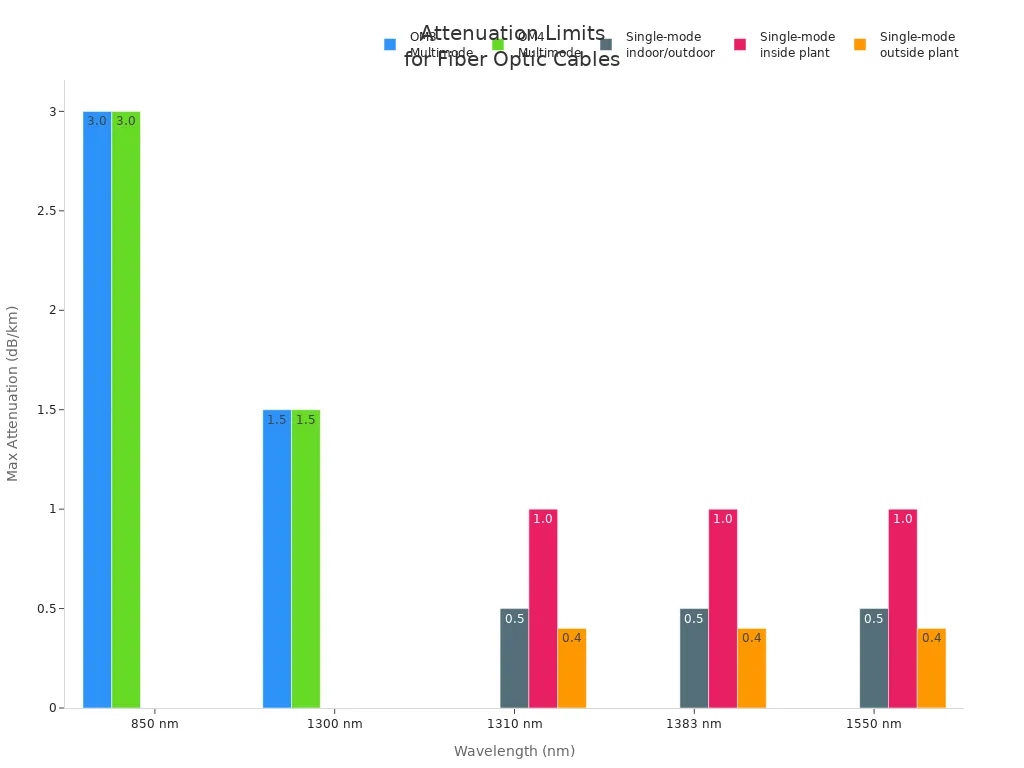
You should also know what the industry says is the highest allowed attenuation:
|
Optical fibre type |
Wavelength (nm) |
Maximum attenuation (dB/km) |
|---|---|---|
|
850nm laser optimised, 50/125 μm Multimode (OM3) |
850 / 1300 |
3.0 / 1.5 |
|
850nm laser optimised, 50/125 μm Multimode (OM4) |
850 / 1300 |
3.0 / 1.5 |
|
Single-mode indoor/outdoor |
1310 / 1383 / 1550 |
0.5 / 0.5 / 0.5 |
|
Single-mode inside plant |
1310 / 1383 / 1550 |
1.0 / 1.0 / 1.0 |
|
Single-mode outside plant |
1310 / 1383 / 1550 |
0.4 / 0.4 / 0.4 |
Bandwidth
Bandwidth tells you how much data your cable can carry. Single-mode fibers can carry the most data and lose the least signal. They are good for long and fast networks. Multi-mode fibers are better for short distances, like in data centers or schools. Pick the right cable for your needs to stop slowdowns and get the most value.
Mechanical Strength
Cables need to be strong to handle tough use and last a long time. Mechanical strength helps your cables survive in hard places.
Tensile Strength
Tensile strength shows how much pulling a cable can take before it breaks. Fiber optic cables can handle 200 to 600 lbs, which is more than copper cables. This means you can use them for longer runs and tall buildings without extra help. Always pull cables straight and do not bend them too much to keep them safe.
Key standards: ANSI/EIA/TIA-455, IEC 60793, IEC 60794, and ANSI/ICEA S-87-640 tell us how strong and tough cables should be.
Industry data: Top brands like AFL and CommScope make cables that meet or beat these rules, with tensile strengths of at least 70kN and can last over 15 years.
Flexibility
Flexibility is important when you need to put cables in tight spots or around corners. Good cables use strength members and buffer tubes so they can bend without breaking. Tests like those in IEC 60794 check if cables can handle bending and moving every day.
Note: Flexible cables help stop small bends from hurting your signal over time.
Environmental Protection
Cables face problems like water, sun, and big temperature changes. Environmental protection keeps your network working well, even outside or in factories.
Moisture Resistance
Water can make signals weak and cause rust. You need features like:
|
Feature |
Description |
|---|---|
|
Splice Closures |
Keep fiber connections safe from water, temperature changes, and dirt. |
|
Sealing Barriers |
Stop water from getting in, which can hurt your signal and cause rust. |
|
High-Quality Materials |
Keep cables strong when temperatures change and stop breaks. |
Top cables pass salt spray tests for at least 500 hours, showing they can handle wet places.
UV Protection
Sunlight can make cables crack and break. UV-resistant coatings and jackets keep your cables safe:
|
Feature |
Description |
|---|---|
|
UV-Cut Coating |
Stops cables from getting brittle and cracking in the sun. |
|
Weather Resistance |
Protects the inside parts from rain, snow, and heat or cold. |
|
Armored Cables |
Use UV-resistant stuff to stay strong in sunlight. |
Tip: For cables outside, always pick ones with UV protection and weatherproof jackets. This helps them last longer and need less fixing.
Fiber Optic Cable Design uses these ideas-signal transmission, mechanical strength, and environmental protection-to make networks that work well and last. By following world standards (IEC, ITU, IEEE) and picking good materials, your network will stay strong, fast, and save money for many years.
Standards
You must follow strict standards when picking Fiber Optic Cable Design. Standards are rules for how cables work and how to install them. They also tell you how to keep cables working well. If your cables meet these standards, they last longer and work better. You will have fewer problems. B2B buyers, like telecom operators, trust standards. Standards help keep networks strong and safe.

International Standards
International standards let you compare cables from many suppliers. These rules make sure cables work in different countries and places.
ITU-T
The International Telecommunication Union (ITU-T) makes rules for fiber types and how they perform. ITU-T G.652 is used for single-mode fibers in long-distance networks. ITU-T G.655 helps with wavelength-division multiplexing. This lets you send more data. ITU-T G.657 gives you bend-insensitive fibers for tight spaces.
IEC
The International Electrotechnical Commission (IEC) sets rules for fiber and cable construction. IEC 60793 covers things like fiber diameter and strength. IEC 60794 tells you how to design cables for inside and outside. These rules help you pick cables that last and work in tough places.
|
Standard |
Description |
|---|---|
|
IEC 60793 |
Optical Fibers, including specifications for fiber diameter and performance. |
|
IEC 60794 |
Optical Cables, covering requirements for indoor and outdoor environments. |
|
ITU-T G.652 |
Standard Single-mode Fiber for long-distance communication. |
|
ITU-T G.655 |
Non-Zero Dispersion-Shifted Fiber for advanced data systems. |
|
ITU-T G.657 |
Bend-Insensitive Single-mode Fiber for tight bends. |
National Standards
National standards help you follow local rules and meet customer needs. They guide you on how to build cables and keep them safe.
TIA/EIA
The Telecommunications Industry Association (TIA/EIA) sets rules for how cables should work and what they are made of. You use these rules for cabling in offices and other buildings.
ISO/IEC
ISO/IEC standards focus on safety and how cables are used. ISO/IEC 11801 says how cables should work in customer buildings. It also asks for low-smoke, zero-halogen materials for safer use.
|
Aspect |
TIA/EIA Standards |
ISO/IEC Standards |
|---|---|---|
|
Performance Levels |
Sets levels for optical fiber systems |
Defines transmission distances for fiber and twisted pair |
|
Materials |
General guidelines |
Requires low-smoke, zero-halogen materials |
|
Application Environments |
Focuses on commercial buildings |
Covers industrial automation and control systems |
Compliance
You need to check compliance before buying cables. Compliance means your cables follow all the rules for safety, quality, and performance. This keeps your business safe from fines and stops network problems.
Quality Assurance
Quality assurance uses tests and certificates to show your cables work well. Brands like Corning and CommScope share papers to prove their cables meet IEC and ITU rules. You can ask for these papers to check if cables are reliable.
Certification
Certification means your cables passed official tests. Look for marks like CE, RoHS, and FCC. These marks show your cables are safe, good for the environment, and legal to use.
|
Compliance Requirement |
Description |
Governing Body |
|---|---|---|
|
ITU-T G.652 |
Single-mode fiber for long-distance communication |
ITU |
|
IEEE 802.3 |
Ethernet networking protocols |
IEEE |
|
CE Marking |
EU safety, health, and environmental protection |
European Union |
|
RoHS |
Limits harmful substances in components |
N/A |
|
WEEE |
Regulates disposal of electrical equipment |
N/A |
|
FCC Regulations |
U.S. framework for fiber optic technologies |
FCC |
|
TRA Regulations |
Middle East framework for fiber optic technologies |
TRA |
Tip: Always ask for certifications and test reports before you buy. This helps you avoid repairs and keeps your network working well.
Materials

Optical Fibers
Core and Cladding
The core and cladding are very important parts. The core moves light signals through the cable. The cladding wraps around the core and keeps light inside. It does this by using total internal reflection. There are two main types you can use. Single-mode fibers have a small core, about 9 microns wide. They work well for long distances and high bandwidth. Multimode fibers have bigger cores, usually 50 or 62.5 microns. They are best for short distances.
|
Fiber Type |
Core Diameter |
Max Distance (Gbps) |
Bandwidth (MHz km) |
Max Attenuation (dB/km) |
|---|---|---|---|---|
|
OM3 |
50 microns |
1000m (10 Gbps), 400m (40 Gbps) |
2000 |
3.0 |
|
OM4 |
50 microns |
550m (40 Gbps), 150m (100 Gbps) |
4700 |
3.0 |
|
OM5 |
50 microns |
1000m (40 Gbps), 150m (100 Gbps) |
4700 |
3.0 |
|
Single Mode |
9 microns |
Longer distances, higher bandwidth |
N/A |
Lower attenuation |
|
Multimode |
50-62.5 microns |
Shorter distances, lower bandwidth |
N/A |
Higher attenuation |
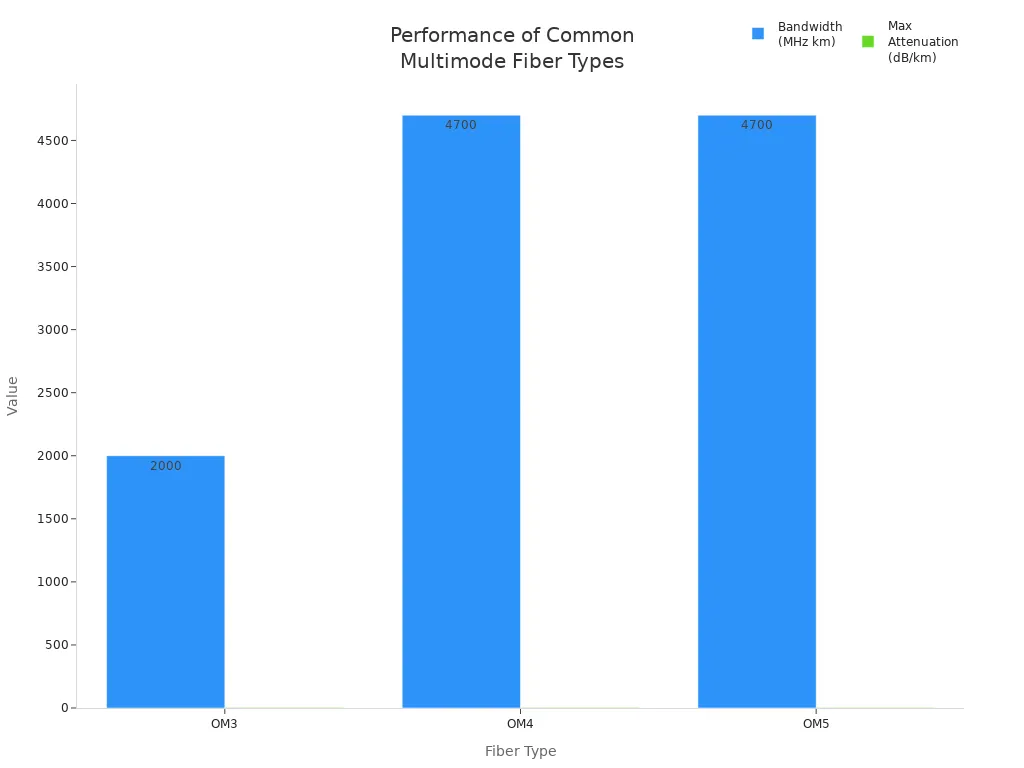
Pick your fiber type based on how far and how fast you need to send data. Single-mode fibers are best for long trips. Multimode fibers save money for short runs in buildings.
Buffer Coating
Buffer coating keeps the glass fiber safe from water, chemicals, and damage. There are different buffer coating materials. Each one has special benefits:
- Polyetheretherketone (PEEK): Handles heat and chemicals well. Use it in tough places.
- Polybutylene Terephthalate (PBT): Very strong and stands up to heat. It helps cables last when temperatures change.
- Polypropylene (PP): Safer than PVC. It makes less smoke and no toxic halogens.
- Polyethylene (PE): Keeps out water and has good electrical properties.
- Low-Smoke Zero Halogen (LSZH): Best for inside spaces. It makes little smoke and no toxic gas in a fire.
Tip: Pick buffer coatings that fit where you will use the cable. For outside or tough places, PEEK and PBT are stronger. For inside or public areas, LSZH is safer.
Strength Members
Aramid Yarn
Aramid yarn, called Kevlar, makes cables stronger. It gives high tensile strength but keeps cables light. You can handle and pull these cables easily.
|
Feature |
Aramid Yarn |
|---|---|
|
Density |
Low (≈ 1,450kg/m³) |
|
Strength |
High tensile (≈ 3,000N/mm²) |
|
Weight in Water |
Light, minimal impact |
|
Compression Strength |
Strong in tension, weak in compression |
|
Flex Life |
Good, but affected by internal friction |
|
Crush Resistance |
Limited, depends on other components |
|
Cost |
Higher than steel, lower than exotic fibers |
Use aramid yarn when you want a cable that is light and strong.
Metal-Clad Options
Metal-clad strength members use steel or other metals for extra strength. These cables are heavier but protect better against animals and heavy things.
|
Feature |
Metal-Clad Strength Members |
|---|---|
|
Density |
High (7,890kg/m³) |
|
Strength |
High load-bearing, limited by weight |
|
Weight in Water |
Heavy, increases tensile load |
|
Compression Strength |
Strong under tension, defined yield stage |
|
Flex Life |
High actual strength |
|
Crush Resistance |
Better than aramid |
|
Cost |
Varies, often higher due to material |
Note: Use metal-clad cables for places with lots of animals or heavy traffic. They protect better but cost and weigh more.
Jackets
The jacket is the outside layer of the cable. It protects from fire, chemicals, sunlight, and damage. You need to match the jacket to where you use the cable.
PVC
PVC jackets are cheap and easy to put in. They resist fire a little but make toxic gas when burned. Do not use PVC in tight spaces.
Polyethylene
Polyethylene jackets are best for outside use. They keep out water and stand up to wear and rust. You can pick HDPE or LDPE for different needs.
LSZH
LSZH jackets are safest in fires. They make very little smoke and no toxic halogens. Use LSZH in tunnels, data centers, and public places.
|
Material |
Fire Resistance |
Environmental Durability |
Toxicity |
|---|---|---|---|
|
PVC |
Moderate |
Poor (unstable in light and heat) |
High |
|
PE |
Good |
Excellent (moisture, abrasion, corrosion resistance) |
Low |
|
LSZH |
High |
Good (suitable for poorly ventilated areas) |
None |
- PVC: Cheap and good for most uses, but not safe for tight spaces.
- PE: Best for outside, keeps out water and chemicals.
- LSZH: Great for safety, good for the environment.
Alert: Always check local rules before picking a jacket. Standards like IEC 60794 and ISO/IEC 11801 tell you what jackets to use in different places.
Choosing the right materials for each layer helps your network last longer and stay safe. Fiber Optic Cable Design needs good materials to give you strong and fast connections everywhere.
Water Blocking
Water blocking is very important in fiber optic cable design. You must keep water out to protect your network. If water gets in, your signal can get weak. Your network might stop working. Repairs can cost a lot of money. Water can sneak in through tiny cracks or cuts. This happens most in outdoor or underground cables. If water touches the fiber, it can cause attenuation and corrosion. Sometimes, the damage cannot be fixed. Picking the right water-blocking method helps cables last longer. It also means less fixing and saves you money.
Gel-Filled
Gel-filled cables have thick gel inside buffer tubes. The gel wraps around the optical fibers. It stops water from moving along the cable. These cables work well outside or underground.
Why pick gel-filled cables?
They give great moisture protection. The gel fills every space and blocks water.
You can trust these cables in wet or flood-prone places.
They help stop signal loss and fiber corrosion.
Main features of gel-filled cables:
|
Feature |
Gel Fiber Cable |
|---|---|
|
Moisture Protection |
Superior resistance to moisture |
|
Suitability |
Ideal for outdoor or harsh environments |
|
Installation |
Messier, requires cleaning after splicing |
|
Maintenance |
May take longer due to gel removal |
Tip: Use gel-filled cables if you expect lots of water. They protect best against water getting in.
Dry Solutions
Dry water-blocking uses powders or tapes instead of gel. These materials swell up when they touch water. This blocks water from moving. Dry cables are popular for indoor and outdoor use.
Why pick dry water-blocking cables?
They are faster and cleaner to install. No sticky gel means less cleaning.
You save time and money, especially on big jobs.
They still protect against moisture in most places.
Things to know about dry cables:
Dry cables block moisture well but not in very wet places.
Do not use dry-only cables where water is always present.
You must install them right to get full protection.
|
Feature |
Dry Fiber Cable |
|---|---|
|
Moisture Protection |
Less resistant to moisture |
|
Suitability |
Adequate for most conditions, not extreme wet/humid environments |
|
Installation |
Faster, cleaner, no gel cleanup |
|
Maintenance |
Easier, less mess during repairs |
Quick comparison:
|
Feature |
Gel Fiber Cable |
Dry Fiber Cable |
|---|---|---|
|
Moisture Protection |
Superior resistance to moisture |
Less resistant to moisture |
|
Suitability |
Ideal for outdoor or harsh environments |
Adequate for most conditions, not extreme wet/humid environments |
|
Installation |
Messier, requires cleaning after splicing |
Faster, cleaner, no gel cleanup |
|
Maintenance |
May take longer due to gel removal |
Easier, less mess during repairs |
Note: If you want fast and clean work with good moisture protection, dry cables are a strong choice for most jobs.
Picking the right water-blocking method in fiber optic cable design helps you avoid problems. You spend less on repairs and keep your network safe. Match your choice to your environment and needs for the best results.
Applications
Fiber optic cable design works in many places. You must pick the right cable for each job. This keeps people safe and helps the network work well. The right cable also saves money and stops problems. It helps your network last longer and gives you more value.

Indoor
Cables inside buildings have special needs. They must bend easily and be safe in a fire. They also need to follow strict rules.
Fire Ratings
Fire safety is very important for indoor cables. You must use cables that meet local fire codes. The table below shows how each cable type deals with fire:
|
Cable Type |
Fire Rating |
|---|---|
|
Plenum (OFNP) |
Stops flames and smoke; best for air spaces |
|
Riser (OFNR) |
Slows fire between floors |
|
General-Purpose |
Not for plenum or riser; use in safe areas |
OFNP cables are best for air ducts in offices or hospitals.
OFNR cables work well in shafts and risers in tall buildings.
General-purpose cables are good for open office spaces with low fire risk.
Tip: Always check local rules before you put in cables. Using the wrong cable can cause safety problems.
Plenum
Plenum spaces need cables with the best fire safety. You should use plenum-rated cables (OFNP or OFCP) here. These cables make less smoke and gas in a fire. This keeps people and equipment safe. Plenum cables often use LSZH jackets for extra safety.
Outdoor
Outdoor cables must be tough. They need to stand up to weather, sun, and water.
Weatherproofing
Outdoor cables face rain, snow, and big temperature changes. Pick cables with gel inside or strong jackets. These keep water out and protect the fibers. Loose tube cables use gel to block water and heat. Direct buried cables have thick jackets to handle dirt and heavy things.
UV Protection
Sunlight can hurt cables over time. UV-resistant jackets, like polyethylene (PE), stop cracks and damage. Aerial cables use steel wires for strength and to fight wind and sun.
|
Cable Type |
Weatherproofing Features |
UV Protection Features |
|---|---|---|
|
Loose Tube |
Gel inside, resists heat and cold |
Strong outer cover |
|
Aerial Fiber |
Made for bad weather, wind, and rain |
Steel wire, UV-resistant |
|
Direct Buried |
Thick jacket, blocks water |
PE jacket for sun |
|
GYXTW |
Water-blocking gel, steel inside |
PE jacket for sunlight |
Note: Outdoor cables with good weather and sun protection last longer. They also need fewer repairs, which saves money.
Specialized
Some places need special cable designs. These include aerial, direct burial, and undersea cables.
Aerial
Aerial cables hang between poles or towers. They need to be strong and use steel or aramid yarn. These cables fight wind, ice, and animal bites. They often have tough polyethylene jackets for extra strength.
Direct Burial
Direct burial cables go underground. They need armor, like steel tape, to stop rocks and animals. Waterproof gel or tape inside keeps water out and signals strong.
Submarine
Submarine cables connect countries under the sea. They have many layers to protect them. These layers block water, use steel armor, and have thick jackets. They must handle high pressure, saltwater, and moving sand. Submarine cables help the world share internet and data.
Thick jackets stop water and damage.
Gel or tape inside blocks water.
Armor protects from animals and rough ground or sea.
Kevlar adds strength for long pulls.
Alert: Special cables cost more at first but last much longer. They need less fixing and protect your network investment.
Fiber optic cable design uses smart ideas, rules, and materials to fix real problems. Picking the right cable for each job keeps your network safe, fast, and valuable for years.
Selection Criteria
Picking the right fiber optic cable design helps your business work well. It also makes sure you follow rules and get good value for your money. You should think about buying, how well cables work for the price, and what help you get after buying. These things help you stop network problems and save money on repairs. They also make sure your cables meet important standards.

Procurement
You want your cables to help your business grow. When you choose fiber optic cables, look at some main things.
Cost
Building a fiber optic network costs a lot at first. The price changes based on how you install cables and what type you pick. You need to know these costs because they change how much money you have. They also affect how big your network can get. Both starting costs and running costs matter for your project. Rules and installation add more to the total price.
Lead Time
Lead time is how fast you can set up your network. Suppliers must change their plans to fit your schedule. Making cables nearby and using many sources helps stop delays. Quick delivery keeps your project moving and stops expensive waiting.
Scalability
Scalability means you can make your network bigger as your business grows. You need cables that let you upgrade and send more data later. Pick suppliers who can make lots of cables and have good skills. This helps you grow without changing everything.
When you check suppliers, look for:
Certifications like ISO 9001, Telcordia GR-20, and RoHS
Proof of good quality checks
Ways to make products fit your needs
Strong money health and good customer reviews
Tip: Good suppliers with certifications and strong production help you avoid problems. They also give you steady quality.
Performance vs. Budget
You need to match cable performance with your budget. The best choice depends on what you need and your future plans.
Trade-Offs
Single-mode fiber goes far and sends lots of data, but costs more.
Multimode fiber is cheaper and works for short distances, but does not perform as well.
How the cable is made, like the core and cladding, changes how well it works in tough places.
Optical fiber is lighter than Quadrax cables. This is good for things like planes. Lighter cables also get less damage from shaking.
Case Studies
|
Organization |
Location |
Solution Description |
Outcome |
|---|---|---|---|
|
Reliance Industries |
India |
Aerial fiber optic cables for office links |
Better network speed and reliability, faster data, and more work done. |
|
University of São Paulo |
Brazil |
Multimode OM4 fiber optic cables for fast data |
Improved connections and teamwork, easier access to online tools. |
|
Toyota Motor Corporation |
Japan |
Light-armored outdoor cables and tough cables for short-term links |
Safe and fast data transfer, better work and new ways to do jobs. |
Note: Think about how much better cables are for the price. For long-term value, buy cables that fit your needs and future plans.
Support
Help after buying and guarantees keep your cables working and lower repair risks.
Warranty
Warranty tells you how much protection you get if something breaks. A good warranty means your cables last longer and cost less to fix.
Technical Service
Technical help lets you fix problems fast. Quick help stops long waits and keeps your business running. Suppliers with high ratings usually give better help and make buyers feel safe.
|
Aspect |
Importance |
|---|---|
|
Warranty Terms |
Protection from broken parts and trust in reliability |
|
Technical Support |
Fast help with problems, less waiting |
|
Supplier Review Scores |
Higher scores mean better help and more trust |
🛡️ Alert: Always check warranty and help before you buy. Good support lowers risk and helps your network last longer.
References
ISO 9001, Telcordia GR-20, RoHS compliance standards
Reliance Industries, University of São Paulo, Toyota Motor Corporation case studies
Supplier review scores and warranty terms from industry reports
Comparison
Standard vs. Premium
Performance
You want your network to be fast and steady. Premium fiber optic cable design gives you better speed and more stable connections than standard cables. Premium cables use very pure glass cores and special coatings. This helps your upload and download speeds stay the same, so data moves quickly both ways. Premium cables also keep working well when lots of people use the network at once. Standard cables are fine for simple jobs, but they can slow down if many users connect at the same time.
|
Feature |
Standard Cable |
Premium Cable |
|---|---|---|
|
Speed |
Good |
Excellent |
|
Stability |
May drop at peak times |
Consistent, low latency |
|
Lifespan |
10-15 years |
25+ years |
|
Maintenance |
Higher |
Lower |
|
Compliance |
Meets basic standards |
Exceeds industry standards |
Tip: Pick premium fiber optic cable design for important business needs. You will get better speed and fewer network troubles.
Cost-Benefit
Premium cables cost more at first, but you save money later. Premium fiber optic cable design cuts your maintenance costs by almost half each year compared to copper or standard cables. Premium cables last over 25 years, but standard cables need changing after 10-15 years. Standard cables look cheaper at first, but you pay more for repairs and hidden fees over time.
|
Cable Type |
Initial Cost |
Annual Maintenance |
Lifespan |
Total Cost Over 25 Years |
|---|---|---|---|---|
|
Standard Fiber |
$$ |
$$$ |
10-15 yrs |
$$$$$ |
|
Premium Fiber |
$$$ |
$ |
25+ yrs |
$$$$ |
|
Copper |
$ |
$$$$ |
5-7 yrs |
$$$$$$ |
🛡️ Alert: Premium fiber optic cable design gives you better value for your money. You spend less on fixes and your network lasts a long time.
Alternative Designs
Innovations
You face new problems in tough places. New fiber optic cable design ideas help you fix these issues. Some special cables work in very hot or cold places, like below -40°C or above +85°C. You can use these cables in deserts, cold areas, or hot factories.
|
Cable Type |
Temperature Range |
|---|---|
|
Standard |
-40°C to +85°C |
|
Specialty |
Below -40°C or Above +85°C |
Fiber optic cables also block electromagnetic and radio frequency interference. You can use them in power plants or factories with lots of electrical noise.
Stronger protection stops small bends from hurting the cable during temperature changes.
Special designs keep your data correct in harsh weather.
Networks keep working even in sandstorms.
Note: Advanced fiber optic cable design lets you build networks where old cables would not work.
Challenging Environments
You need cables that work in the hardest places. Specialty fiber optic cable design uses armored jackets, water-blocking layers, and bend-insensitive fibers. These features protect your network from animals, water, and rough use. Specialty cables follow strict rules like IEC 60794 and ITU-T G.657, so you know they last a long time.
Use armored cables for underground or buried jobs.
Pick bend-insensitive fibers for tight corners or sharp bends.
Choose water-blocking cables for wet or flood-prone spots.
🚀 Tip: For extreme places, buy specialty fiber optic cable design. You get strong performance and keep your network safe.
Trends

Sustainability
Fiber optic cable design is changing quickly. Many companies want to be more eco-friendly. They pick materials that are better for the planet. They also use cleaner ways to make cables. These choices help save money and meet environmental rules. You get fewer problems and less downtime.
Eco-Friendly Materials
You want cables that last longer and make less trash. Fiber optic cables use fewer materials than copper cables. You do not need to replace them as often. This means less waste and lower costs over time. Many companies now recycle fiber optic parts. They use old parts in new projects. This helps cut down on electronic waste and reach green goals.
|
Aspect |
Fiber Optics |
Copper Cables |
|---|---|---|
|
Energy Efficiency |
Minimal energy loss over long distances |
Higher energy use, more signal loss |
|
Material Longevity |
Fewer replacements needed |
More frequent replacements required |
|
Waste Reduction |
Lower demand for raw materials |
Higher waste from replacements |
You can recycle fiber optic parts easily.
Many suppliers use green methods to make cables.
Recyclable fiber optics help you make less electronic waste.
Manufacturing
Manufacturers now use cleaner chemicals and new materials. These changes help the environment during production. Making glass for cables uses a lot of energy. Cleaner methods lower this impact. If you pick suppliers who use these ways, your business meets global green standards. Your brand looks better to customers.
🌱 Tip: Sustainable fiber optic cable design saves money, follows rules, and helps your reputation.
Emerging Technologies
Fiber optic cable design now uses new technology. You get faster data and smarter networks. You can also watch your cables better.
High-Density Cables
High-density cables send more data in small spaces. You get faster speeds and more connections in the same area. This is important for data centers and smart cities. You can grow your network quickly without big changes.
High-density cables send more data.
You fit more connections in tight spaces.
These cables help your network grow in the future.
Smart Sensing
Smart sensing uses fiber optic cables to watch temperature, movement, and shaking. You can find ground movement near gas lines. You spot problems before they stop your network. New technology mixes photonics, nanotechnology, and signal processing. This brings new uses for sensing, pictures, and quantum information. You get better maintenance and safer networks.
Fiber optic sensing finds changes right away.
You stop failures and save money on repairs.
Smart sensing makes networks safer and more reliable.
🚀 Note: New ideas in fiber optic cable design help you fix problems, lower risks, and get better results.
Annotation/References
Industry reports on sustainable fiber optic manufacturing
Supplier documentation on recyclable fiber optic components
Technology reviews on high-density cables and smart sensing applications
If you pay attention to Fiber Optic Cable Design, your network works well and stays strong. You reach your business goals by picking cables that work for your needs, last in hard places, and fit your setup.
Choosing the right specs keeps your signal strong.
Using tough materials means you do not have to replace cables often.
Picking designs that fit your system makes installation faster.
You lower problems and get more value when you follow the rules and use good materials. Always think about these things when you buy and set up cables.
FAQ
Why should you choose fiber optic cable design over copper cables?
Fiber optic cable design lets you send more data at once. These cables last longer and do not break as often. You get faster speeds and less signal loss. This means your network works better and you save money over time.
Why do standards matter in fiber optic cable design?
Standards make sure your cables work with other networks. You will not have problems connecting to different systems. Following rules keeps your cables safe and helps you pass checks. This also means you fix fewer problems later.
Why does material selection impact cable performance?
The materials in your cable change how strong and flexible it is. Good materials help your cables last longer and stay safe from water or sun. If you use high-quality stuff, you fix cables less and save money.
Why do B2B buyers focus on compliance and certification?
Compliance and certification show your cables meet important rules. This helps you avoid legal trouble and makes your cables work well. Certified cables help you get more jobs and make customers trust you.
Why is water blocking important in outdoor fiber optic cable design?
Water blocking keeps water out of your cables. This stops signal loss and rust. Your cables last longer and you do not have to fix them as much, even in tough weather.
Why should you consider long-term ROI when selecting fiber optic cables?
Long-term ROI means you spend less money fixing cables. Premium fiber optic cables last longer and need less work. You get better value and your business runs smoother.
Why do different applications require specific fiber optic cable designs?
Different places need different cables. Indoor cables must be safe in fires. Outdoor cables need to handle rain and sun. Special cables work in very hard places. The right cable keeps your network safe and working.
Why is scalability important for B2B fiber optic cable projects?
Scalability means you can make your network bigger later. You do not have to spend a lot to upgrade. Scalable cables help your business grow and use new technology.