







Traditional outdoor fiber routes carry a hidden cost. Once a direct-buried or duct-pulled cable is in the ground, adding capacity usually means digging a new trench or threading another heavy cable through a congested conduit. A blown micro-cable system - sometimes called air-blown fiber or cable jetting - takes a different path: it separates the duct infrastructure from the fiber itself, so capacity can be added later, in stages, without civil works each time. This guide explains how blown micro-cable works, where it fits in outdoor networks, how it compares with conventional pulled and direct-buried cables, and what to check before you specify it.
What Is a Blown Micro-cable System?
In a conventional install, a fully populated cable is pulled through a duct from end to end. A blown micro-cable system reverses the order of work. First, a thin-walled micro-duct - or a bundle of micro-ducts - is placed in the ground or inside an existing conduit. Later, when capacity is actually needed, a light micro-cable (commonly 12, 24, 48, or more fibers) is propelled into the micro-duct by compressed air or nitrogen, with the drag force spread along the cable rather than pulled from one end.
It helps to separate two terms that are often used loosely. The phrase air-blown fiber originally described blowing bare fiber units into a micro-duct, and that approach is still used today; this is what most vendors list as air-blown fiber units. A blown micro-cable, by contrast, is a complete, jacketed cable that is blown into the duct as a single unit. Both rely on jetting equipment, but they differ in what is being installed and in how it is later accessed and spliced.

How Blown Micro-cable Installation Works
Deployment follows a repeatable sequence rather than a single pull:
- Lay the micro-duct or micro-duct bundle along the route, with sealed connectors at joints and access points.
- Verify the duct before blowing - confirm continuity, cleanliness, and pressure integrity (more on this below).
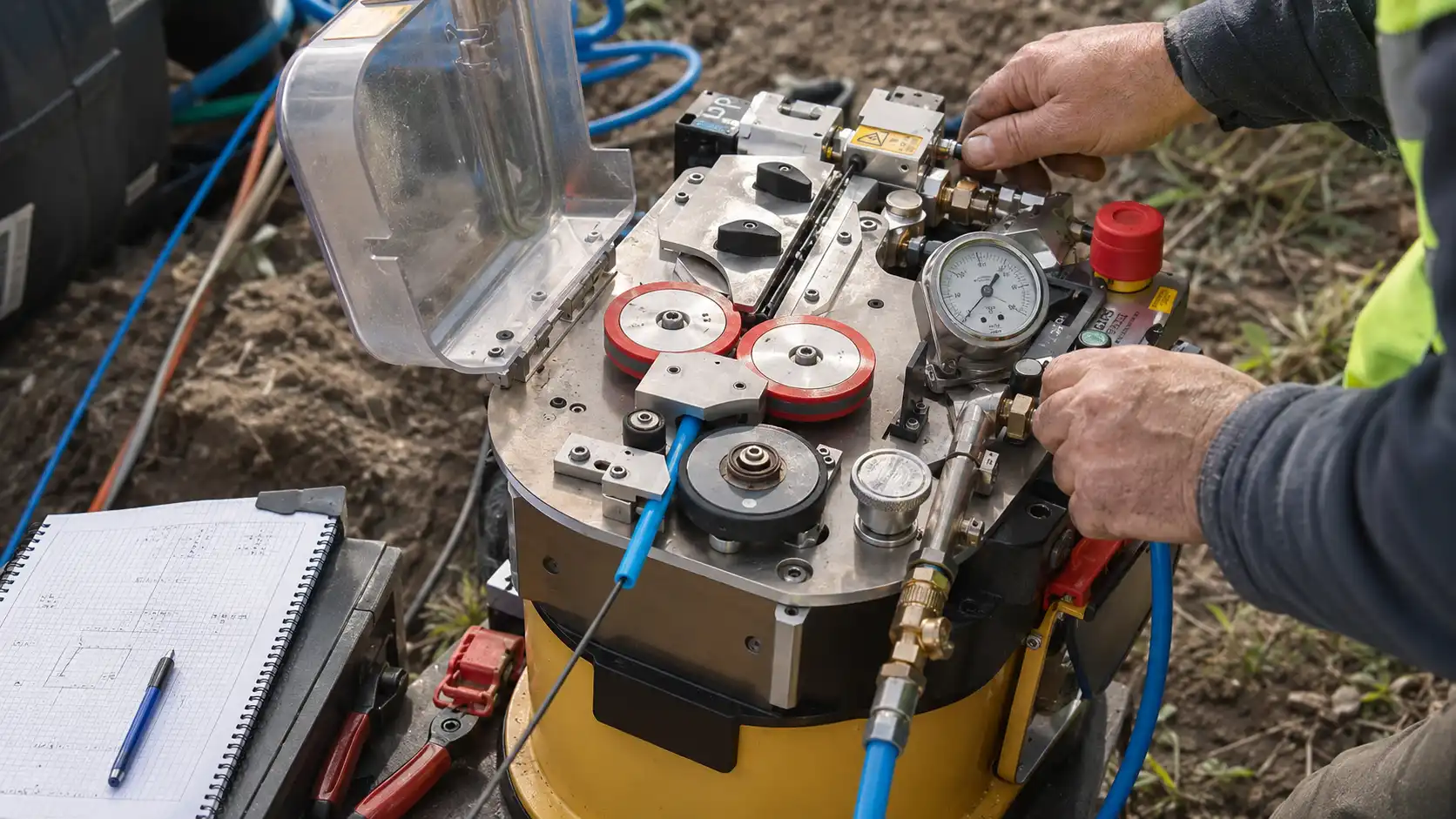
- Load the micro-cable into the jetting machine, which combines a mechanical drive with a high-volume airstream.
- Blow the cable to the next access point, then splice or store slack as the design requires.
Under favorable conditions, modern jetting equipment can place a micro-cable more than 1,000 m in a single run. The distance and speed you actually achieve depend heavily on the route: the number and radius of bends, duct cleanliness, temperature, humidity, lubrication, air pressure, and the cable's outer diameter all matter. Tight or repeated 90° bends, in particular, can shorten the practical blowing distance well below the headline figure.
Blown Micro-cable vs Traditional Outdoor Cable
The trade-off is mostly about when you commit fiber and civil resources. A conventional duct (pulled) cable commits the full fiber count and most of the civil cost up front; a blown micro-cable lets you stage that investment as demand becomes clearer.
| Factor | Traditional pulled / direct-buried cable | Blown micro-cable |
|---|---|---|
| Initial fiber commitment | Full fiber count fixed at install | Staged; blow capacity as needed |
| Initial civil cost | Higher (trenching or duct, plus full cable) | Micro-duct first; cable cost deferred |
| Expanding capacity | New trench or an extra duct cable | Blow another micro-cable into a spare micro-duct |
| Disruption when expanding | High (civil works, permits) | Low if spare micro-duct already exists |
| Duct utilization | Roughly one cable per duct | Multiple micro-ducts and cables per conduit |
| Equipment needed | Pulling winch and lubricant | Air compressor and jetting machine |
| Route dependency | Tolerant of long, complex routes | Sensitive to bends, cleanliness, and distance |
| Repair and re-entry | Repair or replace the cable in the duct | Blow out and replace an individual micro-cable |
| Best fit | Long, stable backbone runs; single-phase builds | Phased rollouts, congested ducts, uncertain take-up |

Why Operators Are Increasingly Choosing Blown Micro-cables
A few converging pressures explain the growing use, and they are easier to defend with current market data than with a single "tipping point" claim.
First, mature fiber markets are getting harder to build. The FTTH Council Europe's 2026 Market Panorama reports that full-fiber networks now pass roughly 295 million homes across 39 European countries - about 79% coverage - while noting that the market is entering a more mature phase, where the remaining build-out is more complex and costly and operators are focused on extracting more value from existing infrastructure. In that environment, reusing spare micro-duct capacity instead of opening new trenches becomes increasingly attractive.
Second, mobile densification keeps adding sites that need fiber. The Ericsson Mobility Report identifies the densification of mid-band and 5G Standalone sites as a key step in realizing 5G, which in practice means connecting many more small-cell and radio sites - often in dense urban areas where new fiber is hard to install. Staged blowing lets operators match fiber spend to each new site as it comes online, rather than overbuilding in advance.
Third, congested urban ducts favor micro-ducts. Where a conventional conduit is considered full, a bundle of micro-ducts can often be installed inside or alongside it, raising effective fiber density without new civil works. Exact configurations - for example, how many micro-ducts fit a given conduit - depend on the duct and micro-duct sizes involved.
Key Applications
Blown micro-cable suits outdoor networks that grow in phases or run through constrained space:
- FTTH and FTTx backbones and distribution, where subscriber take-up is uncertain and capacity is added street by street; the last-mile link is then completed with an FTTH drop cable.
- 5G fronthaul and backhaul to small cells and radio sites that are added over time.
- Smart-city and intelligent-transport corridors, where ducts are shared across many services and may be extended in stages.
- Campus, industrial-park, and data-center-adjacent routes that expand as demand grows.
Key Specifications to Check Before Choosing
Treat a blown micro-cable as a system - cable, micro-duct, and equipment together. Useful things to confirm before you specify:
- Micro-duct and cable sizing. Micro-ducts are usually quoted as outer/inner diameter pairs (for example 10/8, 8/6, or 5/3.5 mm). Match the cable's outer diameter to the micro-duct's inner diameter and to the planned route length.
- Fiber type and count. High-density micro-cables built on 200 µm fibers can reach high counts in a compact body - figures such as 96 fibers in roughly a 6 mm outer diameter are achievable in some designs - but confirm the exact count against the datasheet.
- Fiber grade. Decide between standard single-mode and bend-insensitive grades. G.657.A1 bend-insensitive fiber is compliant with G.652.D and tolerates tighter bends, which helps in dense access routes, while G.654.E targets long-haul, low-loss backbone links. Per ITU-T, G.657 fiber is specified for access networks and remains compatible with G.652.D systems.
- Construction. All-dielectric micro-cables with dry, water-blocking elements (no gel) are common, because they are clean to handle and quicker to splice.
- Achievable blowing distance. Ask for installation data against your planned route profile, not just a best-case number.

Benefits and Limitations
The benefits are clear when growth is uncertain: lower up-front cost, staged investment, higher duct utilization, and the option to mix fiber types over the life of the route. It is fair to be just as clear about the limits.
- A micro-duct network has to be designed and installed first, so there is up-front planning and some civil effort before any fiber is blown.
- Performance is route-dependent. Long runs with many tight bends, contamination, water ingress, or deformed ducts can reduce - or stop - a blow.
- Existing or older ducts cannot be assumed blowable; they should be inspected and tested first.
- Jetting needs a compressor and trained crews, which is a different skill set from pulling.
- For very short or one-off drops, a pre-connectorized drop cable can be simpler and cheaper than setting up a blow.
Standards and Testing Requirements
For blown installation, the relevant test method is defined in IEC 60794-1-124:2025 (Method E24), which sets out how micro-duct cabling - micro-duct cables, fiber units, and hybrid cables - is evaluated for blowing behavior, including blowing-track layouts that force realistic left- and right-hand bending. This edition replaced the older Method E24 previously published under IEC 60794-1-21. The broader product requirements for blown micro-duct cabling sit in the IEC 60794-5 family of sectional specifications.
Before blowing on a live route, typical pre-installation checks include a duct continuity and cleanliness pass (rod, mandrel, or brush), a pressure and leak check on the duct and its seals, and a bend-radius review against the cable's limits. Acceptance testing of the installed fiber - attenuation and, where required, OTDR traces - follows the same fiber optic cable testing practices used for other outdoor cables.
Example Deployment Scenario
Consider a municipal FTTH build that uses a backbone micro-duct network of roughly 50 km. (This is an illustrative scenario, not a specific project.) In phase one, the operator blows 48-fiber micro-cables to reach the first neighborhoods served. As new housing connects in phase two, additional 24- or 48-fiber micro-cables are blown into spare micro-ducts on the same route, so most expansion avoids new trenching and the associated permitting - provided the micro-ducts were sized and reserved for that growth, and the routes stay within practical blowing limits.
FAQ
Q: What is the difference between air-blown fiber and a blown micro-cable?
A: Air-blown fiber usually means blowing bare fiber units into a micro-duct, while a blown micro-cable is a complete, jacketed cable blown in as one unit. Both use jetting; they differ in what is installed and in how it is accessed and spliced.
Q: How far can a micro-cable be blown?
A: Single runs of more than 1,000 m are achievable under good conditions, but the real figure depends on bends, duct cleanliness, temperature, humidity, lubrication, air pressure, and cable diameter. Tight or repeated bends can reduce it significantly.
Q: Is blown fiber better than pulled fiber?
A: Not universally. Blowing is well suited to phased rollouts and congested ducts; pulling can still be the better choice for long, stable backbone runs or single-phase builds. The right answer depends on the route and on how capacity will grow.
Q: What micro-duct size is used for blown fiber?
A: Micro-ducts are commonly specified as outer/inner pairs such as 10/8, 8/6, or 5/3.5 mm, often grouped into a bundle. The cable's outer diameter must suit the micro-duct's inner diameter.
Q: Can blown fiber be used for FTTH?
A: Yes. Blown micro-cable is widely used for FTTH backbone and distribution, with the final connection completed by a drop cable. It lets operators add capacity as subscribers actually connect.
Q: What are the disadvantages of air-blown fiber?
A: The main ones are the need to install a micro-duct network first, route sensitivity (bends, cleanliness, and distance), the requirement for jetting equipment and trained crews, and limited benefit for very short or one-off runs.
Summary
Blown micro-cable does not replace every outdoor cable, but it changes the economics of networks that grow in stages. By separating duct installation from fiber installation, operators can defer fiber cost, reuse congested ducts, and add or swap micro-cables as demand and technology change - as long as routes are designed within practical blowing limits and ducts are tested before each blow.
Prepared from outdoor optical cable and micro-duct engineering practice. Verify cable, micro-duct, and equipment specifications against current product datasheets and the applicable IEC and ITU-T standards for your project.