





According to the recommendations of ITU-T, communication fiber is divided into: G.651, G.652,G.653,G654,G655,G656, G.657.In this blog,we will present the main characteristics and application principles of each fiber, as well as the science behind optical communication transmission.
G.651 Optical Fiber
G.651 is multimode fiber, while G.652 to G.657 are single-mode fibers.Optical fiber is mainly composed of three parts: core, cladding and coating layer. The fiber core is the core part that transmits optical signals. The cladding surrounds the fiber core to limit light loss and provide a reflective surface, while the coating protects the fiber from water vapor and mechanical damage.
The diameter of the cladding layer is usually 125μm, and the diameter of the coating layer (after coloring) is generally 250μm. However, the diameter of the fiber core is not a fixed value, because the different diameter of the fiber core directly leads to a huge change in the transmission performance of the fiber.

Figure 1.Structural diagram of fiber
The core diameter of the multimode fiber is generally 50μm ~ 100μm,and when the core diameter becomes small, the transmission performance of the fiber is significantly improved.Different from single-mode fiber which can only transmit light in one mode, multi-mode fiber can support the transmission of multiple transverse guided wave modes.when the diameter of the fiber core becomes smaller, the transmission modes of optical signals will also become less, and the interference between each transmission mode will become less.

Figure 2.Multimode and single-mode fiber transmission modes
G.652 Optical Fiber
G.652 fiber is the most widely used fiber. At present, in addition to the fiber to the home (FTTH) cable, the long distance and metropolitan area use almost all G.652 fiber.According to the light energy distribution, the optical signal in the single-mode fiber is not only transmitted in the core, but also in the cladding. In order to describe the concentration degree of light energy in a single-mode fiber, the maximum distance between two points in the fiber is defined as the mode field diameter, which is the point where the light intensity is reduced to 1/(e^2) of the maximum light intensity at the axis.
One of the most important factors affecting the transmission distance of the fiber is the fiber attenuation, and the fiber attenuation coefficient is wavelength dependent. The fading coefficient of the conventional single-mode fiber is shown in FIG. 5. It can be seen from the figure that the fiber attenuation is small at 1310nm and 1550nm, and 1310nm and 1550nm have become the two most commonly used wavelength Windows for single-mode fiber.

Figure 3.Transminssion Loss
G.653 Optical Fiber
After the rate of the optical communication system is further increased, the transmission of the signal begins to be affected by the dispersion of the fiber. Dispersion refers to the phenomenon of signal distortion (pulse broadening) when different frequency components or different mode components of a signal (pulse) propagate at different speeds and reach a certain distance
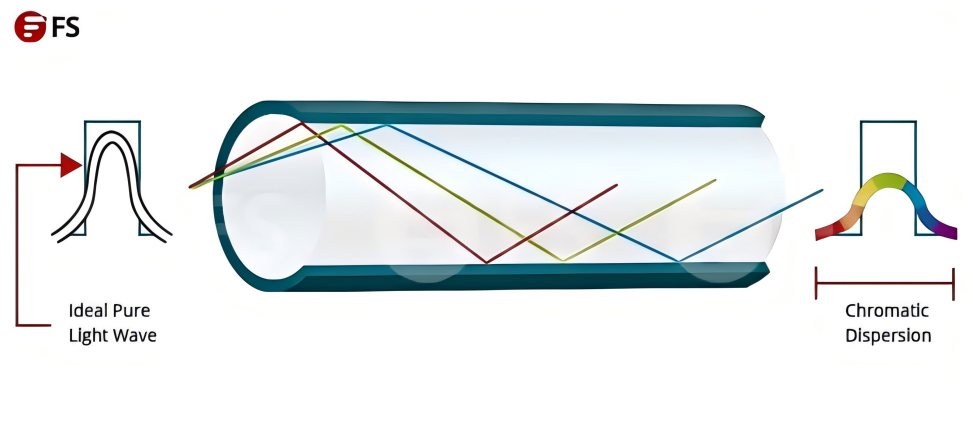
Figure 4.Diagram of dispersion
The dispersion of the fiber varies with the wavelength, and the attenuation coefficient of the single-mode fiber is the smallest at 1550nm, but the dispersion coefficient is larger at this wavelength. So people have developed a single mode fiber with a dispersion coefficient of 0 at 1550nm, and this seemingly perfect fiber is G.653.
G.654 Optical Fiber
G.654 optical fiber is mainly used in submarine cable communication system. In order to meet the needs of long distance and large capacity of submarine cable communication, G.654 optical fiber is improved in two aspects. (1) Reduce the loss of optical fiber; From 0.22dB/km of G.652 to 0.19dB/km (standard value). (2) increasing the mode field diameter of the fiber; The larger the diameter of the mode field of the fiber, the smaller the energy density through the cross section of the fiber, so as to improve the nonlinear effect of the fiber and enhance the signal-to-noise ratio of the fiber communication system.
G.655 Optical Fiber
G.653 fiber has zero dispersion at 1550nm wavelength and does not use WDM system. Therefore, a fiber with small but non-zero dispersion at 1550nm wavelength has been developed, which is G.655 fiber. G.655 fiber has the smallest attenuation and smaller dispersion around 1550nm, which can be used in WDM systems. Therefore, G.655 fiber has been the first choice for long distance trunk lines for a long time.However, with the maturity of dispersion compensation technology, G.655 fiber is gradually replaced by G.652 fiber, the main reason is the large difference in fiber price.
G.657 Optical Fiber
G.657 fiber is the most used fiber except G.652. It is a kind of bending insensitive fiber, which is mainly used for indoor fiber wiring.G.657 fiber is used in FTTH cables that are thinner than telephone lines.

Figure 5.Diagram of dispersion