






Preform Stage: The Core Logic of Building the Glass Structure with PECVD and PCVD
Describe the process like a manufacturer, not an encyclopedia. Focus on system modules, what is being controlled, and what is delivered. Avoid formulas and numeric thresholds.
Key Modules in the Deposition System

A PECVD or PCVD preform deposition line is best understood as a set of tightly coordinated modules designed to keep the plasma stable, the gas delivery repeatable, and the deposition environment clean. Typical building blocks include a plasma excitation module, commonly RF-based or microwave-based depending on system design; a reaction chamber with a tube-based deposition geometry and controlled motion or feed to keep deposition uniform along the length; gas delivery with mass flow control for repeatable chemistry delivery; vacuum and pressure control combined with exhaust handling and safety interlocks; and cleanliness management that targets moisture, oxygen, and particle contamination. The point is not to optimize for a single setpoint, but to maintain stable plasma behavior, stable gas delivery, and a consistently clean process environment so the deposited glass layers remain structurally uniform.
Why PECVD and PCVD Matter for the Refractive-Index Profile?
The refractive-index profile is the foundation of how an optical fiber guides light. It influences mode propagation, bend sensitivity, and dispersion behavior, and it is a key reason why two fibers with the same nominal type can still perform differently in real networks. Plasma-assisted deposition supports controlled formation of glass layers and dopant distributions, and that control translates directly into how consistently the intended refractive-index profile can be achieved. Layer thickness stability helps prevent profile ripple and local variation, while dopant distribution consistency helps reduce radial non-uniformity that can later show up as performance variation. Typical process risks include layer thickness fluctuation, radial non-uniformity, and particles or micro-defects. These issues may not remain small; they can be amplified during consolidation and fiber drawing, making downstream stability harder to maintain.
Post-Processing and Inspection: Turning Deposition into a Draw-Ready Preform

Preform Production Process Overview: Deposition → Post-Processing → Inspection
After deposition, the preform typically goes through consolidation, densification, collapse, and final forming steps, depending on the chosen route. This is where the deposited structure is converted into a mechanically robust, draw-ready preform with the required geometry and internal integrity. Inspection focuses on geometric consistency such as concentricity and roundness, as well as visual and structural indicators like striations, bubbles, inclusions, and stress-related features. The output of this stage is not just a preform that meets a basic specification, but a preform engineered for drawability and structural consistency, which is essential for stable fiber drawing, coating performance, and ultimately predictable field performance.
From Preform to Fiber
How Drawing and Coating Turn Structural Stability into Scalable Consistency
Closed-loop control and in-line monitoring are what transform a good preform into repeatable, mass-producible fiber performance. This section explains the key modules in the drawing tower and how SPC stops variation before it reaches downstream cabling.
Key Modules in the Fiber Drawing Tower
Preform loading and stable feed
Ensures steady material input so the drawing process stays consistent over long runs.
High-temperature furnace with stable thermal field
Maintains a controlled temperature environment and reduces contamination risk during drawing.
In-line diameter measurement for closed-loop control
Real-time diameter feedback enables automatic adjustment to keep fiber geometry consistent.
Tension and line-speed closed-loop control
Coordinates capstan and take-up to keep mechanical conditions stable and reduce fluctuation.
Coating application, primary and secondary layers
Applies protective layers to support handling durability and long-term reliability.
UV curing system for consistent cure quality
Ensures coating is fully and uniformly cured to reduce coating-related defects.
In-line proof testing for strength screening
Screens mechanical strength to prevent weak sections from moving downstream.
In-Line Monitoring and SPC
Stopping Variation During Production
What is monitored
- Geometry: diameter, ovality, concentricity
- Process stability: tension behavior, line-speed stability
- Coating condition: coating integrity and consistency indicators
How variation is controlled
- Trend-based alarms to catch drift early
- Rapid isolation of abnormal segments
- Batch and reel traceability to link outcomes to upstream process data
Why this improves quality
- Reduces batch-to-batch variation
- Prevents latent defects from entering cabling, where detection and correction are harder and costlier
- Strengthens acceptance confidence through more stable and repeatable output

From Fiber to Cable
How Structural Manufacturing Prevents Hidden Loss and Reliability Issues in the Field
Present cabling as structural engineering and risk control, not a list of product models. Focus on how each process step reduces latent loss mechanisms and improves long-term reliability.
Buffering and Tubing
Tight Buffer and Loose Tube
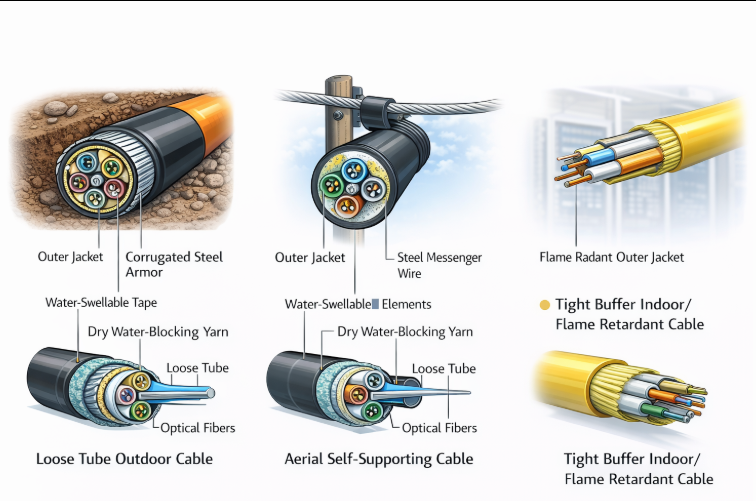
Loose tube
The objective is to protect fibers while keeping them mechanically decoupled from external stresses. Key controls include fiber excess length management to reduce stress transfer, and a water-blocking approach selected for the product line, such as dry water-swellable materials or gel-based filling. The goal is stable fiber positioning, reduced moisture risk, and lower probability of stress-induced attenuation over time.
Tight buffer
Tight buffering focuses on dimensional stability and handling performance. Process control targets consistent outer diameter, stable concentricity, and material uniformity to support flexibility and repeated bend performance. The objective is to reduce stress concentration points that can drive bend sensitivity and microbending loss in high-density or frequently handled environments.
Stranding and Forming
SZ Stranding and Layer Stranding
Lay control and back-twist control goals
Stranding is engineered to balance flexibility, crush resistance, and stress distribution. The objective is to maintain stable lay behavior without introducing periodic stress patterns that can translate into attenuation variation.
Tension control and uniform distribution of water-blocking elements
Controlled tension keeps structural elements consistent through the run, while uniform placement of water-blocking yarns or tapes avoids localized hard spots that can create microbending risk.
Design and process practices to reduce microbending and macrobending risk
Structural symmetry, stable element positioning, and controlled contact interfaces help reduce pressure points and long-term creep effects. The focus is preventing small, hidden stress sources that may not be visible during installation but can increase loss or reduce reliability over time.
Armoring and Jacket Extrusion
Equipment-Based View Plus Quality Controls
Armoring options
Depending on the design, armoring may use longitudinal tape wrapping, corrugated metal structures, or wire armor. The goal is to add mechanical protection while controlling stiffness and preventing stress transfer into the fiber bundle.
Jacket extrusion workflow
A typical line includes extrusion, sizing, cooling, hauling, printing, and in-line inspection. In-line electrical testing concepts such as spark testing can be used to detect jacket defects early and prevent damaged sections from moving forward.
Key control targets
Focus areas include stable outer diameter, low eccentricity, minimal surface defects, and well-defined layer interfaces. Interface design targets controlled bonding or clean stripping behavior, depending on the application, to support installation reliability and long-term environmental resistance.
Why Hengtong Delivers Better Quality?
Four Evidence Pillars Based on Public Statements
Writing goal: Support "better" with mechanisms, publicly available evidence, and deliverable documents.
Pillar 1 - Source control
An integrated quality chain starting from the glass structure
Hengtong states publicly that it has optical fiber preform design and manufacturing capabilities and publishes clear capability boundaries: preform length up to 6 m, outer diameter up to 200 mm, and a single preform can draw more than 15,000 km of fiber. It also lists a preform outer diameter range of 80 to 200 mm and notes these preforms can be used to produce G.652.D low-water-peak fiber and G.657.A FTTx fiber.
Pillar 2 - Process control
PCVD deposition described as precise refractive-index and high-purity layer control
In publicly available Hengtong content, PCVD is described as enabling strong control of refractive index and layer purity, supporting thin layers and high-purity layers, and improving fiber performance by adjusting the fiber profile. The same source notes material utilization above 95 percent.
Pillar 3 - In-process control
In-line monitoring and closed-loop control to reduce variation during production
Hengtong publicly describes drawing uniform 125 micrometer fiber on automated lines and states that inline gauges monitor diameter, concentricity, and coating cure in real time.
At the system level, Hengtong also describes factory informatization, lean manufacturing, and having systems in place to trace quality.
Hengtong also highlights that serious testing starts before cabling, describing proof testing at the bare fiber stage as a mechanical strength screening step that affects the reliability baseline of fiber entering the cable core.
Pillar 4 - Deliverable proof
Testing systems and certifications that make quality verifiable and traceable
Hengtong's public single-reel test guidance explains that OTDR backscatter methods can provide the backscatter trace, fiber length, and attenuation results, supporting standardized evaluation of delivered reels.
Its public acceptance testing guidance also states that OTDR testing should be performed on each fiber core during completion acceptance.
For certifications, Hengtong's public certifications page lists UL1651 optical fiber cable types including OFNR, OFNP, and OFCR.
What to Request in a Practical Delivery Evidence Package?
When evaluating suppliers or preparing for project acceptance, ask for a clear evidence package aligned with your application and market requirements.
Traceability identifiers
Reel ID, batch ID, and mapping to key process stages, so issues can be investigated efficiently.
Factory test records
OTDR-based single-reel results when applicable, plus supporting optical and dimensional checks as required by the product.
Acceptance testing guidance
Clear OTDR per-core acceptance expectations for commissioning and handover.
Compliance and certification support
Certification lists relevant to your region and application, such as UL1651 categories for certain indoor cable ratings.
FAQ
Q: Is PECVD used in cable jacket extrusion?
A: No. PECVD is associated with preform and fiber-making processes, not cable jacketing or cabling.
Q: Why do PECVD and PCVD show up together in fiber discussions?
A: In preform manufacturing, PCVD is commonly used to describe plasma-driven deposition approaches closely related to PECVD, with naming depending on convention.
Q: Why does the refractive-index profile matter for bending and field performance?
A: Refractive-index profile design is a recognized lever for reducing bend sensitivity and influencing how coated fiber performs under bending conditions. Google Patents
Q: What is the practical purpose of in-line gauges during drawing?
A: To detect drift early and keep geometry and coating cure stable in real time, reducing batch-to-batch variation.
Q: Where does proof testing fit, and why should buyers care?
A: Hengtong describes proof testing as a bare-fiber mechanical strength screening step before cabling, which affects the reliability margin of fiber used inside the finished cable.
Q: What does an OTDR result actually give you?
A: OTDR characterizes loss behavior along a fiber by analyzing backscatter and reflections, supporting identification of events and attenuation trends. Fluke Networks
Q: What is single-reel OTDR testing used for?
A: Hengtong's guidance notes that OTDR backscatter methods provide the trace, fiber length, and attenuation results for reel-level assessment.
Q: What is a typical acceptance expectation during project handover?
A: Hengtong's acceptance testing guidance states that OTDR testing should be performed on each fiber core during completion acceptance.
Q: Which UL categories are commonly referenced for certain indoor fiber optic cables?
A: Hengtong's certification listings include UL1651 cable types such as OFNR, OFNP, and OFCR.
Conclusion
PECVD and PCVD belong to the beginning of fiber quality, where the glass structure and refractive-index profile are formed. Hengtong's public technical materials position PCVD as a way to tightly control refractive index and layer purity, while its manufacturing descriptions emphasize in-line monitoring, process traceability, and early strength screening before cabling. Combined with OTDR-based reel testing guidance and published certification listings, this forms a practical chain from upstream process control to delivery evidence that buyers can use for selection, acceptance, and project delivery.
Share your application scenario, route constraints, core count, fire rating needs, and acceptance requirements. Hengtong can align a cable structure recommendation and a delivery evidence package to your project.