





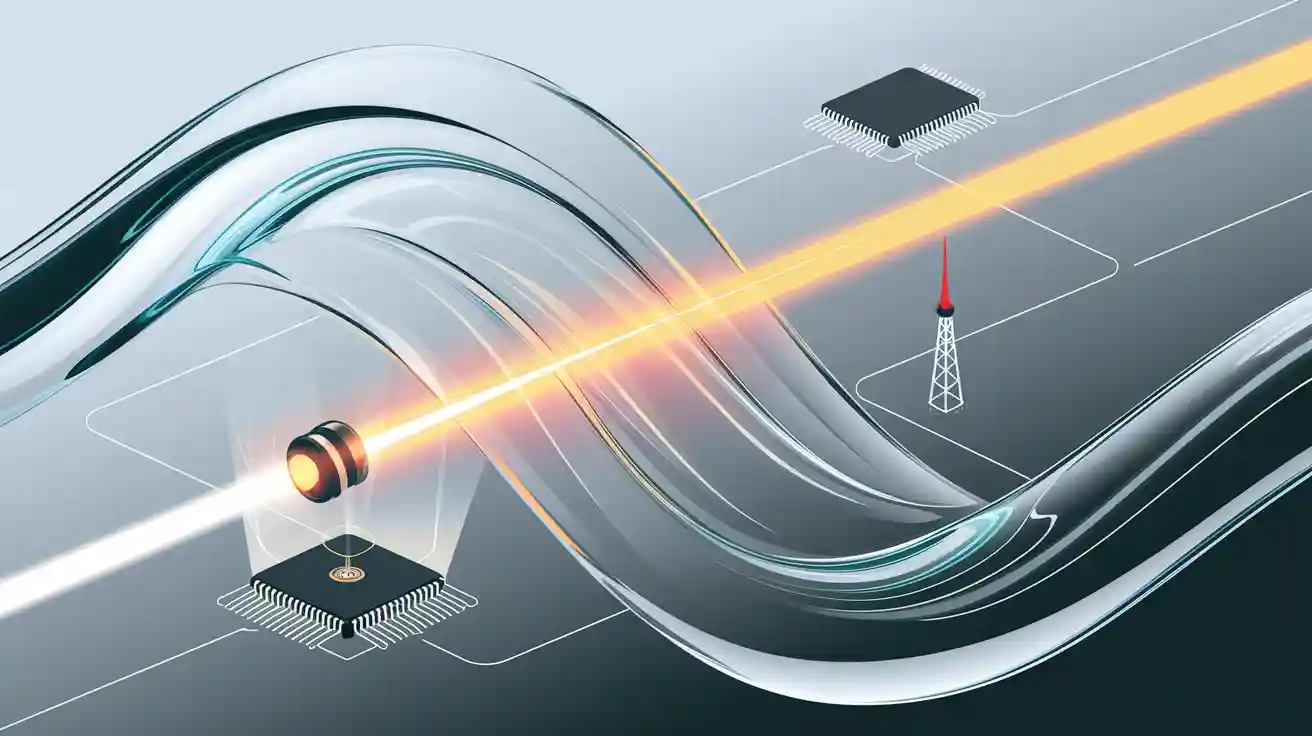
An optical waveguide guides light efficiently and confines energy in one direction using a core surrounded by cladding. You encounter this technology in devices that power high-speed internet and advanced displays. The global market for optical waveguides is growing rapidly, driven by demand in datacenters and 5G networks. Researchers continue to improve AR glasses and wearable sensors, making them lighter and more comfortable for everyday use. These innovations help shape healthcare, manufacturing, and consumer electronics by enabling smarter, more reliable solutions.
Key Takeaways
- Optical waveguides efficiently guide light using a core and cladding structure, minimizing signal loss.
- Total internal reflection is the key principle that allows light to be confined within the waveguide, ensuring effective transmission.
- Different types of waveguides, such as optical fibers and planar waveguides, serve various applications in telecommunications and sensing.
- Single-mode waveguides are ideal for long-distance communication, while multimode waveguides are better for short-range applications.
- Choosing the right materials for waveguides, like silica or polymers, impacts performance and application suitability.
- Waveguides play a crucial role in modern technologies, enabling high-speed internet, advanced medical imaging, and integrated photonics.
- Understanding waveguide properties, such as attenuation and dispersion, helps optimize performance for specific applications.
- Future trends in waveguide technology include miniaturization, flexible devices, and advancements in quantum computing.
What Is an Optical Waveguide?

Definition
You can think of an optical waveguide as a physical structure that channels light along a specific path. This structure uses a core with a higher refractive index, surrounded by a cladding with a lower refractive index. The difference in refractive indices is crucial because it enables total internal reflection. When light enters the core at the right angle, it reflects off the boundary with the cladding and stays trapped inside the core. This process allows you to transmit light efficiently over long distances or through compact devices.
Note: The main function of an optical waveguide is to confine and direct light, preventing it from escaping and minimizing loss.
Structure
The structure of a waveguide determines how well it can guide light and how efficiently it can transmit signals. Most optical waveguides have a simple yet effective design: a central core and an outer cladding. The core's higher refractive index keeps the light inside, while the cladding acts as a barrier. You will find several types of waveguide geometries, such as planar, strip, and fiber shapes. Each geometry supports different applications and performance needs.
Here is a table summarizing the key physical characteristics that define an optical waveguide:
|
Characteristic Type |
Description |
|---|---|
|
Types |
Optical fiber waveguides, transparent dielectric waveguides, liquid light guides, and liquid waveguides. |
|
Geometry |
Planar, strip, or fiber waveguides. |
|
Mode Structure |
Single-mode or multi-mode. |
|
Refractive Index Distribution |
Step index or gradient index. |
|
Material |
Glass, polymer, or semiconductor. |
|
Principle of Operation |
Light is guided by total internal reflection at a dielectric interface. |
You will encounter a variety of materials in waveguide construction, each chosen for its unique optical properties:
- Silica (SiO2): Ideal for fiber optic cables due to low loss and high thermal stability.
- Silicon (Si): Used in silicon-on-insulator waveguides for strong refractive index contrast.
- Silicon Nitride (Si3N4): Offers low optical losses and broad wavelength operation.
- Polymers: Such as PMMA, suitable for short-distance communication and easy processing.
- Glasses: Including phosphate and chalcogenide glasses, valued for special optical features.
- Lithium Niobate (LiNbO3): Preferred for high electro-optic coefficients.
- III-V Semiconductors: Like GaAs and InP, important for integrating active devices.
The structure also supports various spatial and polarization channels, which is essential for efficient light transmission. For example, a well-designed waveguide matches the beam diameter to the mode size, ensuring effective coupling and minimal loss.
Core Purpose
The core purpose of an optical waveguide is to confine and direct light with minimal loss. You rely on this technology to transmit data, sense changes in the environment, and deliver precise signals in medical and industrial devices. The waveguide's design allows you to control light modes, shape wavefronts, and couple light efficiently between different components.
You benefit from waveguides because they:
- Keep light signals strong and focused over long distances.
- Enable high-speed data transfer in communication networks.
- Support advanced sensing and imaging in healthcare and industry.
- Allow integration of multiple optical functions on a single chip.
When you use devices powered by optical waveguides, you experience faster internet, clearer medical images, and more reliable sensors. The waveguide's ability to manage light efficiently is the foundation for many modern technologies.
Waveguide Principles

Total Internal Reflection
You rely on total internal reflection as the main mechanism that allows a waveguide to confine light. When light travels through the core, it encounters the boundary with the cladding. If the angle of incidence exceeds a certain threshold, called the critical angle, the light reflects entirely back into the core. This process keeps the light trapped and enables efficient transmission along the waveguide.
Jean-Daniel Colladon first demonstrated this principle in the 1840s with his famous "Light Fountain" experiment. He directed light through a stream of water, showing how it could follow a curved path without escaping. This experiment laid the groundwork for modern optical waveguide technology.
In practical devices, you see total internal reflection in action when light remains confined within a core that has a higher refractive index than the surrounding cladding.
Advanced tools like total internal reflection fluorescence (TIRF) microscopy use this principle to achieve precise control over light at the microscopic level. Quality control in waveguide manufacturing often involves measuring propagation losses, confirming that total internal reflection works as intended.
You benefit from this mechanism because it ensures that light stays within the waveguide, minimizing loss and supporting reliable transmission.
Refractive Index
The refractive index difference between the core and cladding is essential for light confinement. You calculate the refractive index contrast, Δ, using the formula Δ = (n1² - n2²) / (2n1²), where n1 is the core index and n2 is the cladding index. For total internal reflection to occur, the cladding must have a lower refractive index than the core.
- A higher refractive index in the core improves light confinement, allowing more efficient transmission of light modes.
- When light strikes the core-cladding boundary at angles greater than the critical angle, it reflects back into the core. This keeps the light focused and prevents it from leaking out.
- Standard optical fibers often have a low refractive index contrast. This results in weaker guiding, so a larger portion of the light's electric field extends into the cladding.
You can optimize waveguide performance by carefully selecting materials and adjusting the refractive index contrast. This control lets you design waveguides for specific transmission needs, such as long-distance communication or sensitive sensing applications.
Light Propagation
Light propagation in a waveguide describes how light travels through the core while maintaining its direction and intensity. You observe that the waveguide supports different modes, which are specific patterns of electromagnetic fields that can exist within the structure. Each mode has unique propagation characteristics, such as phase and attenuation constants.
- Researchers have developed methods to accurately calculate these constants, even in complex waveguides with periodic structures or material losses. This understanding helps you predict how light will behave in real-world applications, from high-speed data transmission to advanced sensors.
- You use waveguides to achieve efficient wave propagation, ensuring that light signals remain strong and clear over long distances. By mastering these principles, you unlock the full potential of optical waveguide technology in modern communication and sensing systems.
Modes
When you use an optical waveguide, you encounter the concept of modes. Modes describe the distinct patterns in which light travels through the waveguide. Each mode represents a specific distribution of the electromagnetic field across the core and cladding. You need to understand modes because they determine how efficiently your device transmits signals and how much information you can send.
You often hear about two main types of modes: single-mode and multimode. Single-mode waveguides allow only one path for light to travel. This design minimizes signal distortion and supports high-speed communication over long distances. Multimode waveguides support multiple paths, or modes, for light. These waveguides work well for short-distance applications, such as local area networks or imaging systems.
Tip: Choose single-mode waveguides for long-haul data transmission. Select multimode waveguides for cost-effective solutions in short-range networks.
The number of supported modes depends on the waveguide's core diameter, refractive index profile, and the wavelength of light. You can use the following table to compare single-mode and multimode waveguides:
|
Feature |
Single-Mode Waveguide |
Multimode Waveguide |
|---|---|---|
|
Core Diameter |
Small (8-10 µm) |
Large (50-62.5 µm) |
|
Supported Modes |
One |
Multiple |
|
Signal Quality |
High |
Moderate |
|
Typical Use |
Long-distance communication |
Short-distance networks |
|
Cost |
Higher |
Lower |
You benefit from understanding modes because they affect wave propagation and signal integrity. In single-mode waveguides, you achieve stable wave propagation with minimal interference. This stability is essential for applications like high-speed internet and precision sensing. In multimode waveguides, you may notice modal dispersion, where different modes travel at different speeds. This effect can limit bandwidth and reduce signal clarity.
You can optimize your system by matching the mode structure to your application. For example, you select single-mode fibers for backbone internet connections. You choose multimode fibers for building networks or medical imaging devices. You also encounter advanced mode engineering in integrated photonics, where controlling modes enables compact, multifunctional chips.
Modes play a crucial role in the design and performance of optical waveguides. When you understand how modes influence wave propagation, you make informed decisions about materials, geometry, and signal processing. This knowledge helps you build reliable, high-performance optical systems for communication, sensing, and beyond.
Types of Optical Waveguides

Optical Fiber
You encounter optical fibers in almost every modern communication system. These waveguides form the backbone of optical fiber networks, carrying light signals over long distances with minimal loss. You see them as flexible filaments made of clear glass. The core, usually silica glass, transmits light, while the cladding surrounds the core with a lower refractive index. This structure ensures that light remains confined through total internal reflection.
Why do you rely on optical fibers? You benefit from their ability to transmit large amounts of data quickly and efficiently. The design allows light to travel through the fiber with very little attenuation, making them ideal for high-speed internet, cable television, and medical imaging. You also find optical fibers in sensors and industrial equipment, where precise light transmission is essential.
Here are the main reasons you choose optical fibers for your applications:
- They support long-distance transmission with low signal loss.
- The flexible design makes installation easy in various environments.
- You achieve high bandwidth, which is crucial for data-heavy tasks.
Tip: Use optical fibers when you need reliable, high-capacity communication over extended distances.
Planar Waveguide
You use planar waveguides when you need to integrate optical functions onto a flat surface. These waveguides consist of thin layers of optical material deposited on a substrate. The core layer guides light, while the surrounding layers act as cladding. You find planar waveguides in integrated optical circuits, sensors, and photonic chips.
Why do you select planar waveguides? You benefit from their compatibility with microfabrication techniques. This allows you to create compact, scalable devices for telecommunications, data centers, and biosensors. Planar waveguides enable you to combine multiple optical components on a single chip, reducing size and cost.
Key advantages of planar waveguides include:
- Easy integration with electronic and photonic circuits.
- Support for mass production using semiconductor processes.
- Precise control over light propagation and device geometry.
You often choose planar waveguides for applications that require miniaturization and integration of multiple optical functions.
Photonic Crystal Waveguide
You turn to photonic crystal waveguides when you need advanced control over light. These waveguides use a linear defect in a high-index dielectric membrane to guide light. The structure relies on both total internal reflection and distributed reflections, allowing you to transmit light efficiently even with sharp bends.
Why do photonic crystal waveguides matter? You benefit from their ability to support densely integrated photonic circuits with minimal transmission loss. The unique design lets you manipulate light in ways that traditional waveguides cannot. You achieve greater flexibility in circuit layout and improved performance in compact devices.
Consider these reasons for using photonic crystal waveguides:
- Efficient light transmission in complex, miniaturized circuits.
- Support for advanced photonic integration and low-loss operation.
- Enhanced control over light propagation, enabling new device functionalities.
You find photonic crystal waveguides in cutting-edge research, optical computing, and next-generation communication systems.
Note: Choose photonic crystal waveguides when you need high performance and flexibility in integrated photonic devices.
|
Waveguide Type |
Structure & Materials |
Light Guiding Mechanism |
Typical Applications |
|---|---|---|---|
|
Optical Fiber |
Flexible glass core/cladding |
Total internal reflection |
Telecom, medical imaging, sensors |
|
Planar Waveguide |
Thin layers on substrate |
Total internal reflection |
Integrated circuits, biosensors |
|
Photonic Crystal |
Defect in dielectric membrane |
Internal & distributed reflections |
Photonic chips, optical computing |
You choose the right waveguide based on your needs for light transmission, integration, and device performance.
Rib and Strip Waveguide
You often need to guide light precisely on a chip or within a compact device. Rib and strip waveguides give you this control. These structures use a rectangular or raised "rib" of material on a flat substrate. You find them in integrated photonic circuits, where space and efficiency matter most.
Why choose rib and strip waveguides?
You benefit from their ability to confine light tightly in small regions. This design lets you build dense optical circuits, which is essential for modern data centers and advanced sensors. You also achieve low propagation loss, which means your signals stay strong as they travel through the device.
You see rib waveguides as a raised section of core material, usually silicon or another semiconductor, on top of a lower-index layer. The rib shape helps you balance tight light confinement with easy fabrication. Strip waveguides, on the other hand, use a fully etched rectangular core. This structure gives you even stronger confinement, which is ideal for sharp bends and compact layouts.
Tip: Use rib waveguides when you need low loss and easy alignment. Choose strip waveguides for maximum integration and tight bends.
You often compare these waveguides to optical fibers. While optical fibers excel at long-distance transmission, rib and strip waveguides shine in on-chip applications. You use them to connect lasers, modulators, and detectors on a single platform. This integration supports the rapid growth of optical fiber networks and enables new technologies in computing and sensing.
Here is a quick comparison table:
|
Feature |
Rib Waveguide |
Strip Waveguide |
Optical Fibers |
|---|---|---|---|
|
Structure |
Raised rib on substrate |
Fully etched core |
Cylindrical core |
|
Light Confinement |
Moderate |
Strong |
Moderate |
|
Integration Level |
High |
Very High |
Low |
|
Typical Use |
Photonic chips |
Dense photonic circuits |
Long-distance links |
You gain several advantages with rib and strip waveguides:
- High integration density for compact devices.
- Compatibility with standard semiconductor processes.
- Precise control over light propagation and coupling.
You should consider rib and strip waveguides when you want to move beyond traditional optical fibers and build next-generation photonic systems. These waveguides help you create faster, smaller, and more efficient devices for communication, sensing, and computing.
Waveguide Properties

Attenuation
You need to understand attenuation when you work with any optical waveguide. Attenuation describes how much the intensity of light decreases as it travels through the waveguide. Lower attenuation means higher transmission efficiency, which is critical for long-distance communication and high-performance devices.
Attenuation in fiber optics is measured in decibels (dB) using the formula:
Attenuation (dB) = 10 × log10(Input intensity (W) / Output intensity (W))
Several factors influence attenuation:
- At wavelengths longer than about 1.5 microns, infrared absorption increases, causing higher attenuation.
- The low-attenuation band near 1.5 microns spans about 20 THz, giving you substantial bandwidth for data transmission.
- Early optical waveguides faced high propagation loss due to impurities in the glass, but modern manufacturing has reduced these losses significantly.
You should select waveguides with low attenuation for applications that require strong light signals over long distances. This choice ensures reliable performance in telecommunications, medical imaging, and industrial sensing.
Dispersion
Dispersion affects how light pulses spread as they travel through a waveguide. You must pay attention to dispersion because it can distort signals and limit the distance light can travel without regeneration.
If dispersion is too high, a group of pulses representing a bit-stream will spread in time and merge, rendering the bit-stream unintelligible. This limits the length of fiber that a signal can be sent down without regeneration.
Dispersion leads to pulse broadening, which causes signal distortion. When pulses overlap, you find it difficult to distinguish the intended signal. Increased dispersion lowers achievable data rates and limits transmission distance.
- Dispersion causes pulse broadening, leading to signal distortion.
- Overlapping light pulses make it difficult to identify the intended signal.
- Increased dispersion results in lower achievable data rates and limits transmission distance.
- You see three main effects of dispersion in waveguides:
- Pulse spreading leads to Inter-Symbol Interference (ISI).
- Increased ISI raises the Bit Error Rate.
- Longer fiber links exacerbate dispersion effects, limiting maximum reach without regeneration.
You should choose waveguides with low dispersion for high-speed data transmission. This choice helps maintain signal clarity and supports advanced communication systems.
Mode Field
Mode field describes how light distributes across the cross-section of a waveguide. You need to understand mode field diameter (MFD) because it affects coupling efficiency, bending sensitivity, and overall transmission efficiency.
Several factors influence the mode field diameter:
- The refractive index profile determines how tightly light is confined.
- The wavelength of the optical signal plays a significant role in setting the MFD.
- The geometry of the fiber, such as core diameter and shape, also affects the MFD.
- The MFD relates to the effective cross-sectional area of the fiber.
- The numerical aperture (NA) is inversely proportional to the MFD, impacting bending sensitivity and coupling efficiency.
You should match the mode field diameter to your application. For example, a larger MFD improves coupling with other optical components, while a smaller MFD enhances light confinement and reduces bending losses.
|
Factor Influencing MFD |
Impact on Mode Field Diameter |
|---|---|
|
Refractive Index Profile |
Tighter confinement with higher contrast |
|
Wavelength |
Longer wavelengths increase MFD |
|
Fiber Geometry |
Larger core increases MFD |
|
Numerical Aperture (NA) |
Higher NA reduces MFD |
You optimize waveguide performance by balancing these factors. This approach ensures efficient light transmission and reliable operation in your optical systems.
Material Choices
When you select materials for an optical waveguide, you make decisions that directly affect performance, reliability, and cost. The right material ensures strong light confinement, low transmission loss, and stable operation in your application. You must consider several factors, such as refractive index, transparency, mechanical strength, and compatibility with fabrication processes.
Why does material choice matter for optical waveguides?
You need a material with a high refractive index for the core and a lower refractive index for the cladding. This difference allows total internal reflection, which keeps light trapped inside the waveguide. If you choose the wrong material, you risk high attenuation, poor signal quality, or even device failure.
Tip: Always match the material to your application's wavelength range and environmental conditions.
Here are the most common materials you encounter in optical waveguide design:
- Silica Glass (SiO₂): You use silica for fiber optics because it offers low attenuation, high transparency, and excellent thermal stability. Silica supports transmission over long distances and works well in harsh environments.
- Polymers (PMMA, polycarbonate): You select polymers for flexible, low-cost waveguides. They suit short-distance communication and disposable sensors. Polymers allow easy processing and integration with electronics.
- Semiconductors (Silicon, GaAs, InP): You rely on silicon and III-V semiconductors for integrated photonic circuits. These materials provide high refractive index contrast, enabling compact designs and fast signal processing.
- Lithium Niobate (LiNbO₃): You choose lithium niobate for modulators and switches. It offers strong electro-optic properties, making it ideal for high-speed applications.
- Specialty Glasses (chalcogenide, phosphate): You use specialty glasses for infrared transmission and nonlinear optics. These materials expand the range of waveguide applications.
|
Material Type |
Key Properties |
Typical Applications |
|---|---|---|
|
Silica Glass |
Low loss, high stability |
Fiber optics, telecom |
|
Polymers |
Flexible, easy to process |
Sensors, short-range links |
|
Silicon |
High index, CMOS compatible |
Photonic chips, data centers |
|
Lithium Niobate |
Electro-optic, stable |
Modulators, switches |
|
Chalcogenide Glass |
IR transmission, nonlinear |
Specialty sensors, lasers |
You must also consider how the material interacts with light at different wavelengths. For example, silica transmits visible and near-infrared light efficiently, while chalcogenide glass works best in the mid-infrared range. If you need high-speed data transmission, you often choose silicon for its compatibility with electronic circuits.
Note: Material selection impacts not only optical performance but also manufacturing cost and scalability.
When you understand why material choices matter, you can design optical waveguides that deliver reliable, high-quality transmission in any environment. You ensure your device meets industry standards and user expectations.
Citations and annotations will be collected at the end of the article.
Optical Waveguide Applications
Telecommunications
You rely on optical waveguides every time you use the internet, make a video call, or stream high-definition content. These waveguides form the backbone of modern communication networks. They guide light signals with minimal loss, enabling high-speed data transfer across continents and under oceans. You benefit from rapid, reliable transmission that supports your daily digital activities.
Optical waveguides play a crucial role in several key applications within telecommunications. The table below highlights the most significant uses:
|
Application |
Description |
|---|---|
|
High-Speed Data Transmission |
Fiber optic cables use waveguides to deliver high-speed data transfer, meeting the demands of modern bandwidth-intensive services. |
|
Wavelength Division Multiplexing |
This technology allows multiple data streams to travel simultaneously over a single fiber, greatly increasing network capacity. |
|
Optical Networks |
Advanced waveguide designs improve efficiency and reduce latency, which is vital for 5G networks and reliable data connections. |
You see the impact of these applications in your everyday life. Fiber optic waveguides enable seamless video streaming and cloud computing. Wavelength division multiplexing lets service providers offer faster internet speeds without laying new cables. Optical networks support the growth of smart cities and connected devices. You experience fewer dropped calls and faster downloads because waveguides maintain strong light signals over long distances.
When you choose a service provider, you often look for high-speed data transfer and reliable signal transmission. Optical waveguide technology meets these needs by delivering robust communication solutions. You can trust that your data travels securely and efficiently, whether you work from home or connect with friends around the world.
Sensors
You encounter optical waveguides in sensor applications that monitor your environment, protect your health, and improve industrial processes. These waveguides guide light to detect changes in temperature, pressure, chemical composition, and more. You benefit from accurate, real-time data that helps you make informed decisions.
Optical waveguide sensors offer several advantages in industrial and environmental monitoring:
- Laser and lidar sensing of the environment
- Optical detection of fugitive emissions in the oil and gas supply chain
- Novel optical techniques for monitoring industrial emissions and process control
- Photonics for increased efficiency and sustainability in agriculture
- Optics and photonics for renewable and petrogenic energies
Recent advancements in waveguide sensor technology, especially those using Fano resonance, have improved sensitivity and detection accuracy. You can monitor biochemical changes and environmental conditions with greater precision. These sensors detect subtle shifts in refractive index, which is essential for tracking pollution, ensuring food safety, and maintaining industrial equipment.
You rely on waveguide sensors for applications that demand high accuracy and fast response times. For example, you use them to detect hazardous gases in factories or monitor soil quality in agriculture. These sensors help you reduce risks, optimize production, and protect the environment. You gain peace of mind knowing that waveguide technology delivers reliable data for critical applications.
Medical Devices
You benefit from optical waveguides every time you undergo a medical test or procedure that uses light. These waveguides enable noninvasive imaging, precise diagnostics, and targeted therapies. You experience safer, more comfortable treatments because waveguides guide light directly to tissues and cells.
Medical devices use biocompatible waveguides to transmit light for real-time sensing and therapy. These waveguides avoid foreign body reactions, making them suitable for insertion into the human body. You see their impact in endoscopes, which allow doctors to visualize internal organs without surgery. Optical waveguides also support fluorescence and bioluminescence imaging, providing high-resolution views of tissues and cells.
- Biocompatible waveguides serve as a medium for light and tissues, enabling real-time sensing and therapy.
- These waveguides are designed to avoid foreign body reactions, ensuring safe use inside the body.
- They enable noninvasive imaging techniques, such as fluorescence and bioluminescence, for high-resolution visualization.
You rely on these applications for early disease detection, minimally invasive surgeries, and advanced research. Waveguide technology helps doctors diagnose conditions faster and treat patients with greater accuracy. You benefit from improved outcomes and reduced recovery times. When you choose a healthcare provider, you look for advanced imaging and diagnostic tools powered by optical waveguides.
Integrated Photonics
You see integrated photonics as a driving force behind the next generation of optical applications. This technology allows you to combine multiple optical functions onto a single chip, similar to how microelectronics revolutionized computing. You use integrated photonics to achieve compact, efficient, and scalable solutions for communication, sensing, and data processing.
You rely on optical waveguides in integrated photonics because they guide light with precision across tiny circuits. These waveguides enable you to transmit signals between lasers, modulators, detectors, and other components without significant loss. You benefit from reduced size, lower power consumption, and improved performance in your devices.
Why do you choose integrated photonics for your applications? You need high-speed transmission and reliable communication in data centers, cloud computing, and advanced sensors. Integrated photonics lets you process vast amounts of information using light, which moves faster and consumes less energy than electrical signals.
You encounter several key applications for integrated photonics:
- Data center interconnects: You achieve rapid optical communication between servers, supporting cloud services and streaming.
- Quantum computing: You use waveguides to control and transmit quantum light signals for secure data processing.
- LiDAR systems: You rely on integrated photonics for precise light transmission in autonomous vehicles and robotics.
- Biosensors: You detect biological changes using compact optical chips, improving medical diagnostics and environmental monitoring.
Tip: Integrated photonics helps you scale up your optical communication networks while reducing cost and complexity.
You see the impact of integrated photonics in your daily life. Smartphones, smartwatches, and wearable devices use optical waveguides for fast data transmission and advanced sensing. You benefit from seamless connectivity and smarter technology in your home and workplace.
Here is a table showing how integrated photonics supports different applications:
|
Application Area |
Role of Optical Waveguides |
Benefit to You |
|---|---|---|
|
Data Centers |
High-speed light transmission |
Faster cloud access |
|
Quantum Computing |
Secure quantum light communication |
Advanced data security |
|
LiDAR |
Precise light guidance |
Safer autonomous vehicles |
|
Biosensors |
Efficient light detection |
Better health monitoring |
You choose integrated photonics when you need compact, high-performance solutions for modern optical applications. You gain speed, efficiency, and reliability by using waveguides to manage light transmission on a chip. This approach supports the growth of optical communication and sensing technologies that shape your future.
Waveguide Pros and Cons

Advantages
You gain several advantages when you choose a waveguide for your system. Waveguides deliver high bandwidth, allowing you to transfer data at speeds greater than 1 terabit per second. You experience reduced signal loss because waveguides absorb less energy compared to traditional copper wires. This efficiency means your data travels farther without needing repeaters or amplifiers.
You also benefit from high-density integration. Waveguides let you pack many channels into a small space, which is essential for modern data centers and compact devices. You can select from a variety of materials, such as silicon or polymers, to match your application needs. This flexibility supports innovation in fields like photonics and telecommunications.
The table below compares the main advantages of waveguides with traditional electrical transmission methods:
|
Advantage |
Waveguides |
Traditional Electrical Transmission |
|---|---|---|
|
Bandwidth |
Can handle high bandwidth (>1 Tb/s) |
Limited by copper interconnects |
|
Signal Loss |
Reduced signal loss due to low absorption |
Higher signal loss in copper |
|
Efficiency |
Improved overall efficiency in data transfer |
Less efficient due to resistance and heat |
|
Integration |
High-density integration possible |
Limited integration capabilities |
|
Material Variety |
Various materials (silicon, polymer, etc.) |
Primarily copper and aluminum |
You see that waveguides outperform copper wires in almost every major category. If you need fast, reliable data transfer, waveguides offer a clear advantage.
Limitations
You must consider several limitations before you deploy waveguides in your project. Waveguides often have rigidity that restricts their use in dynamic or compact systems. For example, a standard WR-90 waveguide requires a minimum bending radius of 30 centimeters. You cannot twist or fold it like a coaxial cable. This rigidity complicates routing in tight spaces, such as inside aircraft or satellites. You may need custom elbow joints, which increase both cost and insertion loss.
Thermal expansion presents another challenge. Outdoor installations face temperature fluctuations that can cause misalignment or mechanical failure. You need to plan for these risks, especially if your application operates in harsh environments.
These limitations may influence your decision if you require flexible routing or installation in confined areas. You should weigh the benefits of waveguides against these practical constraints.
Cost and Scalability
You face significant cost and scalability challenges when you adopt waveguide technology. High fabrication costs and complex integration processes create barriers, especially outside telecom applications. If you work in consumer electronics or automotive markets, you encounter high cost sensitivity and the need for rugged designs. These factors make waveguides less attractive for mid-volume or price-sensitive projects.
Initial deployment costs remain high, and precise coupling tolerances add to the complexity. You may find that these hurdles slow down mass adoption, even in sectors where performance advantages are clear. In telecom and industrial segments, cost and scalability play a critical role in market acceptance.
You should evaluate your budget and production volume before choosing waveguides. If your project demands high performance and can absorb higher upfront costs, waveguides may be the right choice. For applications where cost and scalability are top priorities, you might consider alternative solutions.
Future Trends
You need to understand why waveguide technology will shape the future of communication, sensing, and computing. The demand for faster, more reliable data transfer grows every year. You see this in the rise of cloud computing, smart devices, and autonomous vehicles. Waveguide innovation responds to these needs by enabling new solutions that traditional wiring cannot match.
You will notice several key trends driving the next generation of waveguide applications:
- Miniaturization and Integration: You want smaller, more powerful devices. Waveguide designs now support dense integration on chips. This trend allows you to combine many functions in a single device, reducing size and power consumption.
- Flexible and Wearable Devices: You expect technology to fit your lifestyle. Researchers develop flexible waveguide materials for wearable sensors and medical patches. These advances let you monitor health or track fitness with comfort and accuracy.
- Quantum Technologies: You hear about quantum computing and secure communication. Waveguide platforms provide the precise control needed for quantum light signals. This control opens new possibilities for data security and advanced computing.
- Environmental Sensing: You care about clean air and water. Waveguide sensors detect pollutants and monitor environmental changes in real time. These tools help you and your community respond quickly to hazards.
- Artificial Intelligence and Photonic Computing: You rely on AI for smarter devices. Waveguide circuits process information using light, not electricity. This shift promises faster, more energy-efficient computing for your daily tasks.
Note: You benefit from these trends because waveguide technology adapts to your changing needs. As devices become smarter and more connected, waveguides deliver the speed, precision, and reliability you expect.
You should watch for breakthroughs in material science. New polymers and hybrid materials will make waveguides even more versatile. You will also see advances in manufacturing, making high-performance waveguides affordable for more industries.
Here is a table summarizing why these trends matter for you:
|
Trend |
Why It Matters to You |
|---|---|
|
Miniaturization |
Smaller, more powerful devices |
|
Flexible Devices |
Comfortable, wearable technology |
|
Quantum Technologies |
Secure data and advanced computing |
|
Environmental Sensing |
Better health and safety monitoring |
|
Photonic Computing |
Faster, energy-saving performance |
You play a role in shaping the future of waveguide technology. Your demand for speed, reliability, and innovation drives research and development. As waveguide solutions evolve, you gain access to smarter, safer, and more efficient technology in every part of your life.
You have seen why optical waveguides matter in today's world. They guide light efficiently, support high-speed data, and enable breakthroughs in fields from telecommunications to quantum computing. Their versatility stands out:
|
Aspect |
Description |
|---|---|
|
Applications |
Crucial in telecom, medical imaging, sensing, and AR displays |
|
Scalability |
Adaptable designs for different wavelengths and environments |
|
Light Control |
Precise filtering and multiplexing for advanced photonic chips |
You benefit from deeper knowledge of optical waveguides, whether you work in engineering, healthcare, or technology. If you want to explore further, look into waveguide Bragg gratings, fabrication methods, and planar lightwave circuits. Optical waveguides will shape the future-consider how they can transform your field.
FAQ
Why do optical waveguides use a core and cladding structure?
You need a core and cladding to keep light confined. The core has a higher refractive index, which traps light inside. The cladding prevents light from escaping, ensuring efficient transmission and minimal signal loss.
Why should you choose optical waveguides over copper wires?
You gain higher bandwidth and lower signal loss with optical waveguides. They support faster data transfer and longer distances. Copper wires cannot match the speed or efficiency of light-based transmission.
Why does refractive index matter in waveguide design?
You rely on the refractive index to control how light travels. A higher index in the core keeps light trapped. The difference between core and cladding indices enables total internal reflection, which is essential for guiding light.
Why do optical waveguides experience attenuation?
You see attenuation because of absorption, scattering, and imperfections in the material. These factors reduce light intensity as it moves through the waveguide. Lower attenuation means better performance for your applications.
Why are single-mode waveguides important for long-distance communication?
You use single-mode waveguides to avoid modal dispersion. They allow only one light path, which keeps signals clear and sharp over long distances. This design supports high-speed, high-quality data transmission.
Why do industries invest in integrated photonics using waveguides?
You benefit from integrated photonics because it combines multiple optical functions on a single chip. This approach reduces size, power use, and cost. Industries choose waveguides for scalable, efficient, and advanced optical solutions.