





The 2026 Optical Fiber Communication Conference and Exhibition (OFC) took place March 17–19 in Los Angeles, drawing nearly 18,000 attendees and delivering one of the most commercially significant weeks the optical networking industry has seen in years. As AI infrastructure spending accelerates and data center architectures evolve from 800G toward 1.6T and beyond, OFC 2026 served as the proving ground where roadmaps turned into working hardware.
Five developments stood out above the rest:
- 400G-per-lane optical technology arrived in silicon, setting the stage for both lower-power 1.6T modules and future 3.2T transceivers.
- 1.6T pluggable modules moved from sampling to confirmed mass production across multiple vendors.
- Near-package optics (NPO) reached 6.4T density, while optical circuit switching (OCS) emerged as a new AI cluster architecture tool.
- Multi-vendor interoperability at 800G and 1.6T was validated live at unprecedented scale - 40 companies in the OIF demo alone.
- Thin-film lithium niobate (TFLN) transitioned from lab material to an industry-recognized platform with dedicated OFC programming and expanding foundry capacity.
Below is a detailed breakdown of each development, what is confirmed versus still early-stage, and what this means for data center buyers, optical engineers, and network planners.
400G Per Lane: The Foundation for 1.6T and 3.2T Optical Modules
The most consequential technology announcement at OFC 2026 was Broadcom's launch of the Taurus BCM83640 - a 3nm 400G-per-lane optical PAM-4 DSP, the first of its kind in the industry. This chip doubles throughput per optical lane compared to the current 200G/lane generation, enabling module manufacturers to build lower-power 1.6T pluggable transceivers while also laying the technical foundation for future 3.2T modules targeting 204.8T switching platforms (Broadcom announcement).
Why 400G/lane matters so much: at the 200G/lane generation, a 1.6T module requires eight optical lanes. With 400G/lane, that drops to four - cutting component count, reducing power consumption, and simplifying optical assembly. The same technology, scaled to eight lanes, enables 3.2T modules. LightCounting CEO Vladimir Kozlov projected that more than 100 million 1.6T and 3.2T transceivers will ship over the next five years, with close to half using 400G optics.

Broadcom demonstrated the Taurus alongside its first-to-market 400G electro-absorption modulated laser (EML) and photodiodes, and announced collaboration with more than 30 partners across the OFC show floor. Coherent independently demonstrated 400G/lane PAM4 links for both 1.6T and 3.2T using differential EML and silicon photonics PIC implementations, confirming that multiple technology paths are actively being pursued.
Eoptolink validated the approach from the module side. Its 400G/lambda 1.6T DR4 OSFP transceiver, demonstrated at OFC 2026, uses a state-of-the-art 8:4 PAM4 DSP bridging an 8×200G electrical interface to a 4×400G optical interface. As Eoptolink Distinguished Engineer Dirk Lutz stated, this module enables testing and characterization of 400G-per-lane transmission, including functional testing in existing switch environments to understand system-level requirements (Eoptolink announcement).
What is confirmed: The 400G/lane DSP is real, sampling to customers, and demonstrated in working modules. What is next: Commercial 1.6T modules based on 400G/lane are expected within 12–18 months. 3.2T modules using this technology remain in validation - a planning item for 2027–2028, not a procurement option today.
1.6T Optical Modules: From Roadmap to Volume Shipments
While 400G/lane and 3.2T attracted the most forward-looking headlines, the most commercially relevant signal at OFC 2026 was simpler: 1.6T pluggable optical modules have entered mass production.
Eoptolink showcased its full 1.6T portfolio at OFC 2026, spanning multiple reach profiles and optical architectures: 200G/lambda 1.6T FRO (fully retimed optics), LRO (linear receive optics), and LPO (linear pluggable optics) series alongside the 400G/lambda 1.6T DR4 discussed above. This breadth of product variants - covering short-reach, medium-reach, and power-optimized configurations - indicates that 1.6T has moved beyond proof-of-concept into application-specific productization.
FICG (Prime Technology) independently confirmed stable mass-production shipments of its 1.6T optical modules, citing a first-pass yield exceeding 99.997% for ultra-miniature passive component placement. In high-frequency, high-speed signal environments, manufacturing precision at this level directly affects module stability and signal integrity - a metric that matters as much to buyers as raw speed specifications (FICG announcement).
For data center operators planning network upgrades for late 2026 or 2027, the implication is practical: 1.6T pluggable modules based on 200G/lambda technology are a procurement option today, with a broadening multi-vendor supply base that should improve pricing and reduce single-source risk over coming quarters. If your existing infrastructure was designed for 400G or 800G, validating link budgets and physical-layer compatibility at 1.6T specifications should be part of the planning process now - before module orders arrive.
Beyond Pluggables: 6.4T NPO and Optical Circuit Switching Enter the Picture

OFC 2026 made clear that the industry's innovation path extends well beyond traditional pluggable modules. Two developments in particular signaled a broader shift in how AI data center networks may be architected.
Near-Package Optics at 6.4T
Eoptolink launched a 6.4T NPO (near-packaged optics) module at OFC 2026, delivering aggregate throughput of 6.4 Tbps across 32 lanes operating at 200 Gbps each using silicon photonics technology. This is a concrete step toward the density levels that AI cluster architects are demanding: more bandwidth per square millimeter, closer to the switching ASIC, with lower power per bit than equivalent pluggable solutions.
Eoptolink also demonstrated a 12.8T XPO module, representing the next tier of optical density beyond NPO. Broadcom showcased a 102.4T Ethernet switch with co-packaged optics (CPO) alongside a 3.2T VCSEL-based NPO solution. Coherent joined the newly formed Open CPX MSA (Open Co-Packaging Multi-Source Agreement) as a founding member, a standardization effort aimed at developing interoperable optical engine specifications for both CPO and near-package interconnect solutions.
The formation of the Open CPX MSA is a significant industry signal. It suggests that co-packaged optics is moving beyond one-off vendor demonstrations toward the kind of multi-vendor interoperability framework that made pluggable transceivers successful. However, broad CPO/NPO deployment still depends on further progress in packaging, thermal management, testing infrastructure, and supply chain development. For most data center deployments in 2026 and 2027, pluggable transceivers remain the volume play.
Optical Circuit Switching: A New Layer for AI Clusters
One of the less expected but potentially most impactful announcements came from Eoptolink's launch of its NX200 and NX300 Optical Circuit Switches (OCS). These are MEMS-based optical switches - supporting 140 and 320 ports respectively - that physically steer light beams to create reconfigurable optical paths between network endpoints, eliminating power-intensive optical-electrical-optical conversions at each network hop (Eoptolink OCS announcement).
Why this matters for AI: in traditional electrical packet switch networks, spine-layer switches can become performance bottlenecks as AI models scale to trillions of parameters. Replacing the spine layer with OCS can increase overall network throughput and simplify scaling of AI cluster sizes. The NX series runs on a SONiC-compliant operating system and aligns with the Open Compute Project's OCS standardization effort - positioning it for hyperscale adoption rather than niche use.
OCS is not a replacement for optical transceivers - it operates at a different layer of the network. But it represents a new category of optical technology that data center architects should track, particularly for large-scale AI training environments where reconfigurable optical connectivity can improve GPU utilization and reduce training time.
Thin-Film Lithium Niobate: Reaching an Inflection Point
Thin-film lithium niobate (TFLN) has been discussed in academic and research contexts for years, but OFC 2026 marked a turning point in industry recognition. The OFC technical program included a dedicated event titled "TFLN Photonics at the Inflection Point", focused specifically on product readiness, manufacturing scaling, packaging, and deployment. That framing - "inflection point" rather than "breakthrough" - provides an honest assessment of where the technology stands.
TFLN's appeal is straightforward: it enables modulation bandwidths above 100 GHz at very low drive voltage (V𝛑 ≤ 1V), with low optical loss and reduced power consumption compared to conventional approaches. As lane rates push toward 200G and 400G per lambda, these properties become increasingly valuable. For next-generation 1.6T and 3.2T optical modules, TFLN-based modulators could offer meaningful power savings - a critical advantage as data center operators face growing energy constraints.
On the manufacturing side, several concrete developments emerged at OFC 2026. G&H (Gooch & Housego) announced plans to become the primary U.S.-based TFLN manufacturer at scale, strengthening domestic supply chain resilience for both commercial and high-reliability communications markets. Startups Lightium and QCi are expanding TFLN foundry capacity, with QCi's Tempe, Arizona facility now operational and fulfilling customer pre-orders.
However, it is important to be precise about what TFLN can and cannot do today. The TFLN supply chain is still narrow compared to silicon photonics. Complete TFLN-based transceiver modules for data center use are not yet available at volume. Silicon photonics remains the dominant production platform and will continue to be for the foreseeable future. TFLN is best understood as a complementary technology - potentially relevant for select high-performance, power-constrained applications from late 2026 onward - rather than a near-term replacement for established platforms.
Test, Measurement, and Multi-Vendor Interoperability
Faster optical modules only matter if they work across vendors, meet specifications under real conditions, and can be validated efficiently at scale. OFC 2026 delivered strong evidence on all three fronts.
VIAVI: Industry-First 1.6T OSFP Test Platform
VIAVI Solutions unveiled the industry's first high-density OSFP test platform designed to validate interoperability, latency, and power efficiency for next-generation 1.6T Ethernet infrastructure (VIAVI announcement). The company also demonstrated test solutions spanning 1.6T Ethernet, silicon photonic manufacturing, PCIe over optics, hollow-core fiber, and distributed acoustic sensing - covering the full lifecycle from component manufacturing through network deployment.
VIAVI additionally launched INX 700 probe microscopes engineered specifically for hyperscale data center connector inspection, where long battery life and inspection speed are critical. This product reflects a broader truth about 1.6T deployment: as lane rates increase, connector contamination that was tolerable at lower speeds can cause link-level failures. Physical-layer testing is becoming more demanding, not less.
Ethernet Alliance: Live 1.6T Interoperability
The Ethernet Alliance hosted a live multi-vendor interoperability demonstration at OFC 2026 covering speeds from 100G to 1.6T. Member companies including Cisco, TE Connectivity, Synopsys, EXFO, Keysight, and others contributed switches, routers, optical interconnects, and test platforms - demonstrating that 1.6T Ethernet solutions work across vendors in real hardware configurations.
In a separate milestone, Keysight Technologies and Broadcom achieved the industry's first public interoperability demonstration of Ultra Ethernet Consortium (UEC) specifications - specifically Link Layer Retry and Credit-Based Flow Control - at full 800GE line rate. These link-layer capabilities are increasingly critical for large-scale AI clusters where tail latency and congestion management directly affect training efficiency.
OIF: Largest Multi-Vendor Showcase to Date
The OIF ran its largest interoperability showcase in history at OFC 2026, with 40 member companies demonstrating real-world interoperability across 400ZR, 800ZR, multi-span coherent optics, multi-core fiber, CEI-448G and CEI-224G electrical interfaces, CMIS, co-packaging, and Energy Efficient Interfaces (EEI). The coherent optics portion alone featured nearly 100 modules from 15 vendors integrated across eleven host platforms - a scale that would have been difficult to imagine even two years ago.
For procurement and engineering teams, the combined message from these three organizations is direct: multi-vendor sourcing at 800G and 1.6T carries significantly less integration risk today than it did a year ago. The interoperability evidence is live, not theoretical.
What This Means for Physical Layer Infrastructure
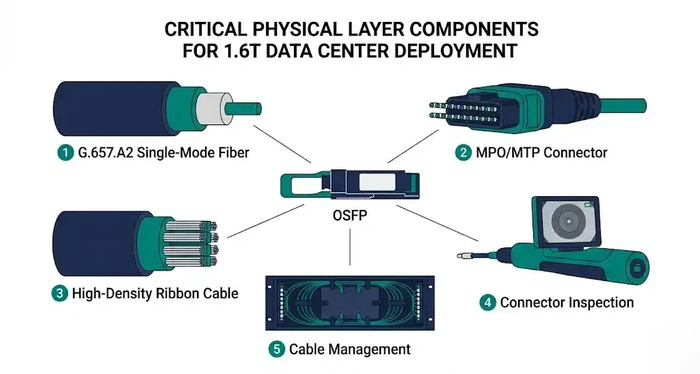
Optical modules receive the headlines, but the fiber infrastructure they connect to determines whether they deliver on their specifications. As lane rates double and module densities increase, the physical layer becomes more critical - not less.
At 1.6T and above, insertion loss budgets shrink, return loss sensitivity increases, and connector contamination tolerances tighten. A fiber plant that performed well at 400G may not pass at 1.6T without re-verification. Several practical considerations for data center planners:
Fiber quality. Verify that existing single-mode fiber meets the tighter optical specifications required for 200G/lambda and 400G/lambda transmission. Bend-insensitive fibers (G.657.A2 and above) provide additional margin in high-density cable routing environments.
Connector cleanliness. High-density MPO/MTP interfaces are particularly vulnerable - a single contaminated fiber in a multi-lane connector can take down an entire 1.6T link. VIAVI's launch of specialized hyperscale inspection tools at OFC 2026 reflects this growing criticality.
Cable density. The increased port counts that 1.6T deployments typically require put pressure on cable pathway capacity. High-density ribbon fiber optic cable designs that maximize fiber count per cable diameter are becoming essential for maintaining manageable cable plant density.
Cable assemblies and patch cords. Precision-manufactured cable assemblies with verified endface geometry (meeting IEC 61300-3-35 standards) reduce insertion loss variability across connections - a factor that compounds across multi-hop paths in large-scale data center fabrics.
Structured management. As link speeds increase, the cost of troubleshooting a single failed connection rises proportionally. Investing in structured fiber management practices and clear labeling before 1.6T deployment avoids costly downtime later.
Summary: Confirmed, Expected, and Still Early-Stage
To help cut through the noise, here is a status-level summary of the key technologies from OFC 2026:
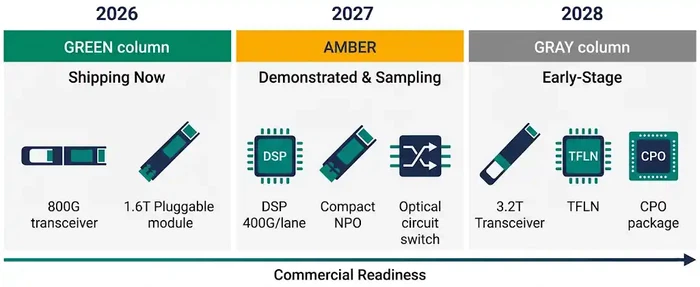
Confirmed and shipping: 800G pluggable transceivers (volume production, fully mature). 200G/lambda 1.6T pluggable transceivers (mass production confirmed by multiple vendors including Eoptolink and FICG). Multi-vendor interoperability at 800G and 1.6T (validated live by Ethernet Alliance, OIF, and individual vendors).
Demonstrated and sampling: 400G/lane DSP (Broadcom Taurus, sampling to early-access customers). 400G/lambda 1.6T DR4 modules (demonstrated in working form, commercial availability expected 2026–2027). 6.4T NPO and 12.8T XPO modules (demonstrated, targeting AI data center design-ins). Optical Circuit Switching (Eoptolink NX200/NX300, demonstrated with MEMS technology).
Early-stage but accelerating: 3.2T pluggable transceivers (chip-level building blocks exist, modules in validation phase, not commercially available). TFLN-based optical modules (foundry capacity expanding, but complete data center transceivers not yet in volume). Co-packaged optics at scale (Open CPX MSA formed, specifications under development, broad deployment likely 2028+).
Frequently Asked Questions
Should I deploy 800G now or wait for 1.6T?
800G modules are fully mature, widely available, and cost-optimized - they remain the right choice for deployments happening in the first half of 2026. 1.6T modules are entering mass production but are still in early volume with higher pricing and a narrower vendor base. For infrastructure being designed today with a 2027+ operational horizon, building 1.6T-ready physical layer (fiber, connectors, cable management) while deploying 800G modules is a practical middle path. The physical layer requirements for 1.6T are stricter than for 800G, so designing infrastructure to the higher standard avoids costly retrofits.
What form factors matter for 1.6T?
Most 1.6T pluggable modules at OFC 2026 used the OSFP form factor. The newer OSFP-XD variant is emerging for higher-density applications. For near-package optics, form factors are being defined through the XPO MSA and Open CPX MSA. For procurement decisions in 2026–2027, OSFP is the safe planning assumption for pluggable 1.6T.
What is OCS and should I care about it?
Optical Circuit Switching (OCS) uses physical light-steering (typically MEMS mirrors) to create reconfigurable all-optical paths between network endpoints, bypassing electrical packet switching at the spine layer. OCS is relevant primarily for large-scale AI training clusters with thousands of GPUs, where reconfigurable optical connectivity can improve GPU utilization and reduce training time. If you operate AI training infrastructure at scale, OCS is worth evaluating as a complementary architecture. For general-purpose data centers, it is less immediately relevant.
Is TFLN ready for production data center use?
Not broadly. TFLN-based components (primarily modulators and photonic integrated circuits) are entering early commercial availability, but complete TFLN-based transceiver modules for volume data center deployment are not yet on the market. Silicon photonics remains the production standard. TFLN is best tracked as a medium-term development - potentially relevant for power-sensitive, high-performance applications from late 2026 onward.
How does 1.6T affect my fiber cabling requirements?
Higher lane rates reduce tolerance for insertion loss, return loss, and connector contamination. If your fiber plant was validated for 400G or 800G, you should re-verify link budgets at 1.6T specifications before deployment. High-density MPO/MTP connections require more rigorous inspection and cleaning. Ribbon fiber cables that support higher fiber counts per cable help manage the increased density. In some cases, new cable pathways or structured cabling upgrades may be needed.