





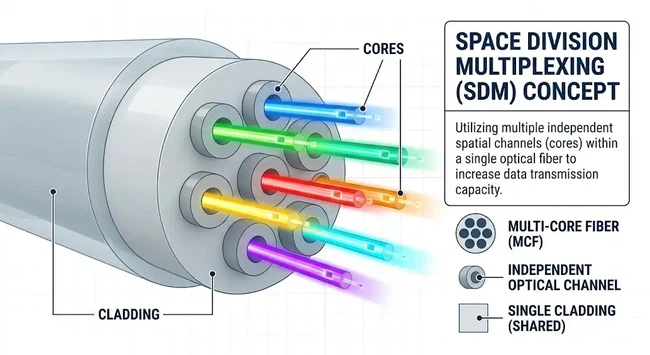
Multi-core fiber (MCF) is a type of optical fiber that integrates multiple independent light-transmitting cores within a single strand of cladding, using a principle called space division multiplexing (SDM) to transmit parallel data streams simultaneously. In today's era of explosive AI computing power and accelerated evolution of 6G technology, optical communication - the "information artery" of the digital economy - is facing unprecedented capacity challenges. This article explores what multi-core fiber is, the R&D background behind it, its core advantages and application scenarios, current technical challenges, as well as Hengtong's layout and future prospects in this field, helping you understand this key technology that unlocks next-generation optical communication.
What Is Multi-Core Fiber and Why Does It Matter Now?
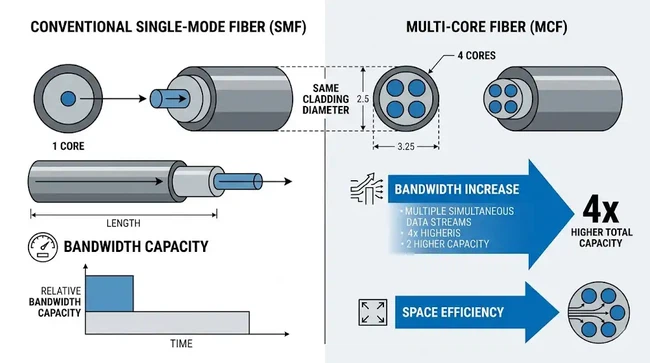
Multi-core fiber refers to an optical fiber that contains two or more separate cores within a single glass cladding - typically with the same standard 125 µm outer diameter used by conventional single-mode fiber. Each core functions as an independent transmission channel, allowing multiple optical signals to travel through one fiber simultaneously. A four-core MCF, for example, can carry roughly four times the data of a single-core fiber within the same physical footprint.
With the in-depth popularization of artificial intelligence, big data, and cloud computing, as well as the accelerated pre-research of 6G technology, the demand for data transmission has shown exponential growth, and the shortcomings of traditional single-mode fiber have become increasingly prominent. Traditional single-mode fiber is limited by the nonlinear Shannon limit, and its transmission capacity has approached the physical upper limit, making it difficult to support the EB-level data transmission and trillion-level device connection needs of the 6G era, nor can it meet the rigid demand for high-density interconnection in ultra-large-scale data centers. As researchers at institutions including NICT and Eindhoven University of Technology have confirmed, data rates in optical networks are expected to grow beyond the fundamental limits of current standard single-mode fiber networks (Nature Communications, 2025).
Against this background, multi-core fiber has emerged as a core solution to break the capacity bottleneck. By adding a new dimension - space - MCF creates parallel optical paths within one fiber, often described as upgrading from a "single-lane" to a "multi-lane."
Advantages and Features: More Than Capacity, Comprehensive Competitiveness
Compared with traditional single-mode fiber, the core advantages of Hengtong's MCF are reflected in three aspects.
First, the capacity achieves exponential growth. By integrating multiple independent cores in a single fiber, MCF is equivalent to upgrading a "single-lane" to a "multi-lane." Without increasing the number of fibers or laying additional pipelines, the transmission capacity can be increased several times or even dozens of times, and the single-fiber transmission rate can reach the Tbps level, perfectly breaking the capacity bottleneck of traditional fiber. Recent research has further confirmed this potential - a team of international researchers demonstrated petabit-per-second-class data transmission using a 19-core MCF with a standard cladding diameter.
Second, low loss, high stability, and adaptation to complex scenarios. Hengtong's independently developed MCF adopts a pure silica core structure and a large effective area design. The attenuation at 1550 nm can be controlled within 0.17 dB/km, and the crosstalk is ≤ −50 dB. The loss is reduced by more than 20% compared with traditional MCF. At the same time, it has excellent high and low temperature resistance and vibration resistance, and can adapt to various complex application environments such as outdoors, seabeds, and data centers.
Third, high integration, high adaptability, and reduced deployment costs. The volume of MCF is equivalent to that of traditional single-mode fiber, but it can achieve higher density transmission, which can greatly reduce the space and cost of fiber laying and equipment deployment, especially suitable for scenarios with strict space requirements such as data centers and backbone networks. At the same time, it is compatible with existing optical communication systems, realizing "plug-and-play" and reducing the cost and operation and maintenance threshold of customer network upgrades. To interface MCF with standard single-core equipment, specialized fan-in/fan-out (FIFO) devices are used, which couple light from individual single-core fibers into each core of the MCF and vice versa.
Multi-Core Fiber vs. Single-Mode Fiber: Key Differences
The advantages described above become clearer when comparing MCF directly with conventional single-mode fiber across key parameters:
| Parameter | Conventional Single-Mode Fiber (SMF) | Multi-Core Fiber (MCF, e.g., Hengtong 4-core) |
|---|---|---|
| Number of cores | 1 | 2, 4, 7, 12, 19, or more |
| Cladding diameter | 125 µm | 125 µm (standard-cladding designs) or larger |
| Capacity per fiber | Limited by nonlinear Shannon limit | Scales with core count - single-fiber rate can reach Tbps level |
| Attenuation at 1550 nm | Typically ~0.18–0.20 dB/km (G.652.D) | ≤ 0.17 dB/km (Hengtong MCF, pure silica core design) |
| Inter-core crosstalk | Not applicable (single core) | ≤ −50 dB (Hengtong MCF) |
| Environmental adaptability | Standard temperature and vibration ratings | Designed for outdoors, seabeds, and data centers with high/low temperature and vibration resistance |
| Splicing complexity | Standard fusion splicing | Requires rotational alignment of cores; specialized splicers needed |
| Connector ecosystem | Mature, widely standardized | Emerging; fan-in/fan-out (FIFO) devices required |
| Deployment space and cost | Baseline | Same fiber volume, higher density - reduces cable count, conduit space, and per-bit cost |
| Compatibility | Universal | Compatible with existing optical communication systems via FIFO devices |
| Standardization | Well-established (ITU-T G.652, G.654, G.657) | In progress (ITU-T G.Sup.87, 2025) |
It is important to note that MCF does not replace single-mode fiber in all scenarios. For many existing access and metro networks, conventional optical fiber remains perfectly adequate. MCF is most compelling where capacity density - the amount of data per unit of physical space - is the primary constraint.
Key Application Scenarios for Multi-Core Fiber
The advantages of MCF - exponential capacity growth, low loss, environmental adaptability, and reduced deployment costs - make it especially well-suited for scenarios where high capacity density and limited physical space intersect.
Submarine cable systems represent the most advanced commercial use case, where the low-loss and seabed-adaptable properties of MCF are particularly valuable. In 2023, Google and NEC announced the first commercial deployment of MCF in the Taiwan-Philippines-U.S. (TPU) submarine cable system, using two-core fiber to double capacity per fiber strand (Google Cloud Blog). In parallel, NEC and NTT demonstrated a transoceanic-class 7,280 km transmission experiment using 12-core MCF in March 2024, presented at OFC 2024 (NEC Press Release). These milestones confirm the practical viability of MCF for long-haul, high-capacity underwater fiber optic cable applications.
Data center interconnects are another high-priority application where the high integration and space-saving advantages of MCF directly address real-world constraints. As AI training clusters scale and east-west traffic between racks grows, operators need to fit more bandwidth into existing conduit and tray space. Because MCF achieves higher density transmission in the same fiber volume as traditional single-mode fiber, it can greatly reduce the space and cost of equipment deployment in these space-constrained environments. NTT has developed construction and maintenance technologies specifically for four-core MCF in inter-data center links (NTT, November 2024).
Backbone and long-haul terrestrial networks represent the next frontier. As traffic demand approaches the capacity ceiling of deployed single-mode fiber, carriers will need SDM-based upgrades for backbone transmission infrastructure. MCF's ability to increase capacity without laying additional pipelines makes it an efficient upgrade path for existing backbone corridors.

Current Technical Challenges of Multi-Core Fiber
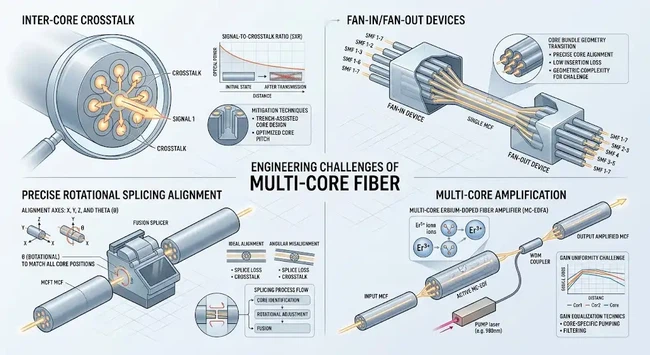
Despite its clear capacity and cost advantages, MCF is not yet a universal drop-in replacement for conventional fiber. Several engineering challenges must be addressed for broader adoption.
Inter-core crosstalk is the most fundamental design concern. Because multiple cores share the same cladding, light can couple between adjacent cores, especially over long distances. Fiber designers manage this through core spacing, trench-assisted refractive index profiles, and optimized cladding geometry. As noted above, Hengtong's MCF achieves crosstalk of ≤ −50 dB through its pure silica core structure and large effective area design - a level sufficient for many practical applications. However, maintaining such low crosstalk performance consistently at scale and over thousands of kilometers remains an active area of research across the industry.
Fan-in/fan-out (FIFO) devices are required to interface MCF with standard single-core equipment. While significant progress has been made - devices with insertion loss below 1 dB per channel and crosstalk below −40 dB are available - achieving consistent, low-cost FIFO performance across high core counts is still being refined. This is a key component in realizing the "plug-and-play" compatibility that makes MCF practical for network upgrades.
Splicing and connectorization add complexity. Unlike single-core fiber, MCF splicing requires precise rotational alignment of all cores simultaneously. Specialized fusion splicers have been developed, but the process is more complex than conventional fiber splicing and testing.
Amplification presents another challenge. Multi-core erbium-doped fiber amplifiers (MC-EDFA) must amplify all cores uniformly, which is more complex than amplifying a single core. Pump delivery and gain equalization across cores are active research topics.
Standardization is in progress but not yet complete. ITU-T Study Group 15 has published technical supplements on SDM fiber, including ITU-T G.Sup.87 (March 2025), which addresses SDM fiber classification, test methods, and deployment considerations. However, unified standards for MCF connectors, cables, and installation procedures are still under development.
Hengtong's MCF R&D and Future Outlook
Hengtong Optoelectronics has keenly captured industry trends and laid out MCF R&D in advance. Relying on the company's profound technical accumulation in the optical fiber and cable materials field, it has overcome core technical difficulties such as low loss and low crosstalk, and successfully achieved a key breakthrough in large effective area ultra-low loss four-core fiber, laying a solid foundation for the industrialization of MCF.
Looking ahead, Hengtong plans to continue focusing on 6G space division multiplexing technology and ultra-low loss material R&D, further optimizing the performance indicators of MCF, breaking through the technical bottleneck of higher core counts beyond four cores, and promoting the product to upgrade towards higher capacity, lower loss, and wider adaptability. The company also aims to strengthen cooperation with global communication equipment manufacturers, cloud service providers, and operators to promote the large-scale application of MCF worldwide.
The MCF market is expected to grow significantly in the coming years. According to market research from Market Growth Reports, the global MCF market was valued at approximately USD 16.9 million in 2025 and is projected to grow at a compound annual growth rate of over 34% through the next decade, driven by surging demand for high-capacity optical transmission in submarine cables, data centers, and next-generation networks. With continued investment in R&D and industrialization, Hengtong aims to be a key contributor to this rapidly evolving field. Readers interested in Hengtong's broader capabilities can explore the company's optical cable product range and successful project cases.
Frequently Asked Questions About Multi-Core Fiber
What is multi-core fiber?
Multi-core fiber is an optical fiber that contains two or more independent light-transmitting cores within a single glass cladding. Each core can carry a separate data stream, allowing the fiber to transmit multiple signals in parallel using space division multiplexing (SDM). This enables single-fiber transmission rates at the Tbps level.
How does MCF differ from multimode fiber?
These are different concepts. Multimode fiber has a single core with a larger diameter that supports multiple propagation modes of light. Multi-core fiber has multiple separate cores, each typically operating in single-mode. MCF multiplies capacity by adding spatial channels (cores), while multimode fiber uses different light modes within one core. For a detailed comparison of fiber types, see this guide to single-mode vs. multimode fiber.
Is multi-core fiber compatible with existing optical networks?
MCF can interface with existing single-mode fiber equipment through fan-in/fan-out (FIFO) devices. Hengtong's MCF is designed to be compatible with existing optical communication systems, reducing the threshold for customer network upgrades. However, full integration may also require specialized splicing equipment and modified amplification systems depending on the specific network architecture.
Where is MCF being deployed commercially?
The most notable commercial deployment is the Google/NEC Taiwan-Philippines-U.S. submarine cable system, which uses two-core MCF. Data center interconnects and backbone network upgrades are expected to follow. MCF's ability to achieve higher density transmission in the same fiber volume makes it especially attractive for space-constrained data center and submarine environments.
What are the main barriers to widespread MCF adoption?
The primary barriers include the complexity and cost of splicing and connectorization, the need for specialized amplifiers, incomplete standardization, and the current price premium of MCF components compared with conventional fiber. These barriers are expected to decrease as production scales and standards solidify.
How many cores can a multi-core fiber have?
Researchers have demonstrated fibers with up to 19 cores within a standard 125 µm cladding diameter, and experimental designs with even higher core counts exist. Commercially available MCF typically uses two to four cores, with seven-core and higher designs in active development. Hengtong's current roadmap includes progression beyond four-core designs toward even higher core counts.